




Showing all 16 results

Filter by price
Filter by brands

- National Instruments
- PXI Systems
- PXI Chassis
- PXI Controller
- PXI Modules
- PXI Semiconductor Test
- PXI FPGA and RIO Modules
- PXI MXI Interfaces
- PXI Programmable Power Supplies & SMU
- PXI Sensor Measurements
- PXI Signal Generators
- PXI Vision
- PXI Data Acquisition
- PXI Oscilloscopes/Digitizers
- PXI Counter/Timers
- PXI RF and Wireless Test
- PXI GPIB, Ethernet and VXI
- PXI Switches
- PXI Digital Multimeters
- PXI Digital Input/Output
- PXI Industrial Communication
- PXI Dynamic Signal Analysis
- PXI Data Streaming
- CompactDAQ Systems
- CompactRIO Systems
- PCI Modules
- USB Devices
- USRP Software Defined Radio Device
- PXI Systems
- keysight
- Tektronix



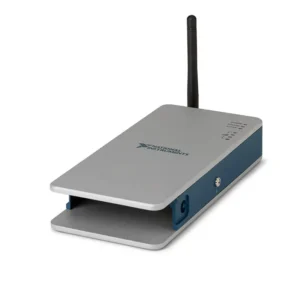
NI CompactDAQ Chassis
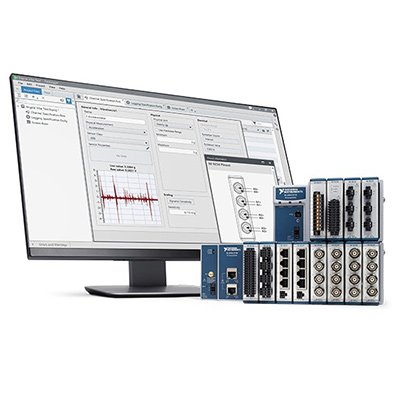
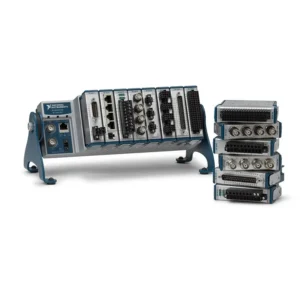
NI CompactDAQ Chassis provide the modular hardware foundation for sensor measurement, data logging, validation and distributed data acquisition. Each chassis accepts compatible C Series I/O modules and supplies the communication, power, timing and synchronization resources required to build a complete CompactDAQ measurement system.
CompactDAQ chassis are available with USB, Ethernet, TSN-capable network and wireless connectivity. They support applications ranging from portable laboratory measurements to multichannel industrial monitoring, vehicle testing, structural measurement and long-duration environmental data collection.
What Is a CompactDAQ Chassis?
A CompactDAQ chassis is a host device for NI C Series measurement modules. The chassis connects the installed modules to a computer or network, distributes timing and power, and coordinates data transfer between the modules and acquisition software.
A typical system consists of a CompactDAQ chassis, one or more C Series modules, compatible cables or terminal blocks, and a host computer running NI-DAQmx and application software. Some applications instead use an embedded CompactDAQ controller, which combines processing and C Series module slots into one standalone device.
A C Series module is not automatically compatible with every CompactDAQ chassis. Confirm the exact chassis model, module model, firmware, NI-DAQmx version, operating system and required sample mode before ordering or replacing hardware.
CompactDAQ Chassis Connectivity Options
| Chassis Type | Connection Method | Best Fit | Key Consideration |
|---|---|---|---|
| USB CompactDAQ Chassis | Direct USB connection to a host computer | Benchtop test, portable measurement, laboratory development and temporary test setups | Host computer location and USB cable routing determine the practical deployment distance |
| Ethernet CompactDAQ Chassis | Wired Ethernet network connection | Remote measurement, machine monitoring, distributed test stations and industrial installations | Network topology, cable routing, IP configuration and sustained network traffic must be planned |
| TSN-Capable CompactDAQ Chassis | Ethernet with time-sensitive networking support on applicable models | Synchronized distributed acquisition and networked systems requiring coordinated timing | End-to-end synchronization depends on the complete network, modules and software configuration |
| Wireless CompactDAQ Chassis | Wireless network connection | Mobile, temporary or hard-to-cable measurement locations | Wireless coverage, interference, security and data-rate requirements must be validated for the application |
CompactDAQ Chassis Slot Capacity
CompactDAQ chassis are available in one-slot, four-slot, eight-slot and higher-density configurations. Select the slot count from the required C Series module configuration rather than only the current channel count.
Reserve capacity when future expansion may require additional sensor types, dedicated synchronization resources, communication interfaces or spare measurement channels. A system with available slots must also retain adequate power, bandwidth and supported timing resources for the planned modules.
CompactDAQ Chassis Model Classification
| Model | Unique Category | Connection Family | Best Fit |
|---|---|---|---|
| cDAQ-9170 | USB CompactDAQ Chassis | USB | Compact PC-based C Series measurement systems |
| cDAQ-9171 | USB CompactDAQ Chassis | USB | Single-module sensor and signal acquisition |
| cDAQ-9172 | USB CompactDAQ Chassis | USB | PC-connected multichannel C Series systems |
| cDAQ-9173 | USB CompactDAQ Chassis | USB | Portable mixed-signal measurement applications |
| cDAQ-9174 | USB CompactDAQ Chassis | USB | Laboratory and validation measurement systems |
| cDAQ-9177 | USB CompactDAQ Chassis | USB | Portable multichannel sensor acquisition |
| cDAQ-9178 | USB CompactDAQ Chassis | USB | High-channel-count PC-based data acquisition |
| cDAQ-9179 | USB CompactDAQ Chassis | USB | Expanded C Series measurement and logging systems |
| cDAQ-9181 | Ethernet CompactDAQ Chassis | Ethernet | Remote single-module measurement points |
| cDAQ-9183 | Ethernet CompactDAQ Chassis | Ethernet | Distributed C Series data acquisition |
| cDAQ-9184 | Ethernet CompactDAQ Chassis | Ethernet | Networked multichannel monitoring systems |
| cDAQ-9185 | Ethernet CompactDAQ Chassis | Ethernet | Remote engineering and industrial measurement |
| cDAQ-9187 | Ethernet CompactDAQ Chassis | Ethernet | Distributed sensor and I/O expansion |
| cDAQ-9188 | Ethernet CompactDAQ Chassis | Ethernet | Network-connected multichannel C Series systems |
| cDAQ-9189 | TSN CompactDAQ Chassis | Ethernet and TSN | Synchronized distributed measurement applications |
| cDAQ-9191 | Wireless CompactDAQ Chassis | Wireless network | Mobile and difficult-to-cable measurement locations |
Model availability, driver support and lifecycle status can vary. Verify the complete part number, revision, supported operating system and required C Series module combination before approving a new system or legacy replacement.
How to Choose a CompactDAQ Chassis
1. Define the Required C Series Modules
Start with the electrical signals and sensors being measured. Select the required C Series modules for voltage, current, thermocouples, RTDs, strain gauges, IEPE sensors, digital I/O, counters or communication buses. Then verify that the selected modules are supported by the proposed CompactDAQ chassis.
Different C Series modules can have different sampling architectures, isolation requirements, power requirements and timing behavior. The chassis must support the complete module combination, not only individual modules in isolation.
2. Select USB, Ethernet or Wireless Connectivity
USB chassis are usually the most direct choice when the acquisition hardware is located near the host computer. Ethernet chassis are better suited to remote measurement locations, test cells, machinery and distributed installations. Wireless chassis should be selected only after confirming network coverage, security and sustained data-transfer requirements.
For synchronized distributed systems, evaluate whether a TSN-capable chassis and compatible timing architecture are required. Standard Ethernet connectivity alone does not guarantee deterministic synchronization between systems.
3. Match Slot Count to the Module Plan
Count the physical C Series modules required today and include realistic expansion needs. A mixed application may require separate modules for temperature, bridge sensors, vibration, analog voltage, digital control and industrial communication.
Do not assume that one high-density chassis is always preferable. Smaller chassis can simplify field deployment, reduce unused capacity and place measurement hardware closer to the sensors.
4. Check Sampling and Synchronization Requirements
Applications such as vibration, acoustics, strain, force, power analysis and transient capture can require simultaneous sampling and precise timing relationships. Confirm the chassis timing resources, supported sample rates and synchronization method for the exact module combination.
For slower temperature, environmental and process measurements, a multiplexed acquisition architecture may be appropriate. Select the system based on the required timing accuracy rather than only the number of connected channels.
5. Review Network and Data Throughput
The total data rate depends on active channels, sample rate and bytes transferred per sample:
Data rate = active channels × sample rate × transferred bytes per sample.
Allow margin for protocol overhead, software buffering, other network traffic, data logging and real-time display. High-speed dynamic modules and multiple synchronized chassis require a complete system bandwidth review.
6. Confirm Software and Operating-System Support
Most CompactDAQ chassis use NI-DAQmx for device discovery, channel configuration, timing, triggering and acquisition. NI Measurement & Automation Explorer can be used to detect supported hardware, inspect the configuration and run available diagnostic functions.
Before purchase, confirm the required NI-DAQmx version, operating system, LabVIEW version, FlexLogger support and any existing application requirements. Legacy chassis may require a specific driver version or may not support current operating systems.
CompactDAQ Chassis Compatibility Checklist
Confirm the following before ordering a CompactDAQ chassis:
- Exact chassis model and complete part number
- Required USB, Ethernet, TSN or wireless connection method
- Number of C Series module slots required
- Exact C Series module models and quantities
- Required sample rate, bandwidth and timing relationship between channels
- Synchronization, start-trigger and reference-clock requirements
- Host computer, network hardware and operating system
- NI-DAQmx, LabVIEW, FlexLogger or other software version
- Sensor cables, terminal blocks, power supplies and mounting accessories
- Environmental conditions, cable distance and installation location
- New or pre-owned hardware preference
CompactDAQ Chassis, Controllers and C Series Modules
A standard CompactDAQ chassis relies on a connected host computer for application execution and data processing. An embedded CompactDAQ controller provides local processing for standalone or distributed acquisition applications.
The measurement function is provided by the installed NI C Series modules. These modules provide the sensor interfaces, signal conditioning, excitation, isolation, analog conversion, digital I/O or communication connections required by the application.
Review the complete NI CompactDAQ system when configuring a chassis, modules and controller as one measurement assembly.
Typical Applications
- Automotive component, vehicle and powertrain testing
- Temperature, pressure, strain, force and torque measurement
- Acoustic, vibration and condition-monitoring systems
- Environmental and long-duration data logging
- Industrial machine and process monitoring
- Laboratory research and product validation
- Structural, fatigue and materials testing
- Distributed sensor acquisition in test cells and facilities
- Energy, battery and power-electronics testing
- Automated engineering measurement systems
CompactDAQ Chassis vs CompactRIO vs PXI
| Platform | Primary Strength | Best Fit |
|---|---|---|
| CompactDAQ | Modular sensor and electrical data acquisition with integrated signal conditioning | Portable, distributed and multichannel measurement systems |
| CompactRIO | Embedded real-time processing and FPGA-based control | Deterministic control, machine automation and embedded systems |
| PXI Systems | High-performance modular instruments, switching and synchronized test | Automated test equipment, RF, semiconductor and high-throughput validation |
Legacy CompactDAQ Chassis Replacement
Replacing an older CompactDAQ chassis requires more than matching the slot count. Newer hardware can use a different connector, USB generation, Ethernet architecture, synchronization method, power requirement or supported driver version.
Compare the existing and replacement systems by C Series compatibility, sample timing, trigger support, operating system, NI-DAQmx version, cable type, network configuration and required software changes. Requalify the full acquisition system when the application involves calibrated sensors, regulated testing or production data collection.
FAQ
Can every C Series module be used in every CompactDAQ chassis?
No. C Series modules must be checked against the exact CompactDAQ chassis and NI-DAQmx version. Module support, sample timing, power consumption and available features can vary by chassis family.
Should I choose USB or Ethernet CompactDAQ?
Choose USB when the chassis can remain near the host computer and portability is important. Choose Ethernet when the measurement hardware must be deployed remotely, connected through an existing network or installed near machinery or a test cell.
Does Ethernet CompactDAQ require an embedded controller?
No. Ethernet CompactDAQ chassis can be controlled by a compatible computer over the network. An embedded CompactDAQ controller is used when local processing or standalone operation is required.
Can multiple CompactDAQ chassis be synchronized?
Yes, but synchronization depends on the exact chassis models, installed modules, timing configuration and network or clock-distribution architecture. Confirm the required trigger, reference clock and sample-timing method before system selection.
Can I use a CompactDAQ chassis for thermocouples and vibration sensors in the same system?
Yes, when compatible thermocouple and dynamic-signal C Series modules are selected. Confirm the required slot count, sample architecture, synchronization and sensor accessories for both measurement types.
Why is NI-DAQmx compatibility important?
NI-DAQmx provides hardware discovery, channel configuration, timing and data acquisition support. An older chassis may require a specific driver version and may not be supported by the operating system used on a new host computer.
Related NI CompactDAQ Products
Build a complete system with C Series measurement modules for sensor and electrical I/O, or select an embedded CompactDAQ controller for standalone data acquisition and local processing.
NI CompactDAQ Chassis from PXISOURCE
PXISOURCE supports engineers and procurement teams with CompactDAQ chassis selection, C Series module compatibility review, controller matching, legacy-system replacement and complete system sourcing. Send the required module list, channel count, sample rate, connection method, software version and preferred hardware condition for a technically matched quotation.
Need help selecting the right NI CompactDAQ chassis? Email sales@pxisource.com or contact PXISOURCE on WhatsApp.