



Filter by price
Filter by brands

- National Instruments
- PXI Systems
- PXI Chassis
- PXI Controller
- PXI Modules
- PXI Semiconductor Test
- PXI FPGA and RIO Modules
- PXI MXI Interfaces
- PXI Programmable Power Supplies & SMU
- PXI Sensor Measurements
- PXI Signal Generators
- PXI Vision
- PXI Data Acquisition
- PXI Oscilloscopes/Digitizers
- PXI Counter/Timers
- PXI RF and Wireless Test
- PXI GPIB, Ethernet and VXI
- PXI Switches
- PXI Digital Multimeters
- PXI Digital Input/Output
- PXI Industrial Communication
- PXI Dynamic Signal Analysis
- PXI Data Streaming
- CompactDAQ Systems
- CompactRIO Systems
- PCI Modules
- USB Devices
- USRP Software Defined Radio Device
- PXI Systems
- keysight
- Tektronix
National Instruments

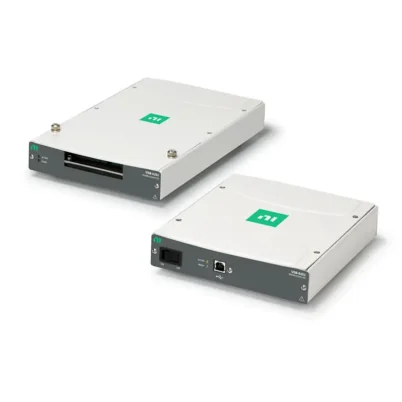

National Instruments Test and Measurement Hardware
National Instruments (NI) provides modular hardware and software platforms for automated testing, data acquisition, sensor measurement, embedded control, RF research and industrial monitoring. NI products are widely used in engineering laboratories, validation systems, production test stations, research facilities and long-term monitoring installations.
PXISOURCE supplies NI PXI and PXIe systems, CompactDAQ hardware, CompactRIO controllers and chassis, C Series I/O modules, PCI and PCIe boards, USB measurement devices and USRP software-defined radios. Selecting the correct platform requires matching the application, signal type, channel count, bandwidth, timing, processing, environmental and software requirements.
National Instruments Product Categories
| Product Family | Unique Category | Core Architecture | Best Fit |
|---|---|---|---|
| PXI Systems | Modular Automated Test Platform | PXI or PXI Express chassis with an embedded or remote controller and modular instruments | High-performance automated test, electronic validation, semiconductor test, RF and synchronized measurement |
| CompactDAQ Systems | Modular Sensor Data Acquisition | USB, Ethernet or controller-based chassis using interchangeable C Series I/O modules | Benchtop, portable, distributed and mixed-sensor data acquisition |
| CompactRIO Systems | Real-Time FPGA Control Platform | Real-time processor, user-programmable FPGA and modular industrial I/O | Deterministic control, embedded monitoring, hardware-in-the-loop and industrial systems |
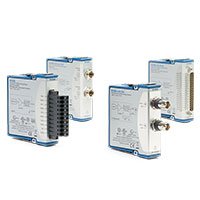
| C Series Modules | Conditioned Modular I/O | Compact I/O modules with signal conversion, conditioning, isolation and sensor connectivity | Voltage, current, temperature, strain, vibration, digital I/O, relay and communication applications |
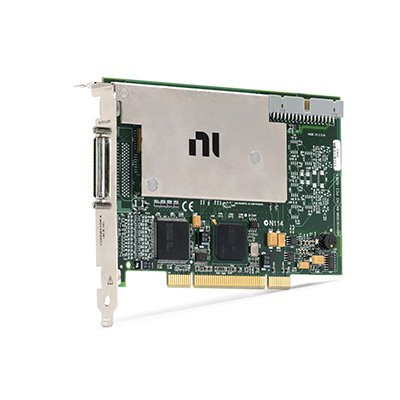
| PCI and PCIe Modules | Internal Computer-Based Measurement | Measurement, control and communication boards installed directly in a compatible desktop or industrial computer | Fixed test stations requiring direct PC integration and low-latency bus access |
| USB Devices | External Computer-Based Measurement | Portable measurement and communication hardware connected directly to a host computer through USB | Laboratory development, education, troubleshooting and compact automated systems |
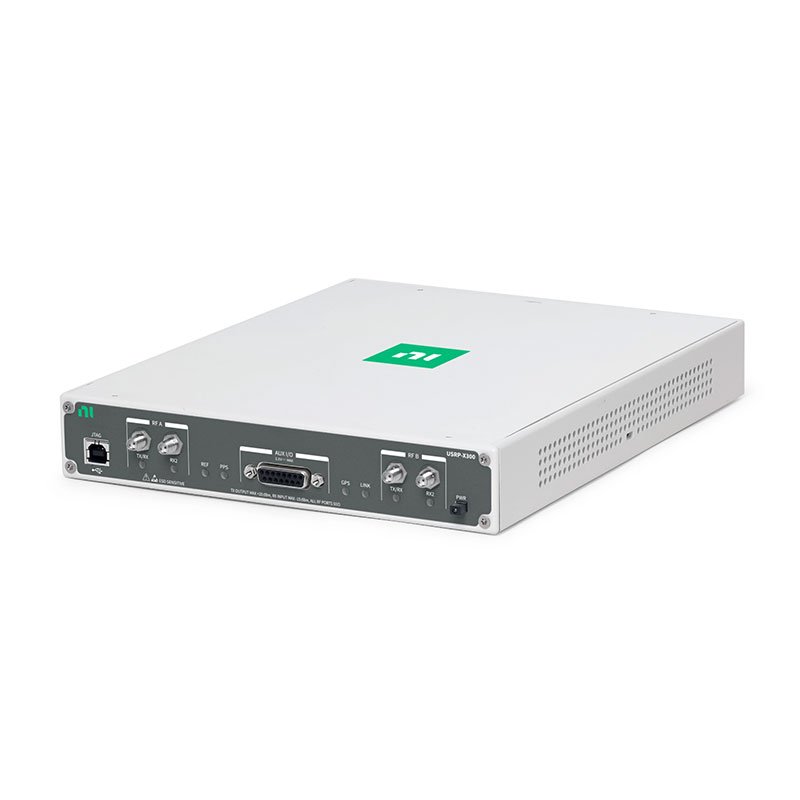
| USRP Software Defined Radio Devices | Software-Defined RF Platform | RF transceiver hardware with host- or FPGA-based signal processing | Wireless research, spectrum monitoring, communications prototyping, radar and signal intelligence |
How the NI Hardware Platforms Differ
The best NI platform is determined by the complete system requirement rather than a single specification. PXI emphasizes modular instrumentation and synchronization, CompactDAQ emphasizes flexible sensor measurement, CompactRIO adds deterministic real-time processing and FPGA control, while PCI, USB and USRP products address specific computer-based or RF applications.
| Application Requirement | Recommended Platform | Selection Reason |
|---|---|---|
| High-performance automated test using multiple instrument types | PXI or PXI Express | Provides a shared chassis, high-throughput backplane, timing resources and modular instruments |
| Portable or distributed sensor measurement | CompactDAQ | Supports interchangeable signal-conditioned modules with USB or Ethernet connectivity |
| Deterministic machine control or FPGA-based processing | CompactRIO | Combines a real-time processor, FPGA and industrial I/O in an embedded architecture |
| Measurement hardware installed inside a desktop computer | PCI or PCIe | Provides direct internal bus integration without a separate external chassis |
| Compact connection to a laptop or laboratory computer | USB | Provides straightforward external connectivity and portable deployment |
| Wireless algorithm development and RF prototyping | USRP | Provides a software-defined RF architecture with configurable signal-processing workflows |
NI PXI and PXI Express Systems
PXI is a modular test and measurement platform designed for applications that require multiple synchronized instruments, automated operation and scalable channel counts. A complete PXI system normally consists of a chassis, controller, measurement modules, instrument drivers and test software.
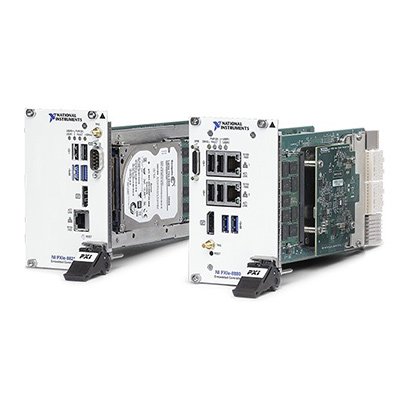
The PXI chassis provides power, cooling, backplane communication, reference clocks and trigger resources. The PXI controller runs the operating system, drivers and test application. The installed PXI modules perform acquisition, generation, switching, measurement, communication or control functions.
PXI Express uses PCI Express backplane technology and is generally preferred for high-speed digitizers, RF instruments, FPGA modules, digital pattern instruments and continuous data streaming. Conventional PXI remains important for maintaining validated legacy systems using PCI-based modules.
Common PXI Instrument Functions
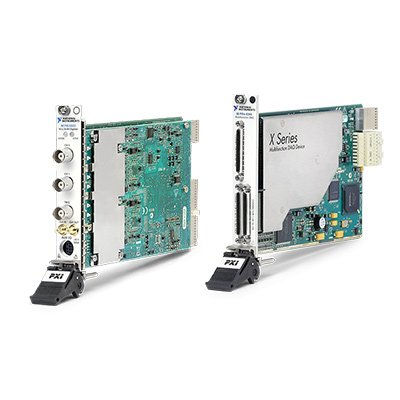
- Multifunction data acquisition and analog output
- Oscilloscopes and high-speed digitizers
- RF signal generation, analysis and vector signal transceiver functions
- Digital multimeters and LCR measurement
- Source measure units and programmable power supplies
- Matrix, multiplexer and RF switching
- Semiconductor digital pattern testing
- FPGA processing and FlexRIO instrumentation
- Sensor, sound, vibration and bridge measurement
- Industrial, automotive and instrument communication interfaces
NI CompactDAQ Systems
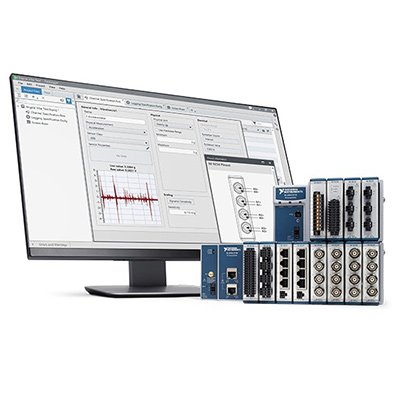
CompactDAQ is a modular data acquisition platform for measuring electrical and physical signals. A typical system combines a CompactDAQ chassis with one or more C Series modules selected for the connected sensors.
CompactDAQ chassis are available with different communication interfaces, slot counts and controller architectures. USB chassis are well suited to local benchtop measurement, while Ethernet chassis support longer distances and distributed acquisition. Controller-based CompactDAQ systems can perform measurement and logging without depending on a continuously connected external computer.
CompactDAQ is commonly selected for temperature, voltage, current, strain, pressure, force, sound, vibration and digital measurements. Module-level signal conditioning can reduce the need for separate external conditioners, but the sensor interface and accessory requirements must still be verified.
NI CompactRIO Systems
CompactRIO combines a real-time processor, user-programmable FPGA and modular I/O for embedded measurement and control. The real-time processor executes application logic and communication tasks, while the FPGA can handle operations requiring precise timing, high-speed logic or deterministic response.
CompactRIO is appropriate when the system must continue operating independently of a Windows computer or must respond to input signals within defined timing limits. Common applications include machine control, condition monitoring, energy systems, mobile equipment, hardware-in-the-loop testing and long-duration field installations.
CompactRIO selection should consider processor performance, FPGA resources, C Series slot count, networking, storage, operating temperature, power input, software licensing and required industrial interfaces.
NI C Series I/O Modules
C Series modules provide the measurement and control interfaces used by CompactDAQ and CompactRIO systems. Depending on the model, a module may include analog-to-digital or digital-to-analog conversion, isolation, filtering, excitation, bridge completion, sensor power, industrial communication or relay circuitry.
| C Series Function | Typical Signals | Important Selection Factors |
|---|---|---|
| Analog Input | Voltage and current | Input range, resolution, sampling architecture, isolation and channel count |
| Analog Output | Voltage and current generation | Output range, update rate, drive capability, isolation and startup state |
| Temperature | Thermocouple and RTD sensors | Sensor type, cold-junction compensation, wire configuration and accuracy |
| Dynamic Signal | IEPE, sound and vibration sensors | Sample rate, simultaneous sampling, excitation, coupling and dynamic range |
| Bridge Measurement | Strain, load, force, pressure and torque sensors | Bridge type, excitation, completion, mV/V range and remote sensing |
| Digital I/O | Logic, industrial digital signals and pulse control | Logic level, sourcing or sinking, isolation, current and update timing |
| Relay Output | Electromechanical switching | Topology, voltage, current, switching power and expected relay life |
| Communication | CAN, LIN, serial and industrial buses | Protocol, port count, transceiver type, isolation and software support |
C Series module compatibility depends on both the module and the selected CompactDAQ or CompactRIO chassis. Some functions, timing modes and software APIs are platform-specific. Verify the module manual, chassis documentation and driver support before ordering.
NI PCI, PCIe and USB Devices
NI PCI and PCIe products install directly in a compatible desktop or industrial computer. They are suitable for fixed systems where the computer provides the enclosure, processor, storage and user interface. Product families include multifunction DAQ, digital I/O, counters, high-speed digitizers, dynamic signal acquisition, FPGA hardware and communication interfaces.
Before selecting an internal board, confirm the computer’s physical slot, PCI or PCIe interface, lane configuration, available space, power capacity, operating system and driver version. Conventional PCI and PCI Express are not physically interchangeable.
NI USB devices provide external measurement, digital I/O, digitizer, multimeter, counter, FPGA, RF and communication functions. They are useful when portability, simple host connection or laptop compatibility is more important than the density and synchronization capabilities of a PXI system.
USB bandwidth is shared across the host controller and should be reviewed when several high-rate devices operate simultaneously. Cable length, power requirements, grounding and connector retention should also be considered for industrial installations.
NI and Ettus USRP Software Defined Radios
USRP software-defined radio devices provide configurable RF transmit and receive hardware for wireless research and development. Signal generation, acquisition, modulation, demodulation and analysis are implemented primarily through software or programmable FPGA resources.
USRP platforms support applications such as wireless communications research, spectrum monitoring, direction finding, radar development, channel sounding, signals intelligence, education and algorithm prototyping. Depending on the product family, software development may use the UHD driver, GNU Radio, Python, C++, MATLAB or supported NI software.
USRP selection requires the operating frequency range, instantaneous bandwidth, number of transmit and receive channels, phase-coherence requirements, FPGA resources, host interface, reference clock, synchronization method and intended software workflow.
How to Select National Instruments Hardware
1. Define the Application Architecture
Determine whether the system is intended for automated test, sensor measurement, embedded control, data logging, RF research or industrial communication. This first decision usually identifies the most suitable platform family.
2. Identify Every Signal and Sensor
Record the electrical interface for each channel, including voltage, current, thermocouple, RTD, bridge, IEPE, charge, digital logic, relay, counter, encoder or communication bus. The measured physical parameter alone does not identify the required hardware.
3. Calculate Channels, Rate and Bandwidth
Specify the active channel count, sample rate, measurement bandwidth, input range and required resolution. Also determine whether channels must be sampled simultaneously or whether multiplexed acquisition is acceptable.
4. Determine Timing and Synchronization Requirements
Applications involving phase, waveform correlation, stimulus-response testing or several instruments may require shared sample clocks, start triggers, reference clocks or timestamp synchronization. Installing devices in the same system does not automatically guarantee synchronized measurements.
5. Choose the Processing Architecture
A host-based system is appropriate when a Windows or Linux computer can manage acquisition and analysis. Select real-time or FPGA hardware when the application requires deterministic response, independent operation, custom high-speed logic or low-latency control.
6. Review Isolation and Grounding
Confirm channel-to-earth and channel-to-channel isolation requirements, common-mode voltage, grounding arrangements and cable shielding. Incorrect grounding can introduce noise, measurement error or unsafe voltage conditions.
7. Check Mechanical and Environmental Requirements
Review slot type, chassis capacity, cooling, power input, installation space, mounting, operating temperature, shock, vibration and connector access. A technically compatible module may still be unsuitable for the intended installation environment.
8. Verify Software and Driver Support
Confirm the operating system, driver, programming environment and application version before purchasing hardware. A legacy product may be electrically suitable but unsupported by the intended operating system or current driver release.
NI Software and Driver Ecosystem
NI hardware is supported by different software environments and instrument drivers. The correct software stack depends on the product family and application.
| Software or Driver | Primary Function | Typical Hardware |
|---|---|---|
| LabVIEW | Graphical application development, measurement, analysis and control | PXI, CompactDAQ, CompactRIO, USB, PCI and supported USRP hardware |
| NI-DAQmx | Configuration and programming of compatible data acquisition hardware | CompactDAQ, supported C Series, PXI DAQ, PCIe DAQ and USB DAQ |
| TestStand | Automated test sequencing, execution, reporting and code-module management | PXI and other automated test systems |
| InstrumentStudio | Interactive configuration and measurement using supported modular instruments | Compatible PXI oscilloscopes, generators, SMUs, DMMs and RF instruments |
| FlexLogger | Configuration-based sensor measurement and data logging | Compatible CompactDAQ, PXI and C Series hardware |
| LabVIEW Real-Time and FPGA | Deterministic applications and user-programmable hardware logic | CompactRIO, sbRIO and supported FPGA-based PXI hardware |
| UHD | Open-source host driver and API for compatible USRP devices | NI and Ettus USRP software-defined radios |
Driver support varies by model, hardware revision, operating system and software release. Confirm compatibility through the documentation for the exact part number rather than assuming that every product in a family uses the same driver.
System Compatibility and Accessories
A complete NI system may require more than the primary chassis or module. Confirm all necessary accessories during system planning:
- Terminal blocks, connector blocks and breakout accessories
- Shielded cables, sensor cables and bus-specific transceivers
- Bridge-completion, cold-junction or sensor-conditioning accessories
- Rack-mount, DIN-rail and strain-relief hardware
- Power supplies and country-specific power cords
- Synchronization, trigger and reference-clock cables
- PXI filler panels and slot blockers for correct airflow
- Software licenses, drivers and analysis toolkits
- Calibration documentation and traceability requirements
Part numbers are important because one product model may have several connector, memory, channel, frequency, bandwidth or software configurations. Provide the complete NI part number whenever possible.
Typical Applications
- Automated production and functional testing
- Electronic design validation and verification
- Semiconductor characterization and production test
- Automotive, battery and electric-vehicle testing
- Aerospace, defense and avionics validation
- Temperature, strain, vibration and structural measurement
- Industrial machine monitoring and control
- Hardware-in-the-loop and real-time simulation
- RF, radar and wireless communications research
- Energy, power quality and renewable-energy testing
- University teaching and scientific research
- Long-duration data logging and condition monitoring
Legacy NI Hardware Replacement
Replacing a discontinued NI product requires more than selecting a newer model with similar channel counts. The replacement may use a different bus, connector, terminal block, sample clock, voltage range, isolation architecture, driver or software API.
Compare the following before approving a replacement:
- Complete model and part number
- PXI, PXIe, PCI, PCIe, USB or C Series form factor
- Signal ranges, channel count and timing architecture
- Connector type, cable and terminal-block pinout
- Sampling rate, bandwidth and simultaneous or multiplexed operation
- Isolation, common-mode and grounding specifications
- Chassis, controller and slot compatibility
- Operating-system and driver support
- Application-code and configuration compatibility
- Calibration and system-requalification requirements
A newer product may offer improved performance but still require wiring changes, software updates or complete system revalidation.
National Instruments Procurement and RFQ Guide
Provide the following information for accurate product identification and quotation:
- Complete NI model and part number
- Required quantity
- Target application and measured signal types
- Channel count, sample rate and bandwidth
- Existing chassis, controller or host-computer model
- Required terminal blocks, cables and accessories
- Operating system and NI software or driver version
- Calibration-document requirements
- New or pre-owned hardware preference
- Delivery destination and required delivery date
If the exact product number is unavailable, provide photographs of the model label, front connector and system configuration. This helps distinguish between hardware revisions and ordering options that may share a similar model name.
FAQ
What is National Instruments hardware used for?
NI hardware is used for automated testing, data acquisition, sensor measurement, embedded control, RF research, semiconductor test, industrial monitoring and scientific experimentation.
What is the difference between PXI and CompactDAQ?
PXI is a modular instrumentation platform for high-performance automated test and synchronized mixed-instrument systems. CompactDAQ focuses on flexible sensor and electrical measurement using portable or distributed chassis and C Series I/O modules.
What is the difference between CompactDAQ and CompactRIO?
CompactDAQ is primarily designed for data acquisition controlled by a host computer or integrated controller. CompactRIO adds a real-time processor and user-programmable FPGA for deterministic control, independent operation and custom high-speed logic.
Can the same C Series module work in CompactDAQ and CompactRIO?
Many C Series modules support both platforms, but compatibility, operating modes, timing and driver support can differ. Verify the exact module and chassis combination before ordering.
Can a conventional PXI module be installed in a PXIe chassis?
Only when the chassis provides a compatible hybrid slot and the module meets the connector and signaling requirements. A PXIe peripheral slot without hybrid support cannot accept a conventional PXI module.
Do all NI data acquisition products use NI-DAQmx?
No. Many DAQ devices use NI-DAQmx, while RF instruments, oscilloscopes, FPGA products, industrial interfaces and USRP devices may use different drivers. Check the software requirements for the exact product.
Is a model number sufficient for ordering NI hardware?
Not always. Some model families have several connector, memory, bandwidth or configuration options. The complete NI part number provides more reliable identification.
Related National Instruments Product Families
Choose PXI for synchronized modular instrumentation, CompactDAQ for flexible sensor acquisition, CompactRIO for real-time FPGA control, PCI or USB hardware for computer-based measurement, and USRP for software-defined RF development. Each platform should be selected as a complete system that includes compatible hardware, accessories, drivers and application software.
National Instruments Products from PXISOURCE
PXISOURCE supports engineers, system integrators, laboratories and procurement teams with NI product identification, platform selection, chassis and module compatibility review, accessory matching and legacy-system replacement. Send the required model numbers, part numbers, quantities and system configuration for a technically matched quotation.
Need help selecting the right NI solution? Email sales@pxisource.com or contact PXISOURCE on WhatsApp.