

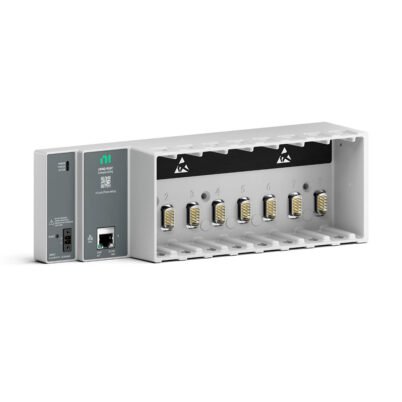

cDAQ-9183 4-Slot TSN Ethernet CompactDAQ Chassis
The NI cDAQ-9183 is a four-slot, TSN-enabled Ethernet CompactDAQ chassis designed for distributed data acquisition, synchronized measurements and industrial monitoring applications. It connects as many as four compatible NI C Series I/O modules to a host computer through a single 10/100/1000 Mb/s Ethernet interface.
By combining modular C Series signal conditioning with Gigabit Ethernet connectivity, the cDAQ-9183 allows engineers to place measurement hardware closer to sensors and devices under test. This architecture can reduce analog cable lengths, simplify field wiring and support remote measurements at distances up to 100 m per Ethernet segment.
The chassis supports IEEE 802.1AS network synchronization, seven high-performance data streams, four 32-bit counter/timers and hardware-timed analog and digital operations. Its -40°C to 70°C operating range and 9 VDC to 30 VDC power input make it suitable for laboratory systems, production equipment and demanding industrial installations.
Key Features of the cDAQ-9183
- Four slots for compatible NI C Series I/O modules
- One 10/100/1000 Mb/s Ethernet port
- Time Sensitive Networking support
- IEEE 802.1AS network synchronization
- Less than 1 µs specified network synchronization accuracy
- Less than 100 ns synchronization accuracy in an optimized configuration
- Seven high-performance data streams
- Four integrated 32-bit counter/timers
- Analog input, analog output and digital waveform support
- Up to 10 MHz finite or regenerated digital sample clocks
- Up to 1.6 MS/s aggregate analog output with onboard regeneration
- 9 VDC to 30 VDC power input
- 16 W maximum chassis power consumption
- -40°C to 70°C operating temperature range
- IP40 ingress protection
- NI-DAQmx software support
cDAQ-9183 Technical Specifications
| Product Model | cDAQ-9183 |
|---|---|
| Product Type | TSN-enabled Ethernet CompactDAQ chassis |
| Number of C Series Slots | 4 |
| Network Ports | 1 Ethernet port |
| Ethernet Communication Rates | 10/100/1000 Mb/s, automatically negotiated |
| Maximum Ethernet Cable Distance | 100 m per segment |
| Supported Network Protocols | TCP/IP and UDP |
| IP Configuration | DHCP plus Link-Local, DHCP, static or Link-Local |
| High-Performance Data Streams | 7 |
| Network Synchronization Protocol | IEEE 802.1AS over 1000BASE-T full-duplex Ethernet |
| Network Synchronization Accuracy | Less than 1 µs, system dependent |
| Optimized Synchronization Accuracy | Less than 100 ns with one hop and optimized C Series module selection |
| IEEE 1588 Support | Supported with NI-DAQmx 18.1 or later |
| General-Purpose Counters | 4 |
| Counter Resolution | 32 bits |
| Counter External Base Clock | 0 MHz to 20 MHz |
| Counter Output Frequency | 0 MHz to 20 MHz |
| Analog Input FIFO | 127 samples per slot |
| Analog Input Sample Rate | Determined by the installed C Series modules and task configuration |
| Analog Output Channels with Onboard Regeneration | Up to 16 channels |
| Maximum Regenerated Analog Output Rate | 1.6 MS/s aggregate |
| Analog Output FIFO | 8,191 samples shared among active channels |
| Digital Input FIFO | 511 samples per slot for parallel modules; 63 samples per slot for serial modules |
| Digital Output FIFO | 2,047 samples per slot for parallel modules; 63 samples per slot for serial modules |
| Finite Digital Sample Clock | Up to 10 MHz |
| Time-Based Triggers | 5 |
| Timestamps | 4 |
| Input Voltage Range | 9 VDC to 30 VDC |
| Maximum Power Consumption | 16 W with a fully populated chassis under worst-case conditions |
| Power Connector | 2-position, 3.5 mm-pitch Mini-Combicon screw terminal with screw flanges |
| Operating Temperature | -40°C to 70°C |
| Storage Temperature | -40°C to 85°C |
| Operating Humidity | 10% to 90% RH, noncondensing |
| Ingress Protection | IP40 |
| Maximum Altitude | 5,000 m |
| Dimensions | 178.1 × 88.1 × 64.1 mm, unloaded |
| Weight | 660.5 g, unloaded |
| Software Driver | NI-DAQmx |
Analog input accuracy, channel count, voltage range, sample rate, isolation and signal-conditioning capabilities are determined by the C Series modules installed in the chassis. Review both the chassis specifications and the documentation for every selected module.
cDAQ-9183 Part Number and Accessories
| Item | Part Number | Description |
|---|---|---|
| cDAQ-9183 | 789996-01 | Four-slot, one-port TSN Ethernet CompactDAQ chassis |
| Hardware Assembly | 142095-02L | Hardware assembly identification associated with the cDAQ-9183 |
| Power Connector Plug | Phoenix Contact 1714977 or equivalent | Compatible two-position power input mating connector |
| PS-15 Power Supply | Configuration dependent | Power supply recommended for operation below 0°C or other compatible installations |
| NI-9917 Industrial Enclosure | Verify configuration | Protective enclosure for harsh, dirty or wet environments |
| NI-9918 Industrial Enclosure | Verify configuration | Alternative industrial enclosure for protected installations |
| Ethernet Cable | Application dependent | Compatible network cable supporting the required distance and Gigabit communication rate |
| C Series I/O Modules | Module dependent | Measurement, output, communication and control modules installed in the four chassis slots |
The standard cDAQ-9183 ordering configuration is identified by part number 789996-01. Confirm the included power supply, regional power cord, mounting hardware and connector package when requesting a quotation.
The desktop power supply supplied with certain kits is not intended for hazardous locations. Hazardous-location installations require an appropriately rated external power supply and must follow the applicable installation and certification requirements.
Four-Slot Modular Architecture
The cDAQ-9183 accepts as many as four compatible NI C Series modules. Different module types can be combined in one chassis, allowing voltage, current, temperature, strain, vibration, sound, digital I/O and industrial communication functions to operate within the same distributed system.
This modular design allows the system to be configured around the required sensors instead of forcing every application to use a fixed channel type. Individual modules can also be replaced as measurement requirements change.
TSN-Enabled Gigabit Ethernet
The chassis includes one automatically negotiated 10/100/1000 Mb/s Ethernet port. It can communicate with a host computer through standard Ethernet infrastructure using TCP/IP and UDP protocols.
Supported address configurations include DHCP, DHCP with Link-Local fallback, static addressing and Link-Local operation. A static address may be preferred for permanent automated test or industrial installations where the chassis must always be available at a predictable network location.
IEEE 802.1AS Network Synchronization
Time Sensitive Networking allows compatible CompactDAQ chassis and other synchronized devices to share a common concept of time across an Ethernet network. The cDAQ-9183 supports IEEE 802.1AS synchronization over full-duplex Gigabit Ethernet.
Specified synchronization accuracy is less than 1 µs, although final I/O alignment depends on the network architecture and installed modules. An optimized one-hop system with suitable C Series modules can achieve accuracy below 100 ns.
This capability is useful when measurements must be correlated across several physical locations, machines or sections of a large test article.
Seven High-Performance Data Streams
The cDAQ-9183 supports seven high-performance data streams for analog input, analog output, digital input, digital output, counter input, counter output and compatible NI-XNET operations.
Multiple streams allow the chassis to perform different hardware operations within the same application. Available performance still depends on network capacity, host configuration, installed modules, task structure and acquisition settings.
C Series Signal Conditioning
Many C Series modules integrate sensor-specific signal conditioning, analog-to-digital conversion and channel-to-earth or channel-to-channel isolation. This can reduce the need for separate external conditioners and simplify field wiring.
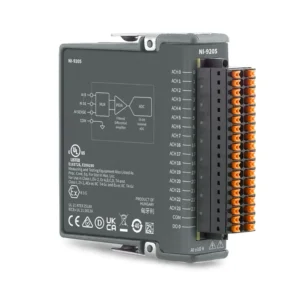
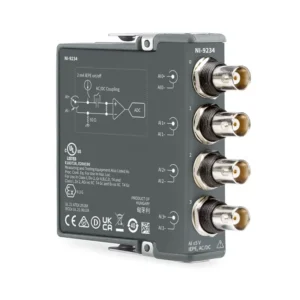
For example, the chassis can be configured with a NI-9205 analog input module for general voltage measurements, an NI-9213 thermocouple module for temperature monitoring or an NI-9234 dynamic signal acquisition module for vibration and acoustic measurements.
Hardware-Timed Analog Input
The cDAQ-9183 provides analog input timing resources and a 127-sample input FIFO for each slot. Maximum sample rate and supported channel count are determined by the installed modules and the number of channels included in the acquisition task.
Internal timing bases include 80 MHz, 20 MHz, 13.1072 MHz, 12.8 MHz, 10 MHz and 100 kHz clocks. These timing resources help support accurate, repeatable hardware-timed measurements.
Analog Output Waveform Generation
With compatible analog output modules, the chassis supports non-periodic waveforms, periodic regeneration from onboard memory and waveform regeneration from a host buffer with dynamic updates.
Onboard regeneration supports as many as 16 analog output channels with a maximum aggregate update rate of 1.6 MS/s. The shared onboard analog output FIFO contains 8,191 samples.
Digital Waveform Acquisition and Generation
The cDAQ-9183 supports hardware-timed digital input and output when used with compatible C Series digital modules. Finite input sampling and finite or regenerated output generation can operate at clock rates up to 10 MHz.
This functionality is useful for capturing digital events, generating control patterns, monitoring encoders and coordinating external equipment with analog measurements.
Four 32-Bit Counter/Timers
Four integrated 32-bit counter/timers support edge counting, pulse measurement, frequency measurement, period measurement, pulse-width measurement and two-edge separation measurements.
The counters also support X1, X2 and X4 quadrature encoder measurements with Channel Z reloading. Output functions include pulse generation, dynamically updated pulse trains, frequency division and equivalent-time sampling.
Time-Based Triggers and Timestamps
The chassis provides five time-based triggers and four timestamps. Supported operations vary according to the measurement subsystem but can include start triggers, synchronization pulses, reference triggers and first-sample timestamps.
Time-based triggering is valuable when several synchronized systems must begin acquisition or generation at a specified network time rather than responding to an electrical trigger cable.
Rugged Industrial Operation
The cDAQ-9183 is specified for operation from -40°C to 70°C and provides IP40 ingress protection. When operating below 0°C, use the NI PS-15 or another power supply rated for the required low-temperature conditions.
For installations exposed to dirt, moisture or other harsh conditions, NI recommends a suitable NI-9917 or NI-9918 industrial enclosure. The chassis is intended for indoor use and should not be exposed directly to wet environments.
Published shock and vibration ratings require the system to be panel mounted. Mounting orientation, spacing and airflow requirements must follow the official installation instructions to avoid temperature derating.
Flexible 9 VDC to 30 VDC Power Input
The wide 9 VDC to 30 VDC input range allows the chassis to operate from compatible industrial DC supplies. Maximum power consumption is 16 W for a fully populated chassis under worst-case operating conditions.
Power wiring accepts 24 AWG to 14 AWG copper conductors. Use one conductor per terminal, maintain the specified strip length and tighten both the terminal screws and connector flanges to the recommended torque.
NI-DAQmx Software Integration
The cDAQ-9183 is controlled through the NI-DAQmx driver. NI-DAQmx provides device configuration, task creation, timing, triggering, synchronization, diagnostics and data-transfer functions.
Applications can be developed with LabVIEW and other environments supported by the installed NI-DAQmx version. The chassis can be discovered, named, reserved and tested using NI Measurement & Automation Explorer.
cDAQ-9183 Applications
- Distributed data acquisition
- Industrial machine monitoring
- Structural and mechanical testing
- Temperature and environmental monitoring
- Automotive component validation
- Aerospace ground testing
- Vibration and acoustic measurement
- Energy and power-system monitoring
- Production test equipment
- Remote laboratory measurements
- Condition-based maintenance systems
- Synchronized multi-location acquisition
- Digital control and event monitoring
- CAN and LIN network testing with compatible modules
Distributed Data Acquisition
Ethernet connectivity allows the cDAQ-9183 to be installed close to remote sensors while the host computer remains in a laboratory, control cabinet or operator station. Locating the analog conversion hardware near the sensors can reduce long low-level signal runs and their susceptibility to interference.
Machine Condition Monitoring
When combined with appropriate vibration, temperature, current and digital modules, the chassis can monitor rotating machinery, pumps, motors and production equipment. Synchronized channels help correlate mechanical vibration with speed, temperature and operating-state information.
Structural and Mechanical Testing
C Series bridge, strain and dynamic signal modules allow the cDAQ-9183 to support load, pressure, strain, acceleration and displacement measurements. Multiple synchronized chassis can distribute acquisition hardware across large structures or test fixtures.
Automotive and Transportation Testing
The chassis can collect analog sensor measurements, digital events and compatible CAN or LIN data within a unified NI-DAQmx system. Its wide operating-temperature range supports test cells, validation benches and appropriately protected vehicle installations.
Environmental Monitoring
Thermocouple, RTD, voltage and current modules can be combined for environmental chambers, energy systems and long-duration validation tests. Ethernet connectivity enables monitoring from a remote workstation without requiring a host computer beside the sensors.
Production and Functional Testing
A cDAQ-9183 system can acquire test measurements, monitor fixture states and generate control outputs during automated production sequences. Swappable C Series modules make it possible to adapt the same chassis platform to different products and fixtures.
cDAQ-9183 Installation Workflow
Step 1: Select the C Series Modules
Choose modules according to the sensor type, channel count, input range, accuracy, isolation, sample rate and required signal conditioning. Verify that every module is supported by the intended NI-DAQmx version.
Step 2: Plan the Mounting Location
Select an indoor location that provides the required ventilation, temperature range and environmental protection. Use panel mounting when the installation must meet the published shock and vibration specifications.
Step 3: Install the C Series Modules
Power down the system when required by the installation procedure. Insert each module into an available slot until its retention mechanism is fully engaged.
Step 4: Connect Chassis Ground
Connect the chassis grounding screw to an appropriate protective or functional ground using a short, low-impedance conductor. Proper grounding can improve safety and reduce measurement noise.
Step 5: Wire the DC Power Input
Connect a regulated 9 VDC to 30 VDC source to the two-position power terminal. Observe polarity, conductor gauge, temperature rating and terminal-torque requirements.
Step 6: Connect Ethernet
Connect the chassis to the host computer or network infrastructure with a suitable Ethernet cable. A single cable segment may be as long as 100 m.
Step 7: Discover the Chassis
Open NI Measurement & Automation Explorer and locate the cDAQ-9183 under network devices. Configure DHCP, Link-Local or static addressing according to the network design.
Step 8: Configure Synchronization
For synchronized systems, configure IEEE 802.1AS-compatible network equipment and verify that all participating devices share the required time reference. Use Gigabit full-duplex communication for the specified TSN synchronization performance.
Step 9: Test Each Module
Use NI MAX test panels to verify channels, wiring and sensor behavior. Confirm that measurement ranges and terminal configurations match the connected devices.
Step 10: Create the NI-DAQmx Application
Configure acquisition or generation tasks, sample clocks, triggers, channel scaling and data logging. Validate the complete system under representative operating and network-load conditions.
cDAQ-9183 Troubleshooting
The cDAQ-9183 Is Not Detected
Confirm that the POWER and Ethernet LINK indicators are active. Check the Ethernet cable, host adapter, network switch and DC power source. Verify that NI-DAQmx supports the chassis and temporarily disable incompatible network filtering when permitted by the system administrator.
The Chassis Receives a Link-Local Address
A Link-Local address can indicate that no DHCP server responded. Configure an appropriate static address or restore access to the DHCP service. Ensure that the host and chassis addresses belong to compatible network subnets.
A C Series Module Is Missing
Confirm that the module is fully seated and latched. Verify model compatibility and driver support. Power-cycle the chassis using the documented procedure if the module remains unavailable.
Measurements Contain Excessive Noise
Inspect sensor grounding, shielding, cable routing and chassis grounding. Separate low-level analog wiring from motors, switching power supplies and high-current conductors. Confirm that the selected C Series module provides suitable isolation and filtering.
Data Transfer Is Slower Than Expected
Verify that the connection negotiated at 1000 Mb/s and inspect the network for congestion, damaged cables or low-performance switches. Review the number of active streams, sample rates, data types and host processing load.
Network Synchronization Is Inaccurate
Confirm that the connection is operating at 1000BASE-T full duplex and that the network devices support the required timing standard. Synchronization results also depend on network topology, hop count, selected modules and task configuration.
The Chassis Disconnects Intermittently
Check the DC supply voltage at the chassis while all modules are operating. Inspect the power connector and Ethernet cable for movement or loose connections. Review network switch logs and disable inappropriate energy-saving settings on the host adapter.
The Chassis Overheats
Verify mounting orientation, airflow, spacing and ambient temperature. Remove dust or obstructions around the enclosure and confirm that installed modules do not create an unsupported power or thermal configuration.
Hardware-Timed Output Does Not Start
Check the sample clock, trigger source and route configuration. Confirm that the installed module supports hardware-timed output and that the requested rate does not exceed the applicable chassis or module specification.
The System Does Not Operate Below 0°C
Use an NI PS-15 or another power supply rated for operation below 0°C. Confirm that cables, connectors, sensors and installed C Series modules also support the required ambient temperature.
cDAQ-9183 Comparison
| Model | Slots | Host Interface | Network Configuration | Best Suited For |
|---|---|---|---|---|
| cDAQ-9174 | 4 | USB | Direct host connection | Portable and benchtop measurements near the computer |
| cDAQ-9183 | 4 | Ethernet | One Gigabit port with TSN | Compact synchronized distributed acquisition |
| cDAQ-9185 | 4 | Ethernet | Dual-port TSN network architecture | Daisy-chained and more flexible distributed systems |
| cDAQ-9189 | 8 | Ethernet | Dual-port TSN network architecture | Higher-density synchronized Ethernet acquisition |
cDAQ-9183 vs cDAQ-9174
The cDAQ-9174 is a four-slot USB chassis intended primarily for direct connection to a nearby computer. The cDAQ-9183 uses Ethernet and can be installed farther from the host, making it better suited to distributed systems.
Choose the cDAQ-9174 for straightforward benchtop or portable USB acquisition. Choose the cDAQ-9183 when Ethernet distance, network access or time-based synchronization is required.
cDAQ-9183 vs cDAQ-9185
Both chassis provide four C Series slots and TSN-enabled Ethernet operation. The cDAQ-9183 has one Ethernet port, while the cDAQ-9185 uses a dual-port network architecture that supports more flexible line and daisy-chain topologies.
The cDAQ-9183 is suitable for an endpoint connected to an existing Ethernet switch. The cDAQ-9185 may be preferred when multiple chassis must be connected in a line or when dual-port network flexibility is important.
cDAQ-9183 vs cDAQ-9189
The cDAQ-9183 provides four slots, while the cDAQ-9189 provides eight. Both support TSN-based synchronized Ethernet acquisition, but the cDAQ-9189 accommodates twice as many C Series modules.
Select the cDAQ-9183 for compact four-module systems. Select the cDAQ-9189 when higher channel density can reduce the number of required chassis.
Selecting Compatible C Series Modules
Select modules based on the signal rather than the chassis alone. Important parameters include sensor excitation, measurement range, resolution, sampling mode, isolation, channel density and connector style.
- NI-9205 Analog Input Module for general-purpose voltage acquisition
- NI-9213 Thermocouple Module for temperature measurements
- NI-9234 Dynamic Signal Acquisition Module for vibration and sound
- NI-9263 Analog Output Module for voltage generation
- NI-9401 Digital I/O Module for bidirectional digital applications
- NI-9862 CAN Interface Module for compatible NI-XNET applications
Why Choose the cDAQ-9183?
- Combines four C Series slots with a compact Ethernet chassis
- Supports precise IEEE 802.1AS network synchronization
- Provides Gigabit communication at distances up to 100 m per segment
- Supports seven concurrent high-performance data streams
- Includes four 32-bit counter/timers
- Supports hardware-timed analog and digital operations
- Operates from a flexible 9 VDC to 30 VDC supply
- Supports temperatures from -40°C to 70°C
- Works with a broad selection of NI C Series modules
- Integrates with NI-DAQmx and LabVIEW-based systems
cDAQ-9183 Frequently Asked Questions
What is the cDAQ-9183?
The cDAQ-9183 is a four-slot, TSN-enabled Ethernet CompactDAQ chassis that connects compatible NI C Series measurement and control modules to a networked host computer.
What is the cDAQ-9183 part number?
The standard orderable part number is 789996-01.
How many C Series modules can it hold?
The chassis accepts as many as four compatible C Series modules. Different measurement and output module types can be installed together.
How many Ethernet ports does it have?
The cDAQ-9183 has one automatically negotiated 10/100/1000 Mb/s Ethernet port.
Does the cDAQ-9183 support TSN?
Yes. It supports IEEE 802.1AS network synchronization over a full-duplex Gigabit Ethernet connection.
What synchronization accuracy does it provide?
The specified network synchronization accuracy is less than 1 µs. An optimized one-hop configuration with suitable C Series modules can achieve accuracy below 100 ns.
What is the maximum Ethernet cable distance?
The maximum supported cable distance is 100 m per Ethernet segment. Network switches or other supported infrastructure can extend the total system distance.
Can the cDAQ-9183 generate analog and digital waveforms?
Yes, when compatible output modules are installed. It supports analog waveform regeneration and hardware-timed digital generation, subject to chassis and module limits.
How many counters does the chassis provide?
It provides four 32-bit general-purpose counter/timers for edge, frequency, period, pulse, encoder and pulse-generation applications.
What power supply does the cDAQ-9183 require?
It accepts 9 VDC to 30 VDC and consumes a maximum of 16 W under the specified fully populated worst-case condition.
Can the cDAQ-9183 operate outdoors?
The chassis is intended for indoor use. A suitable NI-9917, NI-9918 or application-specific enclosure is required to protect it in harsh, dirty or wet environments.
What software controls the cDAQ-9183?
The chassis uses the NI-DAQmx driver and can be configured in NI Measurement & Automation Explorer. Application support depends on the installed NI-DAQmx version and development environment.
Does it support CAN and LIN modules?
The chassis supports compatible NI-XNET C Series modules. An active CAN or LIN session uses two of the available high-performance data streams, regardless of the number of active NI-XNET modules.
Can the chassis be used in hazardous locations?
The hardware has applicable hazardous-location certifications, but the complete installation must follow the corresponding certification, wiring, enclosure and power-supply requirements. The standard desktop power supply is not intended for hazardous locations.
Recommended Related Products
- cDAQ-9174 4-Slot USB CompactDAQ Chassis
- cDAQ-9185 4-Slot TSN Ethernet CompactDAQ Chassis
- cDAQ-9189 8-Slot TSN Ethernet CompactDAQ Chassis
- NI-9205 Analog Input Module
- NI-9213 Thermocouple Input Module
- NI-9234 Dynamic Signal Acquisition Module
- NI-9263 Analog Output Module
- NI-9401 Digital I/O Module
Request a Quote for the cDAQ-9183
Contact us for current availability, lead time and project pricing for the NI cDAQ-9183 4-Slot TSN Ethernet CompactDAQ Chassis. We can also help identify compatible C Series I/O modules, power supplies, industrial enclosures, mounting accessories and Ethernet components for your distributed data acquisition system.