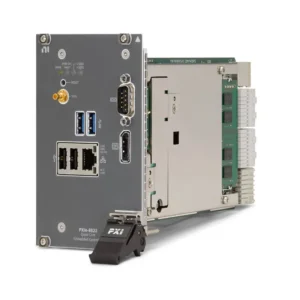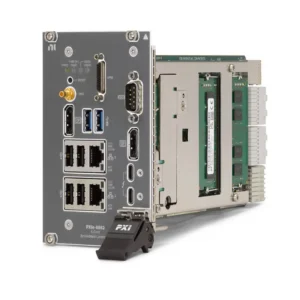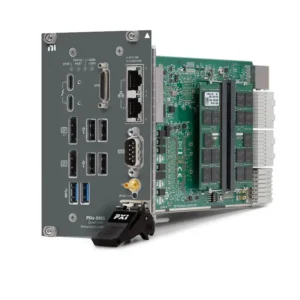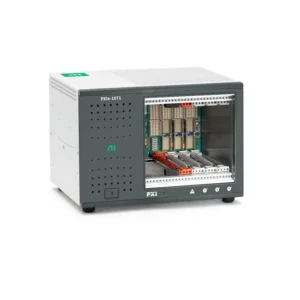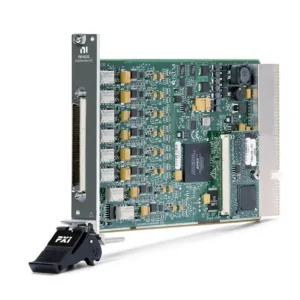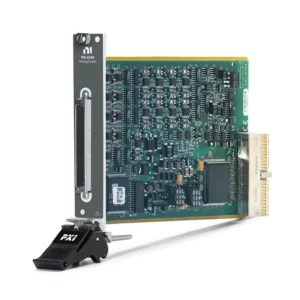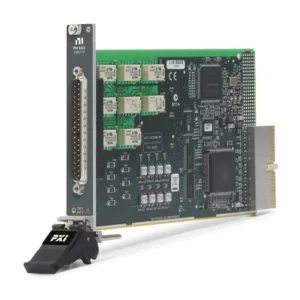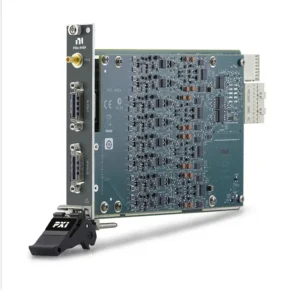




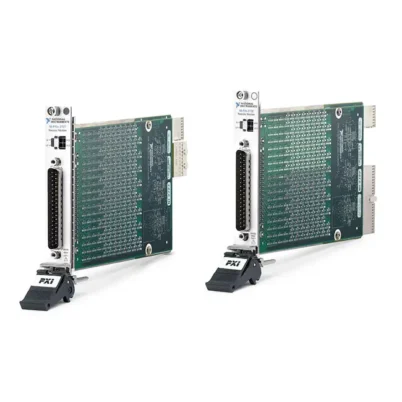
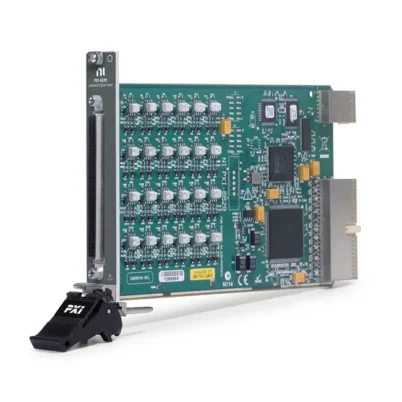

HDD-8261 PXI Express High-Speed Data Storage Module
The HDD-8261 is an in-chassis PXI Express storage module designed for high-speed signal recording, field testing and expansion of PXI controller storage. It integrates multiple 2.5-inch SATA drives and an onboard PCI Express SATA controller into a three-slot-wide PXI Express module.
Two principal configurations were offered. The HDD version provides four hard disk drives with 4 TB total raw capacity and sustained throughput up to approximately 250 MB/s. The SSD version provides six solid-state drives with approximately 2.9 TB capacity and sustained read/write performance up to 2 GB/s.
Key Features of the HDD-8261
- In-chassis PXI Express data storage
- HDD and SSD configuration options
- 4 TB four-drive HDD configuration
- Approximately 2.9 TB six-drive SSD configuration
- Up to 250 MB/s sustained HDD throughput
- Up to 2 GB/s sustained SSD throughput
- PCI Express Gen 2 x8 backplane interface
- Onboard Marvell 88SE9485 SATA controller
- Software RAID and JBOD support
- Striped, simple and spanned volume configurations
- Compact three-slot PXI Express design
- Power, drive activity and failure indicators
- Suitable for continuous high-speed signal recording
- Removable storage module for transferring data between systems
- Recommended replacement: PXIe-8267
HDD-8261 Technical Specifications
| Product Model | HDD-8261 |
|---|---|
| Product Type | In-chassis PXI Express data storage module |
| HDD Configuration Part Number | 784191-01 |
| SSD Configuration Part Number | 784192-01 |
| Bus Interface | PCI Express Gen 2 x8 through the PXI Express backplane |
| SATA Controller | Marvell 88SE9485 |
| HDD Drive Configuration | 4 × 1 TB or greater 2.5-inch SATA hard disk drives |
| HDD Total Capacity | 4 TB |
| HDD Sustained Throughput | Up to 250 MB/s sequential read/write |
| SSD Drive Configuration | 6 × 400 GB or greater 2.5-inch SATA solid-state drives |
| SSD Total Capacity | Approximately 2.9 TB |
| SSD Sustained Throughput | Up to 2 GB/s sequential read/write |
| RAID Implementation | Software RAID |
| Supported Storage Modes | Striped, simple, spanned and JBOD configurations |
| Onboard Hardware RAID Cache | No |
| Module Width | 3 PXI slots |
| Module Format | 3U PXI Express/cPCI Express |
| Front-Panel Indicators | Power, failure and drive activity LEDs |
| Documented Operating System | Windows 7 64-bit for full documented performance |
| LabVIEW Real-Time Support | Not supported |
| Driver | NI-8261 1.0 driver |
| Lifecycle Status | Discontinued with limited NI support |
| Recommended NI Replacement | PXIe-8267, part number 787850-01 |
HDD-8261 Part Numbers and Configurations
| Part Number | Drive Type | Number of Drives | Capacity | Maximum Sustained Throughput |
|---|---|---|---|---|
| 784191-01 | Mechanical HDD | 4 | 4 TB | 250 MB/s |
| 784192-01 | Solid-state drive | 6 | Approximately 2.9 TB | 2 GB/s |
| 787850-01 | M.2 solid-state storage | Replacement product | 4 TB | Refer to PXIe-8267 specifications |
Confirm the complete part number before ordering because the HDD and SSD configurations have significantly different capacity, drive count, throughput and environmental behavior.
In-Chassis PXI Express Storage
The HDD-8261 installs directly in a compatible PXI Express chassis. Unlike an external RAID enclosure, it does not require a separate rack unit, external power supply or cabled PCI Express interface.
Its integrated design is useful for mobile, laboratory and field-test systems where storage must travel with the PXI instruments. The module occupies three adjacent PXI Express slots.
PCI Express Gen 2 x8 Interface
The module connects to the chassis backplane through a PCI Express Gen 2 x8 interface. This high-bandwidth connection supports direct data transfer between the storage module, PXI controller and compatible acquisition instruments.
Actual storage throughput depends on the chassis backplane topology, slot placement, controller performance, RAID configuration, file system and acquisition software.
4 TB HDD Configuration
Part number 784191-01 contains four 2.5-inch SATA hard disk drives with a total raw capacity of 4 TB. The HDD configuration prioritizes storage capacity over maximum streaming speed.
When configured as a striped software RAID volume, the HDD version can provide sequential read and write speeds up to approximately 250 MB/s across about 80% of the array’s capacity.
2.9 TB SSD Configuration
Part number 784192-01 contains six SATA solid-state drives with approximately 2.9 TB total storage capacity. This version is intended for applications requiring higher sustained bandwidth and greater resistance to shock and vibration.
The SSD array can achieve sequential read and write performance up to approximately 2 GB/s under the documented optimized system configuration.
HDD vs SSD Configuration
| Characteristic | HDD Version | SSD Version |
|---|---|---|
| Part Number | 784191-01 | 784192-01 |
| Number of Drives | 4 | 6 |
| Total Capacity | 4 TB | Approximately 2.9 TB |
| Maximum Sustained Throughput | 250 MB/s | 2 GB/s |
| Shock and Vibration Resistance | Limited by rotating media | Better suited to mobile and field applications |
| Primary Advantage | Higher capacity | Higher bandwidth and ruggedness |
Software RAID Architecture
The HDD-8261 uses software RAID rather than a dedicated hardware RAID processor. Windows combines the physical drives into striped, simple or spanned volumes.
Because there is no onboard hardware RAID cache, host memory and software configuration have a significant effect on streaming performance. Large DMA and file buffers help absorb temporary changes in drive write speed.
RAID 0 Striping
A striped RAID 0 volume distributes data across multiple drives to increase sequential read and write performance. This is the normal configuration for applications that prioritize recording bandwidth.
RAID 0 does not provide data redundancy. If any drive in the striped array fails, the complete volume and recorded data may become inaccessible.
Simple, Spanned and JBOD Storage
The drives can also be configured as simple volumes, spanned volumes or individual JBOD disks. These modes may be useful when the application does not require maximum aggregate throughput.
Storage mode should be selected before collecting important data. Reconfiguring or initializing a volume can erase existing information.
High-Speed Signal Recording
The HDD-8261 can store high-rate data generated by digitizers, RF instruments, FlexRIO modules, cameras and other PXI acquisition hardware. Its in-chassis connection avoids the additional bottlenecks of many external storage interfaces.
Required write bandwidth should be calculated from the number of channels, sample rate, sample width and metadata overhead. The application should maintain additional bandwidth margin for filesystem and drive-performance variation.
Raw Data Rate Calculation
The approximate raw data rate for an acquisition can be calculated using the following relationship:
Data Rate = Channels × Samples per Second × Bytes per Sample
For example, eight channels recorded at 10 MS/s with two bytes per sample produce a raw rate of approximately 160 MB/s before file and processing overhead.
Host DMA Buffer Requirements
NI recommends a large host DMA buffer for sustained SSD streaming at approximately 2 GB/s. A buffer of around 2 GB can absorb short periods in which SSD write speed temporarily decreases.
DMA buffers of this size require a 64-bit operating environment and appropriate application memory configuration. An insufficient buffer can cause overflow and data loss.
PXI Chassis Placement
The SSD version performs best when installed close to the embedded controller in a chassis with adequate PCI Express bandwidth. NI documented maximum performance using a PXIe-1085 chassis and PXIe-8880 embedded controller.
For the HDD version, NI recommends compatible slots near the controller while also considering vibration. Chassis slot topology should be reviewed because not every slot necessarily provides the same bandwidth to the controller.
PXI Chassis Cooling
Storage drives generate heat during sustained recording. The chassis must provide adequate airflow around all three occupied slots.
Mechanical HDD performance can also be affected by vibration. NI testing found that the PXIe-1085 automatic fan mode could provide better HDD performance than the high fan setting because increased fan vibration affected the rotating drives.
Field-Test Applications
The in-chassis design allows the measurement instruments and storage array to remain together during transport. The SSD configuration is especially suitable for mobile systems because it has no rotating media.
Field-test systems should still provide appropriate mechanical protection, cooling and power conditioning. Do not remove the module or drives while the system is powered or writing data.
Moving Data Between Test Systems
The HDD-8261 can be moved between compatible PXI Express systems, allowing recorded information to travel with the storage module. Windows may need to recognize or reinitialize the software RAID configuration after the module is installed in another controller.
Back up important information before relocating or reconfiguring the array. Do not approve any initialization prompt unless the effect on existing data is understood.
Expanding Controller Storage
The module can supplement the limited internal drive capacity of a PXI embedded controller. Large test datasets can be stored on the HDD-8261 while the operating system and application remain on the controller drive.
Separating recorded data from the system disk can also reduce competition between operating-system activity and high-speed file writing.
Front-Panel Status Indicators
Front-panel LEDs provide basic power, drive activity and failure status. These indicators help confirm that the module is powered and that storage operations are occurring.
A failure indication should be investigated immediately. Stop the acquisition safely, check Windows storage status and back up accessible data before attempting repairs or volume reconfiguration.
Windows Operating-System Support
The original HDD-8261 documentation specifies Windows 7 64-bit as the supported operating system for documented performance. Operation on other Windows versions may result in reduced performance or driver-compatibility problems.
Before installing the module in a current system, verify controller hardware, Windows version and availability of the NI-8261 driver. Legacy operating-system requirements can make the module unsuitable for a new test platform.
No LabVIEW Real-Time Support
The HDD-8261 driver supports Windows systems and does not provide support for NI LabVIEW Real-Time operating systems. A Phar Lap or Linux Real-Time controller cannot use the array as a supported high-speed RAID volume.
Applications requiring deterministic real-time acquisition may need to stream data to a supported Windows controller or use a storage solution specifically compatible with the selected real-time target.
Typical HDD-8261 Applications
- High-speed waveform recording
- RF signal recording
- Radar and electronic-warfare data capture
- Multichannel digitizer streaming
- FlexRIO data recording
- Machine-vision image storage
- Field-test data logging
- Automotive and aerospace testing
- Scientific experiment recording
- PXI controller storage expansion
- Large production-test datasets
- Moving recorded data between PXI systems
RF and Wideband Signal Recording
The SSD configuration can support recording from high-bandwidth RF and digitizer modules when the combined data rate remains within the sustained storage and backplane limits.
Long-duration RF recording requires careful calculation of required capacity. At 2 GB/s, one hour of continuous uncompressed data would require approximately 7.2 TB, exceeding the array’s available capacity.
Multichannel Digitizer Streaming
The module can record synchronized data from several digitizer channels. Data reduction, decimation or triggered segmentation may be required when the combined raw rate exceeds the storage capability.
The complete path—from instrument through the PXI backplane, controller memory and filesystem to the drives—must sustain the required rate.
Machine-Vision Storage
High-speed cameras and frame grabbers can generate large image streams. The HDD-8261 can provide local storage for image sequences, inspection data and production records.
Image-processing operations should be optimized so that CPU and memory activity do not interrupt disk streaming. Where possible, use separate processing and recording threads with adequately sized buffers.
HDD-8261 Installation Considerations
The module occupies three adjacent PXI Express slots. Verify slot availability, backplane bandwidth and airflow before installation.
Power down the chassis before inserting or removing the HDD-8261. Follow electrostatic-discharge precautions and secure all retaining screws before operating the system.
HDD-8261 Troubleshooting
The HDD-8261 is not detected by Windows
Confirm that the module is fully seated in a compatible PXI Express slot and that the NI-8261 1.0 driver is installed. Check Windows Device Manager for the SATA controller and restart the system.
The module does not appear in NI MAX
The storage volume is primarily managed through Windows rather than as a conventional NI-DAQmx instrument. Check Windows Device Manager and Disk Management in addition to NI MAX.
The drives appear but no volume is available
Open Windows Disk Management and verify whether the software RAID volume is online. Do not initialize or format the drives if they contain data that must be preserved.
Write speed is below 250 MB/s on the HDD version
Verify RAID 0 striping, available free space, chassis slot placement and fan configuration. HDD throughput can decline as more of the disk capacity is used.
The SSD version cannot reach 2 GB/s
Check the chassis backplane topology, controller performance, slot location, RAID configuration and DMA-buffer size. The documented maximum requires an optimized system and large host buffers.
Streaming stops with a buffer overflow
Increase the host buffer and reduce competing system activity. Confirm that the sustained acquisition rate does not exceed the array’s actual write performance.
The mechanical drives report errors after transport
Stop using the array and check Windows disk status. Mechanical HDDs are more sensitive to shock and vibration than SSDs and should be transported with appropriate protection.
The failure LED is illuminated
Stop recording safely and inspect the drive and software RAID status. Back up accessible information before replacing a drive or rebuilding the volume.
The RAID volume is missing after moving the module
Windows may need to import or recognize the existing software RAID volume. Avoid reinitializing the disks until the previous configuration and data-recovery requirements have been confirmed.
The module is not available in LabVIEW Real-Time
The HDD-8261 RAID driver does not support NI real-time operating systems. Use a supported Windows controller or select a storage solution compatible with the real-time target.
HDD-8261 Comparison with Related PXI Storage Products
| Model | Storage Architecture | Capacity | Primary Advantage |
|---|---|---|---|
| NI-8260 | Four-drive in-chassis HDD or SSD array | Up to approximately 3 TB in documented HDD configurations | Earlier generation in-chassis PXI storage |
| HDD-8261 HDD | Four-drive software RAID | 4 TB | Higher storage capacity |
| HDD-8261 SSD | Six-drive software RAID | Approximately 2.9 TB | Up to 2 GB/s streaming performance |
| PXIe-8267 | Modern M.2 solid-state storage | 4 TB | Current replacement with newer storage technology |
HDD-8261 HDD vs HDD-8261 SSD
The 784191-01 HDD configuration provides 4 TB capacity and up to 250 MB/s sustained throughput. The 784192-01 SSD configuration provides approximately 2.9 TB and up to 2 GB/s sustained throughput.
Choose the HDD version when capacity is the primary requirement and the data rate remains moderate. Choose the SSD version for high-bandwidth acquisition, field use and better resistance to shock and vibration.
HDD-8261 vs NI-8260
The NI-8260 is an earlier three-slot in-chassis storage module with lower documented HDD capacity. The HDD-8261 increases available capacity and offers an optimized six-drive SSD configuration.
System compatibility, driver support and existing RAID configuration should be reviewed before replacing one legacy module with the other.
HDD-8261 vs PXIe-8267
The PXIe-8267 is the NI-recommended replacement for the HDD-8261. It uses newer M.2 solid-state storage technology and provides 4 TB capacity in a modern PXI Express design.
The PXIe-8267 is preferable for new systems, but it is not necessarily a direct software or storage-volume replacement. Review operating-system support, slot requirements and achievable throughput before migration.
Recommended Related Products
- PXIe-8267 4 TB M.2 PXI Express Data Storage Module
- NI-8260 In-Chassis PXI Data Storage Module
- PXIe-8880 High-Performance Embedded Controller
- PXIe-1085 High-Bandwidth PXI Express Chassis
- View More NI PXI Controllers
- View More NI PXI and PXI Express Chassis
- View More NI PXI and PXI Express Modules
Selecting the Right PXI Storage Module
Choose the HDD-8261 HDD configuration when maintaining an existing Windows-based PXI system that requires approximately 4 TB of local storage and sustained recording rates up to 250 MB/s.
Choose the SSD configuration when the system requires substantially greater bandwidth or must operate in a mobile environment. For new PXI Express systems, consider the PXIe-8267 and verify that its capacity and throughput meet the acquisition requirements.
Why Choose the HDD-8261?
- Adds high-capacity storage directly inside a PXI Express chassis
- Offers separate capacity-optimized HDD and speed-optimized SSD versions
- Provides up to 4 TB total storage
- Supports sustained streaming up to 2 GB/s
- Uses a PCI Express Gen 2 x8 backplane connection
- Supports software RAID and JBOD configurations
- Occupies only three adjacent PXI slots
- Provides front-panel activity and failure indicators
- Supports high-speed signal recording and field testing
- Allows storage to be moved between compatible PXI systems
Frequently Asked Questions
What is the HDD-8261?
The HDD-8261 is a three-slot PXI Express storage module containing multiple SATA hard drives or solid-state drives for high-speed data streaming and PXI controller storage expansion.
What are the HDD-8261 part numbers?
Part number 784191-01 identifies the 4 TB HDD configuration. Part number 784192-01 identifies the approximately 2.9 TB SSD configuration.
How many drives does the HDD version contain?
The 4 TB HDD configuration contains four 2.5-inch SATA mechanical hard drives.
How many drives does the SSD version contain?
The approximately 2.9 TB SSD configuration contains six 2.5-inch SATA solid-state drives.
What is the maximum HDD throughput?
The HDD configuration supports sustained sequential read and write performance up to approximately 250 MB/s in an optimized striped software RAID volume.
What is the maximum SSD throughput?
The SSD configuration supports sustained sequential read and write performance up to approximately 2 GB/s with an optimized chassis, controller and buffering configuration.
Does the HDD-8261 include a hardware RAID controller?
No. It includes a PCI Express SATA controller but uses Windows software RAID. It does not provide a dedicated hardware RAID cache.
Does RAID 0 protect data from drive failure?
No. RAID 0 improves performance but provides no redundancy. Failure of one drive can make the entire striped volume inaccessible.
How many PXI slots does the HDD-8261 occupy?
The module occupies three adjacent PXI Express slots.
Can the HDD-8261 be used with LabVIEW Real-Time?
No. The required storage driver supports Windows and does not support NI LabVIEW Real-Time operating systems.
Which operating system was officially documented?
The original guide specifies Windows 7 64-bit for supported operation and documented performance. Other Windows versions may have compatibility or performance limitations.
Which driver is required?
The HDD-8261 uses the NI-8261 1.0 driver. Driver and operating-system compatibility should be verified before installation.
What is the recommended replacement?
NI recommends the PXIe-8267, part number 787850-01, a 4 TB M.2 PXI Express storage module.
Is the HDD-8261 discontinued?
Yes. NI lists both HDD-8261 configurations as discontinued with limited support. Availability may depend on remaining inventory or tested secondary-market equipment.
Request a Quote for the HDD-8261
Contact us for current availability, condition, drive health, lead time and project pricing for the HDD-8261 PXI Express Data Storage Module. Please specify whether you require part number 784191-01 with HDD storage or part number 784192-01 with SSD storage. We can also help identify compatible PXI Express chassis, controllers and current replacement storage modules.