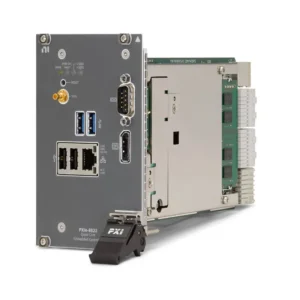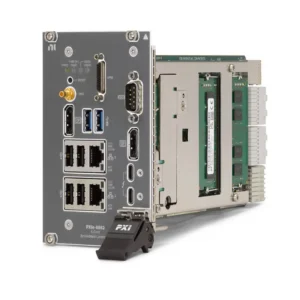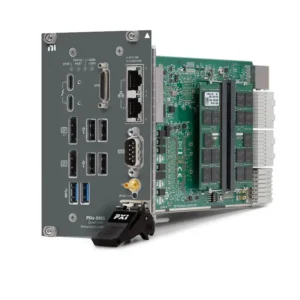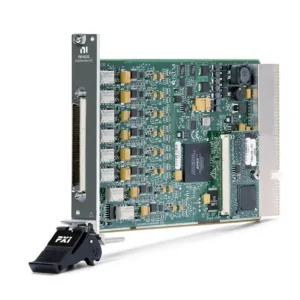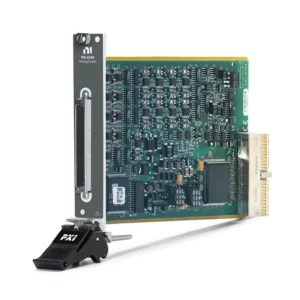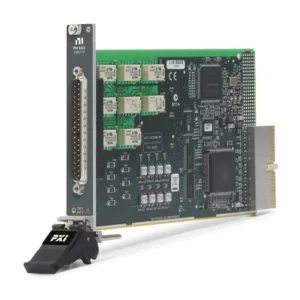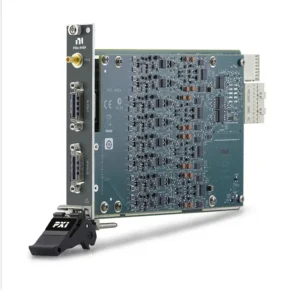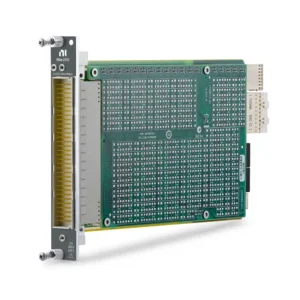





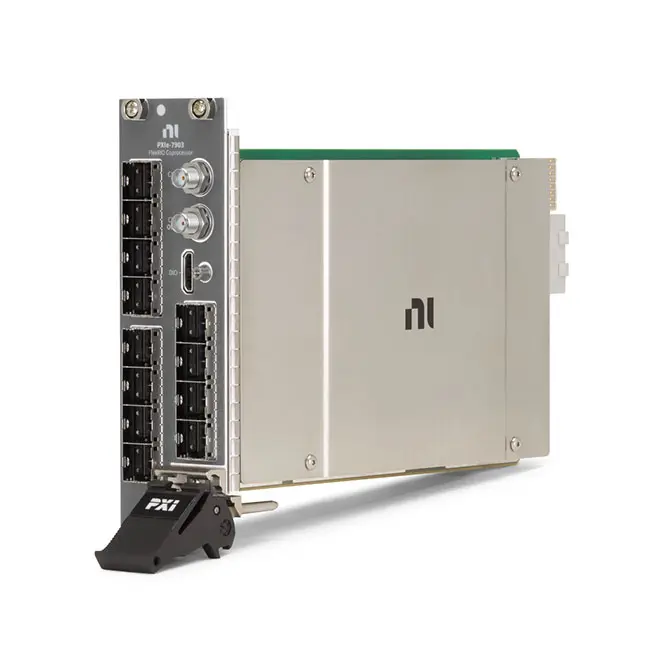
PXIe-7903 48-Channel High-Speed Serial FPGA Module
The PXIe-7903 is a high-performance PXI high-speed serial instrument and FPGA coprocessor designed for high-volume data movement, real-time signal processing and custom serial protocol implementation. It provides 48 bidirectional multigigabit transceiver lanes with line rates from 500 Mbit/s to 28.2 Gbit/s per lane.
The module combines a Xilinx Virtex UltraScale+ XCVU11P FPGA, 20 GB of onboard DRAM, twelve Mini-SAS HD ports and eight auxiliary digital I/O channels. Its large FPGA and high-bandwidth memory architecture make it suitable for radar, electronic warfare, beamforming, high-speed data acquisition and protocol validation applications.
As part of the NI PXI modular instrumentation platform, the PXIe-7903 can exchange data with controllers, storage systems and other FPGA-enabled PXI instruments through a PCI Express Gen 3 x8 backplane interface.
PXIe-7903 Product Overview
The PXIe-7903 is designed for applications that exceed the channel count, FPGA resources or onboard memory available from conventional high-speed serial instruments. Each of its twelve Mini-SAS HD connectors carries four transmit and receive lanes, providing a total of 48 bidirectional serial transceivers.
The user-programmable FPGA can implement standard or proprietary serial protocols, real-time data processing, packet inspection, data reduction and deterministic response logic. Existing VHDL, Verilog and compatible FPGA intellectual property can be integrated into supported LabVIEW FPGA projects.
The PXIe-7903 occupies two PXI Express slots and requires a chassis with sufficient slot power and cooling capacity. System configuration should therefore include a careful review of chassis compatibility, cable type, FPGA power consumption and data-transfer requirements.
Key Features of the PXIe-7903
48 Bidirectional Serial Transceiver Lanes
The PXIe-7903 provides 48 FPGA-connected multigigabit transceivers. Each lane includes transmit and receive capability, enabling full-duplex protocol interfaces and high-density data movement.
The transceivers are divided among twelve Mini-SAS HD connectors, with four TX/RX lanes available through each port.
28.2 Gbit/s Maximum Line Rate
Each serial lane supports line rates from 500 Mbit/s to 28.2 Gbit/s without the 8 Gbit/s to 9.8 Gbit/s operating gap found on selected earlier-generation NI serial instruments.
The published line rate represents the raw serial bit rate. Actual payload throughput depends on protocol encoding, headers, error correction and other transmission overhead.
Virtex UltraScale+ XCVU11P FPGA
The PXIe-7903 incorporates a Xilinx Virtex UltraScale+ XCVU11P FPGA with extensive logic, memory and digital signal processing resources:
- Approximately 2.835 million system logic cells
- 9,216 DSP slices
- 341 Mb of embedded block RAM and UltraRAM
- 48 multigigabit transceiver lanes
- 60 DMA channels
Some FPGA resources are reserved for PCI Express communication, device configuration and board-level interfaces. The resources available to the user are therefore slightly lower than the total device resources.
20 GB of Onboard DRAM
The module provides 20 GB of DRAM divided into two independent 10 GB banks. This memory can store generated waveforms, captured serial data, lookup tables and intermediate FPGA-processing results.
The current PXIe-7903 specification lists a maximum theoretical aggregate DRAM data rate of 53.2 GB/s, or 26.6 GB/s per memory bank. Actual application performance depends on the FPGA design and memory access pattern.
Twelve Mini-SAS HD Ports
Twelve front-panel Mini-SAS HD connectors provide access to the 48 serial transceiver lanes. Ports 0 through 7 support passive copper cables, while ports 8 through 11 can support passive cables and appropriately selected powered optical cables.
NI recommends validating active optical cables for the required data rate and protocol. Optical cable compatibility should not be assumed solely because power is available from the connector.
Eight Auxiliary Digital I/O Channels
A Mini-HDMI-style connector provides eight individually configurable, single-ended digital I/O channels. Supported logic families include 1.8 V, 2.5 V and 3.3 V, with a maximum operating frequency of 60 MHz.
The DIO connector is not an HDMI multimedia interface. Commercial HDMI cables or consumer HDMI devices must not be connected unless the cable and pinout have been specifically designed for the PXIe-7903 auxiliary I/O interface.
External Clock Input and Output
Separate SMA connectors provide external clock input and clock output capability. The clock input supports frequencies from 10 MHz to 300 MHz and has a nominal 50 Ω input impedance.
The programmable clock output provides multiple supported frequency ranges up to 1 GHz, allowing the module to distribute a reference or sample-related clock to compatible external equipment.
PCI Express Gen 3 x8 Interface
The PXIe-7903 communicates through a PCI Express Gen 3 x8 backplane link. NI documents host and peer-to-peer streaming performance up to approximately 7 GB/s in supported unidirectional configurations.
Peer-to-peer streaming allows FPGA data to move directly between compatible PXI instruments without first passing through the host processor.
PXIe-7903 Technical Specifications
| Product Model | PXIe-7903 |
|---|---|
| NI Part Number | 788917-01 |
| Product Type | PXI High-Speed Serial Instrument / FlexRIO FPGA Coprocessor |
| Serial Transceiver Lanes | 48 bidirectional TX/RX lanes |
| Serial Line-Rate Range | 500 Mbit/s to 28.2 Gbit/s per lane |
| Serial Ports | 12 × Mini-SAS HD |
| Lanes per Port | 4 |
| Supported Cable Types | Passive copper; powered optical on ports 8–11 when validated |
| I/O Coupling | AC coupled, 100 nF |
| FPGA | Xilinx Virtex UltraScale+ XCVU11P |
| System Logic Cells | 2,835 K |
| DSP Slices | 9,216 |
| Embedded Memory | 341 Mb |
| Onboard DRAM | 20 GB, two 10 GB banks |
| Theoretical DRAM Data Rate | 53.2 GB/s aggregate |
| PXI Express Interface | PCI Express Gen 3 x8 |
| DMA Channels | 60 |
| Host/P2P Streaming | Up to approximately 7 GB/s in supported configurations |
| Auxiliary Digital I/O | 8 bidirectional single-ended channels |
| DIO Voltage Families | 1.8 V, 2.5 V and 3.3 V |
| DIO Maximum Frequency | 60 MHz |
| DIO Connector | Mini-HDMI-style connector, not an HDMI interface |
| External Clock Input | SMA, 10 MHz to 300 MHz |
| Clock Output | SMA, programmable ranges up to 1 GHz |
| Form Factor | 3U, two-slot PXI Express module |
| Maximum Total Power | 164 W, FPGA design dependent |
| Required Slot Cooling | At least 82 W per slot |
| Operating Temperature | 0°C to 40°C |
| Programming Environment | LabVIEW FPGA and supported HDL integration |
| Lifecycle Status | Active |
How the PXIe-7903 Works
Incoming serial data enters through the Mini-SAS HD connectors and passes directly to the FPGA multigigabit transceivers. The FPGA recovers and decodes the data according to the protocol implemented by the user.
The FPGA can process data immediately, buffer it in one of the two onboard DRAM banks or transfer selected information through the PXI Express backplane. For generation applications, data can be read from DRAM or created algorithmically and then transmitted through the selected serial lanes.
This architecture supports several data-processing paths:
- Serial input to real-time FPGA processing
- Serial input to onboard DRAM capture
- DRAM waveform playback to serial outputs
- Serial data streaming to the PXI controller
- Peer-to-peer transfer to another FPGA-enabled PXI module
- Low-latency serial input-to-output protocol bridging
FPGA Coprocessing Applications
The large XCVU11P FPGA allows the PXIe-7903 to operate as a coprocessor for other PXI instruments. Digitizer, vector signal transceiver or data acquisition streams can be transferred to the FPGA for deterministic processing.
Possible FPGA processing functions include:
- Digital downconversion and channelization
- Beamforming and phase adjustment
- Radar target generation
- Real-time spectral processing
- Data compression and reduction
- Custom triggering and event detection
- Protocol conversion and packet inspection
- Inline signal-processing acceleration
High-Speed Serial Protocol Development
The PXIe-7903 can implement standard and proprietary serial protocols through FPGA code and compatible protocol intellectual property. Potential interfaces include high-speed Ethernet implementations, Aurora-based communication and custom multigigabit links.
Final protocol compatibility depends on the required line rate, encoding, lane bonding, reference clock, electrical characteristics and availability of suitable FPGA intellectual property.
Typical Applications
- Custom high-speed serial protocol implementation
- High-density SerDes validation
- Radar target generation
- Electronic warfare test systems
- Electronically scanned array characterization
- Multichannel beamforming
- Real-time spectrum analysis
- Spectral stitching between RF instruments
- High-speed record and playback systems
- 100 Gigabit Ethernet FPGA development
- Semiconductor and ASIC interface validation
- High-volume data movement and processing
Software and FPGA Development
The PXIe-7903 is programmable using LabVIEW FPGA and the applicable NI FlexRIO or FPGA-based instrument driver. Engineers can develop graphical FPGA applications or integrate supported VHDL, Verilog and netlist-based intellectual property.
A typical development system may require:
- A compatible LabVIEW version
- LabVIEW FPGA Module
- Applicable NI FlexRIO driver
- Compatible Xilinx compilation tools
- A supported high-power PXI Express chassis
- A PXI controller or remote-control interface
- Mini-SAS HD copper or validated optical cables
- Protocol-specific FPGA intellectual property
System and Chassis Requirements
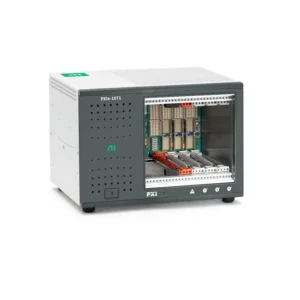
The PXIe-7903 is a two-slot module with a maximum total power requirement of 164 W. It requires a chassis that can provide at least 82 W of cooling capacity per occupied slot and power through both PXI Express backplane power connectors.
Before selecting a chassis such as the PXIe-1095, verify its high-power slot configuration, cooling profile and support for the module’s two-slot mechanical arrangement.
System designers should evaluate:
- Available adjacent PXI Express slots
- At least 82 W cooling capacity per slot
- PCI Express Gen 3 x8 backplane connectivity
- Controller and storage throughput
- Copper or optical cable requirements
- External reference-clock requirements
- FPGA compilation time and resource utilization
- Continuous and burst data-transfer requirements
PXIe-7903 Troubleshooting
Serial Link Does Not Establish
Verify the line rate, reference clock, lane assignment, transmitter polarity, receiver polarity and protocol encoding. Confirm that the cable and interface fixture support the required bandwidth.
High Bit-Error Rate
Review cable loss, connector condition, channel impedance and transceiver equalization settings. Transmit amplitude, pre-emphasis, post-emphasis and receiver equalization may need to be adjusted for the physical channel.
Host Streaming Is Below the Expected Rate
Confirm that the module is connected through a full PCI Express Gen 3 x8 backplane path. Chassis topology, controller bandwidth, storage performance and other installed modules can reduce sustainable throughput.
FPGA Compilation Does Not Fit
Review logic, memory, DSP and timing utilization. Although the XCVU11P is a large FPGA, board-interface logic reserves some resources and complex multichannel protocols can require significant routing capacity.
DIO Connection Does Not Work
Confirm that the dedicated auxiliary I/O cable is being used. The DIO connector resembles Mini-HDMI but is not electrically compatible with a standard HDMI interface.
Module Reports a Thermal or Power Error
Verify that both occupied slots meet the 82 W cooling requirement and that the chassis airflow is unobstructed. Actual power consumption varies according to the FPGA design.
PXIe-7903 vs PXIe-7902
The PXIe-7902 provides 24 bidirectional serial lanes with maximum line rates of 12.5 Gbit/s. It uses a Virtex-7 FPGA, includes 2 GB of DRAM and communicates through a PCI Express Gen 2 x8 interface.
The PXIe-7903 doubles the serial lane count, increases the maximum rate to 28.2 Gbit/s, provides a substantially larger UltraScale+ FPGA and increases onboard memory to 20 GB.
| Specification | PXIe-7903 | PXIe-7902 |
|---|---|---|
| Serial Lanes | 48 TX/RX | 24 TX/RX |
| Maximum Line Rate | 28.2 Gbit/s | 12.5 Gbit/s |
| FPGA | Virtex UltraScale+ XCVU11P | Virtex-7 485T |
| Onboard DRAM | 20 GB | 2 GB |
| PXI Interface | PCIe Gen 3 x8 | PCIe Gen 2 x8 |
| Mini-SAS HD Ports | 12 | 6 |
| Auxiliary DIO | 8 channels | None |
PXIe-7903 vs PXIe-6594
The PXIe-6594 also supports line rates up to 28.2 Gbit/s but provides eight bidirectional lanes through QSFP28 connectors. It uses a Kintex UltraScale+ KU15P FPGA and includes 8 GB of DRAM.
Choose the PXIe-6594 when eight lanes, QSFP28 connectivity and a single-slot form factor meet the application requirements. Choose the PXIe-7903 when the system requires substantially more lanes, a larger FPGA, deeper memory or FPGA coprocessing capability.
High-Speed Serial Instrument Comparison
| Model | Serial Lanes | Maximum Rate | FPGA | DRAM | Connector |
|---|---|---|---|---|---|
| PXIe-7903 | 48 | 28.2 Gbit/s | Virtex UltraScale+ XCVU11P | 20 GB | Mini-SAS HD |
| PXIe-7902 | 24 | 12.5 Gbit/s | Virtex-7 485T | 2 GB | Mini-SAS HD |
| PXIe-6594 | 8 | 28.2 Gbit/s | Kintex UltraScale+ KU15P | 8 GB | QSFP28 |
| PXIe-6593 | 8 | 16.3 Gbit/s | Kintex UltraScale KU040/KU060 | 4 GB | QSFP28 |
How to Select the Right Serial Instrument
Choose the PXIe-7903 when the application requires a combination of high serial lane density, rates above 12.5 Gbit/s, extensive FPGA processing resources and deep onboard memory.
A lower-density module may be more suitable when:
- Only four or eight serial lanes are required
- A single-slot module is preferred
- QSFP28 or SFP+ connectivity is required
- The chassis cannot provide 82 W of cooling per slot
- FPGA coprocessing resources are not necessary
- Lower system cost is more important than maximum scalability
Recommended Related Products
- PXIe-7902 High-Speed Serial Instrument – 24-lane Mini-SAS HD platform for serial protocols up to 12.5 Gbit/s.
- PXIe-6594 High-Speed Serial Instrument – Eight-lane, 28.2 Gbit/s alternative with QSFP28 connectivity.
- PXIe-6593 High-Speed Serial Instrument – Eight-lane platform for applications up to 16.3 Gbit/s.
- PXIe-6592 High-Speed Serial Instrument – Four-lane SFP+ option for lower-density serial interfaces.
- PXIe-1095 Chassis – PXI Express chassis option for large, high-bandwidth test systems; verify the required high-power cooling configuration.
- PXIe-8881 Embedded Controller – High-performance controller for data-intensive PXI Express systems.
Why Choose the PXIe-7903?
- 48 bidirectional multigigabit transceiver lanes
- Line rates from 500 Mbit/s to 28.2 Gbit/s
- Twelve Mini-SAS HD ports
- Virtex UltraScale+ XCVU11P FPGA
- 20 GB of high-bandwidth onboard DRAM
- PCI Express Gen 3 x8 backplane interface
- Up to approximately 7 GB/s host or P2P streaming
- Eight auxiliary digital I/O channels
- Custom protocol and FPGA coprocessing capability
Frequently Asked Questions
What is the PXIe-7903 used for?
The PXIe-7903 is used for high-density serial protocol testing, real-time FPGA processing, radar and electronic warfare systems, beamforming, data movement and custom digital interface development.
How many serial lanes does the PXIe-7903 provide?
It provides 48 bidirectional TX/RX serial lanes through twelve Mini-SAS HD connectors.
What is the maximum serial line rate?
The maximum raw line rate is 28.2 Gbit/s per lane. Supported operation begins at 500 Mbit/s.
Which FPGA does the module use?
The PXIe-7903 uses a Xilinx Virtex UltraScale+ XCVU11P FPGA.
How much onboard memory is available?
The module provides 20 GB of DRAM divided into two independent 10 GB banks.
Does the PXIe-7903 support optical cables?
Ports 8 through 11 can provide power for suitable active optical cables. The selected cable must be validated for the intended protocol and data rate. Ports 0 through 7 support passive copper cables only.
Does the module provide auxiliary digital I/O?
Yes. It provides eight bidirectional single-ended channels supporting 1.8 V, 2.5 V and 3.3 V logic families.
Can a standard HDMI device connect to the DIO port?
No. The connector resembles Mini-HDMI but is not an HDMI interface. Use only a compatible PXIe-7903 auxiliary I/O cable or breakout accessory.
How many PXI slots are required?
The PXIe-7903 occupies two adjacent PXI Express slots.
What chassis cooling is required?
The chassis must provide at least 82 W of cooling capacity for each occupied slot. Chassis power, airflow and slot compatibility should be confirmed before installation.
What is the part number for the PXIe-7903?
The standard NI part number is 788917-01.
Is the PXIe-7903 still active?
Yes. NI currently classifies the PXIe-7903 as an Active product.
Request a Quote for the PXIe-7903
Contact us for current availability, lead time and project pricing for the PXIe-7903 48-Channel High-Speed Serial FPGA Module. We can also help verify compatible PXI Express chassis, controllers, Mini-SAS HD cables, clock accessories and software requirements.