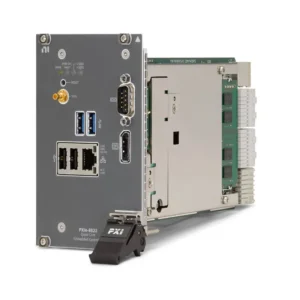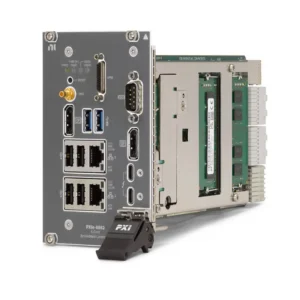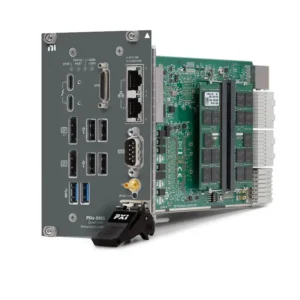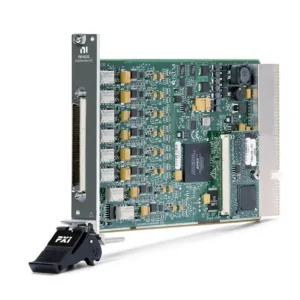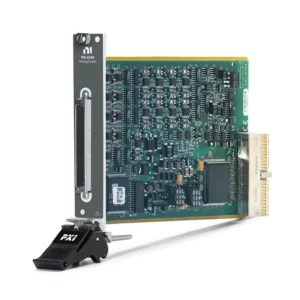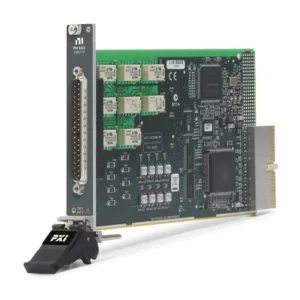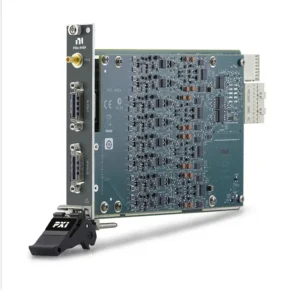






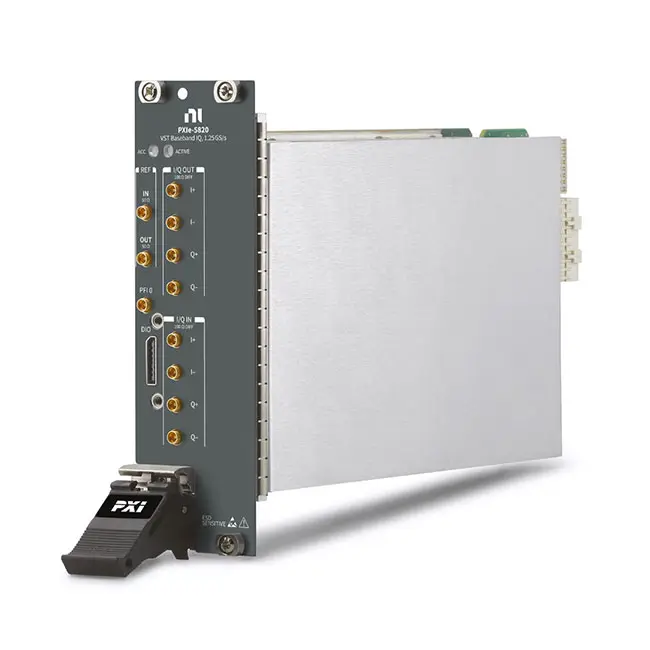
The NI PXIe-5820 is a wideband baseband PXI Vector Signal Transceiver (VST) designed for generating and analyzing complex I/Q signals. It combines an I/Q digitizer, I/Q arbitrary waveform generator and user-programmable FPGA in a two-slot PXI Express module.
With a DC to 500 MHz frequency range, 1 GHz complex I/Q bandwidth and 1.25 GS/s ADC and DAC sample rates, the PXIe-5820 is suitable for baseband wireless chipset testing, power-amplifier envelope tracking, digital predistortion and advanced communications research.
Key Features of the NI PXIe-5820
- Baseband PXI Vector Signal Transceiver
- DC to 500 MHz baseband frequency range
- 1 GHz complex I/Q bandwidth
- Wideband I/Q signal generation and analysis
- 14-bit, 1.25 GS/s analog-to-digital converters
- 16-bit, 1.25 GS/s digital-to-analog converters
- Flexible I/Q data rates from approximately 19 kS/s to 1.25 GS/s
- Xilinx Virtex-7 X690T user-programmable FPGA
- Two 2 GB FPGA-accessible DRAM banks
- Eight programmable LVCMOS digital I/O lines
- Four high-speed serial transmit and receive lanes
- Peer-to-peer data streaming support
- Hardware triggering and PXI synchronization
- Two-slot PXI Express form factor
- NI-RFSA, NI-RFSG and RFmx software support
PXIe-5820 Technical Specifications
| Product Model | PXIe-5820 |
|---|---|
| Product Type | Baseband PXI Vector Signal Transceiver |
| Part Numbers | 783967-01, 789179-01 and 789180-01 |
| I/O Type | Complex baseband I/Q |
| Frequency Range | DC to 500 MHz |
| Complex I/Q Bandwidth | 1 GHz |
| Input Channels | One complex I/Q input channel on VST configurations |
| Output Channels | One complex I/Q output channel |
| I/Q Input Components | Two differential analog inputs: I and Q |
| I/Q Output Components | Two differential analog outputs: I and Q |
| ADC Resolution | 14 bits |
| ADC Sample Rate | 1.25 GS/s |
| DAC Resolution | 16 bits |
| DAC Sample Rate | 1.25 GS/s, internally interpolated to 2.5 GS/s |
| I/Q Data Rate | Approximately 19 kS/s to 1.25 GS/s |
| Maximum Output Level | Up to approximately +15 dBm |
| Onboard FPGA | Xilinx Virtex-7 X690T |
| FPGA Lookup Tables | 433,200 |
| FPGA DSP Slices | 3,600 |
| Embedded Block RAM | 52.9 Mbits |
| Onboard DRAM | Two banks, 2 GB per bank |
| DMA Channels | 56 |
| Parallel Digital I/O | 8 bidirectional LVCMOS lines |
| Digital Logic Levels | 1.2 V, 1.5 V, 1.8 V, 2.5 V and 3.3 V |
| High-Speed Serial I/O | Four transmit and four receive MGT lanes |
| Peer-to-Peer Streaming | Supported |
| Bus Interface | PXI Express |
| Module Width | 2 slots |
| Dimensions | 4.1 cm × 13.0 cm × 21.6 cm |
| Weight | Approximately 795 g |
| Product Status | Active |
PXIe-5820 Part Numbers and Configurations
| Part Number | Configuration | Input | Output | I/Q Bandwidth |
|---|---|---|---|---|
| 783967-01 | Original PXIe-5820 baseband VST | Complex I/Q analysis | Complex I/Q generation | 1 GHz |
| 789179-01 | PXIe-5820 standalone baseband VST, no extension | Complex I/Q analysis | Complex I/Q generation | 1 GHz |
| 789180-01 | PXIe-5820 standalone baseband vector signal generator, no extension | Not included | Complex I/Q generation | 1 GHz |
Select a VST configuration when both I/Q generation and analysis are required. Choose 789180-01 when the application requires only baseband arbitrary waveform generation.
Complex I/Q Signal Architecture
The PXIe-5820 represents modulated signals using two orthogonal baseband components: in-phase data and quadrature data. Together, these I and Q signals describe the amplitude and phase of a complex modulated waveform.
Using direct baseband I/Q connections allows wireless chipsets, modulators, demodulators and RF transceivers to be tested without an external RF frequency-conversion stage.
Wideband I/Q Digitizer
VST configurations include two differential 14-bit ADC inputs operating at up to 1.25 GS/s. These inputs simultaneously acquire the I and Q components of a complex baseband signal.
The 1 GHz complex bandwidth supports wide communication channels, carrier aggregation, envelope waveforms and signals with fast amplitude or phase transitions.
I/Q Arbitrary Waveform Generator
The PXIe-5820 includes two differential 16-bit DAC outputs for generating the I and Q components of complex waveforms. Each DAC operates at 1.25 GS/s and is internally interpolated to 2.5 GS/s.
Engineers can generate standard-compliant or custom baseband signals for receiver testing, chipset validation, amplifier envelope control and modulation research.
Flexible I/Q Data Rates
The I/Q input and output data rates can be configured from approximately 19 kS/s to 1.25 GS/s. Lower input rates are produced through fractional decimation, while lower output rates use fractional interpolation.
This flexibility allows the module to handle both narrowband and extremely wideband signals without forcing every test to process data at the maximum rate.
Virtex-7 User-Programmable FPGA
The onboard Xilinx Virtex-7 X690T FPGA supports real-time signal processing, custom triggering and low-latency control. It includes 433,200 lookup tables, 866,400 flip-flops and 3,600 DSP48 slices.
Custom FPGA applications can implement channel emulation, digital predistortion, envelope tracking, custom modulation, protocol-aware triggering and hardware-in-the-loop processing.
Onboard DRAM and Data Movement
The PXIe-5820 provides two independently accessible DRAM banks with 2 GB per bank. The FPGA can use this memory to store generated waveforms, acquired data or intermediate processing results.
The module supports DMA, interrupts and programmed I/O, with 56 DMA channels available for transferring data between the FPGA, onboard memory and PXI controller.
High-Speed Serial and Digital I/O
The 42-pin digital connector provides eight programmable LVCMOS digital lines and four high-speed multi-gigabit transceiver lanes in each direction.
The parallel digital lines support SPI, I²C, hardware triggers and device-control functions. The serial lanes enable high-throughput, low-latency connections to compatible digital instruments and custom hardware.
Peer-to-Peer Streaming
Peer-to-peer streaming allows the PXIe-5820 to exchange data directly with compatible PXI FPGA, storage or serial instruments without routing each transfer through host memory.
This architecture reduces host-processor load and can improve latency in real-time recording, playback, channel-emulation and closed-loop test applications.
Envelope Tracking and Digital Predistortion
The PXIe-5820 is suitable for generating and measuring wideband envelope signals used with RF power amplifiers. Its FPGA can process digital predistortion algorithms and coordinate baseband envelope and RF stimulus paths.
These capabilities help engineers evaluate power-amplifier efficiency, linearity, memory effects and response to rapidly changing modulation envelopes.
Typical PXIe-5820 Applications
- Baseband I/Q chipset testing
- Wireless transceiver validation
- 5G NR baseband waveform testing
- Wi-Fi 6 and 802.11ax development
- LTE-Advanced Pro testing
- Power-amplifier envelope tracking
- Digital predistortion development
- Wideband channel emulation
- Custom modulation research
- Hardware-in-the-loop testing
- Semiconductor production testing
- Real-time signal-processing research
NI-RFSA, NI-RFSG and RFmx Support
NI-RFSA controls the digitizer and analysis path, while NI-RFSG controls baseband waveform generation. RFmx provides interactive and automated waveform creation and measurement functions.
LabVIEW FPGA and compatible instrument design libraries are required when developing custom FPGA processing. LabVIEW, TestStand, C/C++, .NET and supported Python environments can be used for system automation.
PXI Chassis and System Integration
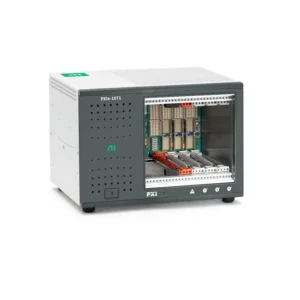
The PXIe-5820 occupies two PXI Express slots and requires a compatible chassis and controller. Chassis selection should consider cooling capacity, PCI Express bandwidth and the number of additional RF or digital instruments.
Compatible chassis options include the PXIe-1088, PXIe-1092 and PXIe-1095.
PXIe-5820 Troubleshooting
Why does the acquired I/Q signal show amplitude or phase imbalance?
Check differential wiring, cable matching, input ranges and common-mode voltage. Perform self-calibration and verify that the I and Q paths are connected with consistent polarity.
Why is the available complex bandwidth less than expected?
Confirm the configured I/Q data rate, digital filters and application software settings. Achieving 1 GHz complex bandwidth requires an appropriately high data rate and compatible signal path.
Why does waveform generation underflow?
Check waveform-buffer configuration, PXI Express bandwidth, DMA performance and competing chassis transfers. Consider using onboard DRAM for long or high-rate waveforms.
Why are digital control signals not operating at the expected voltage?
Verify the configured LVCMOS logic level and confirm that the connected device uses a compatible voltage. The digital lines support multiple programmable levels but are not automatically tolerant of every external voltage.
Why can the FPGA application not access both DRAM banks?
Confirm that each bank is configured independently in the FPGA project and that the memory interfaces do not conflict. NI recommends using LabVIEW FPGA memory items for most DRAM applications.
Why can NI-RFSA or NI-RFSG not detect the module?
Confirm that the PXIe-5820 is installed in a compatible PXI Express slot and that supported driver versions are installed. NI-RFSA and NI-RFSG support began with version 17.1.
PXIe-5820 Comparison with Related NI Instruments
| Model | Signal Type | Frequency Range | Maximum Bandwidth | Primary Use |
|---|---|---|---|---|
| PXIe-5820 | Complex baseband I/Q | DC to 500 MHz | 1 GHz complex | Direct baseband generation and analysis |
| PXIe-5841 | RF | 9 kHz to 6 GHz | Up to 1 GHz | Sub-6 GHz RF generation and analysis |
| PXIe-5842 | RF and microwave | Up to 54 GHz, depending on configuration | Up to 4 GHz | Wideband RF and microwave testing |
| PXIe-5433 | Single-ended analog | Baseband waveform output | 80 MHz | General-purpose arbitrary waveform generation |
Recommended Related Products
- NI PXIe-5841 Vector Signal Transceiver – adds RF generation and analysis from 9 kHz to 6 GHz with up to 1 GHz bandwidth.
- NI PXIe-5842 Vector Signal Transceiver – provides higher RF frequency coverage and bandwidth for advanced wireless and microwave testing.
- NI PXIe-5433 Arbitrary Waveform Generator – offers one or two general-purpose analog outputs with 80 MHz bandwidth.
- NI PXIe-7902 FPGA Coprocessor – adds FPGA processing and high-speed serial connectivity for advanced real-time systems.
- NI PXIe-7903 High-Speed Serial Instrument – provides additional high-speed digital and serial interfaces.
- NI PXI and PXI Express Modules – browse additional RF, waveform-generation and FPGA modules.
How to Select the Correct PXIe-5820
Choose a VST configuration when the application requires simultaneous baseband I/Q generation and analysis. Select the generator-only 789180-01 when only wideband I/Q signal generation is required.
Choose the PXIe-5820 instead of an RF VST when the DUT exposes direct baseband I/Q connections. Use the PXIe-5841 or PXIe-5842 when frequency conversion and direct RF connections are required.
Why Choose the NI PXIe-5820?
The PXIe-5820 combines wideband I/Q generation, acquisition, FPGA processing, large onboard memory and high-speed digital connectivity in one module. It provides a flexible platform for developing and automating advanced baseband communication tests.
Frequently Asked Questions
What is the frequency range of the PXIe-5820?
It supports direct baseband signals from DC to 500 MHz.
What is its maximum complex I/Q bandwidth?
The PXIe-5820 provides up to 1 GHz of equalized complex I/Q bandwidth.
What are the ADC and DAC sample rates?
The 14-bit ADCs and 16-bit DACs operate at 1.25 GS/s. DAC data is internally interpolated to 2.5 GS/s.
Does the PXIe-5820 include a user-programmable FPGA?
Yes. It includes a Xilinx Virtex-7 X690T FPGA for real-time signal processing and control.
How much onboard DRAM is available?
The module provides two independently accessible 2 GB DRAM banks, for a total of 4 GB.
Does it support high-speed serial I/O?
Yes. The digital connector provides four transmit and four receive MGT lanes, plus eight programmable LVCMOS lines.
Can the PXIe-5820 generate RF signals directly?
No. It is a baseband I/Q instrument. Use an RF VST such as the PXIe-5841 when a direct RF input or output is required.
How many PXI slots does it occupy?
The PXIe-5820 occupies two PXI Express slots.
Is the PXIe-5820 still an active product?
Yes. NI currently lists all three PXIe-5820 configurations as active products.
Request a Quote for the NI PXIe-5820
Contact us for current availability, lead time and project pricing for the NI PXIe-5820 Baseband Vector Signal Transceiver. Please specify whether you require a VST or generator-only configuration and provide the preferred part number.