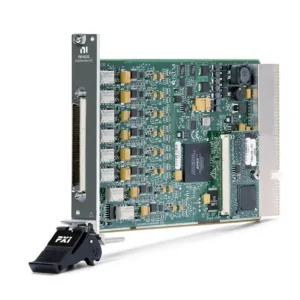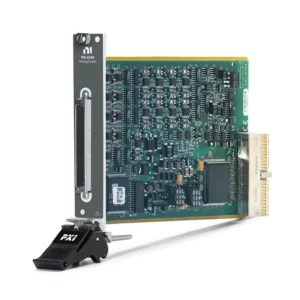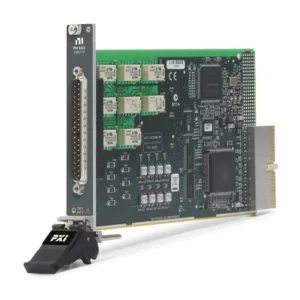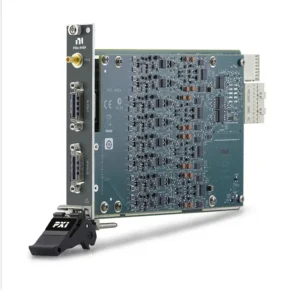





Product Introduction
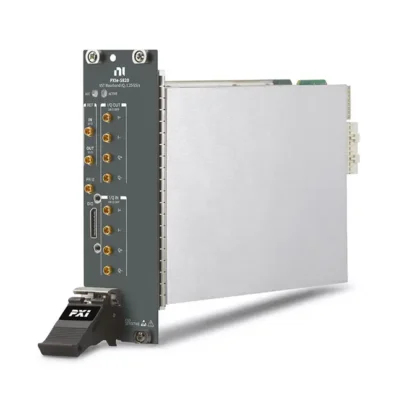
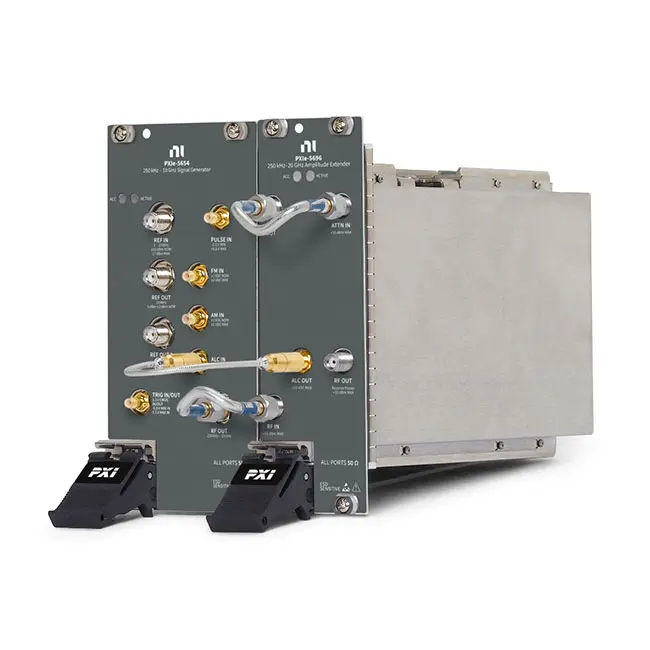
The NI PXIe-5654 is a PXI Express RF analog signal generator designed for automated RF and microwave test applications. It provides high-frequency signal generation for applications including RF component characterization, receiver testing, wireless research, aerospace and defense testing, semiconductor validation, and automated production test.
The PXIe-5654 provides RF signal generation with frequency coverage extending up to 20 GHz. Its modular PXI Express architecture allows the signal generator to be integrated with RF analyzers, oscilloscopes, digitizers, switching modules, power supplies, and other PXI instruments in a synchronized automated test system.
For applications requiring a compact microwave signal source with software-controlled frequency and power settings, the PXIe-5654 provides an effective alternative to a standalone benchtop RF signal generator.
Product Overview
The National Instruments PXIe-5654 is a microwave-capable RF analog signal generator for the PXI Express platform.
It can generate continuous-wave RF signals across a wide frequency range and is designed for applications where engineers need a programmable RF source integrated directly into an automated PXI test system.
Typical applications include:
- RF component characterization
- Receiver testing
- Amplifier testing
- Filter characterization
- Mixer testing
- Frequency response measurements
- Semiconductor RF validation
- Aerospace and defense test
- Microwave device testing
- Automated production test
Key Features
Frequency Coverage Up to 20 GHz
One of the primary advantages of the PXIe-5654 is its frequency coverage extending into the microwave range up to 20 GHz.
This enables the instrument to generate signals for a broad range of RF and microwave devices.
Typical DUTs can include:
- RF amplifiers
- Microwave amplifiers
- Filters
- Mixers
- Receivers
- RF front-end modules
- Frequency converters
- Microwave components
- RF semiconductor devices
PXI Express RF Signal Generator
The PXIe-5654 integrates RF signal generation into the PXI Express modular instrumentation platform.
Compared with a standalone RF source, PXI integration provides several advantages for automated test:
- Compact system architecture
- Centralized software control
- PXI timing and synchronization
- Integration with other measurement instruments
- High instrument density
- Scalable multi-instrument test systems
Continuous-Wave RF Signal Generation
The PXIe-5654 can generate continuous-wave RF signals for component characterization and receiver testing.
A basic CW test configuration is:
PXIe-5654 RF Output → Device Under Test → RF Measurement Instrument
Test software can automatically sweep the RF source across different frequencies and power levels while recording DUT measurement results.
Programmable Frequency
The PXIe-5654 provides software-controlled RF frequency configuration.
Automated test applications can sweep the signal generator through multiple frequency points without manual adjustment.
For example:
1 GHz → 2 GHz → 5 GHz → 10 GHz → 15 GHz → 20 GHz
This capability is particularly useful for frequency response and broadband RF characterization.
Programmable RF Output Power
RF output power can also be controlled programmatically.
This allows engineers to evaluate DUT performance across different input signal levels.
Typical tests can include:
- Receiver sensitivity testing
- Amplifier gain testing
- Compression testing
- Linearity testing
- Input-level characterization
- RF component validation
Microwave Signal Generation
Because the PXIe-5654 extends to 20 GHz, it can support microwave-frequency test applications that exceed the frequency range of lower-frequency RF signal generators.
This makes the module useful for testing microwave components used in:
- Radar systems
- Satellite communications
- Aerospace electronics
- RF front ends
- Microwave communication systems
- Electronic warfare research
Fast Automated Frequency Sweeps
The software-controlled architecture allows the PXIe-5654 to perform automated frequency sweeps as part of a complete test sequence.
A typical test can be:
Set Frequency → Set RF Power → Generate Signal → Measure DUT → Change Frequency → Repeat
This is useful for characterizing device performance across a large number of frequency points.
PXI Timing and Synchronization
The PXIe-5654 can operate within a PXI system containing multiple synchronized measurement instruments.
PXI timing resources can coordinate RF signal generation with:
- RF signal analyzers
- Oscilloscopes
- Digitizers
- Digital instruments
- Switching modules
- Other signal generators
This capability is particularly valuable for automated multi-instrument RF test systems.
External Reference Synchronization
RF test systems often require multiple instruments to operate from a common frequency reference.
The PXIe-5654 can be incorporated into synchronized RF architectures using compatible PXI timing and reference-clock resources.
A common reference helps maintain frequency coherence between the RF source and other measurement instruments.
Software-Controlled Operation
The PXIe-5654 is designed for programmatic control, making it suitable for automated validation and manufacturing test.
Software can configure:
- RF frequency
- RF output power
- Output enable and disable
- Frequency sweeps
- Power sweeps
- Triggering
- Reference clock configuration
Technical Specifications
| Parameter | Specification |
|---|---|
| Product Type | PXI Express RF Analog Signal Generator |
| Model | NI PXIe-5654 |
| Platform | PXI Express |
| Maximum Frequency | 20 GHz |
| Signal Type | RF / Microwave Analog Signal Generation |
| Continuous-Wave Generation | Supported |
| Programmable Frequency | Supported |
| Programmable RF Power | Supported |
| Automated Frequency Sweeps | Supported |
| Automated Power Sweeps | Supported |
| External Reference Operation | Supported |
| PXI Synchronization | Supported |
| Software Control | Supported |
| Primary Applications | RF Component Test, Receiver Test, Microwave Test and Automated RF Validation |
What Is an RF Analog Signal Generator?
An RF analog signal generator produces controlled radio-frequency signals with programmable frequency and amplitude.
These signals can be applied to a DUT to evaluate its response under known RF stimulus conditions.
A typical measurement architecture is:
RF Signal Generator → DUT → RF Analyzer
The signal generator provides the stimulus, while the analyzer measures the DUT output.
PXIe-5654 as an RF Stimulus Source
The PXIe-5654 can serve as the RF stimulus source in automated component characterization systems.
For example:
PXIe-5654 → RF Amplifier → PXI RF Analyzer
The signal generator supplies a known RF input to the amplifier, while the analyzer measures output power, frequency-domain behavior, harmonics, and other relevant parameters.
RF Amplifier Testing
The PXIe-5654 can provide programmable RF stimulus for amplifier characterization.
Typical amplifier measurements can include:
- Gain
- Gain flatness
- Frequency response
- Compression behavior
- Output power
- Harmonic response
The RF source frequency and power can be swept automatically while measurement results are collected by a compatible RF analyzer.
Filter Characterization
The PXIe-5654 can be used as a swept RF source for filter characterization.
A typical system is:
PXIe-5654 → RF Filter → RF Analyzer
By sweeping the input signal across the desired frequency range, the test system can evaluate:
- Passband behavior
- Insertion loss
- Stopband attenuation
- Frequency response
- Filter bandwidth
Mixer Testing
RF mixers require one or more controlled RF signals for characterization.
The PXIe-5654 can provide an RF or LO stimulus within its supported frequency range.
A typical mixer test architecture can include:
PXIe-5654 RF/LO Source → Mixer → RF Signal Analyzer
Additional signal generators can be used when independent RF and LO sources are required.
Receiver Testing
A programmable RF signal generator is a fundamental instrument for receiver validation.
The PXIe-5654 can generate controlled RF stimulus at different frequencies and power levels to evaluate receiver performance.
Typical receiver tests can include:
- Frequency response
- Input-level response
- Receiver sensitivity
- Gain behavior
- Frequency conversion
- Functional RF validation
RF Semiconductor Characterization
The PXIe-5654 can be integrated into semiconductor characterization systems requiring programmable microwave stimulus.
A complete system may combine:
- PXIe-5654 RF signal generator
- PXI RF signal analyzer
- PXI Source Measure Units
- PXI digital pattern instruments
- PXI switching modules
- PXI timing and synchronization hardware
This architecture allows RF performance to be correlated with DC and digital DUT operating conditions.
Automated Frequency Response Testing
One of the most common applications for the PXIe-5654 is automated frequency response characterization.
A simplified sequence is:
- Configure the starting RF frequency.
- Set the required RF output power.
- Enable RF output.
- Measure DUT response.
- Increase the RF frequency.
- Repeat the measurement.
- Continue across the required frequency range.
- Generate the final frequency response data.
Power Sweep Testing
In addition to frequency sweeps, engineers can vary RF input power to characterize DUT behavior at different stimulus levels.
A typical sequence can be:
Low Input Power → Nominal Input Power → High Input Power → Compression Region
This type of measurement is useful for amplifier, receiver, and RF semiconductor characterization.
Automated Production Test
The PXIe-5654 is suitable for production systems where RF devices must be tested repeatedly under software control.
A production test sequence may include:
- Connect the DUT through an RF switch.
- Configure PXIe-5654 frequency and power.
- Apply RF stimulus.
- Acquire the DUT response.
- Calculate required RF parameters.
- Compare results against limits.
- Record pass/fail status.
- Switch to the next DUT or RF path.
PXIe-5654 with an RF Signal Analyzer
The PXIe-5654 can be combined with a compatible PXI RF signal analyzer to create a complete RF stimulus-and-measurement system.
A simplified architecture is:
PXIe-5654 → DUT → PXI RF Signal Analyzer
The PXIe-5654 generates the test signal while the RF analyzer measures the DUT response.
PXIe-5654 with PXIe-5668
The PXIe-5654 can be integrated with the NI PXIe-5668 RF signal analyzer family for automated RF and microwave measurements.
A typical system architecture is:
PXIe-5654 RF Source → DUT → PXIe-5668 RF Signal Analyzer
This combination can be useful for RF component characterization, frequency response testing, amplifier testing, and other automated RF measurements.
PXIe-5654 with PXI Switching
RF switching modules can route the PXIe-5654 output to multiple DUTs or multiple RF paths.
A typical production architecture is:
PXIe-5654 → PXI RF Switch → Multiple DUTs
This allows one RF source to be shared across multiple test paths when simultaneous stimulus is not required.
PXIe-5654 with PXI Source Measure Units
RF semiconductor test systems may combine the PXIe-5654 with PXI Source Measure Units.
The SMU provides precision DC bias while the PXIe-5654 provides RF stimulus.
A typical architecture is:
PXI SMU → DUT DC Bias
PXIe-5654 → DUT RF Input
PXI RF Analyzer ← DUT RF Output
This architecture enables RF performance to be evaluated under different DC bias conditions.
PXIe-5654 in a Complete PXI System
The PXIe-5654 can operate as the RF stimulus source within a complete PXI system.
A typical system can include:
- PXI Chassis
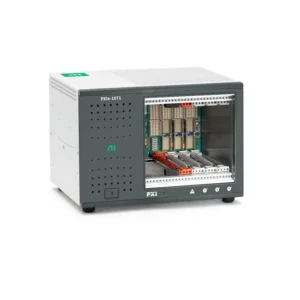
- PXI Controller
- PXIe-5654 RF Analog Signal Generator
- PXI RF signal analyzer
- PXI Modules
- PXI switching modules
- PXI Source Measure Units
- PXI oscilloscopes and digitizers
- PXI timing and synchronization modules
The modular architecture allows RF stimulus, RF analysis, DC measurements, switching, and digital test functions to be controlled within one automated platform.
PXI vs Benchtop RF Signal Generator
| Feature | PXIe-5654 | Typical Benchtop RF Generator |
|---|---|---|
| Architecture | PXI Express Modular | Standalone |
| Automated Test Integration | Excellent | Supported |
| Instrument Density | High | Lower |
| PXI Synchronization | Yes | No |
| Front-Panel Display | No | Usually Yes |
| Best Application | Automated RF Test | Interactive Bench Measurement |
PXIe-5654 vs Vector Signal Generator
The PXIe-5654 is primarily an RF analog signal generator. This is different from a vector signal generator designed to generate complex wideband digitally modulated waveforms.
| Feature | PXIe-5654 | Vector Signal Generator |
|---|---|---|
| Primary Function | RF Analog / CW Signal Generation | Complex Modulated RF Waveforms |
| CW Generation | Yes | Yes |
| Frequency Sweeps | Yes | Yes |
| Complex I/Q Waveforms | Not Primary Function | Yes |
| Best Application | RF Component Characterization | Communication Signal Testing |
How to Choose an RF Signal Generator
Before selecting the PXIe-5654, engineers should evaluate several RF requirements.
- Maximum required frequency
- Minimum required frequency
- Required RF output power
- Power accuracy
- Frequency accuracy
- Phase noise requirements
- Frequency switching requirements
- CW versus modulated signal requirements
- Reference clock requirements
- Triggering requirements
- PXI chassis compatibility
- Software compatibility
When Should You Choose the PXIe-5654?
The PXIe-5654 is particularly suitable when the application requires:
- RF and microwave frequency generation up to 20 GHz
- Software-controlled CW stimulus
- Automated frequency sweeps
- Automated RF power sweeps
- PXI system integration
- Synchronization with other PXI instruments
- Compact multi-instrument test architecture
- Automated RF production testing
Industries
- RF and Wireless Test
- Semiconductor Test
- Aerospace and Defense
- Radar Systems
- Satellite Communications
- Electronic Manufacturing
- Communication Equipment
- Automotive Electronics
- Research and Development
Applications
RF Component Characterization
The PXIe-5654 can generate programmable RF stimulus for testing amplifiers, filters, mixers, receivers, and other RF components.
Microwave Testing
Frequency coverage extending to 20 GHz allows the module to support microwave component and subsystem testing.
Receiver Validation
Programmable RF frequency and power can be used to evaluate receiver behavior across different input conditions.
Amplifier Testing
The PXIe-5654 can provide controlled RF input signals for gain, frequency response, compression, and other amplifier measurements.
Semiconductor RF Test
The module can provide microwave stimulus in automated semiconductor characterization and production test systems.
Automated Production Test
PXI integration and software-controlled RF generation make the PXIe-5654 suitable for high-throughput automated RF test stations.
Recommended Related Products
| NI PXIe-5654 | PXI Express RF analog signal generator providing microwave signal generation up to 20 GHz. |
| NI PXIe-5668 | PXI RF signal analyzer suitable for pairing with an RF source in automated stimulus-and-measurement systems. |
| NI PXIe-5162 | 1.5 GHz, 5 GS/s PXI oscilloscope for high-speed time-domain waveform measurements. |
| NI PXIe-4147 | PXI Source Measure Unit for precision DC bias and measurement in RF semiconductor characterization systems. |
| NI PXI Modules | Modular PXI instrumentation for RF testing, waveform acquisition, switching, source measurement, and automated test. |
Why Choose NI PXIe-5654?
- RF and microwave signal generation
- Frequency coverage up to 20 GHz
- Programmable RF frequency
- Programmable RF output power
- Continuous-wave signal generation
- Automated frequency sweep capability
- Automated power sweep capability
- PXI Express modular architecture
- PXI timing and synchronization
- External reference synchronization capability
- Compact automated test integration
- Suitable for RF component characterization
- Suitable for receiver testing
- Suitable for microwave device testing
- Suitable for semiconductor RF validation
- Suitable for automated production test
Frequently Asked Questions
What is the NI PXIe-5654?
The NI PXIe-5654 is a PXI Express RF analog signal generator designed to generate programmable RF and microwave signals for automated test and component characterization applications.
What is the maximum frequency of the PXIe-5654?
The PXIe-5654 provides frequency coverage extending up to 20 GHz.
Is the PXIe-5654 an RF signal generator?
Yes. The PXIe-5654 is an RF analog signal generator for the PXI Express platform.
Can the PXIe-5654 generate CW signals?
Yes. Continuous-wave RF signal generation is one of the primary applications of the PXIe-5654.
Can the PXIe-5654 generate microwave signals?
Yes. Its frequency coverage extends to 20 GHz, allowing it to operate across RF and microwave frequency ranges.
Can the PXIe-5654 perform frequency sweeps?
Yes. Software can control the RF output frequency, allowing automated frequency sweeps to be incorporated into test sequences.
Can the PXIe-5654 perform power sweeps?
Yes. Programmable RF output power allows automated testing at multiple signal levels.
Can the PXIe-5654 be used for amplifier testing?
Yes. The module can provide programmable RF stimulus for amplifier gain, frequency response, compression, and related characterization measurements when combined with appropriate measurement instruments.
Can the PXIe-5654 be used for filter testing?
Yes. The PXIe-5654 can operate as a swept RF source in automated filter frequency-response characterization systems.
Can the PXIe-5654 be used for receiver testing?
Yes. Its programmable frequency and power make it suitable for generating controlled RF stimulus for receiver validation.
Can the PXIe-5654 be used for semiconductor testing?
Yes. It can be integrated with RF analyzers, Source Measure Units, switching modules, and digital instruments for automated RF semiconductor characterization.
Can the PXIe-5654 be used with the PXIe-5668?
Yes. The PXIe-5654 can provide RF stimulus while a compatible PXIe-5668 RF signal analyzer measures the DUT response, subject to the frequency and performance requirements of the complete test configuration.
Is the PXIe-5654 a vector signal generator?
The PXIe-5654 is primarily an RF analog signal generator. Applications requiring complex wideband I/Q-modulated waveform generation should be evaluated against an appropriate NI vector signal transceiver or vector signal generator architecture.
Does the PXIe-5654 require a PXI chassis?
Yes. The PXIe-5654 is a PXI Express modular instrument and requires a compatible PXI Express chassis and system controller or remote-control architecture.
Can multiple PXI RF instruments be synchronized with the PXIe-5654?
Yes. The PXI platform provides timing, triggering, and reference resources that can be used to coordinate compatible RF and measurement instruments.
What should I check before purchasing a PXIe-5654?
Before purchasing the PXIe-5654, verify the required frequency range, RF output power, amplitude accuracy, phase noise, frequency switching requirements, reference clock requirements, CW or modulation requirements, PXI Express chassis compatibility, software support, connector requirements, and exact NI ordering part number.
Conclusion
The NI PXIe-5654 20 GHz PXI Express RF Analog Signal Generator provides programmable RF and microwave stimulus in a compact modular platform. Its high-frequency coverage, software-controlled frequency and power, PXI synchronization capabilities, and integration with RF analyzers and other PXI instruments make it suitable for RF component characterization, receiver testing, microwave device validation, semiconductor RF testing, aerospace and defense applications, and automated production test systems.