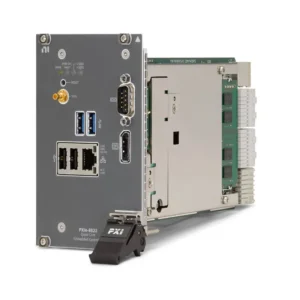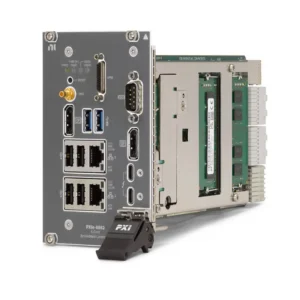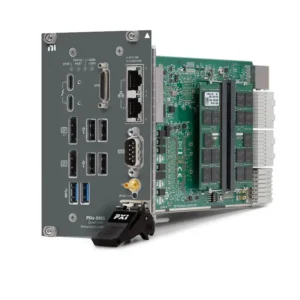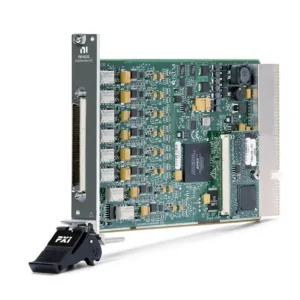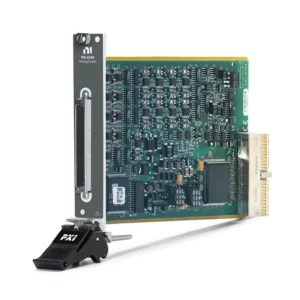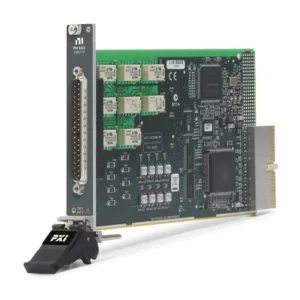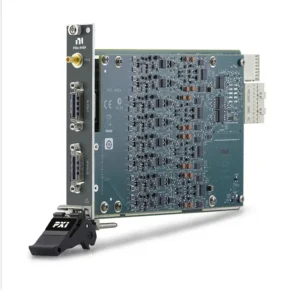




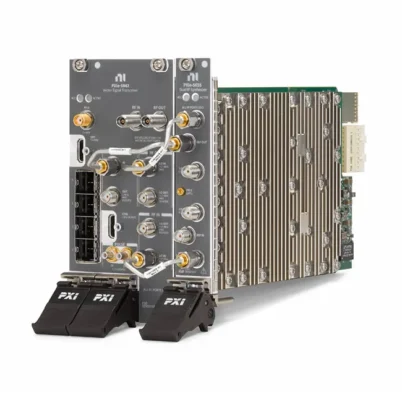

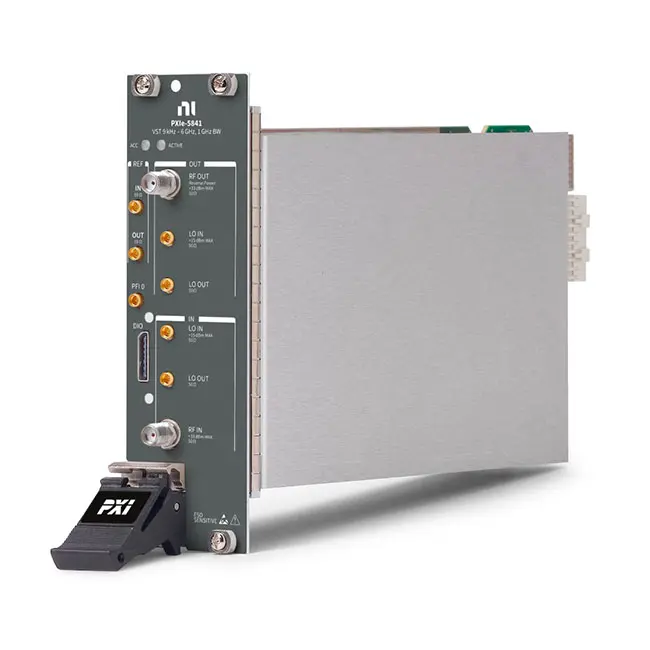
The NI PXIe-5841 is a software-defined PXI Vector Signal Transceiver (VST) covering frequencies from 9 kHz to 6 GHz. It combines a vector signal generator, vector signal analyzer, user-programmable FPGA and high-speed serial interface in a compact PXI Express instrument.
With configurations supporting 200 MHz or 1 GHz instantaneous bandwidth, the PXIe-5841 is designed for wideband wireless, RF semiconductor, radar, aerospace and automated production test applications. It supports technologies such as 5G NR, Wi-Fi 6, Bluetooth and other cellular or wireless standards.
Key Features of the NI PXIe-5841
- 9 kHz to 6 GHz RF frequency range
- Vector signal generator and analyzer functions
- VST, analyzer-only and generator-only configurations
- 200 MHz or 1 GHz instantaneous bandwidth options
- One RF input and one RF output on VST configurations
- Maximum RF generator output power up to +20 dBm
- Maximum VSA input power up to +30 dBm
- FPGA-based real-time signal processing and control
- High-speed serial interface capability
- Peer-to-peer data streaming support
- Optional enhanced local oscillator configuration
- Fast frequency tuning and measurement execution
- Hardware timing and PXI synchronization
- Suitable for MIMO and multichannel RF systems
- RFmx, NI-RFSA and NI-RFSG software support
PXIe-5841 Technical Specifications
| Product Model | PXIe-5841 |
|---|---|
| Product Type | PXI Vector Signal Transceiver |
| RF Frequency Range | 9 kHz to 6 GHz |
| Instantaneous Bandwidth Options | 200 MHz or 1 GHz |
| RF Input Channels | Up to 1, depending on configuration |
| RF Output Channels | Up to 1, depending on configuration |
| Maximum RF Output Power | Up to +20 dBm |
| Maximum VSA Input Power | Up to +30 dBm |
| Tuning Resolution | Approximately 888 nHz |
| Typical Frequency Settling Time | Less than 380 µs; less than 175 µs with supported enhanced LO configurations |
| Absolute Amplitude Accuracy | Approximately ±0.35 dB |
| Typical Phase Noise | Approximately -129 dBc/Hz at 10 kHz offset and 2.4 GHz |
| Nonharmonic Spurs | Approximately -65 dBc |
| Typical Wi-Fi 6 EVM | Approximately -52 dB for 802.11ax, 80 MHz at 5.18 GHz |
| FPGA Processing | User-programmable real-time signal processing and control |
| High-Speed Serial I/O | Four transmit and four receive transceiver lanes |
| Digital I/O | Bidirectional digital lines and FPGA-connected serial interfaces |
| Peer-to-Peer Streaming | Supported |
| Bus Interface | PXI Express |
| Module Width | Varies from 1 to 3 slots according to configuration |
| Cooling Requirement | 58 W per slot recommended for the full operating-temperature range |
| Product Status | Active |
PXIe-5841 Bandwidth by Center Frequency
The maximum instantaneous bandwidth depends on the configured RF center frequency. The full 1 GHz bandwidth is available only across the upper portion of the frequency range.
| Center Frequency | Maximum Instantaneous Bandwidth |
|---|---|
| 9 kHz to below 120 MHz | Less than 120 MHz, using direct low-frequency acquisition or generation |
| 120 MHz to 410 MHz | 50 MHz |
| Above 410 MHz to 650 MHz | 100 MHz |
| Above 650 MHz to 1.3 GHz | 200 MHz |
| Above 1.3 GHz to 2.2 GHz | 500 MHz |
| Above 2.2 GHz to 6 GHz | 1 GHz |
PXIe-5841 Part Numbers and Configurations
| Part Number | Instrument Function | Bandwidth | Enhanced LO |
|---|---|---|---|
| 786982-01 | Vector signal transceiver | 1 GHz | No |
| 785832-01 | Vector signal transceiver | 1 GHz | Yes |
| 788843-01 | Vector signal analyzer only | 1 GHz | No |
| 788845-01 | Vector signal analyzer only | 1 GHz | Yes |
| 788842-01 | Vector signal generator only | 1 GHz | No |
| 788844-01 | Vector signal generator only | 1 GHz | Yes |
| 789182-01 | Vector signal transceiver, standalone configuration | 1 GHz | No external LO extension |
| 789183-01 | Vector signal analyzer, standalone configuration | 1 GHz | No external LO extension |
| 789184-01 | Vector signal generator, standalone configuration | 1 GHz | No external LO extension |
| 789186-01 | Vector signal transceiver, standalone configuration | 200 MHz | No external LO extension |
| 789187-01 | Vector signal analyzer, standalone configuration | 200 MHz | No external LO extension |
| 789185-01 | Vector signal generator, standalone configuration | 200 MHz | No external LO extension |
The PXIe-5841 is available as a complete transceiver, analyzer-only or generator-only instrument. Confirm the required RF function, instantaneous bandwidth, local oscillator performance and module width before selecting a part number.
Vector Signal Transceiver Architecture
A complete PXIe-5841 VST combines RF generation and RF analysis in one software-defined instrument. The generator stimulates the DUT with modulated or continuous-wave signals, while the analyzer captures and measures its RF response.
This integrated architecture simplifies test-system cabling, improves synchronization and reduces the number of separate instruments required for RF validation and production testing.
Vector Signal Generator Function
The RF generator creates continuous-wave and modulated signals from 9 kHz to 6 GHz. It supports instantaneous bandwidth up to 1 GHz and maximum linear output power up to approximately +20 dBm.
Typical uses include receiver testing, amplifier stimulation, wireless-device verification and generation of custom wideband RF signals.
Vector Signal Analyzer Function
The analyzer digitizes RF signals and performs spectrum, modulation and time-domain measurements. Wide instantaneous bandwidth allows the instrument to capture complete channels, carrier aggregations and wideband transient signals in a single acquisition.
The analyzer can be used for transmitter characterization, EVM, spectrum, power, spurious, occupied bandwidth and adjacent-channel measurements.
FPGA-Based Real-Time Processing
The PXIe-5841 includes an onboard user-programmable FPGA for real-time signal processing, triggering and control. FPGA processing can operate directly on acquired or generated data without waiting for the host processor.
Engineers can implement custom triggering, digital predistortion, channel emulation, protocol-aware testing, low-latency control and specialized measurement algorithms using compatible LabVIEW FPGA tools.
High-Speed Serial Interface
The FPGA connects to high-speed serial transmit and receive lanes that support communication with compatible digital instruments and custom hardware. This interface enables low-latency data movement and hardware-level coordination.
The serial interface is useful for RF front-end control, hardware-in-the-loop systems, radar target generation and tightly integrated semiconductor test applications.
Peer-to-Peer Streaming
NI peer-to-peer streaming allows data to move directly between compatible PXI instruments without first passing through host memory. This can reduce system latency and host-processor load.
Peer-to-peer connections can link the PXIe-5841 with FPGA, storage or high-speed serial modules for real-time recording, playback and closed-loop test systems.
Optional Enhanced Local Oscillator
Supported PXIe-5841 configurations can be paired with an enhanced local oscillator system. The enhanced LO improves phase noise, frequency tuning time and modulation performance.
Typical frequency settling improves from less than approximately 380 µs to less than 175 µs with supported enhanced-LO configurations. This can reduce test time when measurements require frequent frequency changes.
Typical PXIe-5841 Applications
- 5G NR transmitter and receiver testing
- Wi-Fi 6 and WLAN device validation
- Bluetooth and cellular testing
- RF semiconductor characterization
- Power amplifier testing
- RF front-end module validation
- Radar signal generation and analysis
- Radar target simulation
- Satellite and aerospace RF testing
- Electronic warfare research
- MIMO wireless test systems
- Automated RF production testing
RFmx and Instrument Driver Support
The PXIe-5841 supports NI-RFSA for vector signal analysis and NI-RFSG for vector signal generation. RFmx provides measurement personalities for cellular, WLAN, Bluetooth, spectrum analysis and other RF applications.
InstrumentStudio supports interactive setup and measurements, while LabVIEW, TestStand, C/C++, .NET and supported Python environments can be used for automated test development.
MIMO and Multichannel RF Testing
Multiple PXIe-5841 instruments can be synchronized within one or more PXI chassis to build MIMO and parallel RF test systems. Shared reference clocks and hardware triggers provide repeatable timing and phase relationships.
Chassis, controller and PXI Express bandwidth should be selected according to the number of instruments, instantaneous bandwidth and required data-transfer rate.
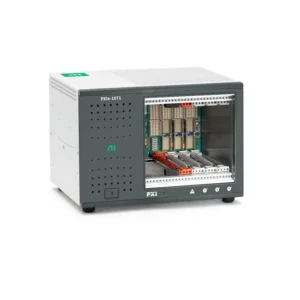
PXI Chassis and Cooling Requirements
The PXIe-5841 requires a compatible PXI Express chassis. NI recommends at least 58 W of cooling per slot for operation across the full specified temperature range.
Compatible chassis options include the PXIe-1083, PXIe-1088, PXIe-1092 and PXIe-1095. Confirm slot width, cooling and PCI Express topology for the selected configuration.
PXIe-5841 Troubleshooting
Why is the full 1 GHz bandwidth unavailable?
The maximum bandwidth depends on center frequency. Full 1 GHz instantaneous bandwidth is available above 2.2 GHz. Lower center frequencies have reduced maximum bandwidth.
Why is the RF output power lower than expected?
Check the configured frequency, power level, external attenuation, cable loss and DUT impedance. Confirm that no additional correction or protection setting is limiting the output.
Why does the analyzer report an overload?
The RF input may exceed the configured reference level or safe input range. Increase the reference level, add suitable attenuation and confirm the expected DUT power before reconnecting the signal.
Why is EVM performance worse than expected?
Perform self-calibration, verify external reference quality, reduce cable loss and mismatch, and confirm the waveform sample rate and measurement configuration. Enhanced LO configurations may improve phase-noise-sensitive measurements.
Why is frequency tuning slower than expected?
Tuning time depends on the LO mode, step size and configuration. Use an appropriate tuning mode or supported enhanced local oscillator when faster frequency switching is required.
Why is the PXIe-5841 overheating?
Confirm that the chassis provides adequate per-slot cooling, the fan setting is appropriate and empty slots use suitable filler panels. Do not block chassis air inlets or outlets.
PXIe-5841 Comparison with Other NI Vector Signal Transceivers
| Model | Frequency Range | Maximum Bandwidth | Architecture | Best Use |
|---|---|---|---|---|
| PXIe-5841 | 9 kHz to 6 GHz | 1 GHz | Zero-IF with direct low-frequency subsystem | Sub-6 GHz wideband RF test |
| PXIe-5842 | Up to 54 GHz, depending on configuration | Up to 4 GHz | Wideband RF and microwave VST | Advanced wideband and microwave testing |
| PXIe-5860 | 50 MHz to 8.5 GHz | 1 GHz | Direct RF sampling | High-density multichannel RF testing |
| PXIe-5831 | 5 GHz to 21 GHz or 44 GHz | 1 GHz | Zero-IF microwave VST | Microwave and mmWave applications |
Recommended Related Products
- NI PXIe-5842 Vector Signal Transceiver – offers higher frequency coverage and bandwidth for advanced RF and microwave applications.
- NI PXIe-5860 Vector Signal Transceiver – provides direct RF sampling and high channel density up to 8.5 GHz.
- NI PXIe-5831 Vector Signal Transceiver – supports microwave and millimeter-wave testing up to 44 GHz.
- NI PXIe-7903 High-Speed Serial Instrument – adds high-speed digital and serial connectivity for advanced RF test systems.
- NI PXIe-1092 PXI Express Chassis – provides high system bandwidth and 82 W slot cooling for demanding RF applications.
- NI PXI and PXI Express Modules – browse additional RF, digital and modular test instruments.
How to Select the Correct PXIe-5841
First select the required instrument function: analyzer only, generator only or full vector signal transceiver. Then determine whether the application requires 200 MHz or 1 GHz instantaneous bandwidth.
Choose an enhanced LO configuration when phase noise, EVM or frequency-switching speed is critical. Also confirm module width, chassis cooling, software licenses and FPGA-programming requirements.
Why Choose the NI PXIe-5841?
The PXIe-5841 combines wideband RF generation, RF analysis, real-time FPGA processing and PXI synchronization in a compact instrument. Its flexible configurations support both laboratory characterization and high-throughput wireless production testing.
Frequently Asked Questions
What is the frequency range of the PXIe-5841?
The RF input and output frequency range is 9 kHz to 6 GHz.
What is its maximum instantaneous bandwidth?
Selected configurations support up to 1 GHz, but available bandwidth depends on center frequency. Full 1 GHz bandwidth is available above 2.2 GHz.
Can the PXIe-5841 generate and analyze RF signals?
Yes, complete VST configurations include both functions. Analyzer-only and generator-only configurations are also available.
Does it include a user-programmable FPGA?
Yes. The onboard FPGA supports real-time signal processing, custom triggering, low-latency control and high-speed serial communication.
Does the PXIe-5841 support peer-to-peer streaming?
Yes. It can exchange data directly with compatible PXI instruments without routing every transfer through host memory.
Can it test 5G NR and Wi-Fi 6 devices?
Yes. Its sub-6 GHz frequency coverage and wide instantaneous bandwidth support compatible 5G NR, Wi-Fi 6 and other wireless test applications.
Does every PXIe-5841 configuration require the same number of slots?
No. Module width varies from one to three slots depending on whether the configuration includes analysis, generation and enhanced local oscillator hardware.
Is the PXIe-5841 still an active product?
Yes. NI currently lists the available PXIe-5841 configurations as active products.
Request a Quote for the NI PXIe-5841
Contact us for current availability, lead time and project pricing for the NI PXIe-5841 Vector Signal Transceiver. Please specify the required analyzer, generator or VST function, bandwidth, enhanced LO option and preferred part number.