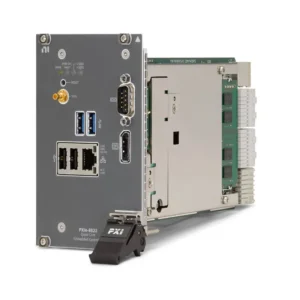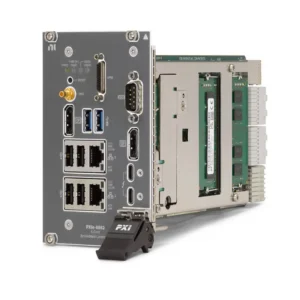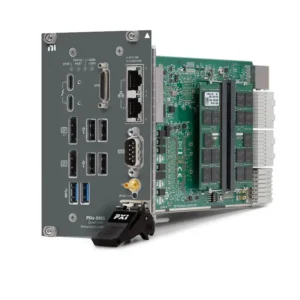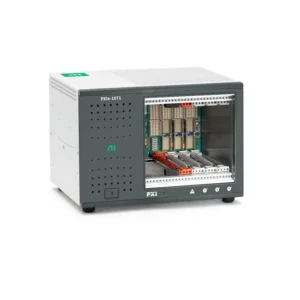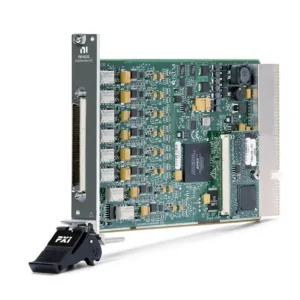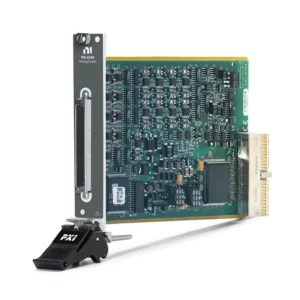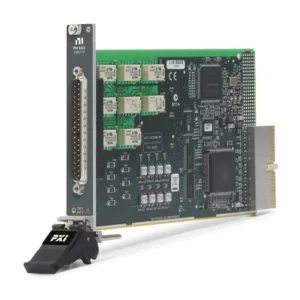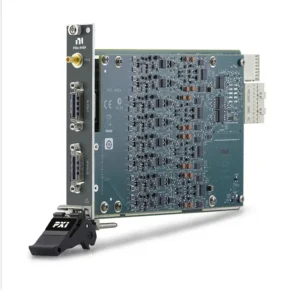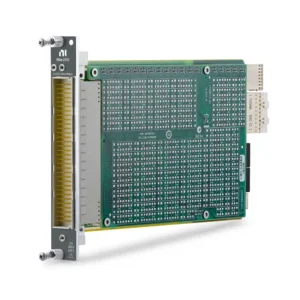




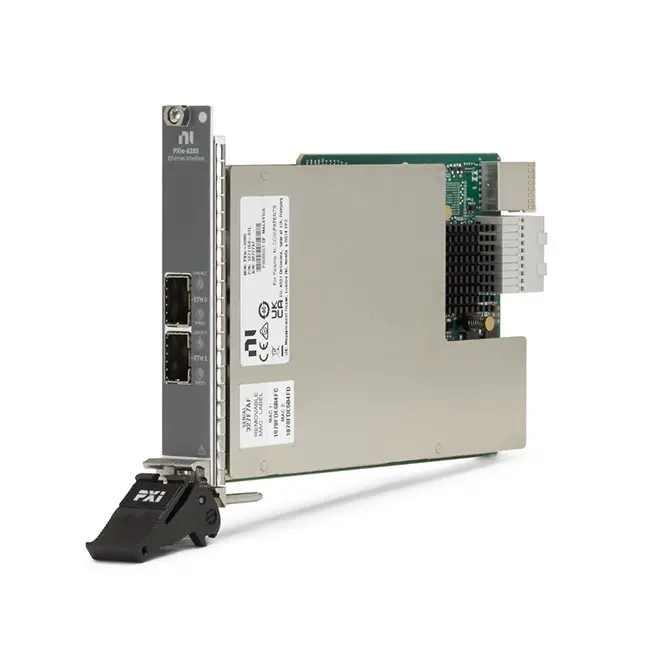
PXIe-8285 Dual-Port 25 Gigabit RDMA Ethernet Interface Module
The PXIe-8285 is a high-performance PXI Express Ethernet interface module designed for high-throughput and low-latency data transfer. It provides two 25 Gigabit Ethernet SFP28 ports in a single-slot PXI Express module and supports Remote Direct Memory Access over Converged Ethernet.
Through RoCE technology, the PXIe-8285 can transfer data between compatible system memory locations while reducing processor involvement and unnecessary data copying. This capability makes the module suitable for distributed test systems, high-speed data streaming, peer-to-peer communication and applications that transfer large volumes of measurement data between PXI systems and external computing equipment.
Key Features of the PXIe-8285
- Two independent 25 Gigabit Ethernet ports
- SFP28 front-panel interfaces
- RDMA over Converged Ethernet support
- PCI Express Gen3 x8 backplane connection
- Up to 25 Gbit/s Ethernet signaling per port
- High-throughput data streaming
- Low-latency system-to-system communication
- Reduced processor involvement during supported RDMA transfers
- Single-slot 3U PXI Express module
- Compatible with supported SFP28 optical and direct-attach links
- NI-RDMA software-driver support
- Operating temperature range of 0°C to 55°C
- Suitable for distributed PXI test and measurement systems
PXIe-8285 Technical Specifications
| Product Model | PXIe-8285 |
|---|---|
| Part Number | 788510-01 |
| Product Type | PXI Express RDMA Ethernet interface module |
| Number of Ethernet Ports | Two |
| Ethernet Bandwidth | 25 Gbit/s per port |
| Front-Panel Interface | SFP28 |
| RDMA Technology | RDMA over Converged Ethernet |
| RDMA Protocol | RoCE |
| Backplane Link | PCI Express Gen3 x8 |
| Bus Interface | PXI Express |
| Module Format | 3U, single-slot PXI Express module |
| Software Driver | NI-RDMA |
| Operating Temperature | 0°C to 55°C |
| Supported Platform | PXI |
PXIe-8285 Part Number and Connection Accessories
| Item | Part Number or Type | Description |
|---|---|---|
| PXIe-8285 | 788510-01 | Dual-port 25 Gigabit RDMA Ethernet PXI Express module |
| SFP28 Optical Transceiver | Application dependent | Provides an optical 25 Gigabit Ethernet connection over compatible fiber |
| SFP28 Direct-Attach Cable | Application dependent | Provides a short-distance copper connection between compatible SFP28 interfaces |
| SFP28 Active Optical Cable | Application dependent | Provides a factory-terminated optical connection for longer distances |
The PXIe-8285 module package does not necessarily include the SFP28 transceivers or data cables required by the final system. Select the connection accessory according to the required distance, cable medium, network topology, temperature rating and compatibility with the equipment at the opposite end of the link.
Two SFP28 ports are available, so a system using both Ethernet links may require two compatible transceiver-and-cable assemblies. Verify that all components support the intended 25 Gigabit Ethernet and RoCE configuration before ordering.
Dual-Port 25 Gigabit Ethernet Architecture
The PXIe-8285 provides two 25 Gigabit Ethernet interfaces from one PXI Express slot. The ports can connect a PXI system to compatible servers, workstations, storage systems, Ethernet switches or additional PXI systems.
Two ports give system developers flexibility when designing high-bandwidth data paths. One port can be used for the primary measurement stream while the other provides an additional data path, connects to a second destination or supports a separate network segment.
The two 25 Gigabit port ratings should not automatically be interpreted as guaranteed application throughput. Actual data-transfer performance depends on the chassis backplane, controller, processor, memory, software, packet size, network equipment, cable type and receiving device.
SFP28 Front-Panel Interfaces
Each Ethernet port uses an SFP28 interface. SFP28 is a modular connection format that supports different physical media without changing the PXIe-8285 itself.
Depending on the installation, users can select an optical transceiver and fiber cable, a passive direct-attach copper cable or an active optical cable. The selected SFP28 component must be compatible with the module, the device at the other end and the required Ethernet operating mode.
Do not assume that every SFP or SFP+ component can operate at 25 Gigabit Ethernet speed. Use SFP28 components specifically designed for the required link rate and physical connection.
What Is RDMA?
Remote Direct Memory Access is a data-transfer method that allows compatible devices to move information directly between memory locations with less processor intervention than a conventional software-managed network transfer.
Traditional network communication may require several software layers and memory-copy operations before measurement data reaches its final destination. Supported RDMA workflows can reduce these operations, improving transfer efficiency and reducing CPU overhead.
RDMA is particularly useful when a PXI system continuously produces large measurement data sets and the controller must also execute instrument control, signal processing or real-time test logic.
RDMA over Converged Ethernet
The PXIe-8285 supports RDMA over Converged Ethernet, commonly abbreviated as RoCE. RoCE carries RDMA traffic across a compatible Ethernet infrastructure while preserving the high-throughput and low-latency advantages associated with direct memory transfers.
A complete RoCE system requires compatible hardware, drivers and network configuration at both ends of the connection. If Ethernet switches are installed between the endpoints, confirm that they support the features required by the intended RoCE architecture.
The PXIe-8285 does not independently guarantee a lossless or correctly configured network. Switch settings, traffic management, flow control and endpoint configuration must be planned as part of the complete system.
PCI Express Gen3 x8 Backplane Connection
The module connects to the PXI Express chassis through a PCI Express Gen3 x8 backplane link. This high-bandwidth interface transfers Ethernet data between the PXIe-8285 and the PXI controller or other supported system resources.
For maximum performance, install the module in a chassis slot that supplies the required PCI Express link width and generation. A mechanically compatible slot with fewer PCI Express lanes may limit the available data-transfer performance or may not support the intended configuration.
Review the chassis slot diagram and controller specifications before installation. The complete data path is limited by its slowest component.
Low-Latency Data Transfer
Reduced latency is valuable when measurement data must be delivered rapidly to another processor, storage system or analysis node. The PXIe-8285 combines 25 Gigabit Ethernet connectivity with RDMA support to reduce avoidable software and memory-transfer overhead.
Actual latency depends on the complete system configuration, including endpoint hardware, operating system, driver, network topology, message size and application architecture. Validate the final configuration using a workload representative of the intended test.
High-Throughput Measurement Streaming
Digitizers, RF instruments, FPGA modules and high-speed data acquisition devices can generate large volumes of measurement data. The PXIe-8285 provides a high-speed path for transferring this data from a PXI chassis to an external processing or storage system.
Streaming applications should be designed around sustained throughput rather than only the nominal Ethernet signaling rate. Processor load, memory bandwidth, disk performance and software buffer management can all affect whether the system can maintain continuous acquisition.
Distributed PXI Systems
The PXIe-8285 can connect test resources located in separate PXI systems. A distributed architecture allows instruments to be positioned closer to the device under test while transferring measurement data to a centralized computing system.
This arrangement can be useful when one chassis cannot hold every required instrument or when test stations must share analysis and storage resources. Network addressing, timing, triggering and software coordination should be planned separately from the Ethernet data connection.
PXI-to-Server Data Transfer
A PXI chassis equipped with the PXIe-8285 can transfer measurement data to a server containing a compatible 25 Gigabit Ethernet and RDMA interface. The server can perform data analysis, database operations, visualization or long-term storage.
Moving intensive processing away from the PXI controller can preserve controller resources for instrument control and test-sequence execution. The receiving server must provide sufficient processor, memory and storage performance to consume the incoming data stream.
Peer-to-Peer System Communication
Two compatible systems can use a high-speed Ethernet link for direct data exchange. This can support test architectures in which one system acquires signals while another performs processing or control functions.
Peer-to-peer communication does not automatically provide shared timing or phase synchronization. Use appropriate PXI timing, triggering, time-synchronization or external clocking hardware when deterministic instrument alignment is required.
Direct-Attach and Switched Connections
The PXIe-8285 can be incorporated into a direct endpoint-to-endpoint connection or a switched Ethernet network. A direct SFP28 connection can simplify a two-system installation and reduce the number of network components.
A compatible Ethernet switch provides greater routing flexibility and allows multiple systems to share a network. However, the switch must support the required port speed and the networking features needed by the selected RoCE configuration.
Network Configuration Requirements
Both endpoints must use compatible IP, Ethernet and RDMA settings. Confirm the supported RoCE version, maximum transmission unit, traffic-class configuration and flow-control requirements for the complete system.
A conventional 25 Gigabit Ethernet link may establish successfully even when RDMA is not configured correctly. Verify RDMA operation separately instead of relying only on link-status indicators or a successful network ping.
NI-RDMA Software Support
The PXIe-8285 uses the NI-RDMA driver. The driver provides the software support required to configure the module and implement compatible RDMA data-transfer applications.
Install a supported NI-RDMA version on the PXI controller before developing the application. The device should then be recognized in the applicable NI configuration and software environment.
Driver support should be verified against the controller operating system, development environment and other installed NI software. For long-term test systems, document the validated driver and operating-system versions before deployment.
Integration with LabVIEW
The PXIe-8285 can be incorporated into LabVIEW-based test systems through supported NI-RDMA software interfaces. LabVIEW applications can coordinate data transfer with measurement, processing, user-interface and file-storage functions.
For continuous streaming, use suitable buffer sizes and separate the data-transfer process from slower display or file-management operations. Benchmark the complete application under full measurement load before production deployment.
Integration with FPGA-Based Instruments
PXI FPGA and FlexRIO instruments can generate or process high-bandwidth data streams. The PXIe-8285 can provide a path for transferring supported data to an external compute or storage destination.
When designing an FPGA-based system, evaluate the throughput of every stage: instrument input, FPGA processing, DMA transfer, controller memory, PXIe-8285 interface, Ethernet link and receiving endpoint.
Typical PXIe-8285 Applications
- High-speed PXI data streaming
- RDMA-based measurement transfer
- Distributed automated test systems
- PXI-to-server data transfer
- High-speed digitizer data offload
- RF measurement streaming
- FPGA-generated data transfer
- Centralized measurement-data storage
- Semiconductor test systems
- Aerospace and defense validation
- Automotive test systems
- Scientific research instrumentation
- Multichassis PXI systems
- Real-time data analysis
Semiconductor Test Systems
Semiconductor characterization and production test systems can generate large data sets from multiple instruments. The PXIe-8285 can transfer this data to an external server for analysis, result management and storage.
Low-latency data movement can also help reduce the time between acquisition and analysis. Total test throughput still depends on device handling, instrument configuration, processing time and database performance.
RF and Wireless Test
RF digitizers and vector signal transceivers can produce continuous high-rate sample streams. The PXIe-8285 provides a 25 Gigabit Ethernet path for moving supported RF data to external computing equipment.
Before implementing continuous RF streaming, calculate the data rate from the sample rate, sample width and number of channels. Allow sufficient margin for protocol overhead, processing delays and temporary variations in the data flow.
Aerospace and Defense Testing
Distributed aerospace and defense test systems may place PXI instrumentation near separate test articles while sending data to centralized analysis equipment. The dual-port architecture can support multiple network paths or separated data destinations.
The complete installation must satisfy the environmental, cybersecurity, network-isolation and system-qualification requirements of the application.
PXIe-8285 Installation Considerations
Install the module in a compatible PXI Express slot that supports the required PCI Express Gen3 x8 backplane link. Make sure the chassis provides adequate airflow and that adjacent cables do not block the module’s cooling path.
Insert SFP28 transceivers or cable assemblies only after confirming their compatibility. Keep optical connector surfaces clean and observe the minimum bend radius specified for the selected cable.
After installation, verify that the chassis controller detects the module and that the NI-RDMA driver is loaded correctly before connecting the system to a production network.
PXIe-8285 Troubleshooting
The PXIe-8285 is not detected
Confirm that the module is fully inserted into a compatible PXI Express slot. Check chassis power, controller communication and NI-RDMA installation. Restart the chassis and inspect the device configuration in the NI software environment.
The Ethernet link does not become active
Verify that both endpoints support 25 Gigabit Ethernet and that the installed SFP28 transceiver or cable assembly is compatible. Inspect the cable, connector seating and configuration of the device at the opposite end.
The module connects at an unexpected speed
Check the supported speed of the transceiver, cable and remote Ethernet port. Confirm that both endpoints are configured for the same operating mode and that the selected component is an SFP28 device rather than an incompatible lower-speed module.
RDMA does not operate
A functioning Ethernet connection does not confirm that RDMA is configured. Verify NI-RDMA software, endpoint compatibility, RoCE configuration, network-switch settings and required traffic-management features.
Data throughput is lower than expected
Check the chassis slot link width, controller memory bandwidth, CPU utilization, software-buffer sizes and receiver performance. If data is written to disk, verify that the storage system can sustain the required rate.
Data transfer stops during long tests
Monitor application buffers, memory usage, packet statistics and the receiving system. Temporary processing or storage delays can cause buffer exhaustion even when average throughput appears sufficient.
The SFP28 module becomes hot
Some high-speed optical transceivers consume significant power and generate heat. Verify the transceiver’s environmental rating, chassis airflow and surrounding temperature. Do not obstruct the PXI chassis cooling path.
The module works directly but not through a switch
Check that the Ethernet switch supports 25 Gigabit SFP28 ports and the features required by the RoCE configuration. Review VLAN, MTU, flow-control and traffic-priority settings on every connected device.
Packet loss occurs under heavy traffic
Inspect switch and endpoint counters for dropped packets or buffer congestion. Review traffic management and flow-control settings, then confirm that the receiver can process or store the sustained incoming stream.
PXIe-8285 Comparison with Other Connectivity Options
| Connection Type | Primary Characteristics | Best Suited For |
|---|---|---|
| PXIe-8285 | Two 25 Gigabit SFP28 ports with RoCE-based RDMA | High-throughput, low-latency Ethernet data transfer |
| Standard 10 Gigabit Ethernet Interface | Lower network bandwidth with widely available infrastructure | Moderate-rate data transfer and conventional networking |
| PXI Remote Control Interface | Extends the computer PCI Express bus to a PXI chassis | Controlling a PXI chassis from an external computer |
| PXI Data Storage Module | Stores measurement data locally inside or near the chassis | Local sustained recording without network transfer |
| Conventional Ethernet Adapter | Standard TCP/IP communication without an optimized RDMA workflow | Instrument control and lower-rate network communication |
PXIe-8285 vs Standard Ethernet
A standard Ethernet interface is appropriate for instrument control, file transfer and moderate-rate data communication. The PXIe-8285 is designed for applications that need 25 Gigabit Ethernet bandwidth and RoCE-based RDMA.
Select the PXIe-8285 when reducing processor overhead and moving large measurement data sets efficiently are important. A conventional interface may be more economical when the application does not require RDMA or sustained high-rate streaming.
PXIe-8285 vs PXI Remote Control
The PXIe-8285 is an Ethernet data interface and does not function as a PXI remote-control module. It transfers application data across an Ethernet network but does not make the PXI chassis appear as a directly attached PCI Express chassis to an external computer.
Choose a remote-control interface when an external computer must enumerate and control the PXI modules through an extended PCI Express connection. Choose the PXIe-8285 when the requirement is high-speed Ethernet and RDMA data transfer between independent systems.
PXIe-8285 vs Local PXI Storage
Local storage records data within the PXI system and can simplify systems that do not need immediate access from another computer. The PXIe-8285 transfers data to an external server or storage destination through Ethernet.
The appropriate architecture depends on the required recording time, data rate, storage capacity, access pattern and physical location of the analysis system. Some applications use local storage and high-speed Ethernet together.
Recommended Related Products
- PXIe-8398 PXI Express Remote Control Module
- PXIe-8301 Thunderbolt PXI Express Remote Control Module
- PXIe-8862 PXI Express Embedded Controller
- PXIe-1095 High-Bandwidth PXI Express Chassis
- PXIe-1092 PXI Express Chassis
- PXIe-7915 FlexRIO Coprocessor Module
- PXIe-7966 FlexRIO FPGA Module
- View More NI PXI and PXI Express Modules
Selecting the Right PXI Data Interface
Choose the PXIe-8285 when the application requires two 25 Gigabit Ethernet ports, SFP28 connectivity and RoCE-based RDMA. It is appropriate for moving large data sets between a PXI system and compatible servers, storage systems or other test platforms.
Before ordering, verify the chassis backplane link, controller operating system, NI-RDMA compatibility, receiving endpoint, SFP28 components and network configuration. Also calculate the required sustained throughput instead of selecting the interface only from the nominal port speed.
Why Choose the PXIe-8285?
- Provides two 25 Gigabit Ethernet ports in one PXI Express slot
- Uses flexible SFP28 front-panel interfaces
- Supports RDMA over Converged Ethernet
- Reduces processor involvement in supported data transfers
- Supports high-throughput measurement streaming
- Uses a PCI Express Gen3 x8 backplane link
- Connects PXI systems to servers and distributed test resources
- Supports NI-RDMA software
- Fits into a single 3U PXI Express slot
Frequently Asked Questions
What is the PXIe-8285?
The PXIe-8285 is a dual-port 25 Gigabit Ethernet PXI Express interface module that supports RDMA over Converged Ethernet.
What is the PXIe-8285 part number?
The standard NI part number for the PXIe-8285 is 788510-01.
How many Ethernet ports does the PXIe-8285 provide?
The module provides two 25 Gigabit Ethernet ports.
Which connector type does it use?
Both front-panel Ethernet ports use SFP28 interfaces.
Does the PXIe-8285 support RDMA?
Yes. The module supports RDMA over Converged Ethernet, commonly called RoCE.
What is the backplane connection?
The PXIe-8285 uses a PCI Express Gen3 x8 backplane link.
Does it occupy more than one PXI slot?
No. The PXIe-8285 is a single-slot 3U PXI Express module.
Are SFP28 transceivers included?
Connection components should be selected separately according to the required link. Confirm the package contents and transceiver compatibility before ordering.
Can the PXIe-8285 use an Ethernet switch?
Yes, provided the switch supports the required 25 Gigabit Ethernet ports and the features needed by the selected RoCE configuration.
Can it connect directly to a server?
Yes. It can connect to a server equipped with a compatible 25 Gigabit Ethernet and RDMA interface using a suitable SFP28 cable or transceiver system.
Is the PXIe-8285 a remote-control module?
No. It is an Ethernet data interface. It does not replace a PXI remote-control module used to extend a computer’s PCI Express bus to a chassis.
Which driver supports the PXIe-8285?
The module uses the NI-RDMA driver.
What is its operating temperature range?
The specified operating temperature range is 0°C to 55°C.
Request a Quote for the PXIe-8285
Contact us for current availability, lead time and project pricing for the PXIe-8285 Dual-Port 25 Gigabit RDMA Ethernet Interface Module. We can also help identify suitable PXI Express chassis, controllers, SFP28 connection components and related high-bandwidth PXI modules for your data-streaming system.