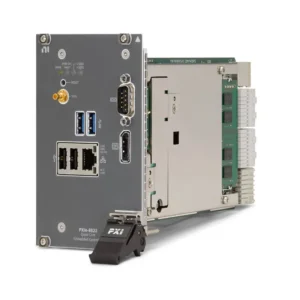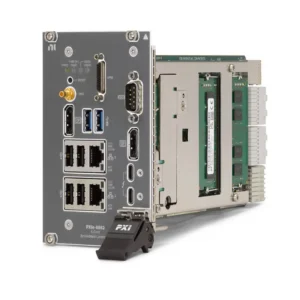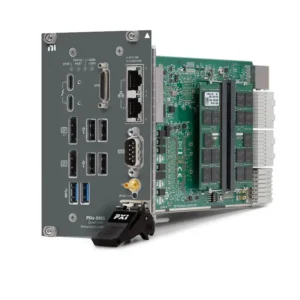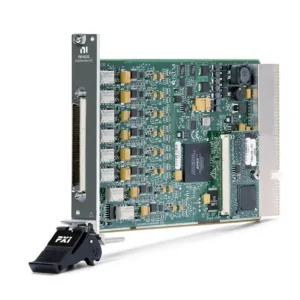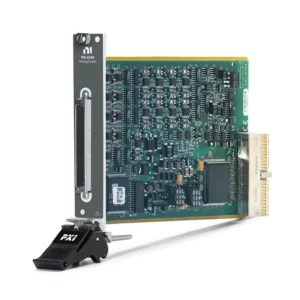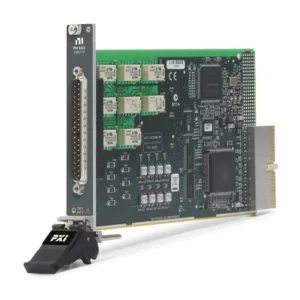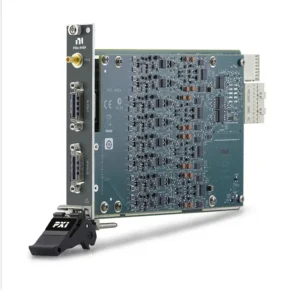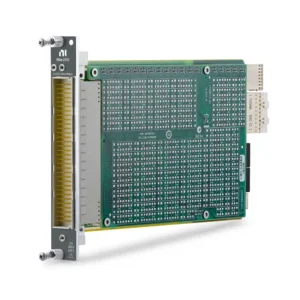





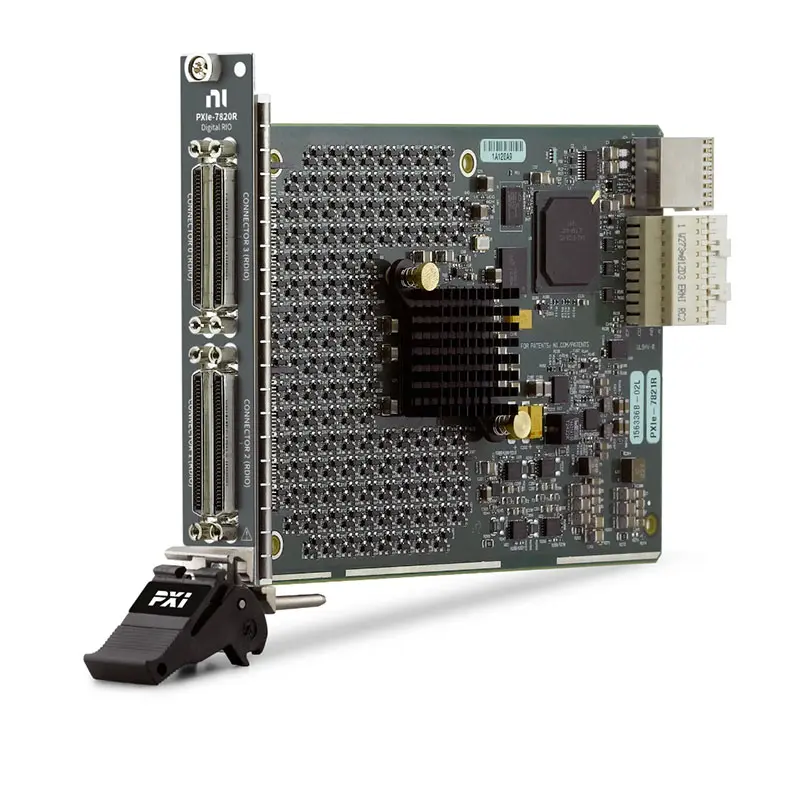
PXIe-7820 128-Channel Digital Reconfigurable I/O Module
The PXIe-7820, also documented as the PXIe-7820R, is a PXI Express digital reconfigurable I/O module featuring a user-programmable Kintex-7 160T FPGA. It provides 128 bidirectional digital channels for applications requiring custom timing, parallel processing and deterministic hardware control.
Each digital line can be configured through the LabVIEW FPGA Module as an input, output, counter, timer, PWM signal, encoder input or part of a custom communication protocol. With signal frequencies up to 80 MHz, the PXIe-7820 is suitable for high-speed waveform generation, hardware-in-the-loop testing, sensor simulation and digital interface validation.
Key Features of the PXIe-7820
- Kintex-7 160T user-programmable FPGA
- 128 bidirectional digital I/O channels
- Maximum acquisition rate of 80 MHz per channel
- Maximum generation rate of 80 MHz per channel
- Selectable 1.2 V, 1.5 V, 1.8 V, 2.5 V and 3.3 V logic levels
- Four groups of 32 digital I/O channels
- Four external clock inputs
- Four 68-pin female VHDCI connectors
- 50 Ω characteristic digital signal routing
- Single-ended digital signaling
- Peer-to-peer data streaming support
- 16 DMA channels
- Single-slot PXI Express module
PXIe-7820 Technical Specifications
| Product Model | PXIe-7820 / PXIe-7820R |
|---|---|
| Part Number | 783484-01 |
| Product Type | PXI Digital Reconfigurable I/O Module |
| FPGA | Kintex-7 160T |
| Digital I/O Channels | 128 bidirectional channels |
| Maximum Clock Rate | 80 MHz |
| Maximum Acquisition Rate | 80 MHz |
| Maximum Generation Rate | 80 MHz |
| Digital Logic Levels | 1.2 V, 1.5 V, 1.8 V, 2.5 V and 3.3 V |
| Signaling Type | Single-ended |
| Digital Signal Impedance | 50 Ω characteristic trace impedance |
| External Clock Inputs | 4 |
| Front Connectors | 4 × 68-pin female VHDCI |
| Onboard DRAM | None |
| DMA Channels | 16 |
| Peer-to-Peer Streaming | Supported |
| Bus Interface | x4 PXI Express |
| Slot Requirements | 1 PXI Express slot |
Part Number and Configuration
| Part Number | FPGA | Digital I/O | Maximum Frequency | Onboard DRAM |
|---|---|---|---|---|
| 783484-01 | Kintex-7 160T | 128 bidirectional channels | 80 MHz | None |
128 Individually Configurable Digital Channels
The PXIe-7820 provides four banks of 32 digital I/O channels. Each channel can be independently programmed as an input or output, allowing one module to support multiple digital interfaces and control functions simultaneously.
Because the channels connect directly to the onboard FPGA through protection circuitry, engineers can implement application-specific timing, triggering and decision-making without depending on nondeterministic host software loops.
Selectable Digital Logic Levels
Each 32-channel connector supports software-selectable logic levels of 1.2 V, 1.5 V, 1.8 V, 2.5 V or 3.3 V. The selected voltage applies to the channels associated with that connector.
This flexibility enables the PXIe-7820 to communicate with embedded processors, digital sensors, memory devices, custom circuit boards and other electronic equipment using different LVTTL and LVCMOS voltage standards.
80 MHz Digital Acquisition and Generation
All four digital connectors support acquisition and generation rates up to 80 MHz. The module can therefore acquire or generate synchronized digital patterns across a large number of channels while maintaining FPGA-controlled timing.
Actual signal quality depends on the cable, terminal accessory, load, wiring layout and selected logic voltage. High-speed applications should use suitable shielded cables and maintain an impedance-controlled signal path.
User-Programmable Kintex-7 FPGA
The Kintex-7 160T FPGA allows engineers to create customized hardware functions using the LabVIEW FPGA Module. Common implementations include counters, timers, quadrature encoder interfaces, PWM generation, digital filters, triggers and proprietary communication protocols.
Multiple FPGA operations can execute in parallel, providing deterministic response and low latency. This architecture is particularly useful when a conventional digital I/O module does not provide the timing precision or customization required by the application.
Custom Protocol and Digital Interface Testing
The PXIe-7820 can implement application-specific serial or parallel protocols directly in FPGA hardware. Engineers can define clocking behavior, data framing, handshaking, trigger conditions and error detection according to the device being tested.
The module does not include the fixed protocol engines found in standard interface cards. The user must develop or obtain an appropriate FPGA personality for the required protocol.
Peer-to-Peer Data Streaming
Peer-to-peer streaming enables the PXIe-7820 to transfer data directly to compatible PXI Express modules without routing every transfer through the host controller. This can reduce host CPU involvement and improve data throughput in complex measurement systems.
For example, acquired digital data can be transferred to a compatible FPGA, digitizer or processing module for real-time analysis and response generation.
Typical PXIe-7820 Applications
- Hardware-in-the-loop simulation
- High-speed digital waveform acquisition
- High-speed digital waveform generation
- Custom digital protocol implementation
- Digital interface validation
- Bit error rate testing
- Sensor and actuator simulation
- PWM generation and measurement
- Quadrature encoder simulation
- Semiconductor device testing
- Electronic control unit validation
- Automated production testing
Software Requirements
The PXIe-7820 is programmed using NI LabVIEW and the LabVIEW FPGA Module. NI-RIO drivers provide communication between the FPGA target and the host or real-time application.
NI VeriStand can also be used in supported hardware-in-the-loop and real-time test systems. Verify compatibility among the PXIe-7820, LabVIEW, LabVIEW FPGA, NI-RIO, VeriStand and the operating system before deployment.
Cables and Connection Accessories
The module has four 68-pin female VHDCI connectors. Suitable accessories may include shielded high-speed digital cables and connector blocks designed for R Series digital I/O products.
- NI SHC68-C68-RDIO2 high-speed digital cable
- NI SCB-68 HSDIO shielded connector block
- Custom interface boards with impedance-controlled routing
- Application-specific breakout and test fixtures
Cables, terminal blocks and interface accessories are normally ordered separately. Confirm connector compatibility, cable length and required shielding before purchase.
PXI Chassis and System Integration
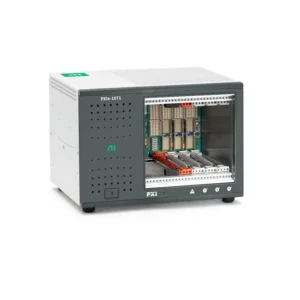
The PXIe-7820 uses an x4 PXI Express interface and can be installed in compatible x4, x8 or x16 PXI Express peripheral slots and supported hybrid slots. It requires a PXI Express chassis with sufficient power, cooling and slot availability.
Compatible chassis options include the PXIe-1092, PXIe-1085 and other supported NI PXI Express chassis. A compatible embedded controller or remote-control interface is also required.
Installation and Troubleshooting
Module Is Not Detected
Verify that the PXIe-7820 is installed in a compatible PXI Express slot. Check the chassis, controller connection and NI-RIO installation before refreshing the hardware configuration in NI Measurement & Automation Explorer.
FPGA VI Cannot Be Compiled or Downloaded
Confirm that the FPGA project targets the PXIe-7820 and that the required LabVIEW FPGA compilation tools are installed. FPGA bitfiles compiled for another R Series model may not be compatible.
Digital Input States Are Incorrect
Check the selected logic voltage, signal grounding and input thresholds. The configured connector voltage must match the logic standard used by the connected device.
High-Speed Signals Are Unstable
Use shielded high-speed digital cables and accessories with suitable impedance characteristics. Check cable length, termination, grounding, edge rate and signal routing for reflections or crosstalk.
Unexpected Output State During Startup
At power-up, digital channels default to an input-low condition with pull-down resistors. If another startup condition is required, configure the system to load an FPGA VI that applies the required digital direction and state.
PXIe-7820 Comparison with Similar Digital RIO Modules
| Model | Digital I/O | FPGA and Memory | Recommended Selection |
|---|---|---|---|
| PXIe-7820 | 128 DIO, up to 80 MHz | Kintex-7 160T, no DRAM | High-channel-count FPGA digital I/O |
| PXIe-7822 | 128 DIO, up to 80 MHz | Kintex-7 325T with onboard DRAM | Larger FPGA designs and buffered data applications |
| PCIe-7820 | 128 DIO, up to 80 MHz | Kintex-7 160T | Desktop or industrial computers with PCI Express slots |
| PXIe-7847 | 48 bidirectional DIO | Kintex-7 160T with onboard DRAM | Applications requiring analog and digital I/O |
| PXIe-7858 | 48 bidirectional DIO | Kintex-7 FPGA with onboard DRAM | Advanced multifunction FPGA measurement and control |
Recommended Related Products
- PXIe-7822 Digital RIO Module – provides a larger FPGA and onboard DRAM for more demanding digital applications
- PCIe-7820 Digital RIO Device – offers similar digital FPGA functionality for PCI Express computers
- PXIe-7847 Multifunction R Series Module – combines analog input, analog output and digital I/O
- PXIe-7858 Multifunction R Series Module – suitable for advanced FPGA-based measurement and control
- PXIe-1092 PXI Express Chassis – provides a platform for modular FPGA test systems
Additional compatible hardware is available in our NI PXI modules category.
How to Select the PXIe-7820
Choose the PXIe-7820 when an application requires a large number of digital channels, custom FPGA processing and deterministic operation at signal frequencies up to 80 MHz. It is particularly appropriate for parallel digital interfaces, HIL systems and custom protocol testing.
Before purchasing, verify the required FPGA capacity, channel count, logic voltage, data buffering requirements, external clock configuration, PXI chassis compatibility and connection accessories. If onboard DRAM or a larger FPGA is required, consider the PXIe-7822.
Why Choose the PXIe-7820?
The PXIe-7820 combines 128 high-speed digital channels with a user-programmable FPGA in a single-slot PXI Express module. It gives engineers direct control over digital timing and behavior, allowing one device to replace multiple fixed-function digital interfaces in specialized automated test systems.
Frequently Asked Questions
How many digital channels does the PXIe-7820 provide?
The PXIe-7820 provides 128 bidirectional digital I/O channels divided among four 68-pin VHDCI connectors.
What is the maximum digital frequency?
All four groups of digital channels support acquisition and generation rates up to 80 MHz when used with suitable cabling and signal routing.
Which digital logic levels are supported?
The module supports software-selectable 1.2 V, 1.5 V, 1.8 V, 2.5 V and 3.3 V logic levels. The logic level is configured by connector.
Does the PXIe-7820 include analog input or output channels?
No. The PXIe-7820 is a digital-only R Series module. Choose a multifunction model such as the PXIe-7847 when analog input and analog output channels are required.
Does the PXIe-7820 have onboard DRAM?
No. The PXIe-7820 does not include onboard DRAM. Applications requiring onboard waveform or data storage should consider the PXIe-7822.
Can each channel be configured independently?
Yes. Individual channels can be programmed as inputs or outputs and used to implement counters, timers, PWM, encoder interfaces or custom digital protocols.
What is the PXIe-7820 part number?
The standard NI part number for the PXIe-7820 is 783484-01.
Request a Quote for the PXIe-7820
Contact us for current availability, lead time and project pricing for the PXIe-7820 128-Channel Digital Reconfigurable I/O Module. We can also help identify compatible PXI chassis, controllers, cables, terminal blocks and software for your FPGA-based test system.