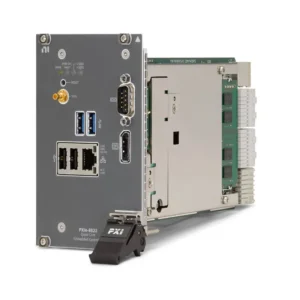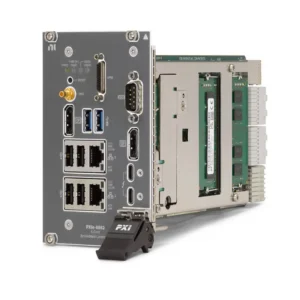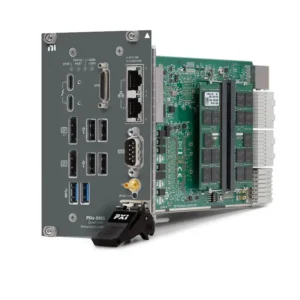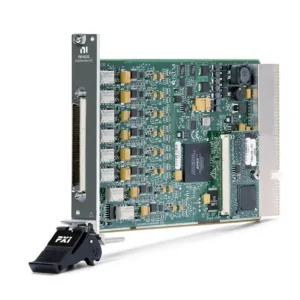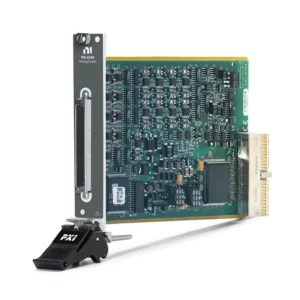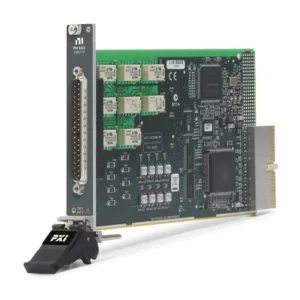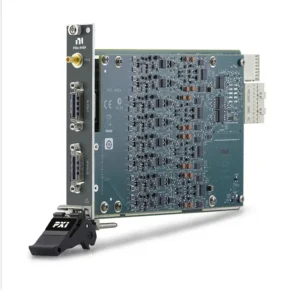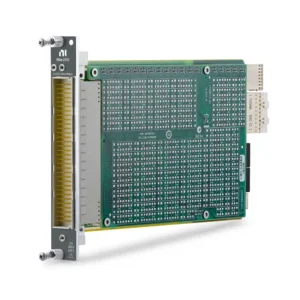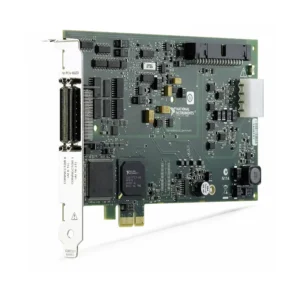




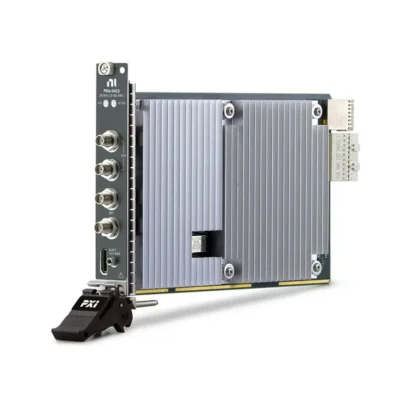

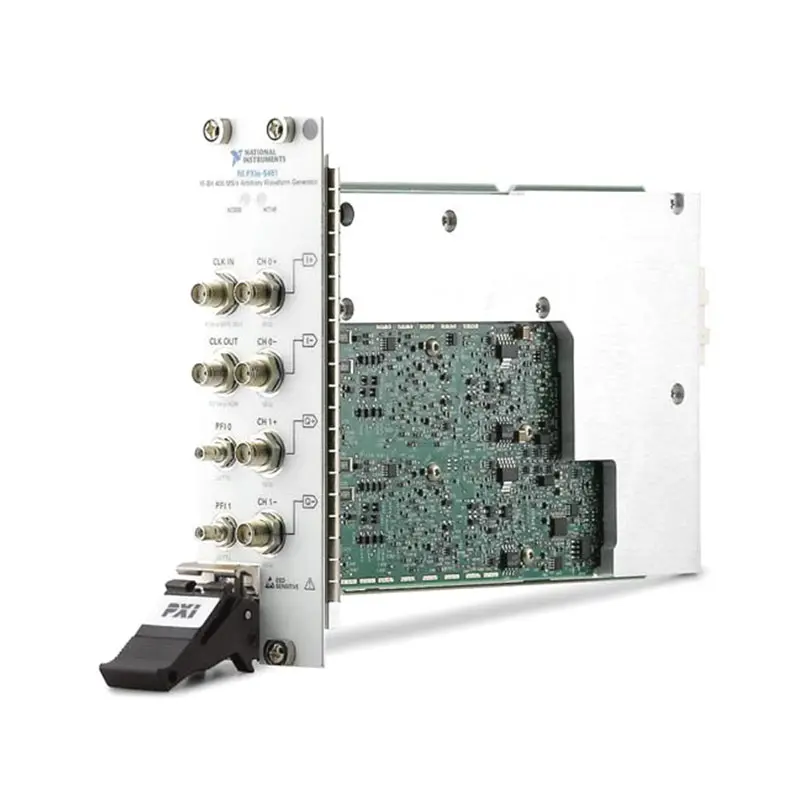
PXIe-5451 145 MHz 16-Bit Dual-Channel PXI Arbitrary Waveform Generator
The PXIe-5451 is a dual-channel, 16-bit PXI Express arbitrary waveform generator designed for high-speed time-domain, baseband I/Q, intermediate-frequency and envelope-tracking signal generation. It provides a maximum sample rate of 400 MS/s per channel and analog bandwidth up to 145 MHz.
The two synchronized output channels can generate independent waveforms or operate as an I/Q pair. Single-ended and differential output paths provide flexibility for directly stimulating amplifiers, data converters, communications devices and other electronic components.
Onboard signal processing includes interpolation filters, pulse-shaping filters, gain and offset control, and numerically controlled oscillators for frequency shifting. These resources allow the PXIe-5451 to generate wideband modulated signals while reducing the amount of waveform data transferred from the host.
Key Features of the PXIe-5451
- Two simultaneously updated analog output channels
- 400 MS/s maximum sample rate per channel
- 16-bit digital-to-analog resolution
- 145 MHz analog output bandwidth
- Single-ended and differential output configurations
- Up to 5 V peak-to-peak differential main-path output
- Up to 2.5 V peak-to-peak single-ended main-path output
- 25 ps typical channel-to-channel skew
- 128 MB, 512 MB or 2 GB onboard memory options
- Continuous host streaming above 600 MB/s under supported conditions
- Integrated digital upconversion
- 160 MHz digital upconverter bandwidth
- Numerically controlled oscillator for frequency shifting
- Interpolation and pulse-shaping filters
- Independent gain and offset control
- Waveform scripting and sequencing
- Advanced triggering and synchronization
- External reference and sample-clock inputs
- PXI Express peer-to-peer streaming support
- NI-FGEN and NI-RFSG software support
PXIe-5451 Technical Specifications
| Product Model | PXIe-5451 |
|---|---|
| Product Type | PXI Express arbitrary waveform generator |
| Number of Output Channels | 2 |
| DAC Resolution | 16 bits |
| Maximum Sample Rate | 400 MS/s per channel |
| Programmable Internal Sample Rate | Approximately 12.2 kS/s to 400 MS/s |
| Maximum Analog Bandwidth | 145 MHz per channel through the direct path |
| Main-Path Bandwidth with Filter Enabled | 135 MHz per channel |
| Main-Path Bandwidth with Filter Disabled | 180 MHz typical, including DAC sinc response |
| Complex Baseband Bandwidth | Up to 290 MHz through the differential direct path with an external I/Q modulator |
| Digital Upconverter Bandwidth | 160 MHz |
| Single-Ended Main-Path Output | Up to 2.5 V peak-to-peak |
| Differential Main-Path Output | Up to 5 V peak-to-peak differential |
| Differential Direct-Path Output | Up to 1 V peak-to-peak differential |
| Output Impedance | 50 Ω nominal per terminal |
| Channel-to-Channel Skew | 25 ps typical |
| Channel Delay Range | 0 ns to 2 ns, independently programmable |
| Channel Delay Resolution | 10 ps nominal |
| Onboard Memory Options | 128 MB, 512 MB or 2 GB |
| Host Streaming Performance | Greater than 600 MB/s under supported system conditions |
| Waveform Types | Arbitrary, sine, square, triangle, ramp, DC and communications waveforms |
| Waveform Sequencing | Scripted generation, looping, branching and triggered sequencing |
| Onboard Signal Processing | Interpolation, filtering, gain, offset and numerically controlled oscillators |
| External Sample-Clock Range | 200 MS/s to 400 MS/s |
| Clock Input Connector | SMA |
| Clock Output Connector | SMA |
| PFI Connectors | Two SMB programmable function interface connectors |
| Analog Output Connectors | Four SMA connectors for two differential output channels |
| Total Front-Panel Connectors | Six SMA and two SMB connectors |
| Bus Interface | PXI Express |
| Module Format | 3U, two-slot PXI Express module |
| Software Support | NI-FGEN, NI-RFSG, LabVIEW and compatible text-based environments |
| Lifecycle Status | Discontinued and no longer available from NI |
| Application-Dependent Replacement | PXIe-5820 or another suitable AWG/VST based on test requirements |
PXIe-5451 Part Numbers and Memory Options
| Part Number | Onboard Memory | Description |
|---|---|---|
| 781204-01 | 128 MB | PXIe-5451 dual-channel, 400 MS/s arbitrary waveform generator |
| 781204-02 | 512 MB | PXIe-5451 with expanded waveform memory |
| 781204-03 | 2 GB | PXIe-5451 with maximum available onboard waveform memory |
All three part numbers provide the same primary channel count, sample rate, resolution, bandwidth and signal-processing architecture. The principal difference is the amount of onboard memory available for storing waveform data.
Dual-Channel Arbitrary Waveform Generation
The PXIe-5451 provides two 16-bit channels that can update simultaneously at rates up to 400 MS/s. The channels can produce independent test signals, synchronized multi-channel waveforms or the in-phase and quadrature components of a communications signal.
Dual-channel operation is useful when a DUT requires two related signals with a controlled phase relationship. Examples include differential devices, I/Q modulators, stereo or dual-channel analog circuits and power amplifiers using a separate envelope-control input.
400 MS/s Sample Rate
A sample rate of 400 MS/s provides a 2.5 ns sample interval. This supports detailed time-domain waveform generation and wideband baseband or intermediate-frequency signals.
The programmable internal sample rate extends from approximately 12.2 kS/s to 400 MS/s. Engineers can select a rate appropriate for the waveform bandwidth, record duration and memory requirements.
When reproducing square waves, pulses or other signals with fast transitions, choose a sample rate and waveform length that provide a suitable number of samples for each feature.
16-Bit DAC Resolution
The 16-bit DAC architecture provides fine control over waveform amplitude. This is valuable when generating low-level modulation, multi-tone signals or waveforms with a large dynamic range.
DAC resolution is only one component of signal quality. Output noise, distortion, sample-clock jitter, analog filtering and the selected output path also affect the waveform measured at the DUT.
145 MHz Analog Bandwidth
The direct analog output path provides bandwidth up to 145 MHz per I or Q channel. When the outputs are used with an external I/Q modulator, they can support complex baseband bandwidth up to approximately 290 MHz.
The main output path provides additional gain and filtering options. With the image-suppression filter enabled, its bandwidth is approximately 135 MHz per channel. The best path depends on the required amplitude, flatness, noise and bandwidth.
Single-Ended and Differential Outputs
Each channel provides positive and negative output terminals. The main path can be used in single-ended or differential configurations, while the direct path is intended for differential operation.
The main path provides up to 2.5 V peak-to-peak single-ended or 5 V peak-to-peak differential output. The direct path provides up to 1 V peak-to-peak differential output with wider bandwidth and strong spectral performance.
When using a differential connection, both output terminals must see matched impedances. Mismatched termination can affect amplitude balance, common-mode behavior and spectral performance.
50 Ω Output Architecture
The analog output terminals use nominal 50 Ω source impedance. Use suitable 50 Ω SMA cables, terminations, attenuators and fixtures to maintain signal integrity.
Connecting a high-impedance load without accounting for source termination can change the measured amplitude. The complete signal path should be verified with an oscilloscope or spectrum analyzer before connecting a sensitive DUT.
Onboard Signal Processing
The PXIe-5451 includes onboard signal-processing resources that can transform waveform data before it reaches the DAC. These functions include interpolation, filtering, gain adjustment, offset control and frequency translation.
Onboard processing can reduce the amount of waveform data stored in memory or transferred from the host. A lower-rate baseband waveform can be interpolated and shifted to the required output frequency directly on the module.
Digital Upconversion
The integrated digital upconverter provides up to 160 MHz of processing bandwidth. A numerically controlled oscillator can translate complex baseband waveform data to another output frequency without requiring the host to calculate every final output sample.
Digital upconversion is useful for generating wideband communications and intermediate-frequency signals. Frequency translation, interpolation and filtering can be configured through supported NI signal-generation software.
Numerically Controlled Oscillators
Numerically controlled oscillators provide precise digital frequency shifting. Frequency changes can be made without reloading an entirely new waveform record.
This capability supports carrier-frequency adjustment, frequency hopping, multi-band testing and automated frequency sweeps. The available configuration depends on the selected generation mode and software API.
Pulse-Shaping and Interpolation Filters
Onboard interpolation filters increase the effective output sample rate while controlling unwanted spectral images. Pulse-shaping filters can be used to generate communications signals with defined bandwidth and symbol characteristics.
Filter selection should match the waveform sample rate, desired occupied bandwidth and output-frequency plan. Incorrect interpolation settings can place spectral images inside the measurement band.
I/Q Signal Generation
The two synchronized channels can operate as in-phase and quadrature outputs for an external I/Q modulator. Accurate channel matching and low skew help maintain modulation quality.
The PXIe-5451 can serve as the baseband waveform-generation component of an RF vector signal generator. It was also used in NI multi-module vector signal generation systems with an I/Q modulator and local oscillator.
Communications Signal Testing
Engineers can use the PXIe-5451 to generate custom digitally modulated signals for receiver, transmitter and component testing. Applications include QAM, PSK, multicarrier and other user-defined modulation formats.
Waveforms can be created in compatible design software, downloaded to onboard memory and generated repeatedly or through scripted test sequences.
Envelope-Tracking Signal Generation
The synchronized dual-channel architecture is suitable for envelope-tracking power-amplifier research. One channel can provide a modulated RF or IF-related stimulus while the other generates a synchronized envelope-control waveform.
Channel delay can be adjusted independently from 0 ns to 2 ns with nominal 10 ps resolution. This allows the alignment between related signals to be optimized during amplifier characterization.
25 ps Channel-to-Channel Skew
The PXIe-5451 provides typical channel-to-channel skew of 25 ps. Low skew is important for I/Q signal generation and differential stimulus because timing mismatch can introduce phase error.
The final timing relationship also depends on cable length, connector delay, fixture layout and the receiving device. Use matched cables and characterize the full signal path when precise phase alignment is required.
Independent Channel Delay
Each channel supports programmable sample-clock delay from 0 ns to 2 ns with nominal 10 ps resolution. Channel delay can compensate for unequal cable lengths, fixture delays and DUT timing requirements.
Delay adjustment should be validated at the actual output frequency because a fixed time difference corresponds to a larger phase shift as frequency increases.
128 MB, 512 MB and 2 GB Memory Options
The PXIe-5451 was produced with 128 MB, 512 MB and 2 GB onboard memory configurations. Greater memory capacity supports longer nonrepeating waveforms, additional waveform records and more complex scripted sequences.
The required memory depends on the number of active channels, sample format, sample rate and waveform duration. At 400 MS/s, long dual-channel records consume memory rapidly, making the 2 GB version preferable for extended nonrepeating generation.
Waveform Scripting and Sequencing
Waveform scripting allows stored records to be repeated, sequenced, triggered and conditionally selected without transferring a new waveform for every test state.
A script can generate a preamble, repeat a steady-state waveform, wait for a trigger and then produce a defined transient. This helps create realistic protocol, burst and device-startup test conditions.
Continuous Data Streaming
The PXI Express interface supports continuous waveform streaming from host memory at rates above 600 MB/s under appropriate controller, chassis and software conditions.
Streaming is useful when a waveform is too long for onboard memory or changes continuously. Sustained performance depends on the PXI Express link, controller memory, transfer-block size and other activity in the chassis.
Peer-to-Peer Data Streaming
PXI Express peer-to-peer streaming can transfer data directly between compatible instruments without routing every block through host application memory. This enables systems in which a digitizer, FPGA or processor provides waveform data to the PXIe-5451.
Peer-to-peer compatibility must be confirmed for every participating module, chassis and driver version. Data format and buffering must also match the generator’s required input stream.
Advanced Synchronization
The PXIe-5451 supports external sample clocks, reference clocks, PXI Express backplane timing and programmable trigger routing. Multiple modules can be synchronized for phase-coherent or multi-channel generation.
An external sample clock between 200 MS/s and 400 MS/s can be applied through the front-panel clock input. Reference and sample clocks can also be exported for use by other instruments.
External Clock Input and Output
The front panel includes SMA connectors for clock input and clock output. The clock input can accept an external reference or sample clock, while the clock output can distribute supported internal clock signals.
Use a low-jitter source and properly terminated 50 Ω cables. Sample-clock quality directly affects phase noise and timing jitter in the generated waveform.
PFI Trigger Connections
Two programmable function interface connectors provide external trigger and event routing. They can initiate generation, advance a sequence or export timing signals to other equipment.
The PXI Express backplane can also carry triggers without requiring additional front-panel cables. Trigger routing should be planned to prevent multiple instruments from driving the same line incompatibly.
Semiconductor Testing
The PXIe-5451 can generate synchronized arbitrary signals for testing data converters, amplifiers, mixers and other semiconductor devices. Its 16-bit resolution and differential outputs support both time-domain and frequency-domain characterization.
When the DUT requires voltage, current or protection beyond the module’s output capability, suitable external amplification, attenuation or interface circuitry should be used.
Radar and Aerospace Signal Generation
Waveform scripting, wide bandwidth and long-memory options allow the PXIe-5451 to generate pulses, chirps and other complex test signals used in radar and aerospace validation.
Multiple generators can be synchronized when the system requires additional channels. Final timing, phase and amplitude relationships should be calibrated through the complete cable and fixture path.
NI-FGEN Software Support
The PXIe-5451 can be controlled with the NI-FGEN instrument driver for arbitrary waveform, standard function, scripted generation, triggering and synchronization applications.
NI-FGEN supports LabVIEW and compatible text-based programming environments. The module uses upgradeable firmware, and an appropriate firmware version may be required for compatibility with the installed driver.
NI-RFSG Integration
NI-RFSG can control the PXIe-5451 in supported RF and I/Q signal-generation systems. This software provides signal-generation functions oriented toward modulated communications and RF test applications.
The PXIe-5451 is also listed in supported RFIC test configurations. Verify compatibility among RFIC Test Software, NI-RFSG, the operating system and all other system modules before deployment.
Typical PXIe-5451 Applications
- Wideband arbitrary waveform generation
- Baseband I/Q signal generation
- Intermediate-frequency signal generation
- RF vector signal generator baseband operation
- Envelope-tracking power-amplifier testing
- QAM and PSK communications testing
- Semiconductor characterization
- Data-converter testing
- Radar pulse and chirp generation
- Aerospace and defense system validation
- Mixed-signal automated testing
- High-speed research and prototyping
PXIe-5451 Troubleshooting
The PXIe-5451 Is Not Detected
Confirm that the module is fully installed in two compatible adjacent PXI Express slots. Check chassis power, controller communication and NI-FGEN installation, then inspect the device in NI Measurement & Automation Explorer.
The Module Reports a Firmware Error
Verify that the installed firmware is compatible with the NI-FGEN version. Run the appropriate firmware updater, then completely power down and restart the PXI Express chassis as instructed.
There Is No Analog Output
Confirm that generation has been initiated and that the module is not waiting for a trigger. Check whether the correct positive, negative or differential output terminals are connected and whether the selected output path is enabled.
The Differential Output Is Incorrect
Verify that both terminals are connected to equal 50 Ω loads. Unequal cable lengths or termination impedances can create amplitude imbalance and phase error.
The Output Amplitude Is Lower Than Expected
Check whether the selected gain range, output path and terminal configuration support the requested amplitude. Verify that the receiving instrument is terminated correctly and that external attenuation has been included in the level calculation.
The I/Q Signal Has Excessive EVM
Check channel gain balance, channel delay, cable matching, sample-clock quality and I/Q modulator calibration. Enable the appropriate flatness correction and confirm that the waveform is not clipping.
A High-Frequency Waveform Is Distorted
Use high-quality 50 Ω SMA cables and inspect the signal at the DUT. Confirm that the waveform sample rate, output path, reconstruction filter and interpolation settings are suitable for the requested frequency.
Streaming Underflow Occurs
Increase the host transfer-block size, allocate larger buffers and reduce competing PXI Express traffic. Use onboard memory or interpolation to reduce the sustained data rate when possible.
The Channels Are Not Phase Aligned
Use matched cables and verify that both channels share the same sample clock. Adjust the independent channel-delay setting to compensate for residual fixture and cable skew.
The Module Overheats
Set the PXI Express chassis fan speed to the required setting, clean the fan filters and install filler panels in unused slots. Ensure that adjacent modules do not obstruct airflow.
PXIe-5451 Comparison with Similar PXI Waveform Generators
| Model | Primary Configuration | Best Suited For |
|---|---|---|
| PXIe-5442 | One channel, 100 MS/s, 16-bit, 43 MHz | Precision single-channel arbitrary waveform generation |
| PXIe-5450 | Two channels, 400 MS/s, 16-bit, high-speed I/Q generation | Dual-channel baseband generation with lower output level |
| PXIe-5451 | Two channels, 400 MS/s, 16-bit, 145 MHz, digital upconversion | Wideband I/Q, IF and envelope-tracking signals |
| PXIe-5433 | Up to two channels, 800 MS/s, 16-bit, 80 MHz | Modern high-voltage arbitrary waveform generation |
| PXIe-5820 | Baseband I/Q vector signal transceiver architecture | Application-dependent migration from legacy I/Q systems |
| PXIe-5745 | Two channels, 6.4 GS/s, 12-bit FlexRIO signal generator | Very-high-speed FPGA-based signal generation |
PXIe-5451 vs PXIe-5450
Both modules provide two 16-bit channels and a maximum sample rate of 400 MS/s. The PXIe-5450 supports high-speed arbitrary waveform and I/Q generation, while the PXIe-5451 adds a more capable output architecture and integrated digital upconversion.
Select the PXIe-5451 when the application requires I/Q frequency translation, increased output range or envelope-tracking operation. Confirm the exact signal-processing requirements before substituting one model for the other.
PXIe-5451 vs PXIe-5433
The PXIe-5433 provides an 800 MS/s sample rate, 16-bit resolution, up to two output channels and a wider voltage range. Its maximum analog bandwidth is 80 MHz.
Choose the PXIe-5451 when 145 MHz bandwidth, differential I/Q outputs and integrated digital upconversion are essential. Choose the PXIe-5433 when higher sample rate, modern software support and higher output voltage are more important.
PXIe-5451 vs PXIe-5442
The PXIe-5442 is a single-channel 100 MS/s arbitrary waveform generator with approximately 43 MHz bandwidth. It is suitable for lower-bandwidth precision waveform generation.
The PXIe-5451 provides two channels, four times the sample rate and significantly greater analog bandwidth, making it more appropriate for high-speed I/Q and communications signals.
PXIe-5451 vs PXIe-5820
NI identifies the PXIe-5820 as an application-dependent migration option for systems using the discontinued PXIe-5451. The PXIe-5820 uses a different baseband I/Q vector signal transceiver architecture.
Migration is not a direct drop-in replacement. Compare output levels, bandwidth, channel configuration, triggering, software APIs, chassis requirements and the surrounding RF signal chain before changing hardware.
PXIe-5451 vs PXIe-5745
The PXIe-5745 is a two-channel, 6.4 GS/s FlexRIO signal generator with a user-programmable FPGA. It provides substantially higher sample rate and analog bandwidth but uses a 12-bit DAC architecture.
Choose the PXIe-5451 for legacy 16-bit I/Q and IF applications. Choose the PXIe-5745 when very-high-speed generation and FPGA-defined real-time processing are required.
Recommended Related Products
- PXIe-5450 Dual-Channel High-Speed Arbitrary Waveform Generator
- PXIe-5442 16-Bit Arbitrary Waveform Generator
- PXIe-5433 800 MS/s Arbitrary Waveform Generator
- PXIe-5820 Baseband I/Q Vector Signal Transceiver
- PXIe-5745 6.4 GS/s FlexRIO Signal Generator
- PXIe-5162 High-Speed Oscilloscope
- View More NI PXI and PXI Express Modules
Selecting the Right PXI Waveform Generator
Choose the PXIe-5451 when maintaining a system that requires two synchronized 16-bit outputs, 400 MS/s generation, bandwidth up to 145 MHz and onboard digital upconversion. It is particularly well suited to I/Q, intermediate-frequency and envelope-tracking applications.
For new general-purpose waveform-generation systems, consider the PXIe-5433. For modern baseband I/Q applications, evaluate the PXIe-5820. Applications requiring much higher sample rates and FPGA processing may be better served by the PXIe-5745.
Why Choose the PXIe-5451?
- Provides two synchronized 16-bit output channels
- Generates arbitrary waveforms at up to 400 MS/s
- Offers analog bandwidth up to 145 MHz
- Supports single-ended and differential signals
- Provides integrated digital upconversion
- Supports pulse shaping and interpolation
- Offers low channel-to-channel skew
- Includes independently adjustable channel delay
- Provides memory options up to 2 GB
- Supports host and peer-to-peer streaming
- Integrates with NI-FGEN and NI-RFSG
Frequently Asked Questions
What Is the PXIe-5451?
The PXIe-5451 is a dual-channel, 400 MS/s, 16-bit PXI Express arbitrary waveform generator with analog bandwidth up to 145 MHz and onboard digital upconversion.
What Part Numbers Are Available?
Part number 781204-01 includes 128 MB of memory, 781204-02 includes 512 MB and 781204-03 includes 2 GB.
How Many Output Channels Does It Provide?
The PXIe-5451 provides two simultaneously updated analog output channels that can operate independently, differentially or as an I/Q pair.
What Is the Maximum Sample Rate?
The maximum sample rate is 400 MS/s per channel, corresponding to a 2.5 ns sample interval.
What Is the Maximum Analog Bandwidth?
The differential direct path provides analog bandwidth up to 145 MHz per channel. Other output-path bandwidths depend on the selected filter and configuration.
Does the PXIe-5451 Support I/Q Signals?
Yes. The synchronized channels can generate in-phase and quadrature signals for external I/Q modulators and communications-device testing.
Does It Support Digital Upconversion?
Yes. Onboard processing includes a numerically controlled oscillator, interpolation filters and digital upconversion with up to 160 MHz of processing bandwidth.
What Is the Maximum Differential Output?
The main output path supports up to 5 V peak-to-peak differential. The direct path supports up to 1 V peak-to-peak differential.
Can It Stream Waveforms from the Host?
Yes. The PXI Express interface supports continuous host streaming above 600 MB/s under suitable controller, chassis and software conditions.
Which Software Controls the PXIe-5451?
The module supports NI-FGEN for general waveform generation and NI-RFSG for compatible communications and RF signal-generation configurations.
Is the PXIe-5451 Still Manufactured?
No. The PXIe-5451 has been discontinued and is no longer available for purchase directly from NI. Surplus and refurbished units may still be available.
What Is the Recommended Replacement?
NI identifies the PXIe-5820 as an application-dependent migration option. The PXIe-5433 or PXIe-5745 may also be considered depending on the required bandwidth, voltage, sample rate and FPGA capabilities.
Request a Quote for the PXIe-5451
Contact us for current availability, memory configuration, condition, lead time and project pricing for the PXIe-5451 145 MHz Dual-Channel Arbitrary Waveform Generator. We can also help identify compatible PXI Express chassis, SMA cables, digitizers and migration options for discontinued I/Q signal-generation systems.