



Product Introduction
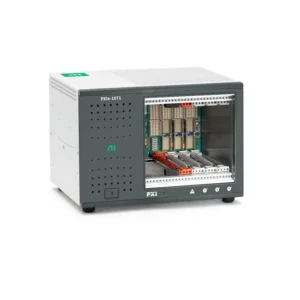
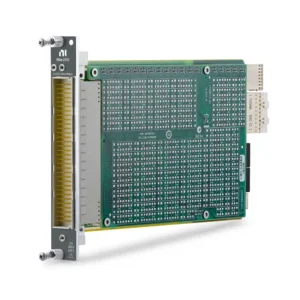
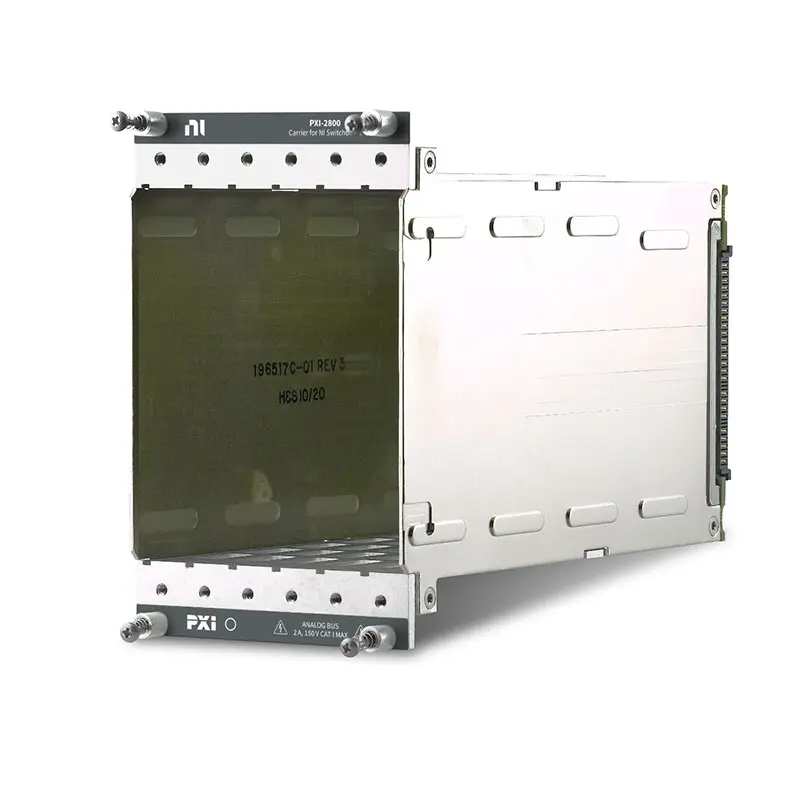
The NI PXI-2800 is a 4-slot PXI carrier module designed for the NI SwitchBlock platform. It provides a scalable architecture for building high-density switching systems used in automated test, semiconductor test, electronic validation, production test, and other applications requiring large programmable switch matrices.
The PXI-2800 occupies four PXI slots and can accommodate up to six NI SwitchBlock relay cards. By connecting multiple SwitchBlock cards through the carrier’s integrated analog bus, engineers can create large and flexible switching matrices while maintaining a compact PXI system footprint.
A single PXI-2800 can support switch configurations with more than 2,000 crosspoints within four PXI slots. Multiple SwitchBlock carriers can be used to build systems with more than 8,000 crosspoints in a single PXI chassis, making the platform particularly suitable for high-channel-count automated test systems.
Product Overview
The National Instruments PXI-2800 serves as the hardware carrier and interconnection platform for compatible NI SwitchBlock relay cards.
Unlike a conventional PXI switch module with a fixed relay topology, the PXI-2800 allows engineers to install different compatible SwitchBlock cards according to the required matrix architecture, signal characteristics, channel count, and switching performance.
- 4-slot PXI carrier module
- Designed for NI SwitchBlock
- Supports up to six SwitchBlock relay cards
- Integrated analog bus
- Supports large configurable switch matrices
- More than 2,000 crosspoints possible in four PXI slots
- More than 8,000 crosspoints possible in a single PXI chassis
- 150 V CAT I carrier analog-bus rating
- Software-controlled switching architecture
- Designed for high-density automated test systems
Key Features
4-Slot PXI Carrier Module
The PXI-2800 occupies four PXI slots within a compatible PXI chassis.
These four slots provide the physical carrier architecture required to install and operate multiple SwitchBlock relay cards as one integrated switching system.
This architecture provides significantly greater switching density than many conventional individual PXI switch modules.
Supports Up to Six SwitchBlock Relay Cards
A single PXI-2800 carrier can accommodate up to six compatible NI SwitchBlock relay cards.
This allows engineers to select relay cards according to the specific requirements of the test system rather than being limited to one fixed switching configuration.
Depending on the selected SwitchBlock cards, systems can be optimized for:
- High-density matrix switching
- Multiplexer applications
- Automated signal routing
- High-channel-count testing
- Functional test
- Semiconductor test
Integrated Analog Bus
A major feature of the PXI-2800 is its integrated analog bus.
The analog bus allows compatible SwitchBlock cards installed in the carrier to be interconnected, enabling multiple relay cards to operate as part of a larger switching matrix.
A simplified architecture can be represented as:
SwitchBlock Card → Integrated Analog Bus → SwitchBlock Card → DUT / Measurement Instrument
This interconnection capability is fundamental to building large-scale switch matrices using the PXI-2800.
More Than 2,000 Crosspoints in Four PXI Slots
By combining multiple compatible SwitchBlock relay cards through the integrated analog bus, the PXI-2800 can support switching matrices with more than 2,000 crosspoints while occupying only four PXI slots.
This high crosspoint density makes the platform particularly attractive for automated test applications where chassis space is limited.
More Than 8,000 Crosspoints in One PXI Chassis
For applications requiring even larger switching architectures, multiple PXI-2800 carriers can be integrated within a compatible PXI chassis.
NI specifies that SwitchBlock architectures can scale to more than 8,000 crosspoints in a single PXI chassis.
This scalability makes SwitchBlock suitable for complex test systems containing hundreds or thousands of programmable signal paths.
Scalable Matrix Switching
The PXI-2800 is particularly useful for applications where switching requirements may increase as a test system evolves.
Instead of replacing the complete switching architecture, engineers can configure compatible SwitchBlock cards according to the required topology and channel count.
This modular approach provides flexibility for:
- Initial system development
- Channel-count expansion
- New DUT configurations
- Production test expansion
- Multi-product test platforms
150 V CAT I Analog Bus Rating
The PXI-2800 analog bus supports signals up to 150 V CAT I, subject to the electrical limits of the carrier and the installed SwitchBlock cards.
The carrier is intended for Measurement Category I signal applications and should not be connected directly to mains distribution circuits.
The electrical limits of the complete switching system are determined not only by the PXI-2800 carrier but also by the specifications of the installed SwitchBlock relay cards and system wiring.
Up to 2 A Carrier Current Capability
The PXI-2800 carrier architecture supports up to 2 A according to the applicable carrier specifications.
However, the actual switching and carry-current capability of a completed SwitchBlock system depends on the specific relay card being used.
For example, different SwitchBlock cards can have different maximum voltage, current, bandwidth, relay type, and switching-power specifications.
Software-Controlled Switching
The PXI-2800 and compatible SwitchBlock cards can be controlled programmatically as part of an automated test system.
Test software can configure signal paths, establish matrix routes, change DUT connections, and coordinate switching operations with measurement instruments.
This enables complex routing operations to be performed automatically without manual cable changes.
Technical Specifications
| Parameter | Description |
|---|---|
| Product Type | PXI Carrier Module for NI SwitchBlock |
| Model | NI PXI-2800 |
| Part Number | 781420-00 |
| Platform | PXI |
| PXI Slots Occupied | 4 |
| SwitchBlock Card Capacity | Up to 6 Relay Cards |
| Internal Interconnection | Integrated Analog Bus |
| Matrix Density | More Than 2,000 Crosspoints in 4 PXI Slots |
| System Scalability | More Than 8,000 Crosspoints in a Single PXI Chassis |
| Maximum Analog Bus Voltage | 150 V CAT I |
| Maximum Carrier Current | Up to 2 A |
| Switching Technology | Depends on Installed SwitchBlock Relay Cards |
| Software Driver | NI-SWITCH |
| Primary Applications | Large Matrix Switching, Automated Test, Semiconductor Test and High-Channel-Count Signal Routing |
What Is NI SwitchBlock?
NI SwitchBlock is a modular switching architecture designed to provide very high switching density within PXI automated test systems.
The architecture separates the carrier from the individual switching cards:
PXI Chassis → PXI-2800 Carrier → SwitchBlock Relay Cards → DUT / Instruments
The PXI-2800 provides the carrier infrastructure, while the installed SwitchBlock cards provide the actual relay switching functionality.
This architecture allows engineers to configure the switching system according to application-specific requirements.
PXI-2800 Is a Carrier, Not a Standalone Relay Card
An important consideration when purchasing the PXI-2800 is that it is a SwitchBlock carrier module, not a complete standalone relay matrix by itself.
Compatible SwitchBlock relay cards must be installed in the PXI-2800 to provide the required switching functionality.
Therefore, a complete system generally requires:
- PXI-2800 carrier
- Compatible SwitchBlock relay cards
- Appropriate cables and connectors
- PXI chassis
- PXI controller
- NI-SWITCH software
- Measurement or stimulus instruments
SwitchBlock Relay Card Selection
The actual switching specifications of a PXI-2800 system depend heavily on the SwitchBlock cards installed in the carrier.
Different cards can provide different:
- Matrix topologies
- Channel counts
- Maximum voltages
- Maximum currents
- Relay technologies
- Bandwidths
- Switching speeds
- Contact resistance characteristics
For this reason, the PXI-2800 carrier and SwitchBlock cards should always be selected as a complete switching architecture rather than evaluating only the carrier specifications.
Large Matrix Switching
Matrix switching is one of the primary applications for the PXI-2800.
A matrix switch allows multiple DUT signals and instruments to be dynamically interconnected through programmable crosspoints.
A simplified matrix architecture can be represented as:
DUT Signals → SwitchBlock Matrix → DMM / SMU / DAQ / Other Instruments
Test software determines which crosspoints are closed to establish the required signal route.
What Is a Crosspoint?
A crosspoint is a programmable switching connection between two signal paths within a matrix.
For example, a matrix containing multiple rows and columns can selectively connect specific rows to specific columns.
As matrix dimensions increase, the number of possible crosspoints can become very large.
The ability of the PXI-2800 architecture to support thousands of crosspoints is therefore important for complex automated test systems.
High-Channel-Count Automated Testing
Large electronic systems may contain hundreds or thousands of test points.
Using a dedicated measurement instrument for every test point would dramatically increase system cost, size, and complexity.
The PXI-2800 SwitchBlock architecture allows a smaller number of measurement instruments to be shared across many DUT signals.
For example:
Hundreds of DUT Test Points → PXI-2800 SwitchBlock → Precision Instruments → Automated Test Software
The switching matrix automatically routes each required signal to the appropriate instrument during the test sequence.
Semiconductor Test Applications
Semiconductor characterization and production test systems can require very large numbers of programmable signal connections.
The high crosspoint density of the PXI-2800 makes it suitable for compatible semiconductor test architectures requiring flexible routing between DUT pins and measurement instruments.
Potential applications include:
- Device characterization
- Pin routing
- Parametric testing
- Functional testing
- Multi-site test architectures
- Automated production testing
Electronic Functional Testing
Complex electronic assemblies often require different DUT nodes to be connected to different instruments throughout a functional test sequence.
A SwitchBlock system can automatically reconfigure these signal paths.
Typical connected instruments may include:
- Digital multimeters
- Source measurement units
- Data acquisition devices
- Oscilloscopes and digitizers
- Power supplies
- Signal generators
- Other switching modules
Production Test Systems
Production environments often require switching systems that can support multiple DUT types and large numbers of test points.
The modular architecture of the PXI-2800 allows switching configurations to be designed around the requirements of a production test fixture.
Typical applications include:
- PCB functional testing
- Electronic assembly testing
- End-of-line testing
- Automated continuity testing
- Multi-point electrical measurements
- Manufacturing validation
- Automated pass/fail testing
PXI-2800 with Digital Multimeters
The PXI-2800 SwitchBlock architecture can be used to route large numbers of compatible signals to a smaller number of precision digital multimeters.
A typical architecture is:
DUT Test Points → SwitchBlock Matrix → PXI DMM → Test Software
The matrix selects the required signal path before each measurement, allowing the DMM to be shared across many DUT test points.
PXI-2800 with Source Measurement Units
SwitchBlock can also be used in compatible systems where multiple DUT points must share source measurement units.
A programmable matrix can connect the required DUT node to the appropriate SMU during different stages of a test sequence.
This architecture can be particularly useful in semiconductor characterization and electronic component testing.
Integrated Analog Bus Architecture
The integrated analog bus is one of the defining characteristics of the PXI-2800.
It provides internal signal connections that allow multiple SwitchBlock cards to operate together rather than as isolated switching cards.
This helps engineers construct larger matrices without requiring extensive external cabling between individual cards.
Reducing external interconnections can simplify:
- System wiring
- Matrix expansion
- Test rack construction
- Maintenance
- System documentation
Scalable Switching Architecture
A major advantage of the PXI-2800 is scalability.
A smaller system can begin with a PXI-2800 and the number of SwitchBlock cards required for the initial application.
As switching requirements increase, additional compatible cards or carrier modules can be incorporated into the system.
This architecture is particularly useful for test platforms that must support multiple products or future channel-count expansion.
PXI-2800 vs Conventional PXI Switch Module
| Feature | PXI-2800 SwitchBlock | Conventional PXI Switch |
|---|---|---|
| Architecture | Carrier + Relay Cards | Standalone Switch Module |
| PXI Slots | 4 | Typically Module Dependent |
| Relay Cards | Up to 6 | Integrated |
| Topology | Configured by Installed Cards | Usually Fixed by Module |
| Matrix Scalability | Very High | Module Dependent |
| Crosspoint Density | More Than 2,000 Possible in 4 Slots | Module Dependent |
| Best Application | Large High-Density Switching Systems | Small to Medium Switching Requirements |
PXI-2800 vs PXI-2533
The PXI-2800 and PXI-2533 are both used for programmable switching, but their architectures are fundamentally different.
| Feature | PXI-2800 | PXI-2533 |
|---|---|---|
| Product Type | SwitchBlock Carrier | Standalone PXI Switch Module |
| Switching Elements | Provided by Installed SwitchBlock Cards | Integrated into Module |
| Architecture | Modular / Expandable | Fixed Module Architecture |
| Primary Advantage | Large Scalable Matrices | Compact High-Density Switching |
| Typical Application | Thousands of Crosspoints | Standalone Multiplexer / Matrix Applications |
Choose the PXI-2800 when the application requires a large, scalable SwitchBlock architecture. A standalone switch module such as the PXI-2533 may be more appropriate when the required channel count and topology can be handled by a single module.
PXI-2800 in a Complete PXI System
The PXI-2800 can serve as the switching infrastructure within a complete PXI automated test system.
A typical system may include:
- PXI Chassis
- PXI Controller
- PXI-2800 SwitchBlock carrier
- Compatible SwitchBlock relay cards
- PXI Modules
- Digital multimeters
- Source measurement units
- Data acquisition modules
- Digitizers
- Programmable power supplies
- Digital I/O modules
This architecture allows switching, measurement, stimulus, data acquisition, and control functions to operate as one integrated automated test platform.
Software and Driver Support
The PXI-2800 SwitchBlock platform is supported by NI-SWITCH.
Compatible software environments can be used to programmatically configure switching routes and coordinate switching operations with other test instruments.
Typical NI software environments include:
- NI-SWITCH
- LabVIEW
- TestStand
- LabWindows/CVI
- NI Measurement & Automation Explorer (MAX)
NI Switch Executive Integration
Large switching systems can contain hundreds or thousands of possible routes, making direct relay-level programming difficult to manage.
NI Switch Executive can be used in compatible systems to define and manage logical switching routes.
This can simplify development by allowing engineers to work with named signal paths instead of manually controlling every individual crosspoint.
PXI-2800 Power Considerations
The carrier has an overall power limit that must be considered when installing and operating multiple SwitchBlock cards.
The total power requirement can reach approximately 25 W, consisting of up to approximately 5 W from the 3.3 V supply and 20 W from the 5 V supply depending on the installed cards and relay configuration.
Actual relay drive limitations depend on the SwitchBlock cards installed in the carrier, so system designers should verify both individual card power requirements and overall PXI-2800 carrier limits.
Important Electrical Considerations
Before configuring a PXI-2800 SwitchBlock system, engineers should evaluate the electrical specifications of both the carrier and the selected relay cards.
- Maximum signal voltage
- Maximum switching current
- Maximum carry current
- Maximum switching power
- Measurement category
- Relay technology
- Bandwidth
- Contact resistance
- Isolation
- Relay lifetime
- Matrix topology
- Carrier power limits
The lowest applicable rating within the complete signal path should be treated as the system limitation.
Industries
- Automated Test Equipment
- Semiconductor Test
- Electronic Manufacturing
- Aerospace and Defense
- Automotive Electronics
- Industrial Electronics
- Research and Development
- Electronic Validation
- Production Test
Applications
Large Matrix Switching
The PXI-2800 is optimized for building scalable SwitchBlock matrices containing hundreds or thousands of programmable signal connections.
Semiconductor Testing
High-density matrix routing can connect multiple DUT pins to shared measurement and stimulus instruments in compatible semiconductor test systems.
Production Testing
SwitchBlock can provide programmable signal routing for high-channel-count electronic production and functional test systems.
Electronic Validation
Large numbers of PCB and subsystem test points can be dynamically connected to measurement instruments during automated design validation.
Multi-Instrument Signal Routing
A SwitchBlock matrix can dynamically connect DUT signals to DMMs, SMUs, DAQ devices, and other compatible test instruments.
High-Channel-Count Automated Test
The high switching density of the PXI-2800 helps reduce the number of individual switching modules required in large automated test platforms.
Recommended Related Products
| NI PXI-2800 | 4-slot PXI carrier for up to six NI SwitchBlock relay cards and large scalable switching matrices. |
| NI SWB-2810 | SwitchBlock relay card for compatible PXI-2800 switching configurations. |
| NI SWB-2816 | SwitchBlock relay card for configurable high-density switching applications. |
| NI SWB-2834 | Electromechanical relay SwitchBlock card for compatible matrix switching applications. |
| NI PXI-2533 | Standalone high-density PXI switch module for applications that do not require the scalable SwitchBlock carrier architecture. |
Why Choose NI PXI-2800?
- 4-slot PXI SwitchBlock carrier
- Supports up to six SwitchBlock relay cards
- Integrated analog bus
- Highly scalable matrix architecture
- More than 2,000 crosspoints possible in four PXI slots
- More than 8,000 crosspoints possible in one PXI chassis
- 150 V CAT I analog-bus capability
- Up to 2 A carrier current capability
- Supports multiple SwitchBlock relay-card configurations
- Suitable for high-channel-count automated testing
- Suitable for semiconductor test
- Suitable for electronic functional test
- Software-controlled switching
- NI-SWITCH support
- Compact alternative to large external switching systems
Frequently Asked Questions
What is the NI PXI-2800?
The NI PXI-2800 is a four-slot PXI carrier module designed for the NI SwitchBlock platform. It provides the carrier and interconnection architecture required to install and operate compatible SwitchBlock relay cards.
What is the part number of the PXI-2800?
The NI ordering part number for the PXI-2800 is 781420-00.
How many PXI slots does the PXI-2800 occupy?
The PXI-2800 occupies four PXI slots.
How many SwitchBlock cards can the PXI-2800 hold?
A single PXI-2800 can hold up to six compatible SwitchBlock relay cards.
Does the PXI-2800 include relay cards?
The PXI-2800 is the carrier for SwitchBlock relay cards. The required SwitchBlock cards should be selected according to the desired topology, voltage, current, bandwidth, relay type, and channel-count requirements.
How many crosspoints can the PXI-2800 support?
By connecting compatible SwitchBlock relay cards through the integrated analog bus, a PXI-2800 system can create matrices with more than 2,000 crosspoints within four PXI slots.
Can multiple PXI-2800 carriers be used in one chassis?
Yes. Depending on chassis capacity and system configuration, multiple SwitchBlock carriers can be used to create switching architectures with more than 8,000 crosspoints in a single PXI chassis.
What is the integrated analog bus?
The integrated analog bus provides internal signal interconnections between compatible SwitchBlock cards installed in the PXI-2800. This allows multiple cards to operate together as part of a larger switching matrix.
What is the maximum voltage of the PXI-2800?
The PXI-2800 analog bus is rated for signals up to 150 V CAT I. The actual system limit may be lower depending on the installed SwitchBlock relay cards and complete signal path.
What is the maximum current of the PXI-2800?
The PXI-2800 carrier supports up to 2 A, but the actual switching and carry-current limit depends on the specific SwitchBlock card and signal path being used.
Is the PXI-2800 itself a matrix switch?
The PXI-2800 is primarily the carrier and interconnection platform. The actual relay switching and matrix topology are provided by compatible SwitchBlock relay cards installed in the carrier.
What SwitchBlock cards can be used with the PXI-2800?
The PXI-2800 supports compatible NI SwitchBlock cards such as members of the SWB-2810, SWB-2816, and SWB-2834 families. Compatibility and Type A/Type B placement should be verified for the specific system configuration.
What software is used with the PXI-2800?
The PXI-2800 SwitchBlock platform is supported by NI-SWITCH and can be integrated into compatible LabVIEW, TestStand, LabWindows/CVI, and NI MAX workflows.
Can the PXI-2800 be simulated in NI MAX?
Yes. With NI MAX and NI-SWITCH installed, engineers can create a simulated PXI-2800 SwitchBlock device and configure simulated compatible cards for software development and testing.
What is the difference between PXI-2800 and a conventional PXI switch module?
A conventional PXI switch generally contains its switching elements and topology within a single module. The PXI-2800 is a carrier architecture that accepts multiple SwitchBlock relay cards, allowing much larger and more configurable switching matrices to be created.
What applications are suitable for the PXI-2800?
Typical applications include large matrix switching, semiconductor test, high-channel-count functional testing, PCB validation, production testing, electronic characterization, multi-instrument signal routing, and other automated test systems requiring hundreds or thousands of programmable connections.
What should I check before purchasing a PXI-2800?
Before purchasing a PXI-2800, verify the required SwitchBlock cards, matrix topology, crosspoint count, voltage and current requirements, relay technology, bandwidth, carrier power limits, Type A and Type B card compatibility, PXI chassis slot availability, cabling requirements, and NI-SWITCH software compatibility.
Conclusion
The NI PXI-2800 4-Slot PXI Carrier Module for SwitchBlock provides a scalable platform for building high-density automated switching systems. With support for up to six SwitchBlock relay cards, an integrated analog bus, more than 2,000 crosspoints within four PXI slots, and the ability to scale beyond 8,000 crosspoints in a single PXI chassis, the PXI-2800 is particularly well suited for semiconductor test, production test, electronic validation, and other applications requiring large programmable switch matrices.