

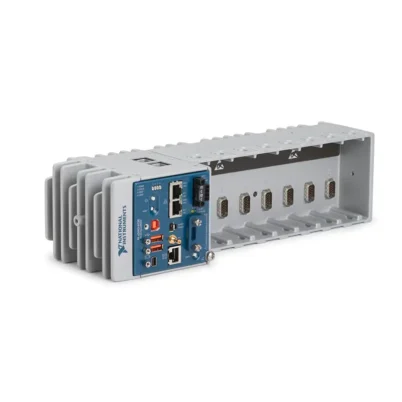

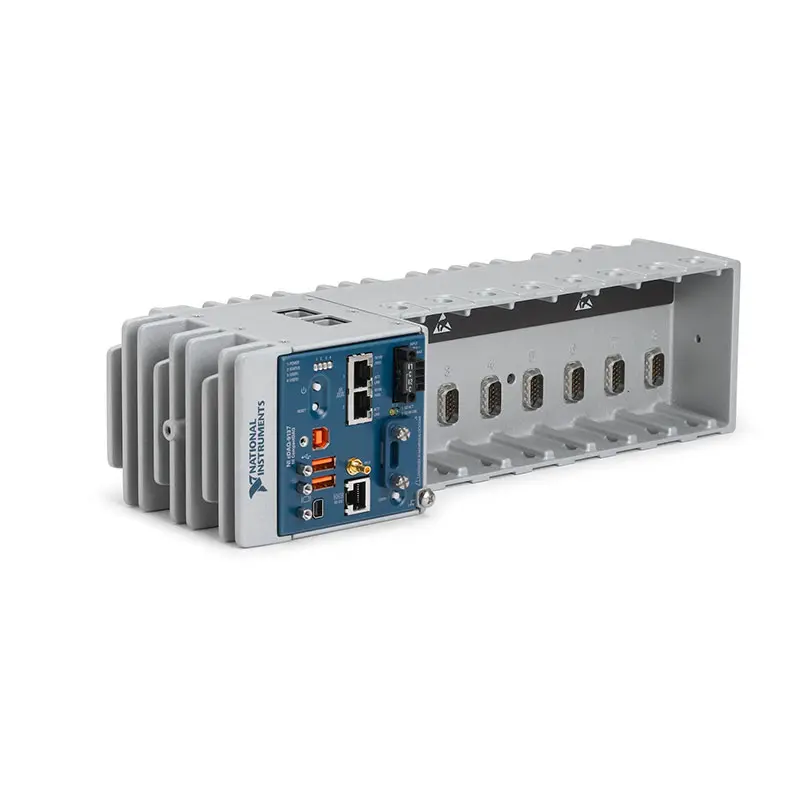
cDAQ-9137 8-Slot Quad-Core CompactDAQ Controller
The NI cDAQ-9137 is a rugged eight-slot CompactDAQ controller that combines an embedded computer, C Series signal-conditioning platform and data acquisition chassis in one integrated system. It can execute measurement, data logging, monitoring and control applications without requiring a continuously connected external computer.
The cDAQ-9137 includes a 1.91 GHz quad-core Intel Atom E3845 processor, 2 GB of DDR3L system memory and a 32 GB solid-state drive. Depending on the ordered configuration, it supports Windows Embedded Standard 7 or NI Linux Real-Time.
Eight C Series slots allow voltage, current, temperature, strain, vibration, sound,, digital I/O and industrial communication modules to be combined in one controller. Dual Gigabit Ethernet, RS-232, USB, Mini DisplayPort, removable SD storage and an SMB PFI connector support standalone and networked measurement systems.
Key Features of the cDAQ-9137
- Eight slots for compatible NI C Series modules
- Integrated 1.91 GHz Intel Atom E3845 processor
- Four processor cores
- 2 MB shared L2 cache
- 2 GB DDR3L system memory
- 32 GB internal solid-state drive
- SD and SDHC removable storage support up to 32 GB
- Windows Embedded Standard 7 or NI Linux Real-Time configuration
- Two 10/100/1000 Mb/s Ethernet ports
- One RS-232 serial port
- Two USB 2.0 host ports
- One USB 2.0 device port
- Mini DisplayPort video output
- Maximum display resolution of 2560 × 1600 at 60 Hz
- Four integrated 32-bit counter/timers
- Seven high-performance C Series data streams
- 9 VDC to 30 VDC power input
- Redundant primary and secondary power terminals
- -20°C to 55°C operating temperature range
- Hazardous-location certifications for appropriate installations
cDAQ-9137 Technical Specifications
| Product Model | cDAQ-9137 |
|---|---|
| Product Type | Eight-slot embedded CompactDAQ controller |
| Number of C Series Slots | 8 |
| Processor | Intel Atom E3845 |
| Processor Cores | 4 |
| Processor Frequency | 1.91 GHz |
| Processor Cache | 2 MB shared L2 cache |
| System Memory | 2 GB DDR3L |
| Internal Storage | 32 GB SSD |
| Removable Storage | SD or SDHC card up to 32 GB, user supplied |
| Supported Operating Systems | Windows Embedded Standard 7 or NI Linux Real-Time, configuration dependent |
| Ethernet Ports | 2 |
| Ethernet Interface | 10BASE-T, 100BASE-TX and 1000BASE-T |
| Ethernet Communication Rates | 10/100/1000 Mb/s, automatically negotiated |
| Maximum Ethernet Cable Distance | 100 m per segment |
| RS-232 Ports | 1 |
| Maximum RS-232 Baud Rate | 115,200 b/s |
| USB Host Ports | 2 standard Type-A connectors |
| USB Device Ports | 1 standard Type-B connector |
| USB Interface | USB 2.0 Hi-Speed, up to 480 Mb/s |
| USB Host Current | 1 A aggregate |
| Video Interface | Mini DisplayPort |
| Maximum Display Resolution | 2560 × 1600 at 60 Hz |
| Module-to-System-Memory Throughput | 20 MB/s, application and system dependent |
| Memory-to-SD Throughput | 10 MB/s, SD card dependent |
| Internal Real-Time Clock Accuracy | 200 ppm; 40 ppm at 25°C |
| Analog Input FIFO | 127 samples per slot |
| Maximum Analog Input Rate | Determined by the installed C Series modules |
| Analog Input Timing Resolution | 12.5 ns |
| Analog Output with Onboard Regeneration | Up to 16 channels |
| Maximum Regenerated AO Rate | 1.6 MS/s aggregate |
| Analog Output FIFO | 8,191 samples shared among active channels |
| Finite Digital Sample Clock | Up to 10 MHz |
| Counter/Timers | 4 |
| Counter Resolution | 32 bits |
| Counter External Base Clock | Up to 20 MHz |
| Counter Output Frequency | Up to 20 MHz |
| Controller PFI Connector | SMB |
| Controller PFI Frequency | Up to 1 MHz |
| High-Performance Data Streams | 7 |
| Power Input Range | 9 VDC to 30 VDC |
| Maximum Power Consumption | 46 W |
| Recommended Power Supply | 100 W, 24 VDC |
| Typical Standby Consumption | 3.4 W at 24 VDC |
| Operating Temperature | -20°C to 55°C |
| Storage Temperature | -40°C to 85°C |
| Operating Humidity | 10% to 90% RH, noncondensing |
| Ingress Protection | IP30 |
| Maximum Altitude | 5,000 m |
| Operating Vibration | 5 g RMS random or 5 g sinusoidal, 10 Hz to 500 Hz |
| Operating Shock | 30 g for 11 ms or 50 g for 3 ms, half-sine |
| Dimensions | 328.8 × 88.1 × 118.6 mm |
| Weight | 2.5 kg unloaded |
The measurement range, accuracy, channel count, isolation and sampling rate of a cDAQ-9137 system are determined primarily by the C Series modules installed in its eight slots. Review the controller specifications together with the documentation for every selected module.
cDAQ-9137 Part Number and Accessories
| Item | Part Number | Description |
|---|---|---|
| cDAQ-9137 Windows Configuration | 784240-01 | Eight-slot embedded CompactDAQ controller with Windows Embedded Standard 7 configuration |
| cDAQ-9137 Real-Time Configuration | 784241-01 | Eight-slot embedded CompactDAQ controller with NI Linux Real-Time configuration |
| SD Card Door Kit | 783660-01 | Retention cover required when meeting specified shock and vibration ratings |
| NI Locking USB Cable | 157788-01 | Retention cable for the USB device connection |
| NI Industrial USB Extender Cable | 152166-xx | Retained USB host connection; length and exact part number vary |
| Mini DisplayPort Retention Accessory | 156866-01 | Secures the Mini DisplayPort cable in vibration-sensitive installations |
| Panel Mount Kit | Verify configuration | Mounting hardware for attaching the controller to a flat metal panel |
| 24 VDC Power Supply | Application dependent | 100 W supply recommended for a fully configured system |
| C Series I/O Modules | Module dependent | Analog, digital, sensor measurement and communication modules |
The cDAQ-9137 was offered in Windows Embedded Standard 7 and NI Linux Real-Time configurations. Confirm the full part number, installed operating system, software image, storage condition and included accessories before ordering.
When purchasing a used controller, confirm whether the administrator password has been cleared, whether the operating system can boot normally and whether the required software licenses transfer with the hardware.
Integrated CompactDAQ Controller
Unlike USB or Ethernet CompactDAQ chassis that depend on a separate computer, the cDAQ-9137 contains its own processor, memory, storage and operating system. Applications can execute directly on the controller.
This integrated design reduces the number of external system components and allows the controller to continue acquiring, processing or logging data without maintaining a continuous connection to a host computer.
Eight C Series Module Slots
The controller accepts as many as eight compatible C Series modules. Different module types can be mixed to create a measurement system for voltage, current, thermocouples, RTDs, strain gauges, accelerometers, microphones, digital signals and industrial communication buses.
The modular architecture allows a system to be reconfigured by replacing individual I/O modules instead of replacing the complete controller.
Quad-Core Intel Atom Processor
The Intel Atom E3845 processor provides four 1.91 GHz cores and 2 MB of shared L2 cache. Multiple cores allow acquisition, logging, communication and analysis operations to be separated into parallel software tasks.
The processor is intended for embedded measurement and control rather than high-end desktop computing. Application performance depends on code structure, acquisition rates, analysis requirements and the selected operating system.
2 GB DDR3L System Memory
The controller includes 2 GB of DDR3L memory for the operating system and running applications. Developers should account for operating-system overhead, driver memory and data buffers when designing large measurement tasks.
Continuous applications should stream data to storage or a network destination instead of retaining an unlimited measurement history in system memory.
32 GB Internal SSD
The internal 32 GB solid-state drive stores the operating system, drivers, deployed applications and measurement data. Actual user-accessible capacity is lower after formatting and installation of system software.
For long-duration logging, manage available capacity carefully and implement automatic file rotation, data transfer or deletion policies. Repeated intensive writes can affect the service life of nonvolatile storage.
Removable SD Storage
An SD card slot supports user-supplied SD and SDHC media with capacity up to 32 GB. The published system-memory-to-SD throughput is 10 MB/s, subject to the performance of the selected card.
Removable storage can simplify data retrieval and provide additional logging capacity. Use industrial-grade media when the application involves continuous writes, vibration or wide temperature variation.
Windows Embedded Standard 7
The Windows configuration supports applications requiring a local graphical interface, conventional Windows software components or direct connection of a display, keyboard and mouse.
Windows Embedded Standard 7 is a legacy operating system. Before purchasing or deploying this configuration, verify software support, cybersecurity requirements, network policy and availability of required drivers.
NI Linux Real-Time
The NI Linux Real-Time configuration is designed for deterministic measurement and control applications developed with compatible versions of LabVIEW Real-Time and NI software.
Real-time operation can provide more predictable execution than a general-purpose desktop operating system. Compatibility must be verified against the specific LabVIEW, NI-DAQmx and Linux Real-Time software image required by the application.
Dual Gigabit Ethernet Ports
Two Ethernet ports support automatically negotiated 10, 100 and 1,000 Mb/s communication. Each copper Ethernet segment can be as long as 100 m.
The ports can connect the controller to host computers, plant networks, data servers and other supported devices. Network configuration depends on the selected operating system and application architecture.
USB Host and Device Connections
Two USB Type-A host ports support USB peripherals with an aggregate available current of 1 A. Typical peripherals include keyboards, mice and compatible storage devices.
The USB Type-B device port is intended for controller configuration, application deployment, debugging and maintenance. All ports use USB 2.0 Hi-Speed technology with a maximum signaling rate of 480 Mb/s.
RS-232 Serial Communication
The integrated RS-232 interface supports baud rates up to 115,200 b/s. Programmable data length, parity, stop bits and flow-control settings enable communication with instruments, controllers and legacy industrial devices.
Supported flow-control modes include RTS/CTS, XON/XOFF and DTR/DSR. Match every serial parameter with the connected device before troubleshooting message or framing errors.
Mini DisplayPort Video Output
The Mini DisplayPort interface supports resolutions up to 2560 × 1600 at 60 Hz. A monitor can be used for local configuration and operation when supported by the installed operating system.
The Windows configuration is generally more suitable for applications requiring a local graphical user interface. Real-time systems are commonly configured and monitored from a networked development computer.
Redundant Power Inputs
The four-position power connector provides primary and secondary power terminals. These inputs allow an appropriately designed system to use two external power sources for improved operating availability.
The controller accepts 9 VDC to 30 VDC and NI recommends a 100 W, 24 VDC supply. Maximum consumption is 46 W for a fully populated system under the specified worst-case conditions.
C Series Analog Input Support
Each slot provides a 127-sample analog input FIFO. Maximum sample rate, channel count, measurement range and accuracy are determined by the installed C Series analog input modules.
Internal timing provides 12.5 ns resolution and 50 ppm sample-rate accuracy, excluding the module’s own group delay and other measurement characteristics.
C Series Analog Output Support
With compatible modules, the cDAQ-9137 supports as many as 16 hardware-timed analog output channels using onboard regeneration. The maximum aggregate regenerated update rate is 1.6 MS/s.
Output modes include non-periodic generation, periodic regeneration from onboard memory and host-buffer regeneration with dynamic updates.
Hardware-Timed Digital I/O
Compatible parallel digital modules support finite input acquisition and finite or regenerated output generation at sample clock frequencies up to 10 MHz.
Actual streaming performance depends on the C Series module, number of slots in the task, controller workload and data-transfer configuration.
Four 32-Bit Counter/Timers
Four general-purpose 32-bit counters support edge counting, pulse, period, semi-period, pulse-width and two-edge separation measurements.
The counters also support X1, X2 and X4 quadrature encoders with Channel Z reloading. Output functions include pulse generation, dynamically updated pulse trains and frequency division.
Controller PFI Connector
An SMB PFI 0 connector provides a controller-level timing input or output with maximum frequency of 1 MHz. It can be used for digital triggers, timing coordination and external clock functions.
Additional PFI functions may be available through compatible C Series modules. Module PFI terminals can support timing input and output frequencies up to 20 MHz.
Seven High-Performance Data Streams
The module interface provides seven high-performance streams for analog input, analog output, digital input, digital output, counter input, counter output and NI-XNET operations.
An active CAN or LIN NI-XNET session uses two streams regardless of how many compatible NI-XNET modules participate in the session.
Rugged Environmental Operation
The cDAQ-9137 operates from -20°C to 55°C when mounted according to the official thermal requirements. Storage temperature extends from -40°C to 85°C.
To maintain full temperature performance, the controller must be mounted horizontally on a metal panel or surface using the mounting holes or an approved panel-mount kit.
Hazardous-Location Support
The controller carries applicable Class I, Division 2 and Zone 2 certifications. Hazardous-location use requires compliance with the controller documentation, power-source limitations, wiring instructions and applicable local regulations.
Product certification does not automatically certify the complete system. Installed modules, enclosure, connectors and external equipment must also be approved for the intended location.
cDAQ-9137 Applications
- Standalone industrial data acquisition
- Embedded machine monitoring
- Condition-based maintenance
- Automotive validation testing
- Remote environmental monitoring
- Structural and mechanical testing
- Vibration and acoustic measurement
- Energy and power-system monitoring
- Distributed control and data logging
- Hazardous-location monitoring
- Production test equipment
- Laboratory automation
- CAN and LIN data acquisition
- Real-time measurement and control
Standalone Data Logging
Applications can run locally and record measurements to the internal SSD or removable SD media. Network communication is only required when transferring data, changing the application or monitoring system status.
Machine Condition Monitoring
Vibration, sound, temperature, current and digital modules can be combined to monitor motors, pumps, gearboxes and production equipment. Embedded processing allows alarms and calculated values to be generated close to the machine.
Automotive Testing
The controller can combine sensor measurements with CAN or LIN data from compatible NI-XNET modules. This supports vehicle subsystem validation, durability testing and mobile data logging.
Structural and Mechanical Testing
Strain, acceleration, force, pressure and displacement modules can be installed together. Eight available slots provide flexibility for mixed-sensor test articles and mechanical validation fixtures.
Remote Monitoring
Dual Ethernet ports allow the controller to communicate with supervisory computers and data servers. Local execution helps the acquisition continue during temporary interruptions in the monitoring connection.
Real-Time Measurement and Control
The NI Linux Real-Time configuration can execute deterministic measurement and control applications. Hardware-timed C Series operations and counter resources support repeatable timing.
Production Test Systems
The cDAQ-9137 can control a test fixture, acquire product measurements and store results without a separate desktop computer. USB, serial and Ethernet ports provide connectivity to peripheral equipment.
cDAQ-9137 Installation Workflow
Step 1: Confirm the Operating-System Configuration
Verify whether the controller uses Windows Embedded Standard 7 or NI Linux Real-Time. Confirm compatibility with the intended application, LabVIEW version and NI drivers.
Step 2: Select the C Series Modules
Choose modules based on sensor type, input range, accuracy, isolation, sampling rate and channel count. Verify support with the controller’s software image.
Step 3: Plan the Mounting Position
For full -20°C to 55°C performance, mount the controller horizontally on a flat metal panel according to the official spacing and cooling instructions.
Step 4: Install the C Series Modules
Insert each module into the selected slot and verify that its latch is fully engaged. Record the slot arrangement for use when configuring software channels.
Step 5: Connect Chassis Ground
Connect the chassis grounding terminal to an appropriate low-impedance ground. Correct grounding helps improve safety and measurement noise performance.
Step 6: Wire the Power Input
Connect a suitable 9 VDC to 30 VDC supply. A 100 W, 24 VDC source is recommended for a fully populated system. Use the secondary input if redundant power is required.
Step 7: Connect Network and Peripherals
Connect Ethernet, RS-232, USB, display and PFI cables required by the application. Install retention accessories when shock and vibration ratings must be maintained.
Step 8: Power On the Controller
Apply power and monitor the status indicators. Allow the operating system and installed services to finish booting before attempting configuration.
Step 9: Discover and Configure the Controller
Use NI Measurement & Automation Explorer or the appropriate system-management tools to configure the hostname, network addresses, time settings and installed software.
Step 10: Deploy and Validate the Application
Deploy the measurement application and test every I/O channel, trigger, network connection and storage destination under representative operating conditions.
cDAQ-9137 Troubleshooting
The cDAQ-9137 Does Not Power On
Measure the supply voltage at the controller and confirm correct polarity. Check the four-position connector, terminal screws, external fuse and supply current capacity.
The Controller Is Not Detected on the Network
Check Ethernet link indicators, the cable and network switch. Confirm that the computer and controller use compatible IP addresses and that firewall rules allow NI discovery services.
The Operating System Does Not Boot
Disconnect unnecessary USB and SD devices and restart the controller. If the problem continues, use the applicable recovery process for WES7 or NI Linux Real-Time.
A C Series Module Is Missing
Confirm that the module is fully seated and supported by the installed NI-DAQmx version. Test the module in another slot to distinguish a module problem from a slot issue.
Data Logging Stops Unexpectedly
Check free SSD or SD-card capacity, file permissions and write performance. Implement file rotation and transfer completed files before the storage device becomes full.
The Controller Overheats
Verify horizontal panel mounting, required clearance and airflow. Check ambient temperature on both sides of the controller and remove obstructions around its cooling surfaces.
USB Devices Disconnect During Vibration
Use the specified industrial USB extender and locking USB cable. Provide strain relief and ensure that cables do not apply sideways force to the connectors.
Real-Time Performance Is Inconsistent
Review task priorities, processor allocation, logging operations and network communication. Avoid running non-deterministic file or user-interface operations inside critical timed loops.
SD Card Performance Is Too Low
Use an industrial SDHC card with suitable sustained-write performance. The controller-to-card specification is up to 10 MB/s and also depends on the selected card.
Counter or Trigger Signals Are Not Detected
Verify the selected PFI source, signal voltage, polarity and routing configuration. The controller SMB PFI supports frequencies up to 1 MHz, while module PFI capabilities vary.
cDAQ-9137 Comparison
| Model | C Series Slots | Controller Architecture | Best Suited For |
|---|---|---|---|
| cDAQ-9136 | 4 | Embedded quad-core controller | Compact rugged systems requiring fewer I/O modules |
| cDAQ-9137 | 8 | Embedded quad-core controller | Standalone rugged systems requiring additional I/O capacity |
| cDAQ-9135 | 8 | Embedded CompactDAQ controller | Eight-slot embedded systems with different environmental requirements |
| cDAQ-9189 | 8 | Ethernet chassis without embedded computer | Networked acquisition controlled by an external computer |
| cDAQ-9183 | 4 | TSN Ethernet chassis without embedded computer | Compact synchronized distributed data acquisition |
cDAQ-9137 vs cDAQ-9136
The cDAQ-9136 provides four C Series slots, while the cDAQ-9137 provides eight. Both belong to the rugged embedded CompactDAQ controller family.
Select the cDAQ-9136 when four modules provide sufficient capacity and compact size is important. Select the cDAQ-9137 when the application requires more module types or higher channel density.
cDAQ-9137 vs cDAQ-9135
The cDAQ-9135 and cDAQ-9137 both provide eight C Series slots and embedded processing. The cDAQ-9137 is designed for the wider -20°C to 55°C operating range and applicable hazardous-location installations.
Verify the processor, operating system, environmental rating and certification requirements when selecting between the two models.
cDAQ-9137 vs cDAQ-9189
The cDAQ-9189 is an eight-slot TSN Ethernet chassis without an embedded application processor. The cDAQ-9137 contains its own processor, memory, storage and operating system.
Select the cDAQ-9189 when a networked host computer will control the acquisition. Select the cDAQ-9137 when the application must execute and store data locally.
cDAQ-9137 vs cDAQ-9183
The cDAQ-9183 is a four-slot TSN Ethernet chassis intended for synchronized distributed I/O. The cDAQ-9137 offers eight slots and embedded computing but belongs to an earlier controller generation.
Selecting Compatible C Series Modules
Select C Series modules according to sensor type, signal range, sampling method, channel count, excitation and isolation. The controller itself does not directly define the measurement accuracy or input range.
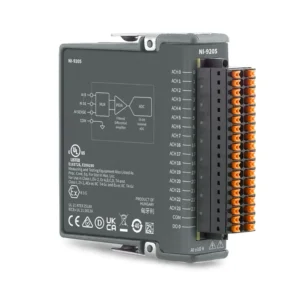
- NI-9205 Analog Input Module for general-purpose voltage acquisition
- NI-9213 Thermocouple Module for temperature measurements
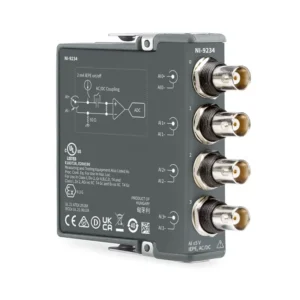
- NI-9234 Dynamic Signal Acquisition Module for sound and vibration
- NI-9237 Bridge Input Module for strain and load measurements
- NI-9263 Analog Output Module for voltage generation
- NI-9401 Digital I/O Module for bidirectional digital applications
- NI-9862 CAN Interface Module for NI-XNET CAN applications
Why Choose the cDAQ-9137?
- Combines embedded computing and eight C Series slots
- Runs applications without a continuously connected host PC
- Provides a quad-core 1.91 GHz processor
- Includes 32 GB SSD and removable SD storage
- Supports Windows or NI Linux Real-Time configurations
- Provides dual Gigabit Ethernet connections
- Includes USB, RS-232, video and PFI interfaces
- Supports four 32-bit counter/timers
- Accepts a wide selection of C Series modules
- Supports redundant DC power inputs
- Operates from -20°C to 55°C
- Supports properly designed hazardous-location systems
cDAQ-9137 Frequently Asked Questions
What is the cDAQ-9137?
The cDAQ-9137 is an eight-slot CompactDAQ controller with an integrated quad-core computer for standalone measurement, data logging and control applications.
How many C Series modules can it hold?
The controller accepts as many as eight compatible NI C Series modules.
Which processor does it use?
It uses a quad-core Intel Atom E3845 processor operating at 1.91 GHz with 2 MB of shared L2 cache.
How much memory and storage are included?
The cDAQ-9137 includes 2 GB of DDR3L system memory and a 32 GB internal SSD. It also supports user-supplied SD or SDHC cards up to 32 GB.
Which operating systems does it support?
The cDAQ-9137 was offered with Windows Embedded Standard 7 or NI Linux Real-Time. The installed operating system depends on the ordered configuration.
What are the cDAQ-9137 part numbers?
Common configurations include 784240-01 and 784241-01. Confirm the associated operating system and complete configuration before ordering.
Can it work without an external computer?
Yes. Applications can execute directly on the integrated processor and store measurements on the internal SSD or removable SD card.
How many Ethernet ports does it provide?
It provides two automatically negotiated 10/100/1000 Mb/s Ethernet ports with a maximum cable distance of 100 m per segment.
Does the cDAQ-9137 support a monitor?
Yes. Its Mini DisplayPort output supports resolutions up to 2560 × 1600 at 60 Hz when supported by the installed operating system.
Does it provide redundant power inputs?
Yes. The four-position power connector provides primary and secondary 9 VDC to 30 VDC inputs for an appropriately designed redundant power system.
What power supply is recommended?
NI specifies a recommended 100 W, 24 VDC power supply. Maximum controller consumption is 46 W under the defined fully populated worst-case condition.
Can it be used in hazardous locations?
Yes, in installations that comply with its applicable Class I, Division 2 and Zone 2 certifications. All modules, wiring, power supplies and enclosures must satisfy the relevant requirements.
What is the operating temperature range?
The specified range is -20°C to 55°C when the controller is mounted horizontally on a suitable metal panel according to the official mounting instructions.
Does it contain a battery?
Yes. The controller contains a long-life coin-cell battery used to maintain the internal real-time clock and CMOS functions.
What should be checked when purchasing a used cDAQ-9137?
Verify the complete part number, operating system, boot condition, SSD health, administrator access, Ethernet and USB ports, module slots, power connector and included mounting accessories.
Recommended Related Products
- cDAQ-9136 4-Slot Embedded CompactDAQ Controller
- cDAQ-9135 8-Slot Embedded CompactDAQ Controller
- cDAQ-9189 8-Slot TSN Ethernet CompactDAQ Chassis
- cDAQ-9183 4-Slot TSN Ethernet CompactDAQ Chassis
- NI-9205 Analog Input Module
- NI-9213 Thermocouple Input Module
- NI-9234 Dynamic Signal Acquisition Module
- NI-9237 Bridge Input Module
- NI-9401 Digital I/O Module
- View More NI C Series Modules
Request a Quote for the cDAQ-9137
Contact us for current availability, lead time and project pricing for the NI cDAQ-9137 8-Slot Quad-Core CompactDAQ Controller. We can also help identify the correct Windows or NI Linux Real-Time configuration, compatible C Series modules, power supplies, mounting kits and cable-retention accessories for your measurement system.