



Product Introduction
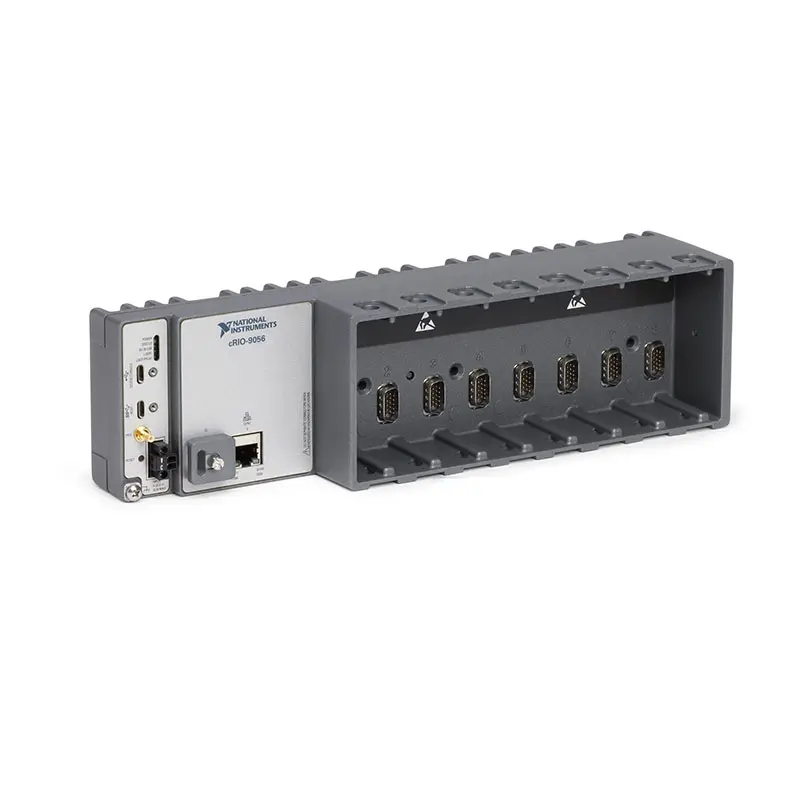
The NI cRIO-9056 is an eight-slot CompactRIO controller designed for deterministic data acquisition, industrial control, distributed measurement, machine monitoring, and embedded automation. It combines an Intel® Atom™ dual-core processor, a user-programmable Xilinx Artix-7 FPGA, NI Linux Real-Time, and modular NI C Series I/O support in one rugged, deployable platform.
The cRIO-9056 supports three C Series programming modes: Real-Time with NI-DAQmx, Real-Time Scan using I/O variables, and LabVIEW FPGA. This flexible architecture allows engineers to select simplified DAQ programming for standard measurements or direct FPGA programming for custom timing, high-speed signal processing, and low-latency control.
Product Overview
The cRIO-9056 features eight C Series module slots for combining analog input, analog output, digital I/O, temperature, strain, vibration, relay, counter, and communication functions in one synchronized embedded system.
A 1.33 GHz dual-core Intel Atom E3805 processor runs the 64-bit NI Linux Real-Time operating system, while the Artix-7 75T FPGA provides deterministic hardware execution and direct access to compatible C Series modules. The controller also includes 1 GB of DDR3L memory, 4 GB of internal storage, and a MicroSD card slot for removable data storage.
Gigabit Ethernet with IEEE 802.1AS and IEEE 1588 synchronization enables precise coordination across distributed measurement systems. USB Type-C host and device ports, an SMB programmable function interface, and a wide-range DC power input simplify integration into industrial and laboratory applications.
Key Features
1.33 GHz Dual-Core Intel Atom Processor
The embedded processor executes real-time measurement, communication, logging, and supervisory control applications locally.
- Intel Atom E3805 processor
- Two processor cores
- 1.33 GHz processor frequency
- 1 MB shared L2 cache
- Standalone embedded operation
Advantage: Applications can run directly on the controller without requiring a continuously connected external computer.
Xilinx Artix-7 75T FPGA
The integrated FPGA provides deterministic hardware processing and customizable access to C Series I/O.
- Xilinx Artix-7 7A75T FPGA
- 94,400 flip-flops
- 47,200 six-input LUTs
- 180 DSP slices
- 3,780 kbits of block RAM
- 16 DMA channels
Advantage: Engineers can implement custom triggering, digital protocols, filtering, pulse generation, encoder processing, and high-speed control directly in hardware.
Eight C Series Module Slots
The cRIO-9056 supports eight interchangeable NI C Series modules for application-specific measurement and control.
- 8 C Series module slots
- Mixed analog and digital I/O
- Sensor-specific signal conditioning
- Industrial communication modules
- Flexible system expansion
Advantage: A single controller can combine multiple sensor, actuator, and communication technologies in one synchronized platform.
Three C Series Programming Modes
The controller supports different programming methods according to application complexity and timing requirements.
- Real-Time NI-DAQmx mode
- Real-Time Scan mode
- LabVIEW FPGA mode
- Hardware-timed data acquisition
- Direct FPGA access to module I/O
Advantage: NI-DAQmx and Scan mode simplify standard applications, while LabVIEW FPGA enables custom hardware behavior and deterministic processing.
NI Linux Real-Time Operating System
The cRIO-9056 runs a 64-bit real-time operating system for reliable and predictable embedded application execution.
- NI Linux Real-Time, 64-bit
- Deterministic scheduling
- Standalone application deployment
- Network and file-system services
- Optional C/C++ development support
Advantage: Predictable execution supports machine control, unattended monitoring, distributed acquisition, and long-duration industrial operation.
TSN Network Synchronization
The Gigabit Ethernet interface supports precise time synchronization across distributed controllers and measurement systems.
- IEEE 802.1AS-2011 support
- IEEE 1588-2008 support
- Network synchronization accuracy below 1 µs
- Time-aware transmission support
- Hardware-based distributed timing
Advantage: Multiple networked controllers can acquire and generate signals using a common synchronized timebase.
High-Speed USB Type-C Connectivity
Two USB Type-C ports provide configuration, console, peripheral, and storage connectivity.
- USB 2.0 Type-C device port
- Console output support
- USB 3.1 Gen 1 Type-C host port
- Up to 5 Gb/s host-port data rate
- Support for compatible USB storage and peripherals
Advantage: USB connectivity simplifies controller setup, diagnostics, data transfer, and peripheral integration.
Rugged Industrial Construction
The cRIO-9056 is designed for reliable operation in demanding measurement and automation environments.
- −20 °C to 55 °C operating range
- 5 g RMS random vibration resistance
- 30 g and 50 g operating shock ratings
- 9 VDC to 30 VDC power input
- IP40 enclosure protection
- 5,000 m maximum altitude
Advantage: Rugged construction supports industrial machinery, energy systems, transportation testing, and distributed monitoring installations.
Technical Specifications
| Parameter | Description |
|---|---|
| Product Type | CompactRIO Embedded Controller |
| Part Number | 786426-01 |
| Number of C Series Slots | 8 |
| Processor | Intel Atom E3805 |
| Processor Cores | 2 |
| Processor Frequency | 1.33 GHz |
| Processor Cache | 1 MB Shared L2 Cache |
| Operating System | NI Linux Real-Time, 64-Bit |
| System Memory | 1 GB DDR3L |
| Maximum Theoretical Memory Rate | 8.533 GB/s |
| Internal Storage | 4 GB |
| Removable Storage | MicroSD and MicroSDHC |
| FPGA | Xilinx Artix-7 7A75T |
| FPGA Flip-Flops | 94,400 |
| FPGA LUTs | 47,200 Six-Input LUTs |
| FPGA DSP Slices | 180 |
| FPGA Block RAM | 3,780 kbits |
| DMA Channels | 16 |
| Logical Interrupts | 32 |
| Ethernet Ports | 1 × 10/100/1000Base-T |
| Maximum Ethernet Cable Length | 100 m per Segment |
| Network Timing Protocols | IEEE 802.1AS-2011 and IEEE 1588-2008 |
| Network Synchronization Accuracy | Less Than 1 µs, System Dependent |
| USB Device Port | USB 2.0 Type-C with Console Out |
| USB Host Port | USB 3.1 Gen 1 Type-C |
| Maximum USB Host Data Rate | 5 Gb/s |
| Controller PFI | 1 × SMB, 5 V TTL Compatible |
| Maximum PFI Frequency | 1 MHz |
| Real-Time Analog Input Timing Resolution | 12.5 ns |
| Real-Time Analog Input Tasks | Up to 8 Hardware-Timed Tasks |
| Maximum Analog Output Update Rate | Up to 1.6 MS/s, Module and System Dependent |
| Maximum Digital Input Sample Clock | 10 MHz |
| Maximum Digital Output Sample Clock | Up to 10 MHz, Timing Engine Dependent |
| Power Input Range | 9 VDC to 30 VDC |
| Maximum Power Consumption | 30 W |
| Recommended Power Supply | 60 W, 24 VDC |
| Dimensions | 328.7 mm × 82.5 mm × 189.6 mm |
| Weight | 1,598 g Unloaded |
| Operating Temperature | −20 °C to 55 °C |
| Storage Temperature | −40 °C to 85 °C |
| Ingress Protection | IP40 |
| Maximum Altitude | 5,000 m |
Software Ecosystem
The cRIO-9056 integrates with the National Instruments software platform for real-time control, FPGA development, data acquisition, and distributed system management.
- LabVIEW: Provides graphical development for measurement, monitoring, communication, analysis, and control applications.
- LabVIEW Real-Time: Supports deterministic application execution on the embedded Intel Atom processor.
- LabVIEW FPGA: Enables graphical programming of the Artix-7 FPGA for custom timing, signal processing, triggering, and I/O control.
- NI-DAQmx: Provides hardware-timed access to supported C Series modules in Real-Time NI-DAQmx mode.
- Real-Time Scan: Provides variable-based access to supported C Series I/O without custom FPGA programming.
- NI MAX: Supports controller discovery, network configuration, software installation, diagnostics, and hardware management.
- C/C++ Development Tools: Provide optional text-based application development for the NI Linux Real-Time processor.
Industries
- Industrial Automation
- Machine Control
- Energy and Power Systems
- Automotive and Transportation
- Aerospace and Defense
- Structural and Condition Monitoring
- Research and Development
- Distributed Test and Measurement
Applications
Distributed Data Acquisition
TSN synchronization and modular C Series I/O support enable coordinated measurements across multiple networked locations.
- Distributed sensor acquisition
- Synchronized test stations
- Remote measurement systems
- Large-scale data logging
Industrial Machine Control
The real-time processor and FPGA can execute deterministic control tasks close to industrial equipment.
- Machine sequencing
- Actuator control
- Equipment interlocks
- Production automation
Condition Monitoring
The controller can combine vibration, temperature, current, voltage, and speed measurements for continuous equipment monitoring.
- Motor monitoring
- Bearing diagnostics
- Vibration analysis
- Predictive maintenance
Custom FPGA Applications
LabVIEW FPGA enables hardware-level functionality that cannot be reliably implemented using software timing alone.
- Custom digital protocols
- Encoder processing
- PWM generation
- High-speed triggering
- Parallel signal processing
Energy and Infrastructure Monitoring
The rugged controller can acquire and process data at remote energy, transportation, and infrastructure sites.
- Power-system monitoring
- Renewable-energy testing
- Structural monitoring
- Remote asset diagnostics
Comparison with Similar Products
| Model | Main Difference | Best Application |
|---|---|---|
|
NI cRIO-9056 | Eight-slot controller with a 1.33 GHz dual-core processor, Artix-7 75T FPGA, TSN synchronization, and NI-DAQmx programming support. | Distributed measurement and general industrial control |
|
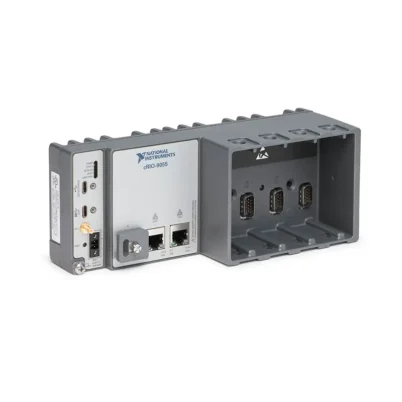
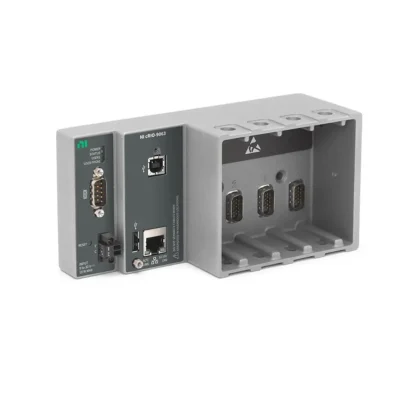
NI cRIO-9053 | Four-slot cRIO-905x controller for systems requiring a smaller I/O footprint. | Compact embedded measurement systems |
|
NI cRIO-9057 | Related eight-slot controller with a different FPGA configuration for applications requiring additional programmable logic resources. | More demanding FPGA-based applications |
|
NI cRIO-9035 | Earlier eight-slot CompactRIO controller using a different processor, FPGA, connectivity, and synchronization architecture. | Established CompactRIO control systems |
|
NI cRIO-9049 | Higher-performance CompactRIO controller with increased processing, storage, connectivity, and FPGA capability. | Advanced industrial automation and edge control |
Recommended Related Products
The following C Series modules can be combined with the cRIO-9056 according to the required measurement, communication, or control function.
|
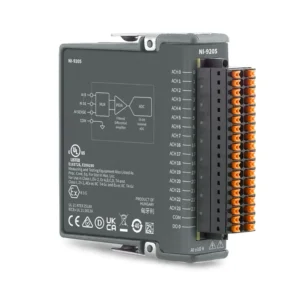
NI-9205 | High-channel-count analog input module for general voltage and sensor measurement. |
|
NI-9219 | Universal analog input module for voltage, current, thermocouple, RTD, resistance, and bridge measurements. |
|
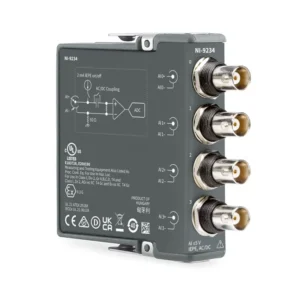
NI-9234 | Dynamic signal acquisition module with IEPE excitation for sound and vibration monitoring. |
|
NI-9401 | Bidirectional digital I/O module for counters, encoders, pulse measurements, and FPGA control. |
|
NI-9478 | Digital output module for controlling external devices in industrial and automated systems. |
|
NI-9881 | C Series CAN interface module for automotive and industrial communication applications. |
Why Choose cRIO-9056?
- Eight interchangeable C Series module slots
- 1.33 GHz dual-core Intel Atom processor
- User-programmable Xilinx Artix-7 75T FPGA
- NI Linux Real-Time operating system
- Real-Time NI-DAQmx, Scan, and LabVIEW FPGA programming modes
- TSN-enabled Gigabit Ethernet synchronization
- Network timing accuracy below 1 µs
- USB 3.1 host and USB 2.0 device ports
- MicroSD removable storage support
- Rugged shock, vibration, and environmental performance
Frequently Asked Questions
Does the cRIO-9056 include a user-programmable FPGA?
Yes. The cRIO-9056 includes a Xilinx Artix-7 7A75T FPGA. The LabVIEW FPGA Module can be used to implement custom timing, triggering, digital protocols, parallel processing, and direct control of compatible C Series I/O.
Can the cRIO-9056 use NI-DAQmx?
Yes. The controller supports Real-Time NI-DAQmx mode for compatible C Series modules. It also supports Real-Time Scan mode and LabVIEW FPGA mode, allowing developers to select the programming approach that best matches the application.
Does the cRIO-9056 support synchronized distributed measurements?
Yes. Its Gigabit Ethernet port supports IEEE 802.1AS and IEEE 1588 network timing. NI specifies network synchronization accuracy below 1 µs, although actual performance depends on the complete network and system configuration.
Conclusion
The NI cRIO-9056 eight-slot CompactRIO controller combines real-time Intel Atom processing, an Artix-7 FPGA, modular C Series I/O, NI-DAQmx support, and TSN-enabled network synchronization in one rugged embedded platform. Its flexible programming modes and deterministic architecture make it well suited for distributed data acquisition, machine control, condition monitoring, industrial automation, energy systems, and custom FPGA-based measurement applications.