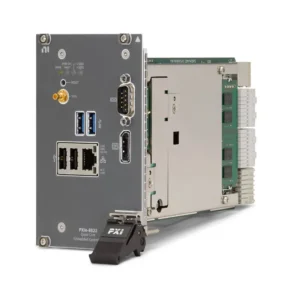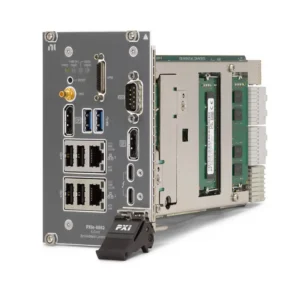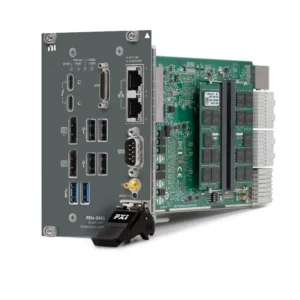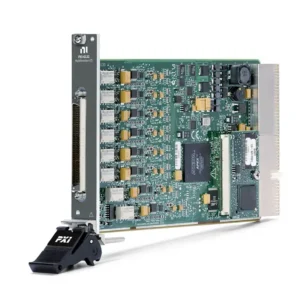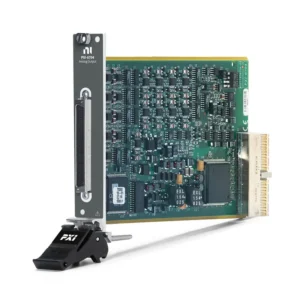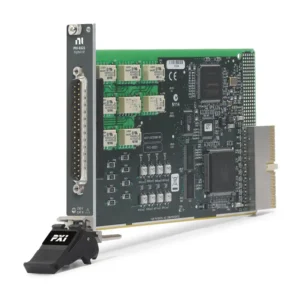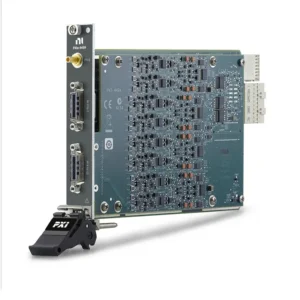


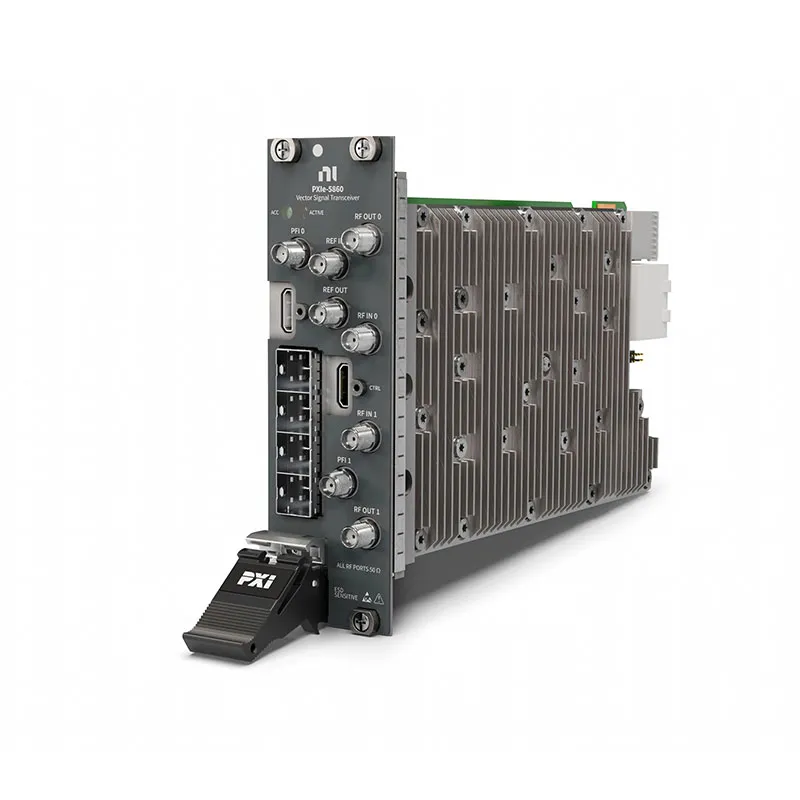
PXIe-5860 8.5 GHz Dual-Channel Vector Signal Transceiver
The NI PXIe-5860 is a high-performance PXI Vector Signal Transceiver designed for wideband RF generation and analysis. It combines as many as two vector signal generators and two vector signal analyzers in a compact two-slot PXI Express instrument.
With frequency coverage from 50 MHz to 8.5 GHz and up to 1 GHz of instantaneous bandwidth, the PXIe-5860 supports cellular, wireless-connectivity and semiconductor test applications. Its dual-channel configuration is particularly useful for multisite production testing, MIMO measurements and parallel RF characterization.
Key Features of the PXIe-5860
- PXI Vector Signal Transceiver
- Single-channel and dual-channel configurations
- 50 MHz to 8.5 GHz RF frequency range
- 1 GHz instantaneous generator bandwidth
- 1 GHz instantaneous analyzer bandwidth
- Up to two RF generator channels
- Up to two RF analyzer channels
- +23 dBm maximum RF output power
- 150 µs typical generator tuning time
- 150 µs typical analyzer tuning time
- Approximately -130 dBm/Hz average noise level
- Peer-to-peer streaming support
- Two-slot PXI Express form factor
- Suitable for Wi-Fi 7 and 5G NR testing
PXIe-5860 Technical Specifications
| Product Model | PXIe-5860 |
|---|---|
| Product Type | PXI Vector Signal Transceiver |
| RF Frequency Range | 50 MHz to 8.5 GHz |
| Generator Frequency Range | 50 MHz to 8.5 GHz |
| Analyzer Frequency Range | 50 MHz to 8.5 GHz |
| Generator Instantaneous Bandwidth | 1 GHz |
| Analyzer Instantaneous Bandwidth | 1 GHz |
| Generator Channels | 1 or 2, depending on configuration |
| Analyzer Channels | 1 or 2, depending on configuration |
| Maximum Output Power | +23 dBm |
| Average Noise Level | Approximately -130 dBm/Hz |
| Typical Generator Tuning Time | 150 µs |
| Typical Analyzer Tuning Time | 150 µs |
| I/O Type | RF |
| Peer-to-Peer Streaming | Supported |
| Bus Interface | PXI Express |
| Module Width | Two slots |
Integrated RF Generation and Analysis
The PXIe-5860 integrates RF stimulus and measurement functions in one instrument. This architecture reduces the number of separate modules, external cables and signal-routing components required for a complete RF test station.
The generator can apply digitally modulated or continuous RF signals to a DUT while the analyzer captures and measures the resulting response. Software can coordinate frequency, power, waveform, triggering and analysis as part of one automated sequence.
Dual-Channel RF Architecture
The dual-channel version contains two RF generator channels and two RF analyzer channels. Engineers can use the channels for parallel multisite testing, MIMO measurements, simultaneous transmitter and receiver tests or independent RF signal paths.
The single-channel version provides the same general frequency coverage and bandwidth with one enabled transceiver channel. Verify the shipping-kit part number and enabled channel count before ordering.
1 GHz Instantaneous Bandwidth
Up to 1 GHz of instantaneous bandwidth allows the PXIe-5860 to generate and analyze wideband signals without stitching together numerous narrow acquisitions. This capability is important for broadband modulation, wide component bandwidths and adjacent-channel measurements.
Actual measurement settings depend on the waveform standard, sample rate, record length, triggering and selected RFmx measurement personality.
5G NR and Wi-Fi 7 Testing
The PXIe-5860 can perform error vector magnitude and related transmitter measurements for wideband cellular and wireless signals, including applicable 5G NR and Wi-Fi 7 configurations.
Test-system performance also depends on calibration, cable loss, fixture quality, reference-clock architecture and selected software. External attenuation or amplification may be required for signals outside the module’s direct operating range.
PXIe-5860 Part Number and Accessories
| Item | Part Number | Description |
|---|---|---|
| PXIe-5860 Dual Channel | 789449-01 | 8.5 GHz, 1 GHz bandwidth, dual-channel PXI VST |
| PXIe-5860 Single Channel | 790790-01 | 8.5 GHz, 1 GHz bandwidth, single-channel PXI VST |
| PXIe-5860 Pass-Through Cable Kit | 790504-01 | Cable kit for applicable PXIe-5633 VNA pass-through configurations |
| RF Cable and Adapter Kit | Configuration dependent | Connects the RF input and output channels to the DUT or test fixture |
| External Attenuator | Application dependent | Protects the analyzer input and adjusts the signal level |
Part number 789449-01 identifies the dual-channel configuration, while 790790-01 identifies the single-channel version. Confirm the required channel count, included accessories and software licenses before ordering.
PXIe-5860 Applications
- 5G NR RF testing
- Wi-Fi 6E and Wi-Fi 7 testing
- Wireless semiconductor production testing
- RF front-end module characterization
- Power-amplifier testing
- Receiver sensitivity testing
- Transmitter EVM measurements
- MIMO and multichannel testing
- Multisite semiconductor testing
- RFIC validation
- Research and development
- Automated wireless-device testing
Semiconductor Production Test
The fast tuning time, dual-channel density and PXI Express architecture make the PXIe-5860 suitable for high-throughput RF semiconductor testing. Multiple DUT sites or RF paths can be measured without duplicating an entire instrument set for every channel.
RF Component Characterization
The instrument can generate a controlled RF stimulus and analyze the output of amplifiers, filters, mixers, transceivers and front-end modules. Measurements can be coordinated with programmable power supplies, source measure units and RF switches.
PXIe-5860 Installation Workflow
Step 1: Verify the System Configuration
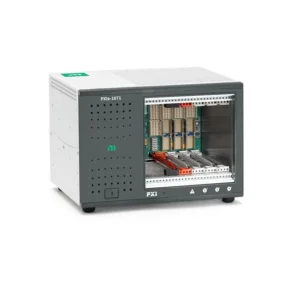
Confirm that the PXI Express chassis has two adjacent compatible slots, sufficient power capacity and adequate cooling for the PXIe-5860.
Step 2: Install the Required Software
Install the applicable NI-RFSA, NI-RFSG, RFmx and system software versions before configuring the instrument.
Step 3: Install the Module
Power down the chassis, insert the PXIe-5860 into the selected slots and secure both front-panel retaining screws.
Step 4: Connect the RF Signal Path
Use frequency-rated RF cables and inspect every connector before attachment. Add external attenuation where the expected input could approach the instrument limit.
Step 5: Configure References and Triggers
Select the reference-clock source, trigger routing and synchronization settings required by the other PXI instruments.
Step 6: Perform Verification
Run device self-tests and begin with a low output level. Verify frequency and amplitude using a known-good measurement path before connecting a sensitive DUT.
PXIe-5860 Troubleshooting
The PXIe-5860 is not detected
Check module seating, chassis compatibility, power capacity and driver installation. Verify that the two required slots support the module configuration.
The measured power is lower than expected
Account for cable, adapter, switch and fixture losses. Confirm whether external attenuation has been included in the software reference-level calculation.
EVM results are inconsistent
Check reference-clock synchronization, analyzer reference level, waveform configuration, DUT power stability and RF connector condition. Allow the instrument and external equipment to reach thermal stability.
The analyzer input overloads
Disconnect the signal and verify its power independently. Add a suitable external attenuator and configure the analyzer reference level before reconnecting it.
Two channels produce different results
Swap the external signal paths and repeat the measurement. Differences may originate from cables, switches, fixtures, calibration data or the DUT rather than the transceiver channels.
PXIe-5860 Comparison
| Model | Primary Configuration | Best Suited For |
|---|---|---|
| PXIe-5860 | Up to 2 channels, 8.5 GHz, 1 GHz bandwidth | Wideband multichannel wireless and production testing |
| PXIe-5840 | Single-channel PXI VST | General-purpose RF generation and analysis |
| PXIe-5831 | Millimeter-wave VST system | Higher-frequency 5G FR2 testing |
| PXIe-5832 | High-frequency VST configuration | Wideband microwave and mmWave applications |
| PXIe-5633 | Vector network analyzer | S-parameter and network measurements |
Selecting the PXIe-5860
Choose the PXIe-5860 when the application requires frequency coverage through 8.5 GHz, 1 GHz instantaneous bandwidth and up to two independent RF transceiver channels. Select a millimeter-wave VST when the DUT operates above the PXIe-5860 frequency range.
PXIe-5860 Frequently Asked Questions
What is the PXIe-5860?
It is a PXI Vector Signal Transceiver that combines RF generation and RF analysis in one two-slot module.
What frequency range does it support?
The generator and analyzer cover frequencies from 50 MHz to 8.5 GHz.
What is its instantaneous bandwidth?
The PXIe-5860 provides up to 1 GHz of instantaneous generator and analyzer bandwidth.
How many RF channels are available?
Single-channel and dual-channel versions are available. Part number 789449-01 is the dual-channel configuration.
Can it be used for Wi-Fi 7?
Yes. Its bandwidth and frequency coverage support applicable Wi-Fi 7 generation and analysis requirements.
Does it support peer-to-peer streaming?
Yes. The PXIe-5860 supports peer-to-peer streaming within compatible PXI Express systems.
Request a Quote for the PXIe-5860
Contact us for availability, lead time and project pricing for the PXIe-5860 Vector Signal Transceiver. We can also help select compatible PXI Express chassis, RF cables, attenuators and related NI PXI modules.