



Показаны все (13)

Фильтр по цене
Фильтровать по брендам

- Национальные инструменты
- Системы PXI
- PXI Шасси
- PXI Контроллер
- Модули PXI
- PXI Semiconductor Test
- PXI FPGA and RIO Modules
- PXI MXI Interfaces
- PXI Programmable Power Supplies & SMU
- PXI Sensor Measurements
- Генераторы сигналов PXI
- PXI Vision
- Сбор данных PXI
- Осциллографы/Цифровые преобразователи PXI
- PXI Счетчики/Таймеры
- PXI РЧ и беспроводное тестирование
- PXI GPIB, Ethernet and VXI
- PXI-коммутаторы
- Цифровые мультиметры PXI
- Цифровой ввод-вывод PXI
- Промышленная связь PXI
- Динамический анализ сигналов PXI
- Передача данных PXI
- CompactDAQ Systems
- CompactRIO Systems
- PCI Modules
- USB Devices
- Устройство программно-определяемого радио USRP
- Системы PXI
- ключи
- ТекТроникс
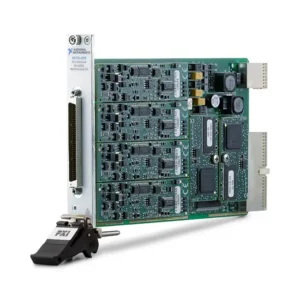
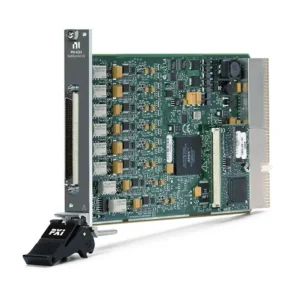
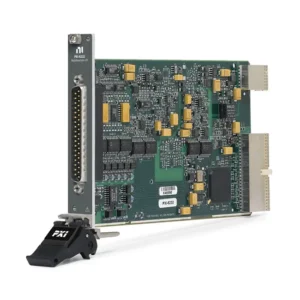
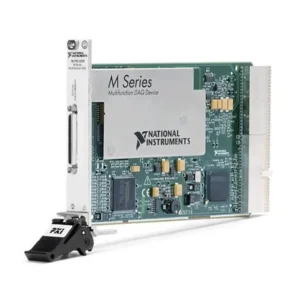
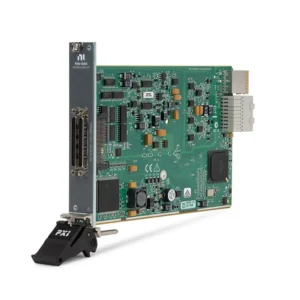


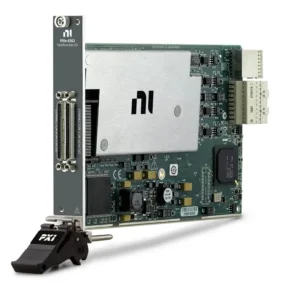


NI PXI Data Acquisition and PXIe DAQ Modules
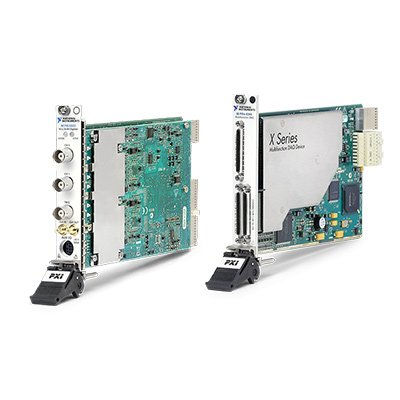
NI PXI Data Acquisition modules provide analog input, analog output, digital I/O and counter functions inside PXI and PXI Express measurement systems. They are used to acquire electrical signals, monitor sensors, generate control voltages, read digital states and coordinate automated measurements.
Selecting the correct PXI DAQ module requires more than comparing channel count and sample rate. Engineers must consider signal range, resolution, accuracy, sampling architecture, isolation, analog output, triggering, synchronization, terminal accessories, chassis bandwidth and NI-DAQmx compatibility.
What Is PXI Data Acquisition?
PXI data acquisition combines modular DAQ hardware with a PXI chassis, system controller and measurement software. The DAQ module converts real-world analog or digital signals into data that can be processed, displayed, stored or used to control a device under test.
A PXI DAQ system can combine several measurement functions in one platform:
- Analog voltage acquisition
- Programmable analog output
- Static or hardware-timed digital I/O
- Frequency, period, pulse and event measurement
- Encoder and position measurement
- Hardware triggering and clock routing
- Synchronization with switching, RF, digitizer and power instruments
PXI DAQ modules operate inside a compatible Шасси PXI and are controlled by an embedded PXI controller or remote computer connection.
A general-purpose DAQ module measures compatible electrical signals but does not automatically provide conditioning for every sensor. Thermocouples, bridge sensors, IEPE transducers and other specialized sensors may require dedicated conditioning hardware.
PXI DAQ Measurement Architectures
| DAQ Architecture | Main Characteristics | Best Fit | Primary Selection Risk |
|---|---|---|---|
| Multiplexed Analog Input | Multiple channels share analog conversion resources | General-purpose measurement and high channel density | Maximum aggregate rate may be divided across active channels |
| Simultaneous Sampling | Multiple analog channels are acquired at the same instant | Phase, power, transient and time-correlated measurements | Usually requires greater data throughput and more signal connections |
| Multifunction I/O | Combines analog input, analog output, digital I/O and counters | Automated functional test and mixed-signal validation | Not every model provides the same quantity of each I/O function |
| Isolated DAQ | Provides electrical separation for supported signal paths | Industrial systems, power electronics and noisy installations | Isolation topology and common-mode limits vary by module |
| High-Resolution DAQ | Optimized for small-signal measurement and precision | Laboratory measurement and detailed electrical characterization | Resolution alone does not define total measurement accuracy |
| High-Density DAQ | Provides many channels in one PXIe slot | Large automated systems with limited chassis space | Connector, cable, scan rate and aggregate throughput requirements |
NI PXI Data Acquisition Model Classification
| Модель | Unique Category | Core Architecture | Best Fit |
|---|---|---|---|
| ПХИ-6115 | Legacy High-Speed S Series DAQ | Traditional PXI multifunction hardware with simultaneous analog acquisition | Maintaining high-speed legacy measurement and transient-test systems |
| PXI-6133 | Legacy Multichannel S Series DAQ | Eight-channel simultaneous analog acquisition with multifunction resources | Time-correlated legacy measurements requiring more input channels |
| PXI-6232 | Isolated M Series DAQ | Traditional PXI multifunction acquisition with isolated signal architecture | Industrial measurement and applications involving ground-potential differences |
| PXI-6280 | High-Resolution M Series DAQ | Precision traditional PXI analog acquisition architecture | Low-level voltage measurement and precision laboratory acquisition |
| PXIe-6343 | General-Purpose X Series DAQ | PXIe multifunction I/O with analog input, analog output, digital I/O and counters | Balanced automated test and mixed-signal measurement systems |
| PXIe-6355 | High-Channel-Count X Series DAQ | Multiplexed multifunction acquisition with increased analog input density | Large channel-count systems requiring versatile I/O functions |
| PXIe-6361 | Compact High-Speed X Series DAQ | Lower-channel-count multifunction PXIe architecture with fast analog acquisition | Automated test requiring high acquisition speed without maximum channel density |
| PXIe-6363 | Expanded-I/O X Series DAQ | Multifunction PXIe acquisition with expanded analog and digital resources | Mixed-signal test systems requiring additional I/O flexibility |
| PXIe-6365 | High-Density High-Speed X Series DAQ | Multiplexed PXIe multifunction architecture with high analog input density | Large automated test systems combining channel density and acquisition speed |
| PXIe-6366 | Eight-Channel Simultaneous X Series DAQ | Multifunction PXIe device with independent simultaneous analog input conversion | Phase-sensitive and time-correlated measurements with moderate channel count |
| PXIe-6368 | Sixteen-Channel Simultaneous X Series DAQ | Higher-channel-count simultaneous acquisition with multifunction I/O | Power, transient and synchronized multichannel measurement |
| PXIe-6375 | Maximum-Density Multiplexed X Series DAQ | 208-channel multifunction analog input architecture for PXIe | High-channel-count automated test with limited chassis space |
| PXIe-6378 | High-Performance Simultaneous X Series DAQ | Simultaneous-sampling multifunction DAQ with analog and digital triggering | Demanding time-correlated measurement and automated validation |
Every model currently listed in this category is assigned to one unique architecture. Models from different generations should not be treated as interchangeable without reviewing connectors, terminal accessories, signal performance, chassis requirements and software compatibility.
How to Select a PXI Data Acquisition Module
1. Identify the Signal Type
Start by identifying the electrical output of the device or sensor. Record whether the signal is voltage, current, resistance, frequency, pulse, digital state or another electrical parameter.
Also determine whether the signal is floating or ground referenced, its source impedance, maximum amplitude, expected frequency content and any common-mode voltage.
2. Determine the Required Channel Count
Calculate the total analog input, analog output, digital I/O and counter channels. Include reference channels, test-fixture monitoring and future expansion.
A high-density module can reduce chassis usage, but it may require multiple cables and terminal blocks. Channel density should not be selected at the expense of sampling, isolation or accuracy requirements.
3. Select the Input Range
The smallest input range that accommodates the maximum expected signal generally provides better usable resolution. Include signal offset, common-mode voltage, transient conditions and overload when selecting the range.
External attenuation or conditioning may be required when signals exceed the module’s supported electrical limits.
4. Evaluate Resolution and Accuracy
ADC resolution describes the number of digital levels used to represent the signal, but it is not the same as measurement accuracy. A complete evaluation includes gain error, offset, noise, drift, input range and calibration uncertainty.
For automated production test, compare system uncertainty with the DUT tolerance and required guard band.
5. Calculate the Required Sample Rate
Select sample rate according to the signal bandwidth and transient behavior. Slowly changing control or sensor signals require less acquisition speed than switching transients, motor waveforms or fast electronic events.
For multiplexed hardware, determine whether the published sample rate is an aggregate rate shared across channels. The per-channel rate can decrease as more channels are added to the scan.
6. Choose Simultaneous or Multiplexed Sampling
Multiplexed acquisition is suitable for general measurements where small timing differences between channels are acceptable. It normally provides higher channel density and efficient use of conversion hardware.
Simultaneous sampling is preferable when phase and timing relationships must be preserved, including:
- Three-phase voltage and current measurement
- Power and energy analysis
- Motor and inverter testing
- Structural and mechanical measurements
- Multichannel transient capture
- Time-correlated DUT response measurement
7. Determine Whether Isolation Is Required
Isolation can reduce ground-loop problems and allow supported measurements between signals operating at different electrical potentials. It can be important in industrial machinery, power electronics, distributed sensors and electrically noisy test environments.
Check whether isolation is provided between channels, between channel banks or only between the measurement circuitry and the PXI system.
8. Review Analog Output Requirements
Multifunction DAQ modules can generate programmable analog voltages for device stimulus, control references and test sequencing. Check output channel count, update rate, range, resolution, drive capability and regeneration mode.
Applications requiring specialized waveform generation may be better served by dedicated PXI signal generators.
9. Review Digital I/O and Counters
Confirm the number of digital lines, logic compatibility, direction control, hardware timing and output-current limits. Digital I/O integrated into a multifunction DAQ device may differ from a dedicated high-performance digital instrument.
For pulse generation, event counting, frequency measurement or encoder input, verify the available counter quantity, timebase and supported routing. Dedicated PXI counter/timer modules may be appropriate when more counter resources are required.
10. Calculate Data Throughput
A simplified payload estimate is:
Data rate = active channels × sample rate × transferred bytes per sample.
For multiplexed devices, use the configured aggregate scan rate. For simultaneous-sampling devices, calculate the combined rate of every active converter. Include multiple modules operating at the same time.
The selected Шасси PXI, controller, memory and storage system must sustain the complete data path.
PXI DAQ vs PXI Digitizer
| Selection Factor | Сбор данных PXI | PXI Oscilloscope or Digitizer |
|---|---|---|
| Primary Function | General measurement, monitoring and control | High-speed waveform and transient acquisition |
| I/O Functions | Can combine analog input, analog output, digital I/O and counters | Primarily optimized for analog waveform input |
| Channel Architecture | Multiplexed, simultaneous or isolated depending on model | Normally simultaneous waveform channels |
| Analog Bandwidth | Suitable for low- to moderate-frequency signals depending on model | Designed for higher-frequency signal fidelity |
| Запуск | Hardware triggers and flexible DAQ timing | Advanced waveform and record triggering |
| Best Fit | Automated functional test, sensor monitoring and mixed I/O | Fast transients, waveform characterization and electronic signal analysis |
If analog bandwidth, waveform fidelity or transient capture is the primary requirement, review PXI oscilloscopes and digitizers rather than selecting a multifunction DAQ device solely because it provides analog inputs.
Triggering and Synchronization
Hardware triggering allows acquisition to begin from an electrical event, another instrument or a chassis trigger line. This provides more predictable timing than starting each operation independently through software.
PXI DAQ synchronization may use:
- Shared start triggers
- Shared sample clocks
- Reference clocks
- PXI or PXIe backplane trigger lines
- External PFI connections
- Dedicated synchronization hardware
Different DAQ generations may use different reference-clock resources. When synchronizing X Series, M Series and older S Series hardware, verify the supported clock and trigger routes instead of assuming that every module can use the same timing method.
For multichassis or advanced clock-distribution requirements, review PXI synchronization modules.
Sensor Measurement and Signal Conditioning
Many sensors do not produce a signal that can be connected directly to a general-purpose DAQ input. The complete system may require amplification, excitation, filtering, bridge completion, isolation or conversion to a compatible voltage.
| Signal or Sensor | Possible Requirement | Selection Guidance |
|---|---|---|
| Conditioned Voltage | Compatible range, grounding and filtering | Often suitable for direct connection to general-purpose DAQ |
| Current Signal | Shunt resistor or current-input conditioning | Verify conversion accuracy and power dissipation |
| Thermocouple | Cold-junction compensation and low-level measurement | Use compatible temperature-measurement hardware |
| RTD | Precision excitation and lead-resistance compensation | Confirm 2-, 3- or 4-wire measurement support |
| Strain or Bridge Sensor | Bridge completion, excitation and shunt calibration | Use dedicated bridge or strain measurement hardware |
| IEPE Sensor | Constant-current excitation and AC/DC coupling | Use suitable dynamic signal measurement hardware |
Review PXI sensor measurement modules for temperature, bridge, LVDT and conditioned-sensor acquisition, or PXI dynamic signal analysis for sound and vibration applications.
Grounding, Cabling and Measurement Integrity
The DAQ module specification represents only part of the total measurement system. Grounding, shielding, cable type, source impedance, terminal accessories and environmental interference can materially affect the result.
Common measurement problems include:
- Ground loops between the DUT and PXI system
- Incorrect differential or referenced single-ended configuration
- Excessive source impedance when using multiplexed inputs
- Long unshielded signal cables
- Power-line and electromagnetic interference
- Input signals exceeding the supported range or common-mode limits
- Incorrect terminal-block or cable pinout
Design the complete connection from the signal source to the module before ordering hardware.
Terminal Blocks and DAQ Accessories
Many PXI DAQ modules use high-density connectors and require separately ordered cables, terminal blocks or breakout accessories. The correct accessory depends on the module connector and required signal performance.
Confirm:
- Module connector type and quantity
- Compatible shielded or unshielded cable
- Terminal-block connector and pinout
- Maximum supported signal voltage
- Whether screw terminals, mass termination or direct fixture connection is required
- Cable length and environmental shielding
- Strain relief and rack integration
The terminal block and cable are part of the measurement path. Ordering the correct DAQ module without its required connection accessories can prevent installation or reduce measurement performance.
NI-DAQmx and Software Compatibility
NI PXI and PXIe multifunction DAQ modules are generally configured through NI-DAQmx. The driver provides device discovery, channel configuration, timing, triggering, scaling, calibration information and programming APIs.
Common software environments include:
- NI Measurement & Automation Explorer for configuration and self-test
- LabVIEW for custom measurement and automation applications
- TestStand for automated production-test sequencing
- FlexLogger for supported data logging and channel configuration
- InstrumentStudio for interactive supported-device measurements
- C, C++, C# and Python applications using supported NI-DAQmx APIs
Before replacing legacy hardware, confirm the required operating system, NI-DAQmx version, application bitness, LabVIEW runtime and custom-code dependencies.
Typical PXI Data Acquisition Applications
- Automated functional and production testing
- Electronic-device design validation
- Automotive ECU and component testing
- Motor, inverter and power-electronics measurement
- Aerospace and avionics system validation
- Industrial equipment monitoring
- Multichannel voltage and sensor acquisition
- Environmental and long-duration testing
- Research laboratory automation
- Hardware-in-the-loop support systems
Legacy PXI DAQ Replacement
Replacing a discontinued PXI DAQ module requires checking more than analog input count. A newer PXIe device may use a different sampling architecture, connector, terminal accessory, voltage range, driver or timing system.
Compare the following before approving a replacement:
- PXI or PXI Express form factor
- Analog input and output channel quantities
- Multiplexed or simultaneous sampling
- Resolution, input range and sample rate
- Isolation and common-mode specifications
- Digital I/O and counter resources
- Trigger and clock-routing capabilities
- Connector, cable and terminal-block compatibility
- NI-DAQmx, operating-system and application support
- Calibration and system-requalification requirements
For validated production systems, obtaining the original model can sometimes be less expensive than modifying fixtures, rewriting software and requalifying the test station.
PXI Data Acquisition Procurement and RFQ Guide
Provide the following information for accurate DAQ selection and quotation:
- Exact module model and complete part number
- Required analog input, analog output and digital channel quantities
- Signal type and expected voltage range
- Required resolution, accuracy and sample rate
- Multiplexed or simultaneous-sampling requirement
- Isolation and common-mode requirements
- Triggering and synchronization requirements
- Existing PXI/PXIe chassis and controller models
- Required cables, terminal blocks and accessories
- Operating system and NI-DAQmx version
- Calibration-documentation requirements
- Quantity, product condition, destination and delivery date
For pre-owned modules, request device recognition, self-test and functional channel-test information. Inspect high-density connectors for bent pins, contamination and physical damage before installation.
Часто задаваемые вопросы
What is the difference between multifunction DAQ and analog-input-only hardware?
Multifunction DAQ can combine analog input, analog output, digital I/O and counter functions. Analog-input-only hardware concentrates on signal acquisition and may provide different channel density, resolution or sampling performance.
What is the difference between simultaneous and multiplexed sampling?
Multiplexed hardware measures several channels through shared conversion resources. Simultaneous-sampling hardware acquires multiple channels at the same instant, preserving relative phase and timing.
Does the published sample rate apply to every channel?
It depends on the module. A multiplexed module normally specifies an aggregate rate shared across the scan, while a simultaneous-sampling module may specify a rate for each channel. Verify the exact specification wording.
Can a general PXI DAQ module measure thermocouples or strain gauges?
Only with suitable signal conditioning. Thermocouples require cold-junction compensation, and strain gauges require bridge completion and excitation. Dedicated sensor modules are usually more appropriate.
Can a traditional PXI DAQ module be installed in a PXIe chassis?
Only when the module is hybrid-slot compatible and the chassis provides a compatible hybrid peripheral slot. Check both model numbers before installation.
Can a newer PXIe DAQ module directly replace an older PXI module?
Not automatically. Differences in chassis interface, connector, terminal block, sampling architecture, timing and software can require hardware and application changes.
Do I need a terminal block and cable?
Usually yes for modules using high-density connectors. Confirm the complete connection path from the DAQ module to the DUT or sensor before ordering.
When should I choose a PXI digitizer instead?
Choose a digitizer when higher-frequency waveform capture, analog bandwidth, transient performance or detailed waveform triggering is the primary requirement.
Recommended NI PXI Data Acquisition Modules
Consider the PXIe-6343 for balanced multifunction I/O, the PXIe-6365 for high-density high-speed acquisition, the PXIe-6368 for multichannel simultaneous sampling, or the PXIe-6375 for maximum analog input density.
Related NI Measurement Platforms
Use CompactDAQ systems for portable or distributed sensor acquisition, PCI and USB DAQ for direct computer-based measurement, or explore additional PXI модули for RF, switching, power and specialized sensor functions.
NI PXI Data Acquisition Modules from PXISOURCE
PXISOURCE supports engineers, system integrators, laboratories and procurement teams with PXI DAQ selection, chassis compatibility review, cable and terminal-block matching, current-product sourcing and legacy-module replacement. Send the signal type, channel count, sample rate, chassis model and preferred hardware condition for a technically matched quotation.
Need help selecting an NI PXI data acquisition module? Email sales@pxisource.com or contact PXISOURCE on WhatsApp.