



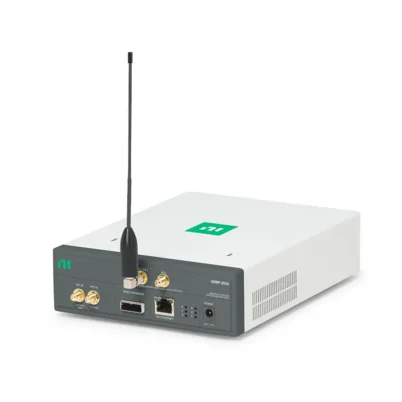
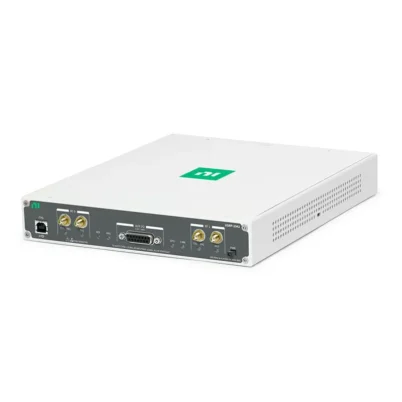
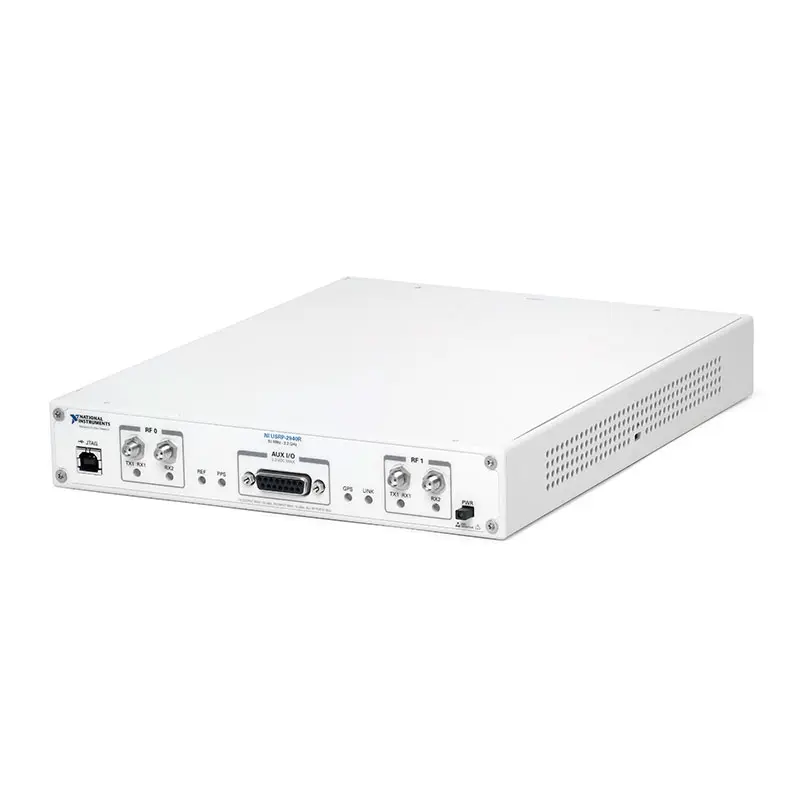
Product Introduction
The NI USRP-2940 is a high-performance software defined radio (SDR) platform designed for wireless communications research, RF prototyping, MIMO development, spectrum monitoring, radar experimentation, and advanced signal processing applications.
Featuring continuous RF coverage from 50 MHz to 2.2 GHz, two transmit channels, two receive channels, configurable 40 MHz or 120 MHz instantaneous bandwidth versions, high-speed I/Q streaming, and a user-programmable FPGA architecture, the USRP-2940 provides significantly greater RF and processing capability than earlier single-channel NI USRP platforms.
The USRP-2940 is particularly suitable for researchers and engineers who require multi-channel RF operation, wider bandwidth, deterministic FPGA processing, and flexible host connectivity for advanced software-defined radio systems.
Product Overview
The NI USRP-2940 belongs to the higher-performance NI USRP family and corresponds to an Ettus Research X310 platform configured with WBX RF front ends.
Unlike earlier USRP-2920 and USRP-2930 platforms that provide one transmit and one receive channel, the USRP-2940 provides two transmit and two receive RF channels. This makes it much better suited for MIMO communication research, multi-antenna systems, beamforming experiments, direction-finding research, and other applications requiring multiple RF channels.
The 50 MHz to 2.2 GHz tuning range covers VHF, UHF, cellular, ISM, navigation, telemetry, public-safety, and numerous experimental RF bands. Combined with 40 MHz or 120 MHz bandwidth configurations, the USRP-2940 provides a flexible platform for both narrowband and wideband SDR development.
Key Features
50 MHz to 2.2 GHz RF Frequency Range
The USRP-2940 provides continuous RF tuning from 50 MHz to 2.2 GHz on its transmit and receive channels.
- 50 MHz to 2.2 GHz transmit frequency range
- 50 MHz to 2.2 GHz receive frequency range
- Frequency step below 1 kHz
- Software-programmable center frequency
- Multi-band RF experimentation
Advantage: The broad tuning range enables a single SDR platform to support research across numerous communication, radar, telemetry, navigation, and experimental RF bands.
2 Transmit and 2 Receive Channels
The USRP-2940 provides two RF transmit channels and two RF receive channels for multi-channel SDR applications.
- 2 RF transmit channels
- 2 RF receive channels
- 2×2 MIMO capability
- Multi-antenna experiments
- Parallel RF signal acquisition
- Parallel RF waveform generation
Advantage: Multi-channel RF capability makes the USRP-2940 suitable for MIMO, beamforming, spatial diversity, direction finding, and advanced wireless communication research.
40 MHz and 120 MHz Bandwidth Versions
The USRP-2940 is available in different bandwidth configurations to support different application requirements.
- USRP-2940 40 MHz version
- USRP-2940 120 MHz version
- Wideband RF signal acquisition
- Wideband waveform generation
- High-throughput SDR applications
Advantage: Engineers can select the bandwidth configuration that best matches the required RF signal bandwidth and system performance.
Up to 200 MS/s I/Q Sample Rate
The USRP-2940 supports high-speed I/Q processing for demanding wireless and RF applications.
- Maximum I/Q sample rate up to 200 MS/s
- Complex I/Q acquisition
- Complex I/Q generation
- Wideband signal processing
- High-throughput RF experimentation
Advantage: High I/Q sample rates enable advanced wideband communication, radar, spectrum, and signal-processing applications.
14-Bit Receiver ADC Architecture
The receiver subsystem incorporates high-speed analog-to-digital conversion for wideband RF signal acquisition.
- 14-bit ADC resolution
- High-speed analog-to-digital conversion
- Wideband I/Q acquisition
- Digital receiver processing
- RF signal characterization
Advantage: The high-speed ADC architecture provides the digital signal representation required for advanced software-defined receiver applications.
16-Bit Transmitter DAC Architecture
The transmitter subsystem uses high-speed digital-to-analog conversion for programmable RF waveform generation.
- 16-bit DAC resolution
- Programmable I/Q waveform generation
- Digital modulation
- Custom RF waveform development
- Wideband signal generation
Advantage: High-resolution DAC resources support flexible generation of complex digitally modulated RF waveforms.
Programmable Transmit Gain
The USRP-2940 provides software-controlled RF transmit gain for adapting the generated signal level to different experimental configurations.
- 0 dB to 31 dB transmit gain range
- 1 dB gain steps
- Software-controlled gain adjustment
- Custom RF waveform transmission
- Laboratory wireless links
Advantage: Programmable gain provides flexibility when configuring transmit levels for different RF experiments and test setups.
RF Output Power
The maximum RF output power of the USRP-2940 varies according to operating frequency.
- Approximately 17 dBm to 20 dBm from 50 MHz to 1.2 GHz
- Approximately 15 dBm to 18 dBm from 1.2 GHz to 2.2 GHz
- Software-adjustable RF gain
- Dual-channel RF transmission
Advantage: Provides useful RF output levels for laboratory wireless communication and controlled over-the-air experiments.
Programmable Receiver Gain
The receiver channels provide software-adjustable gain for capturing signals across different RF environments.
- 0 dB to 37.5 dB receive gain range
- Software-controlled receiver gain
- Dual-channel RF acquisition
- Wireless signal monitoring
- RF signal characterization
Advantage: Adjustable receive gain allows engineers to optimize receiver performance according to the signal level and experimental configuration.
2.5 ppm Frequency Accuracy
The internal reference oscillator provides specified frequency accuracy suitable for many laboratory and wireless research applications.
- 2.5 ppm frequency accuracy
- Stable RF tuning
- Repeatable carrier generation
- External reference capability
- Multi-radio synchronization options
Advantage: Applications requiring greater frequency precision can use an external reference source to improve synchronization and frequency accuracy.
User-Programmable FPGA
One of the major advantages of the USRP-2940 architecture is the FPGA processing capability located directly within the SDR hardware.
- Onboard FPGA processing
- Custom digital signal processing
- Real-time filtering
- Digital upconversion
- Digital downconversion
- Custom triggering and control
Advantage: FPGA processing allows computationally intensive and latency-sensitive algorithms to execute closer to the RF hardware rather than relying entirely on the host computer.
High-Speed Host Connectivity
The USRP-2940 supports high-speed connectivity for transferring I/Q data between the SDR and host processing system.
- Gigabit Ethernet support
- PCI Express / MXI Express connectivity options
- High-throughput I/Q streaming
- PC-based SDR development
- Flexible laboratory integration
Advantage: Multiple host-interface options provide flexibility when balancing throughput, system architecture, and installation requirements.
External Clock and Synchronization
The USRP-2940 supports external timing and reference signals for applications involving multiple synchronized radios.
- External reference clock support
- External timing synchronization
- Multi-device RF systems
- Coordinated acquisition
- Coordinated waveform generation
Advantage: External synchronization enables multiple SDR devices to operate from common timing and frequency references.
Technical Specifications
| Parameter | Description |
|---|---|
| Product Type | High-Performance Software Defined Radio / USRP |
| Model | NI USRP-2940 |
| Equivalent Architecture | Ettus Research X310 + WBX |
| RF Channels | 2 TX / 2 RX |
| Transmit Frequency Range | 50 MHz to 2.2 GHz |
| Receive Frequency Range | 50 MHz to 2.2 GHz |
| Frequency Step | <1 kHz |
| Frequency Accuracy | 2.5 ppm |
| Bandwidth Versions | 40 MHz / 120 MHz |
| Maximum I/Q Sample Rate | 200 MS/s |
| Transmit Channels | 2 |
| Receive Channels | 2 |
| Transmit Gain Range | 0 dB to 31 dB |
| Transmit Gain Step | 1 dB |
| Maximum RF Output Power | 17–20 dBm at 50 MHz–1.2 GHz / 15–18 dBm at 1.2–2.2 GHz |
| Receive Gain Range | 0 dB to 37.5 dB |
| ADC Resolution | 14-bit |
| DAC Resolution | 16-bit |
| FPGA | User-Programmable FPGA Architecture |
| Host Connectivity | Gigabit Ethernet / PCI Express or MXI Express |
| External Reference | Supported |
| Primary Applications | MIMO, Wireless Research, RF Prototyping, Radar, Spectrum Monitoring and FPGA-Based SDR |
Software Ecosystem
The NI USRP-2940 integrates with NI software tools for host-based RF processing as well as FPGA-based software-defined radio development.
- NI-USRP: Provides software APIs for RF configuration, frequency control, gain adjustment, signal acquisition, waveform generation, and I/Q streaming.
- LabVIEW: Enables graphical development of wireless communications, RF measurement, signal processing, modulation, demodulation, and automated SDR applications.
- FPGA Development: The programmable FPGA architecture enables implementation of custom high-speed and low-latency signal-processing algorithms directly within the radio hardware.
- Custom SDR Applications: Engineers can develop application-specific communication, radar, spectrum monitoring, and RF research systems.
Industries
- Wireless Communications
- Telecommunications Research
- Aerospace and Defense Research
- Radar Development
- RF Engineering
- Electronic Warfare Research
- Universities and Education
- Scientific Research
- Wireless Product Development
Applications
MIMO Wireless Communications
The 2 TX / 2 RX architecture makes the USRP-2940 suitable for multi-antenna wireless communication research.
- 2×2 MIMO
- Spatial multiplexing
- Transmit diversity
- Receive diversity
- Multi-antenna algorithm development
Beamforming Research
Multiple RF channels can be used to investigate phased-array and beamforming concepts.
- Digital beamforming
- Multi-antenna processing
- Direction-of-arrival research
- Spatial signal processing
- Antenna-array experiments
Wireless Communications Research
The wide RF tuning range and programmable SDR architecture support development of custom communication systems.
- Digital modulation
- OFDM development
- Channel coding
- Receiver algorithms
- Wireless protocol research
Cellular Research
The USRP-2940 can support experimental cellular communication applications operating within its supported frequency range.
- Cellular waveform research
- Physical-layer development
- Channel characterization
- Baseband algorithm testing
- Multi-antenna cellular experiments
Radar Research
Wide bandwidth, dual-channel RF operation, and programmable FPGA resources make the USRP-2940 useful for experimental radar applications.
- Radar waveform generation
- Radar signal acquisition
- Pulse processing
- FMCW research
- Real-time radar DSP
Spectrum Monitoring
The USRP-2940 can acquire wideband I/Q signals for software-based spectrum monitoring and RF analysis.
- Wideband spectrum monitoring
- Signal detection
- Interference analysis
- RF environment monitoring
- Signal classification research
Direction Finding
Multiple synchronized receive channels can support experimental direction-finding and localization algorithms.
- Direction-of-arrival estimation
- Phase comparison
- Multi-antenna receiver systems
- Signal localization research
- Spatial RF analysis
FPGA-Based Signal Processing
The programmable FPGA allows real-time algorithms to execute directly within the SDR hardware.
- Real-time filtering
- FFT processing
- Custom triggering
- Signal detection
- Digital downconversion
- Low-latency RF processing
Comparison with Similar USRP Devices
| Model | Main Difference | Best Application |
|---|---|---|
| NI USRP-2940 | 50 MHz to 2.2 GHz, 2 TX/2 RX SDR with 40 MHz or 120 MHz bandwidth and programmable FPGA architecture. | MIMO and wideband SDR research |
| NI USRP-2930 | 50 MHz to 2.2 GHz, 1 TX/1 RX SDR with integrated GPS-disciplined timing and lower real-time bandwidth. | GPS-synchronized SDR applications |
| NI USRP-2942 | Similar 2 TX/2 RX high-performance architecture but with 400 MHz to 4.4 GHz RF coverage. | Higher-frequency MIMO and SDR research |
| NI USRP-2950 | 50 MHz to 2.2 GHz, 2 TX/2 RX architecture with integrated GPS-disciplined oscillator for improved synchronization. | Synchronized MIMO and distributed RF systems |
Recommended Related Products
| NI USRP-2930 | 50 MHz to 2.2 GHz GPS-disciplined SDR for applications requiring precise timing and synchronization with lower channel requirements. |
| NI USRP-2942 | 2 TX/2 RX software-defined radio covering 400 MHz to 4.4 GHz for higher-frequency wireless and RF research. |
| NI USRP-2950 | GPS-disciplined version for advanced synchronized MIMO, distributed radio, and wideband wireless research. |
| NI USRP-2920 | Lower-cost 1 TX/1 RX SDR covering 50 MHz to 2.2 GHz for general-purpose wireless communication research. |
Why Choose USRP-2940?
- 50 MHz to 2.2 GHz continuous RF coverage
- 2 transmit and 2 receive RF channels
- Suitable for 2×2 MIMO applications
- 40 MHz and 120 MHz bandwidth configurations
- Maximum I/Q sample rate up to 200 MS/s
- 14-bit receiver ADC architecture
- 16-bit transmitter DAC architecture
- Programmable RF gain
- User-programmable FPGA
- Gigabit Ethernet connectivity
- PCI Express / MXI Express connectivity options
- External synchronization support
- Suitable for wideband wireless and radar research
Frequently Asked Questions
What is the NI USRP-2940?
The NI USRP-2940 is a high-performance software-defined radio platform providing two transmit and two receive RF channels, 50 MHz to 2.2 GHz frequency coverage, wideband I/Q processing, and programmable FPGA resources.
What frequency range does the USRP-2940 support?
The USRP-2940 supports RF transmission and reception from 50 MHz to 2.2 GHz.
How many RF channels does the USRP-2940 have?
The USRP-2940 provides two transmit channels and two receive channels, making it suitable for 2×2 MIMO and other multi-channel RF applications.
What bandwidth does the USRP-2940 support?
The USRP-2940 family is available in 40 MHz and 120 MHz maximum instantaneous real-time bandwidth configurations. The exact bandwidth therefore depends on the specific USRP-2940 version.
What is the maximum I/Q sample rate of USRP-2940?
The USRP-2940 supports a maximum I/Q sample rate of up to 200 MS/s according to the device specifications.
Can USRP-2940 be used for MIMO?
Yes. Its two transmit and two receive channels make the USRP-2940 suitable for 2×2 MIMO, spatial diversity, multi-antenna communications, and related research applications.
Does the USRP-2940 have a programmable FPGA?
Yes. The USRP-2940 architecture includes programmable FPGA resources that can be used for custom digital signal processing, filtering, triggering, modulation, demodulation, and other low-latency RF functions.
What is the difference between USRP-2930 and USRP-2940?
Both devices cover 50 MHz to 2.2 GHz, but the USRP-2930 is a 1 TX/1 RX platform with integrated GPS-disciplined timing and lower bandwidth. The USRP-2940 provides 2 TX/2 RX channels, substantially higher bandwidth options, and a more powerful FPGA architecture for advanced SDR applications.
What is the difference between USRP-2940 and USRP-2942?
The two platforms use a similar high-performance 2 TX/2 RX SDR architecture. The primary difference is RF frequency coverage: the USRP-2940 covers 50 MHz to 2.2 GHz, while the USRP-2942 covers 400 MHz to 4.4 GHz.
What is the difference between USRP-2940 and USRP-2950?
Both provide 50 MHz to 2.2 GHz RF coverage, 2 TX/2 RX operation, and 40 MHz or 120 MHz bandwidth options. The USRP-2950 adds an integrated GPS-disciplined oscillator, making it more suitable for applications requiring improved frequency accuracy, absolute timing, or distributed synchronization.
Can USRP-2940 be used for radar research?
Yes. Its dual transmit and receive channels, wide instantaneous bandwidth, programmable FPGA, and high-speed I/Q processing make the USRP-2940 suitable for experimental radar waveform generation, acquisition, and real-time signal-processing research within the hardware’s RF performance limits.
Can USRP-2940 be used for spectrum monitoring?
Yes. The USRP-2940 can acquire wideband I/Q data for spectrum monitoring, signal detection, interference analysis, and RF research. For calibrated regulatory or metrology measurements, a dedicated calibrated RF instrument may still be required.
What software supports USRP-2940?
The USRP-2940 is supported by compatible NI-USRP software environments and can be integrated with LabVIEW for RF configuration, I/Q streaming, waveform generation, signal acquisition, and software-defined radio development.
Is the USRP-2940 available in different bandwidth versions?
Yes. NI documentation identifies both USRP-2940 40 MHz and USRP-2940 120 MHz versions. When purchasing a replacement or expanding an existing system, the exact bandwidth version and part number should be verified before ordering.
Conclusion
The NI USRP-2940 software defined radio is a high-performance 2 TX/2 RX SDR platform for MIMO communications, RF prototyping, radar research, spectrum monitoring, direction finding, FPGA-based signal processing, and advanced wireless experimentation. With continuous 50 MHz to 2.2 GHz RF coverage, 40 MHz or 120 MHz bandwidth configurations, up to 200 MS/s I/Q sampling, programmable FPGA resources, and high-speed host connectivity, the USRP-2940 provides a substantial performance upgrade for applications requiring wider bandwidth and multiple RF channels.