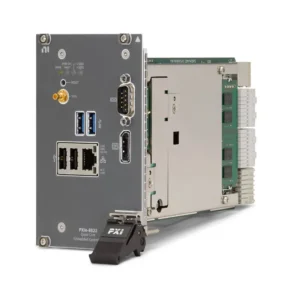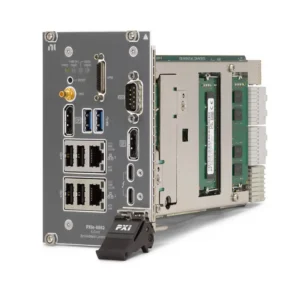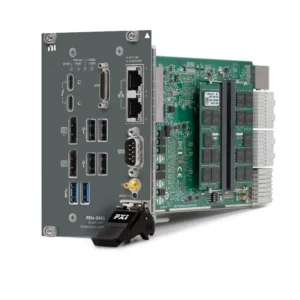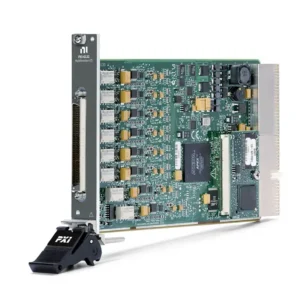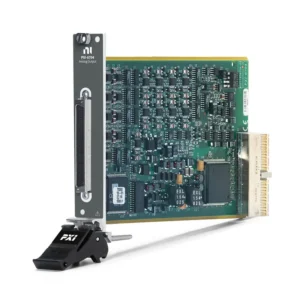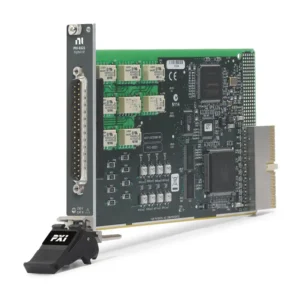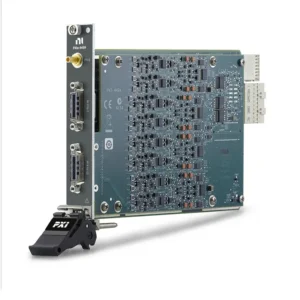


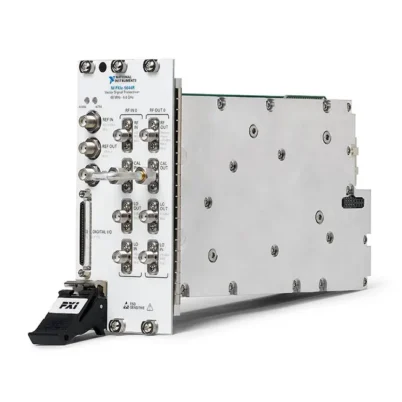
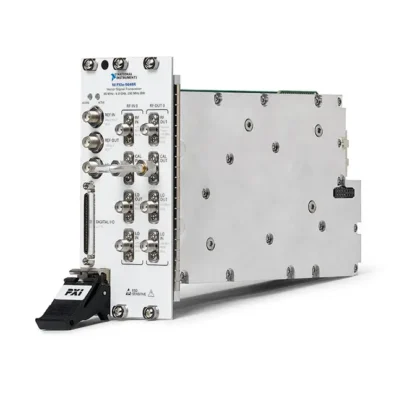
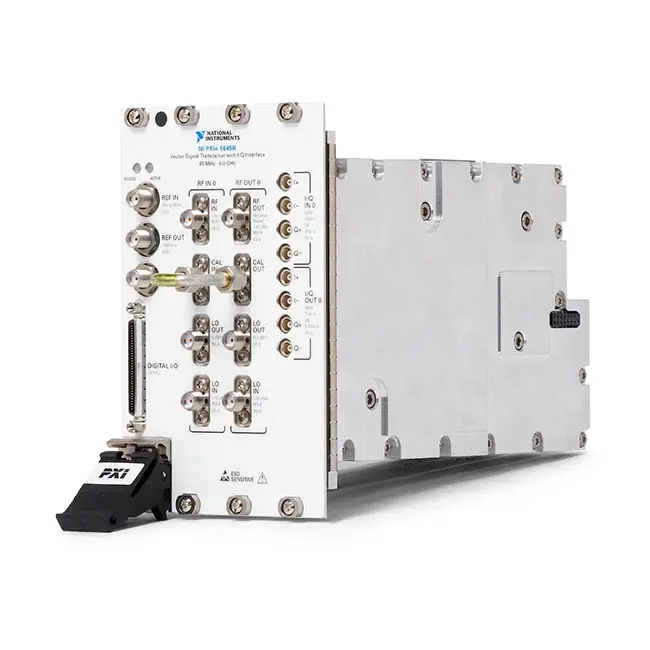
PXIe-5645 RF and Baseband Vector Signal Transceiver
The NI PXIe-5645 is a reconfigurable PXI Express vector signal transceiver for RF and baseband test. It integrates a vector signal analyzer, vector signal generator, differential analog I/Q interfaces, digital I/O and a user-programmable FPGA.
The instrument covers 65 MHz to 6 GHz with up to 80 MHz of digitally equalized RF bandwidth. Direct baseband I/Q connectivity supports applications that need access to modulator, demodulator or transceiver baseband paths in addition to conventional RF measurements.
Key Features of the PXIe-5645
- 65 MHz to 6 GHz RF coverage
- Up to 80 MHz RF instantaneous bandwidth
- Integrated VSA and VSG functions
- Differential analog I/Q input and output
- User-programmable FPGA for real-time processing
- 24 bidirectional digital I/O lines
- RF, baseband and digital interfaces in one instrument
- NI-RFSA, NI-RFSG, RFmx and LabVIEW FPGA support
PXIe-5645 Technical Specifications
| Product Model | PXIe-5645 |
|---|---|
| Product Type | Reconfigurable RF and baseband vector signal transceiver |
| RF Frequency Range | 65 MHz to 6 GHz |
| Maximum RF Bandwidth | 80 MHz; frequency-dependent at low center frequencies |
| Tuning Resolution | Less than 1 Hz |
| Baseband Interface | Differential analog I/Q input and output |
| Digital I/O | 24 bidirectional lines plus programmable function interfaces |
| RF Connectors | 50-ohm SMA RF IN and RF OUT |
| Software | NI-RFSA, NI-RFSG, RFmx and LabVIEW FPGA |
| Ordering Information | Verify revision, cable set and software requirements before ordering |
RF and Baseband Testing
The PXIe-5645 can test a complete RF signal path through its RF connectors or access differential I/Q signals directly. This makes it useful for characterizing mixers, modulators, demodulators, transceivers and custom communication prototypes.
80 MHz Signal Bandwidth
Maximum equalized bandwidth is 80 MHz. NI specifies reduced bandwidth at lower LO frequencies, so test plans should use the published center-frequency limits when selecting waveform bandwidth.
Reconfigurable FPGA Processing
Custom FPGA code can implement deterministic triggering, inline DSP, waveform control and application-specific protocol behavior. Processing close to the converters reduces latency compared with host-only analysis.
Typical PXIe-5645 Applications
- RF transceiver design validation
- Baseband I/Q component testing
- Wireless modulation and demodulation analysis
- RFIC and mixed-signal production test
- Software-defined radio prototyping
- Custom real-time RF control
PXIe-5645 vs PXIe-5644
Both models provide 65 MHz to 6 GHz RF coverage and 80 MHz maximum bandwidth. Select the PXIe-5645 when direct differential analog I/Q access is required; select the PXIe-5644 for an RF-focused legacy VST configuration.
PXIe-5645 vs PXIe-5646
The PXIe-5646 increases maximum instantaneous bandwidth to 200 MHz. The PXIe-5645 remains attractive for 80 MHz applications that specifically need its RF and baseband connection architecture.
Frequently Asked Questions
Does the PXIe-5645 support baseband I/Q signals?
Yes. It provides differential analog I/Q input and output in addition to RF input and output.
What is its RF frequency range?
The RF input and output operate from 65 MHz to 6 GHz.
What is the maximum RF bandwidth?
The maximum digitally equalized RF bandwidth is 80 MHz, with reduced limits at low center frequencies.
Which software controls the module?
NI-RFSA and NI-RFSG control acquisition and generation; RFmx supports measurements, and LabVIEW FPGA supports compatible custom FPGA development.
Request a Quote for the PXIe-5645
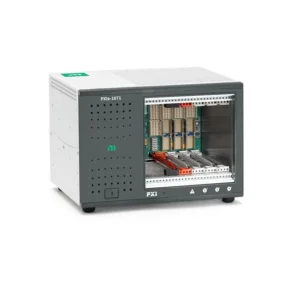
Contact us for availability, configuration review and pricing for the PXIe-5645 RF and Baseband Vector Signal Transceiver. We can also help select compatible I/Q cables, RF accessories and PXI Express chassis.