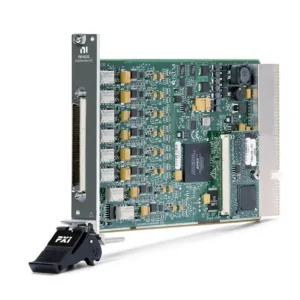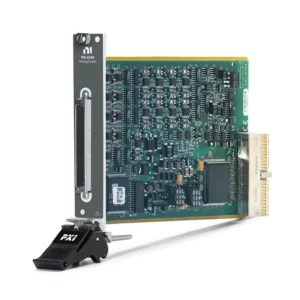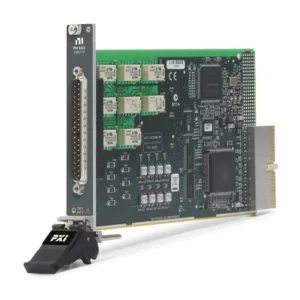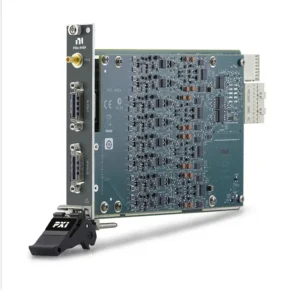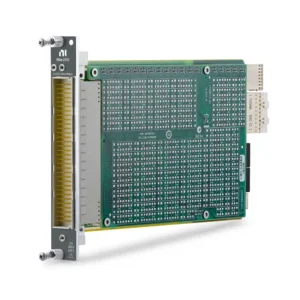






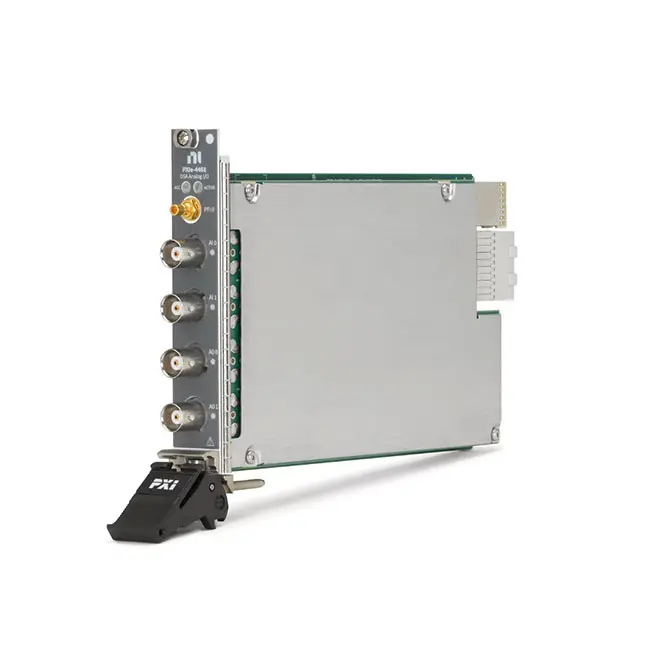
PXIe-4468 Sound and Vibration Module
The PXIe-4468 is a 24-bit PXI sound and vibration module with two simultaneously sampled analog inputs and two analog outputs. It is designed for precision measurements using microphones, accelerometers and other sensors with wide dynamic ranges.
The module provides analog input sampling rates up to 250 kS/s per channel, analog output rates up to 200 kS/s per channel and a typical input dynamic range of up to 121 dB. Integrated IEPE signal conditioning, selectable gain, AC/DC coupling and pure-tone generation reduce the need for separate external instrumentation.
The PXIe-4468 can be used in PXI sound and vibration systems for audio testing, automotive noise and vibration analysis, machine condition monitoring, acoustic measurements and frequency-response testing.
Key Features of the PXIe-4468
- Two simultaneously sampled analog input channels
- Two simultaneously updated analog output channels
- 24-bit delta-sigma ADC and DAC resolution
- 100 S/s to 250 kS/s analog input sampling
- 100 S/s to 200 kS/s analog output generation
- Up to 121 dB typical input dynamic range
- Alias-free input bandwidth up to approximately 101.5 kHz
- Six software-selectable input gain settings
- Input ranges from ±0.316 V to ±42.4 V peak
- ±10 V analog output range
- Independent AC or DC input coupling
- IEPE excitation of 4 mA, 10 mA or 20 mA
- 24 V IEPE compliance voltage
- Software-readable IEPE sensor open and short detection
- Differential or pseudodifferential input configuration
- Integrated antialiasing filters
- Pure-tone signal generation mode
- BNC or mini-XLR connector versions
- PXI Express interface
PXIe-4468 Technical Specifications
| Product Model | PXIe-4468 |
|---|---|
| Product Type | PXI Sound and Vibration Module |
| Analog Input Channels | 2 differential or pseudodifferential |
| Analog Output Channels | 2 differential or pseudodifferential |
| Input ADC Resolution | 24 bits |
| Output DAC Resolution | 24 bits |
| Maximum Input Sample Rate | 250 kS/s per channel |
| Maximum Output Update Rate | 200 kS/s per channel |
| Input Dynamic Range | Up to 121 dB typical |
| Alias-Free Input Bandwidth | DC to the lower of 0.454 × sample rate or approximately 101.5 kHz |
| Alias Rejection | 105 dBc |
| Input Gain Settings | −20 dB, −10 dB, 0 dB, 10 dB, 20 dB and 30 dB |
| Input Voltage Ranges | ±0.316 V, ±1 V, ±3.16 V, ±10 V, ±31.6 V and ±42.4 V peak |
| Input Coupling | AC or DC, independently selectable per channel |
| AC-Coupled High-Pass Cutoff | 0.8 Hz, −3 dB |
| IEPE Excitation | Off, 4 mA, 10 mA or 20 mA |
| IEPE Compliance Voltage | 24 V |
| Analog Output Range | ±10 V |
| Analog Output Coupling | DC |
| Trigger Connection | SMB PFI connector |
| Bus Interface | PXI Express |
| Operating Temperature | 0°C to 55°C |
PXIe-4468 Part Numbers and Connector Options
| Part Number | Front Connector | Channel Configuration |
|---|---|---|
| 788511-01 | 4 × BNC and 1 × SMB | 2 analog inputs and 2 analog outputs |
| 788512-01 | 4 × mini-XLR and 1 × SMB | 2 analog inputs and 2 analog outputs |
The two versions provide the same primary acquisition, generation and signal-conditioning functions. Select part number 788511-01 for standard BNC connectivity or part number 788512-01 when mini-XLR connections are preferred.
When replacing an existing module, verify the complete part number, connector style, cable type and hardware revision. Earlier mini-XLR revisions may have specification differences compared with current BNC and mini-XLR variants.
24-Bit Dynamic Signal Acquisition
The PXIe-4468 uses 24-bit delta-sigma analog-to-digital converters to acquire two analog input channels simultaneously. Simultaneous sampling preserves the timing and phase relationship between channels, which is important for vibration, acoustic, audio and frequency-response measurements.
Input sampling rates can be configured from 100 S/s to 250 kS/s. At the maximum sampling rate, the alias-free input bandwidth extends to approximately 101.5 kHz, allowing the module to measure signals beyond the standard 20 kHz audio band.
Integrated digital antialiasing filters automatically adapt to the configured sample rate. These filters help prevent out-of-band signal energy from appearing incorrectly within the measured frequency spectrum.
Six Input Gain and Voltage Ranges
Each input channel provides six independently selectable gain settings. The gain can be matched to the connected sensor output to improve measurement resolution while avoiding input overload.
| Gain Setting | Full-Scale Input Range |
|---|---|
| 30 dB | ±0.316 V peak |
| 20 dB | ±1 V peak |
| 10 dB | ±3.16 V peak |
| 0 dB | ±10 V peak |
| −10 dB | ±31.6 V peak |
| −20 dB | ±42.4 V peak |
Higher gain settings are appropriate for low-output sensors and small signals. Lower gain settings provide wider input ranges for signal generators, audio amplifiers and other higher-voltage sources.
AC and DC Input Coupling
AC or DC coupling can be selected independently for each analog input channel. DC coupling preserves both the static and dynamic components of the signal and is useful for direct voltage measurements, low-frequency vibration and sensor bias monitoring.
AC coupling removes the DC component and allows the module to focus on changing signal content. The AC-coupled input has a −3 dB high-pass cutoff frequency of approximately 0.8 Hz, supporting low-frequency vibration and acoustic measurements.
IEPE Sensor Signal Conditioning
The PXIe-4468 provides integrated IEPE constant-current excitation for compatible accelerometers and microphones. Each input channel can independently enable 4 mA, 10 mA or 20 mA excitation, with a compliance voltage of 24 V.
Integrated IEPE conditioning allows supported sensors to connect directly to the module without a separate external current source. The module also provides software-readable sensor open-circuit and short-circuit detection to help identify connection and sensor problems.
Before enabling IEPE excitation, verify that the connected transducer is an IEPE-compatible sensor and that the selected excitation current is within its specified operating range. Applying IEPE current to an incompatible device may produce incorrect measurements or damage the connected hardware.
Two-Channel Analog Signal Generation
The PXIe-4468 includes two 24-bit analog output channels with update rates from 100 S/s to 200 kS/s. Each output channel supports a range of ±10 V and can be configured for differential or pseudodifferential operation.
The analog outputs can generate low-distortion signals for audio and vibration testing. They can be used to excite a system while the analog inputs simultaneously measure its response, enabling frequency-response, distortion and stimulus-response measurements in one PXI module.
Pure-Tone Signal Generation
The integrated pure-tone generator is optimized for producing precise sine-wave signals. This capability is useful for audio component testing, signal-chain distortion measurements, acoustic excitation and frequency-response analysis.
Pure-tone generation can reduce waveform-memory and host-streaming requirements compared with continuously transferring calculated waveform data from the PXI controller.
Frequency-Response and Distortion Testing
Because the PXIe-4468 provides both analog input and output channels, it can generate a stimulus and acquire the response of a device under test. Engineers can measure gain, phase, frequency response, total harmonic distortion, noise and other signal-chain characteristics.
Typical devices tested with this configuration include:
- Audio amplifiers
- Loudspeakers and headphones
- Microphones and microphone preamplifiers
- Analog filters
- Data converter signal chains
- Vibration control components
- Electronic sensors
- Automotive audio systems
Typical PXIe-4468 Applications
- Audio signal generation and analysis
- Automotive noise, vibration and harshness testing
- Machine condition monitoring
- Acoustic measurement
- IEPE accelerometer acquisition
- IEPE microphone measurement
- Frequency-response testing
- Signal-chain distortion analysis
- Structural vibration measurement
- Rotating machinery diagnostics
- Speaker and microphone testing
- Research and laboratory automation
- Electronic component validation
- Production audio testing
Synchronization and Triggering
The PXIe-4468 supports PXI Express timing and triggering resources for synchronizing acquisition and generation with other instruments. Its front-panel SMB PFI connection can be used for supported external trigger and timing functions.
Multiple PXIe-4468 modules can be synchronized when additional input and output channels are required. Proper synchronization maintains timing and phase relationships across modules, which is essential for modal analysis, acoustic arrays and multichannel vibration systems.
For the best intermodule phase matching, use a common timebase, allow the modules to warm up and perform self-calibration before acquiring precision measurements.
Software and Driver Support
The PXIe-4468 uses the NI-DAQmx driver for hardware configuration, acquisition, signal generation, timing and triggering. It can be programmed using supported versions of LabVIEW, LabWindows/CVI, C/C++, .NET and Python.
FlexLogger can be used for interactive sensor configuration, data logging, alarms and long-duration condition-monitoring applications. The LabVIEW Sound and Vibration Toolkit provides analysis functions for frequency, octave, order, transient, distortion and vibration measurements.
NI DIAdem can be used for offline data analysis, visualization and automated report generation. Verify operating-system, driver and application-software compatibility before installing the module in an existing system.
PXIe-4468 Chassis Compatibility
The PXIe-4468 is a PXI Express module and requires a compatible PXI Express peripheral or hybrid slot. It cannot operate in a conventional PXI-only slot.
Before purchasing, verify the chassis slot type, controller, cooling capacity, NI-DAQmx version and available PXI timing resources. For synchronized multichannel systems, also confirm the chassis backplane timing architecture.
PXIe-4468 Troubleshooting
The Input Signal Is Clipped
Select a lower gain setting or a wider input range. Verify the sensor bias voltage, signal amplitude and common-mode voltage before beginning acquisition.
An IEPE Sensor Produces No Signal
Confirm that IEPE excitation is enabled and that the selected current is compatible with the sensor. Check the software-readable open and short status, sensor wiring and cable condition.
The Measurement Contains a Large DC Offset
If the DC component is not required, select AC coupling. If DC coupling is necessary, verify the sensor bias, grounding and input configuration.
Unexpected Low-Frequency Attenuation Appears
AC coupling introduces a high-pass response with a −3 dB cutoff near 0.8 Hz. Select DC coupling when measurements must include frequencies approaching DC.
Noise Is Higher Than Expected
Select the smallest input range that does not clip the signal. Use shielded cables, check grounding and keep sensor wiring away from switching power supplies, motors and high-current conductors.
Measured Phase Differs Between Channels
Confirm that both channels use identical sample rates, coupling and gain settings. For measurements involving multiple modules, synchronize them to a common timebase and perform self-calibration after warm-up.
The Analog Output Does Not Reach the Programmed Level
Check the output configuration, connected load impedance and termination mode. Ensure that the programmed waveform does not exceed the ±10 V output range.
PXIe-4468 Compared with Similar Sound and Vibration Modules
| Model | Analog Inputs | Analog Outputs | Maximum Sample Rate | Dynamic Range | Best Fit |
|---|---|---|---|---|---|
| PXIe-4468 | 2 | 2 | 250 kS/s | 121 dB | Combined signal generation and acquisition |
| PXIe-4464 | 4 | 0 | 204.8 kS/s | 119 dB | Four-channel sound and vibration acquisition |
| PXIe-4463 | 0 | 2 | 51.2 kS/s output | Not applicable | Dedicated dynamic signal generation |
| PXIe-4480 | 6 | 0 | 1.25 MS/s | 115 dB | Higher-bandwidth acquisition with signal conditioning |
| PXIe-4481 | 6 | 0 | 1.25 MS/s | 115 dB | Higher-bandwidth voltage acquisition |
The PXIe-4468 is the most suitable option when a system needs both high-dynamic-range acquisition and precision signal generation in one slot. Select the PXIe-4464 when additional input channels are more important than output generation, or choose the PXIe-4480 or PXIe-4481 when higher input bandwidth and sampling rates are required.
Recommended Related Products
- PXIe-4464 Sound and Vibration Module – Provides four simultaneously sampled input channels for higher-channel-count acquisition.
- PXIe-4463 Dynamic Signal Generation Module – A dedicated two-channel analog output module for audio and vibration stimulus generation.
- PXIe-4480 Sound and Vibration Module – Provides six higher-bandwidth input channels with integrated sensor signal conditioning.
- PXIe-4481 Dynamic Signal Acquisition Module – Offers six input channels and sampling rates up to 1.25 MS/s.
- PXIe-4499 Sound and Vibration Module – A higher-channel-count option for large acoustic and vibration measurement systems.
How to Select the Correct PXIe-4468
Choose the PXIe-4468 when an application requires two precision input channels and two analog output channels in the same PXI Express slot. It is particularly useful for stimulus-response measurements and test systems that must generate and analyze dynamic signals simultaneously.
Before ordering, confirm the following:
- BNC or mini-XLR connector preference
- Required input and output channel count
- Maximum signal frequency and sample rate
- Sensor output voltage and required gain range
- IEPE excitation current requirements
- AC- or DC-coupled measurement requirements
- Differential or pseudodifferential wiring
- PXI Express chassis compatibility
- Synchronization with other PXI modules
- Required NI-DAQmx and analysis software
Why Choose the PXIe-4468?
The PXIe-4468 combines high-dynamic-range acquisition, integrated IEPE conditioning and precision signal generation in one PXI Express module. Its two input and two output channels support complete stimulus-response measurements without requiring separate acquisition and generation instruments.
Six input ranges, simultaneous sampling and flexible channel configuration make the module suitable for both low-level sensor signals and higher-amplitude electronic measurements.
Frequently Asked Questions
What is the PXIe-4468?
The PXIe-4468 is a 24-bit PXI Express sound and vibration module with two analog inputs, two analog outputs and integrated IEPE sensor conditioning.
What is the maximum input sampling rate?
The two analog input channels can sample simultaneously at rates up to 250 kS/s per channel.
What is the maximum analog output rate?
The two analog output channels support update rates up to 200 kS/s per channel.
What is the PXIe-4468 dynamic range?
The module provides a typical analog input dynamic range of up to 121 dB under the specified configuration and measurement bandwidth.
Does the PXIe-4468 support IEPE sensors?
Yes. Each input channel supports independently selectable 4 mA, 10 mA or 20 mA IEPE excitation with 24 V compliance.
What is the difference between 788511-01 and 788512-01?
Part number 788511-01 uses BNC connectors, while 788512-01 uses mini-XLR connectors. Their primary measurement and generation capabilities are the same.
What input ranges are available?
The PXIe-4468 provides six full-scale ranges from ±0.316 V to ±42.4 V peak.
Can it generate test signals?
Yes. The module includes two 24-bit analog outputs with a ±10 V range, update rates up to 200 kS/s and pure-tone generation capability.
Does it support simultaneous sampling?
Yes. Both analog input channels are sampled simultaneously to maintain their timing and phase relationship.
Can the PXIe-4468 measure DC signals?
Yes. Each input channel can be independently configured for DC coupling. AC coupling is also available when the DC signal component should be removed.
Which driver controls the PXIe-4468?
The PXIe-4468 is controlled using NI-DAQmx and can be used with supported versions of FlexLogger, LabVIEW and the LabVIEW Sound and Vibration Toolkit.
Request a Quote for the PXIe-4468
Contact us for current availability, lead time and project pricing for the PXIe-4468 Sound and Vibration Module. Please specify whether you require the 788511-01 BNC version or the 788512-01 mini-XLR version.
We can also help verify compatible PXI Express chassis, controllers, IEPE sensors, cables and sound and vibration software for your measurement system.