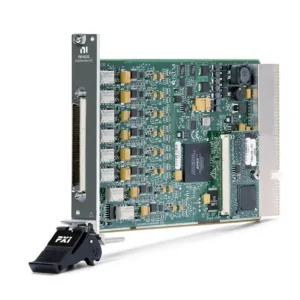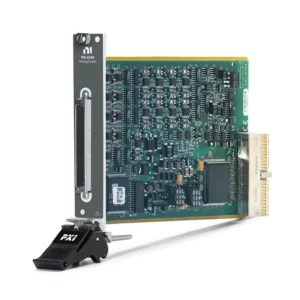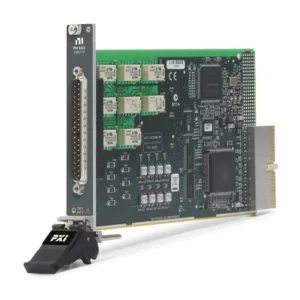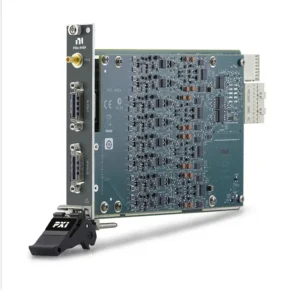




Product Introduction
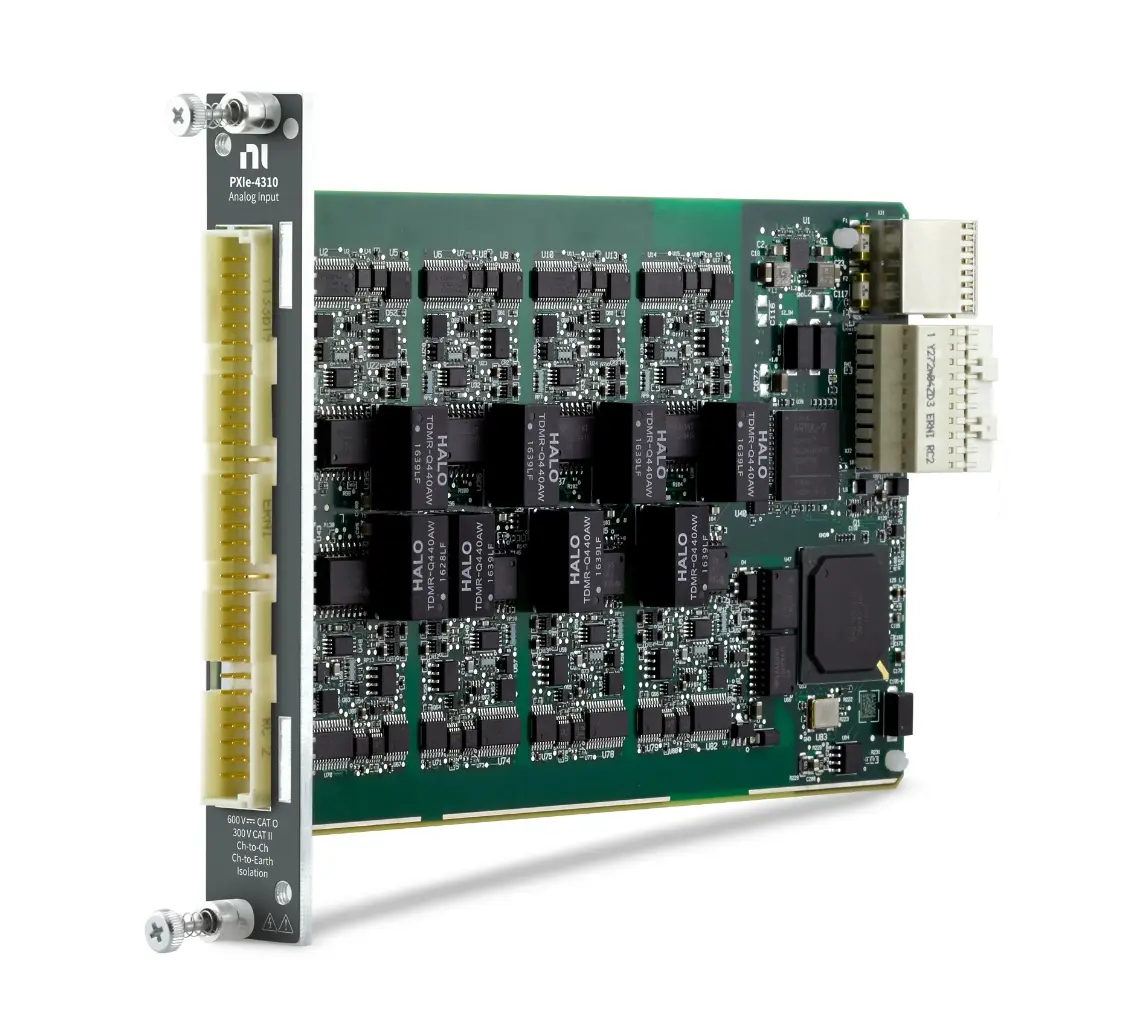
The NI PXIe-4310 is an 8-channel, 16-bit, channel-to-channel isolated PXI Express analog input module designed for simultaneous voltage acquisition, high-voltage measurement, power electronics testing, battery systems, industrial monitoring, automotive validation, and automated test applications.
The PXIe-4310 provides eight differential analog input channels, with an independent analog-to-digital converter on each channel. This architecture enables simultaneous sampling across all channels at rates up to 400 kS/s per channel.
When paired with the appropriate TB-4310 terminal block, the module supports either low-voltage measurement ranges up to ±10 V or high-voltage ranges extending to ±600 V.
The combination of simultaneous sampling, channel-to-channel isolation, selectable input ranges, per-channel filtering, and NI-DAQmx software support makes the PXIe-4310 particularly suitable for demanding multichannel voltage measurement systems.
Product Overview
The National Instruments PXIe-4310 is designed for applications where several voltage signals must be measured simultaneously while maintaining electrical isolation between channels.
Typical applications include:
- High-voltage data acquisition
- Power electronics testing
- Battery and energy storage testing
- Automotive electronics validation
- Electric vehicle testing
- Industrial power monitoring
- Power supply characterization
- Inverter and converter testing
- Electronic design validation
- Automated production test
A typical measurement architecture can be represented as:
Voltage Signals → TB-4310 → PXIe-4310 → PXI Controller → Measurement Software
Key Features
Eight Differential Analog Input Channels
The PXIe-4310 provides 8 differential analog input channels.
Differential measurement helps reject common-mode interference and is particularly useful when measuring signals that are not referenced to the same ground potential.
Eight channels can be used to measure several voltage points in parallel, such as:
- Multiple power rails
- Battery cells or battery sections
- Converter input and output voltages
- Motor drive signals
- Industrial power circuits
- Multiple DUT voltage nodes
16-Bit Analog-to-Digital Conversion
Each PXIe-4310 channel uses a 16-bit analog-to-digital converter.
A 16-bit ADC provides 65,536 theoretical quantization levels across the selected measurement range.
| Resolution | Theoretical Quantization Levels |
|---|---|
| 12 Bit | 4,096 |
| 14 Bit | 16,384 |
| 16 Bit | 65,536 |
Actual measurement accuracy depends on the selected input range, terminal block, calibration, environmental conditions, noise, and other analog specifications.
400 kS/s Per Channel
The PXIe-4310 supports a maximum sampling rate of 400 kS/s per channel.
Because each channel has its own ADC, this sampling capability is available simultaneously across the analog input channels.
This makes the module suitable for capturing dynamic voltage signals and transient electrical behavior.
Simultaneous Sampling
A major advantage of the PXIe-4310 is its simultaneous sampling architecture.
Instead of multiplexing multiple signals through one ADC, each analog input channel has a dedicated converter.
This means voltage measurements from different channels correspond to the same point in time, which is important for:
- Phase measurements
- Power analysis
- Input/output comparison
- Multi-rail transient testing
- Converter efficiency measurements
- Dynamic system characterization
Channel-to-Channel Isolation
The PXIe-4310 provides channel-to-channel isolation, allowing individual analog inputs to operate at different electrical potentials.
Isolation is particularly important when measurements are taken from different sections of high-voltage systems.
It can help:
- Break ground loops
- Reduce common-mode interference
- Separate measurement channels
- Improve safety in appropriate high-voltage systems
- Measure floating signals
Up to 600 V Channel-to-Channel Isolation
NI specifies the PXIe-4310 family with up to 600 V channel-to-channel isolation when used within the applicable system and terminal-block limits.
The complete measurement configuration, including terminal block, wiring, installation, insulation, and measurement category requirements, must be verified before working with high-voltage signals.
Two TB-4310 Terminal Block Options
The voltage range available from the PXIe-4310 depends on the selected TB-4310 front-mount terminal block.
| Terminal Block | Part Number | Measurement Ranges |
|---|---|---|
| TB-4310 (10 V) | 785021-01 | ±1 V, ±2 V, ±5 V, ±10 V |
| TB-4310 (600 V) | 785022-01 | ±60 V, ±120 V, ±300 V, ±600 V |
This gives system designers the flexibility to configure the same PXIe-4310 module for either precision low-voltage measurement or isolated high-voltage acquisition.
±10 V Measurement with TB-4310 (10 V)
When the PXIe-4310 is paired with the TB-4310 (10 V), the system provides four programmable input ranges:
- ±1 V
- ±2 V
- ±5 V
- ±10 V
This configuration is appropriate for lower-voltage sensors, electronic circuits, power rails, and other signals where a ±10 V maximum measurement range is sufficient.
±600 V Measurement with TB-4310 (600 V)
When paired with the TB-4310 (600 V), the PXIe-4310 supports high-voltage measurement ranges of:
- ±60 V
- ±120 V
- ±300 V
- ±600 V
The 600 V terminal block contains attenuation circuitry that extends the underlying PXIe-4310 measurement range for high-voltage applications.
Up to Four Input Ranges Concurrently
The PXIe-4310 architecture allows up to four different input ranges to be used concurrently with the appropriate terminal block and software configuration.
This is useful when different channels in the same test system measure signals with significantly different amplitudes.
For example:
Channel 0 → ±600 V
Channel 1 → ±300 V
Channel 2 → ±120 V
Channel 3 → ±60 V
This flexibility helps maximize measurement resolution without requiring all channels to use the largest available range.
Per-Channel Filtering
The PXIe-4310 provides programmable filtering for analog input channels.
NI specifies discrete low-pass filter options including:
- 10 kHz
- 100 kHz
Per-channel filtering can help reduce unwanted high-frequency noise before the signal is digitized or processed.
Independent ADC Per Channel
Each PXIe-4310 analog input has an independent ADC.
This architecture eliminates the channel-to-channel timing skew associated with conventional multiplexed acquisition systems.
It is particularly valuable when several signals must be compared precisely in time.
Multiple Triggering Configurations
The PXIe-4310 supports flexible triggering and clocking configurations for automated acquisition.
Two PFI lines are available for external triggering and clocking functions.
Triggering can be used to synchronize acquisition with:
- DUT startup
- Power switching events
- External test equipment
- Automated production sequences
- Other PXI instrumentation
NI-DAQmx Support
The PXIe-4310 is supported by NI-DAQmx.
NI-DAQmx provides driver support for configuring acquisition channels, voltage ranges, sampling, triggering, filtering, and data transfer.
Compatible software environments can include:
- LabVIEW
- FlexLogger
- TestStand-based systems
- InstrumentStudio
- Compatible C/C++ applications
- Compatible .NET applications
- Python applications using supported NI APIs
Technical Specifications
| Parameter | Specification |
|---|---|
| Product Type | PXI Express Isolated Analog Input Module |
| Model | NI PXIe-4310 |
| Part Number | 784813-01 |
| Platform | PXI Express |
| Analog Input Channels | 8 Differential |
| ADC Resolution | 16 Bit |
| Maximum Sample Rate | 400 kS/s/ch |
| Sampling Architecture | Simultaneous |
| ADC Architecture | Independent ADC Per Channel |
| Low-Voltage Input Ranges | ±1 V, ±2 V, ±5 V, ±10 V |
| High-Voltage Input Ranges | ±60 V, ±120 V, ±300 V, ±600 V |
| Maximum System Measurement Range | ±600 V with TB-4310 (600 V) |
| Analog Input Isolation | 600 V Channel-to-Channel Isolation |
| Low-Pass Filtering | 10 kHz / 100 kHz Selectable |
| Trigger / Clock Inputs | 2 PFI Lines |
| Driver | NI-DAQmx |
| Low-Voltage Terminal Block | TB-4310, 785021-01 |
| High-Voltage Terminal Block | TB-4310, 785022-01 |
| Primary Applications | High-Voltage Measurement, Power Electronics, Battery Test, Automotive Validation and Automated Data Acquisition |
PXIe-4310 Voltage Range Options
| Terminal Block | Available Measurement Ranges | Typical Application |
|---|---|---|
| TB-4310 (10 V) | ±1 V / ±2 V / ±5 V / ±10 V | Electronic Signals and Low-Voltage Measurements |
| TB-4310 (600 V) | ±60 V / ±120 V / ±300 V / ±600 V | Power Electronics and High-Voltage Measurements |
What Is an Isolated Analog Input Module?
An isolated analog input module electrically separates measurement channels from one another and from other parts of the measurement system.
This differs from many conventional multifunction DAQ modules where several channels share a common measurement reference.
A simplified isolated architecture is:
Signal 1 → Isolated Channel 1
Signal 2 → Isolated Channel 2
Signal 3 → Isolated Channel 3
Signal 4 → Isolated Channel 4
Each signal can operate at a different common-mode potential within the specified isolation limits.
Why Channel-to-Channel Isolation Matters
Channel-to-channel isolation is particularly valuable when measuring several electrical nodes that cannot safely share the same reference.
Typical examples include:
- Power converter input and output
- Series-connected battery sections
- Motor drive phases
- Floating power rails
- Industrial power circuits
- Power supply outputs
Without appropriate isolation, connecting these signals to a common-ground measurement system can create ground loops, measurement errors, or unsafe electrical paths.
PXIe-4310 for High-Voltage Measurement
High-voltage measurement is one of the key applications of the PXIe-4310 when combined with the TB-4310 (600 V).
Available high-voltage ranges include:
- ±60 V
- ±120 V
- ±300 V
- ±600 V
This enables direct acquisition of many power electronics and industrial voltage signals without requiring an external voltage divider in suitable applications.
Power Electronics Testing
The PXIe-4310 is particularly well suited for automated power electronics measurement systems.
Typical DUTs may include:
- DC/DC converters
- AC/DC converters
- DC/AC inverters
- Power supplies
- Motor drives
- Battery chargers
- Power distribution units
- Industrial power modules
DC/DC Converter Testing
A DC/DC converter test system may need to acquire both input and output voltages simultaneously.
A simplified architecture is:
Channel 0 → Converter Input Voltage
Channel 1 → Converter Output Voltage
Because the PXIe-4310 provides independent ADCs, both waveforms can be captured simultaneously.
Additional channels can monitor auxiliary rails, control voltages, or other circuit nodes.
Inverter Testing
The PXIe-4310 can be incorporated into inverter and power-conversion test platforms requiring isolated voltage measurements.
Typical measurements may include:
- DC bus voltage
- Converter output voltage
- Phase-related voltages
- Control supply voltages
- Transient voltage behavior
The required measurement category, isolation, probe architecture, and system safety limits must be verified for the specific inverter application.
Battery Testing
Battery and energy storage systems frequently contain several measurement points operating at different electrical potentials.
The PXIe-4310 can provide isolated simultaneous voltage acquisition for compatible battery test systems.
Applications may include:
- Battery pack voltage monitoring
- Battery module testing
- Charge and discharge validation
- Transient voltage measurement
- Energy storage system characterization
Electric Vehicle Testing
Electric vehicles contain numerous low-voltage and high-voltage electrical subsystems.
The PXIe-4310 can be incorporated into compatible EV validation systems for measuring isolated voltage signals associated with:
- Battery systems
- Power converters
- Charging systems
- Power distribution
- Electronic control systems
- Low-voltage auxiliary circuits
Power Supply Validation
Power supply testing commonly requires simultaneous measurements of several output rails.
The PXIe-4310 can capture these signals in parallel.
For example:
Channel 0 → Input Voltage
Channel 1 → Output Rail 1
Channel 2 → Output Rail 2
Channel 3 → Output Rail 3
This enables engineers to analyze startup, shutdown, regulation, sequencing, and transient behavior.
Power Sequencing Measurements
Modern electronic devices often require several voltage rails to rise and fall in a defined sequence.
Because the PXIe-4310 samples channels simultaneously, it can capture the timing relationship between multiple supply rails.
Measurements may include:
- Rail startup timing
- Power-good sequencing
- Voltage settling
- Shutdown timing
- Overshoot
- Undershoot
Transient Voltage Measurement
With a maximum sample rate of 400 kS/s per channel, the PXIe-4310 can capture many transient voltage events that would be missed by slower monitoring instruments.
Examples include:
- Power-up transients
- Load changes
- Switching events
- Fault conditions
- Supply disturbances
- Battery connection events
Simultaneous Sampling vs Multiplexed DAQ
| Feature | PXIe-4310 | Typical Multiplexed DAQ |
|---|---|---|
| ADC Architecture | ADC Per Channel | Shared ADC |
| Channel Timing | Simultaneous | Sequential |
| Phase Measurements | Better Suited | Channel Delay Must Be Considered |
| Dynamic Multi-Channel Signals | Excellent | Application Dependent |
| Channel Isolation | Channel-to-Channel | Device Dependent |
PXIe-4310 vs Multifunction DAQ
The PXIe-4310 is optimized for isolated voltage acquisition rather than general-purpose multifunction I/O.
| Feature | PXIe-4310 | Typical Multifunction DAQ |
|---|---|---|
| Primary Function | Isolated Voltage Measurement | General Analog/Digital I/O |
| Analog Input Channels | 8 Differential | Device Dependent |
| Resolution | 16 Bit | Device Dependent |
| Simultaneous Sampling | Yes | Often No |
| High-Voltage Measurement | Up to ±600 V with TB-4310 | Usually Much Lower |
| Channel-to-Channel Isolation | Yes | Often No |
PXIe-4310 vs Oscilloscope
The PXIe-4310 and a PXI oscilloscope are designed for different measurement requirements.
| Feature | PXIe-4310 | PXI Oscilloscope |
|---|---|---|
| Maximum Sample Rate | 400 kS/s/ch | Often MS/s to GS/s |
| Resolution | 16 Bit | Model Dependent |
| Channel Isolation | Channel-to-Channel | Usually Different Architecture |
| Direct High-Voltage Measurement | Up to ±600 V with Correct TB-4310 | Probe Dependent |
| Primary Application | Isolated Voltage DAQ | High-Speed Waveform Acquisition |
TB-4310 (10 V)
The TB-4310 (10 V), part number 785021-01, is the low-voltage front-mount terminal block for the PXIe-4310.
It provides access to the following input ranges:
- ±1 V
- ±2 V
- ±5 V
- ±10 V
This terminal block functions primarily as the connectivity interface for lower-voltage PXIe-4310 measurements.
TB-4310 (600 V)
The TB-4310 (600 V), part number 785022-01, extends the PXIe-4310 for higher-voltage measurements.
Available input ranges include:
- ±60 V
- ±120 V
- ±300 V
- ±600 V
The high-voltage terminal block includes attenuation circuitry, so system-level accuracy differs from the module-only specifications and should be evaluated using the PXIe-4310 plus TB-4310 (600 V) specifications.
Choosing the Correct TB-4310
| Measurement Requirement | Recommended Terminal Block |
|---|---|
| Signals Up to ±1 V | TB-4310 (10 V) |
| Signals Up to ±5 V | TB-4310 (10 V) |
| Signals Up to ±10 V | TB-4310 (10 V) |
| Signals Around ±60 V | TB-4310 (600 V) |
| Signals Around ±120 V | TB-4310 (600 V) |
| Signals Around ±300 V | TB-4310 (600 V) |
| Signals Up to ±600 V | TB-4310 (600 V) |
PXIe-4310 in a Complete PXI System
The PXIe-4310 can operate as an isolated voltage acquisition instrument within a complete PXI system.
A typical system may include:
- PXI Chassis
- PXI Controller
- PXIe-4310 Analog Input Module
- TB-4310 Terminal Block
- PXI Modules
- PXI current measurement modules
- PXI oscilloscopes
- PXI switching modules
- PXI programmable power supplies
- PXI Source Measure Units
This architecture allows isolated voltage acquisition to be combined with current measurement, switching, waveform acquisition, stimulus generation, and other automated test functions.
PXIe-4310 with FlexLogger
The PXIe-4310 can be used with compatible versions of NI FlexLogger for interactive and automated data logging.
FlexLogger can simplify:
- Channel configuration
- Data visualization
- Data logging
- Trigger-based acquisition
- Alarm configuration
- Test monitoring
PXIe-4310 with LabVIEW
LabVIEW applications can control the PXIe-4310 through NI-DAQmx.
A LabVIEW-based application can programmatically configure:
- Analog input channels
- Input ranges
- Sampling rate
- Record length
- Trigger conditions
- Filtering
- Data logging
- Automated analysis
Multi-Chassis Measurement Systems
For applications requiring more than eight isolated voltage channels, multiple PXIe-4310 modules can be installed in compatible PXI Express systems.
PXI timing and synchronization capabilities can also support larger multi-module or multi-chassis acquisition architectures.
This makes the PXIe-4310 suitable for scalable high-channel-count voltage measurement systems.
Measurement Range Selection
Choosing the smallest suitable input range generally helps maximize measurement resolution.
For example, a signal expected to remain within ±5 V should normally use an appropriate lower input range rather than automatically using a ±10 V or ±600 V range.
Similarly, high-voltage measurements should use the smallest appropriate range supported by the TB-4310 (600 V).
Correct range selection can improve effective measurement performance while maintaining sufficient headroom for the expected signal.
Filtering Considerations
The selectable 10 kHz and 100 kHz low-pass filtering options allow users to balance bandwidth and noise performance.
A lower cutoff can be useful when:
- The signal changes relatively slowly
- High-frequency noise is unwanted
- Measurement stability is more important than bandwidth
A higher filter setting may be more appropriate when faster signal dynamics must be retained.
High-Voltage Safety Considerations
High-voltage measurement requires careful system-level design.
Before using the PXIe-4310 with the TB-4310 (600 V), verify:
- Maximum measurement voltage
- Channel-to-channel voltage
- Channel-to-ground voltage
- Measurement category requirements
- Terminal block ratings
- Wire insulation ratings
- Clearance and creepage requirements
- PXI system grounding
- Safety enclosure requirements
- Applicable electrical safety procedures
The ±600 V measurement range should not be interpreted as permission to connect any arbitrary 600 V source without verifying the complete installation and applicable NI safety specifications.
PXIe-4310 Selection Considerations
Before purchasing the PXIe-4310, engineers should verify:
- Required number of voltage channels
- Required input voltage range
- Low-voltage or high-voltage TB-4310 requirement
- Required sample rate
- 16-bit resolution suitability
- Need for simultaneous sampling
- Isolation requirements
- Required filtering
- Triggering requirements
- PXI Express chassis compatibility
- NI-DAQmx software compatibility
- Safety and measurement category requirements
Industries
- Power Electronics
- Automotive Electronics
- Electric Vehicle Testing
- Battery Testing
- Energy Storage
- Industrial Electronics
- Automated Test Equipment
- Aerospace and Defense
- Electronic Manufacturing
- Research and Development
Applications
High-Voltage Data Acquisition
With the TB-4310 (600 V), the PXIe-4310 supports isolated voltage measurements across ranges extending to ±600 V.
Power Electronics Testing
Simultaneous isolated channels are useful for measuring converter, inverter, power supply, and motor-drive voltage signals.
Battery Test
Channel isolation and multiple input ranges make the module suitable for compatible battery and energy-storage voltage measurement systems.
Electric Vehicle Validation
The PXIe-4310 can acquire isolated voltage signals from compatible EV battery, charging, converter, and electronic control systems.
Power Supply Testing
Eight simultaneous channels can measure multiple power rails, startup sequences, transient behavior, and regulation performance.
Automated Production Test
NI-DAQmx and PXI integration allow isolated voltage measurements to be incorporated into repeatable automated production test sequences.
Recommended Related Products
| NI PXIe-4310 | 8-channel, 16-bit, 400 kS/s/ch isolated analog input module for simultaneous voltage measurement up to ±600 V with the appropriate terminal block. |
| TB-4310 (10 V) | Part number 785021-01 terminal block providing ±1 V, ±2 V, ±5 V, and ±10 V measurement ranges for the PXIe-4310. |
| TB-4310 (600 V) | Part number 785022-01 high-voltage terminal block providing ±60 V, ±120 V, ±300 V, and ±600 V measurement ranges. |
| NI PXIe-4322 | PXI analog input hardware for isolated measurement applications requiring a different channel, sampling, and signal-conditioning architecture. |
| NI PXI Modules | PXI and PXI Express modules for data acquisition, voltage measurement, waveform acquisition, switching, source measurement, and automated test. |
Why Choose NI PXIe-4310?
- 8 differential analog input channels
- 16-bit ADC resolution
- 400 kS/s per channel
- Simultaneous sampling on all channels
- Independent ADC per channel
- Channel-to-channel isolation
- Up to 600 V channel-to-channel isolation
- ±1 V to ±10 V low-voltage ranges
- ±60 V to ±600 V high-voltage ranges
- 10 kHz and 100 kHz low-pass filtering
- Flexible triggering and clocking
- NI-DAQmx support
- Suitable for power electronics test
- Suitable for battery and EV testing
- Suitable for automated high-voltage data acquisition
Frequently Asked Questions
What is the NI PXIe-4310?
The NI PXIe-4310 is an 8-channel, 16-bit, channel-to-channel isolated PXI Express analog input module designed for simultaneous voltage acquisition at up to 400 kS/s per channel.
What is the part number of the PXIe-4310?
The NI ordering part number for the PXIe-4310 is 784813-01.
How many analog input channels does the PXIe-4310 have?
The PXIe-4310 provides 8 differential analog input channels.
What is the resolution of the PXIe-4310?
Each channel uses a 16-bit ADC.
What is the maximum sample rate of the PXIe-4310?
The PXIe-4310 provides up to 400 kS/s per channel.
Does the PXIe-4310 sample all channels simultaneously?
Yes. Each analog input channel has an independent ADC, allowing simultaneous sampling across all eight channels.
Can the PXIe-4310 measure 600 V?
Yes. When used with the TB-4310 (600 V), part number 785022-01, the system supports input ranges up to ±600 V within the specified electrical and safety limits.
Can the PXIe-4310 measure ±10 V?
Yes. With the TB-4310 (10 V), part number 785021-01, the module supports ±1 V, ±2 V, ±5 V, and ±10 V measurement ranges.
What ranges are available with the 600 V terminal block?
The TB-4310 (600 V) supports ±60 V, ±120 V, ±300 V, and ±600 V ranges.
What ranges are available with the 10 V terminal block?
The TB-4310 (10 V) supports ±1 V, ±2 V, ±5 V, and ±10 V ranges.
Does the PXIe-4310 have channel-to-channel isolation?
Yes. Channel-to-channel isolation is one of the primary features of the PXIe-4310 and makes it suitable for measuring signals operating at different electrical potentials.
Does the PXIe-4310 support filtering?
Yes. NI lists discrete low-pass filtering options including 10 kHz and 100 kHz.
Which terminal block does the PXIe-4310 require?
The required terminal block depends on the measurement range. Use TB-4310 785021-01 for measurements up to ±10 V and TB-4310 785022-01 for high-voltage ranges up to ±600 V.
Can different PXIe-4310 channels use different measurement ranges?
Yes. The PXIe-4310 architecture supports multiple input-range configurations concurrently, allowing signals with different amplitudes to be measured within the same system.
Can the PXIe-4310 be used for power electronics testing?
Yes. Simultaneous sampling, isolation, and high-voltage measurement capability make the PXIe-4310 particularly suitable for compatible converter, inverter, power supply, battery, and power electronics validation systems.
Can the PXIe-4310 be used for battery testing?
Yes. Its isolated differential channels can be used in compatible battery and energy-storage measurement systems where the required voltages and isolation conditions remain within specification.
Can the PXIe-4310 be used for EV testing?
Yes. It can be incorporated into electric vehicle validation systems for compatible battery, converter, charging, power distribution, and auxiliary voltage measurements.
What driver does the PXIe-4310 use?
The PXIe-4310 is supported by NI-DAQmx.
What should I check before purchasing a PXIe-4310?
Before purchasing a PXIe-4310, verify the required number of channels, voltage range, TB-4310 terminal block version, sampling rate, isolation requirements, filtering, triggering, PXI Express chassis compatibility, NI-DAQmx support, wiring requirements, and applicable high-voltage safety specifications.
Conclusion
The NI PXIe-4310 8-Channel Isolated PXI Analog Input Module combines 16-bit resolution, simultaneous 400 kS/s/ch acquisition, independent ADCs, channel-to-channel isolation, programmable filtering, and flexible voltage ranges. With the TB-4310 (10 V), it supports measurements from ±1 V to ±10 V, while the TB-4310 (600 V) extends the available ranges to ±60 V, ±120 V, ±300 V, and ±600 V. These capabilities make the PXIe-4310 particularly well suited for power electronics testing, battery and EV validation, high-voltage data acquisition, power supply characterization, industrial monitoring, and automated test systems.