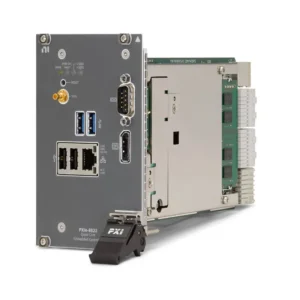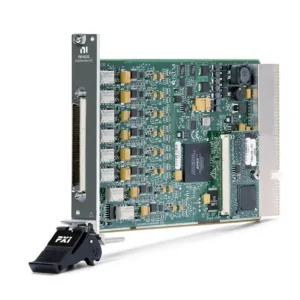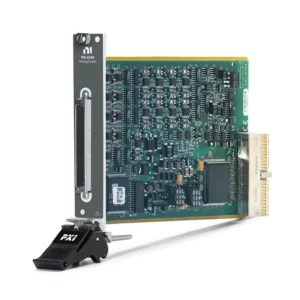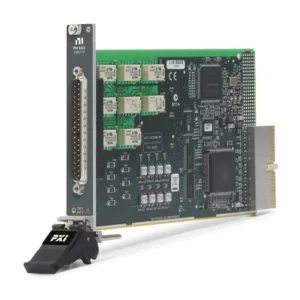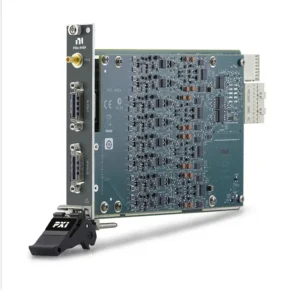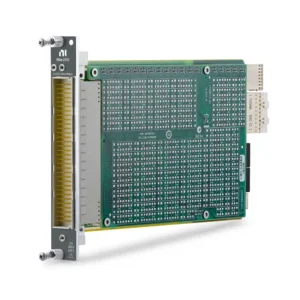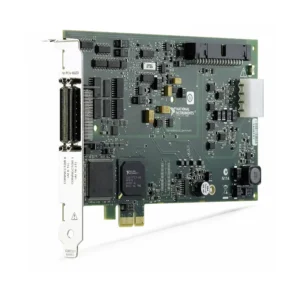




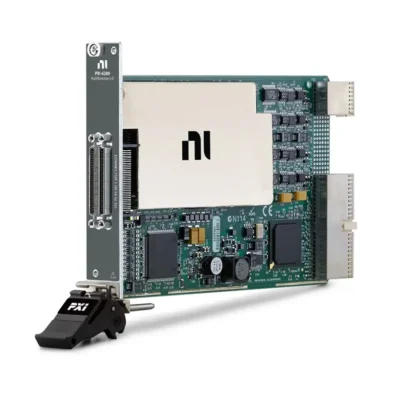
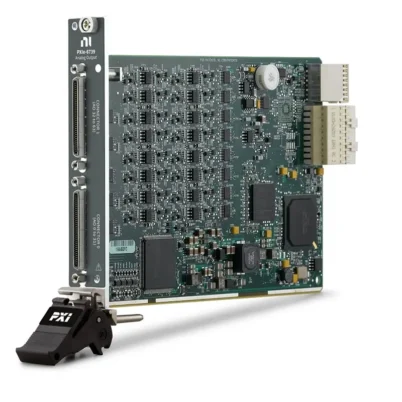
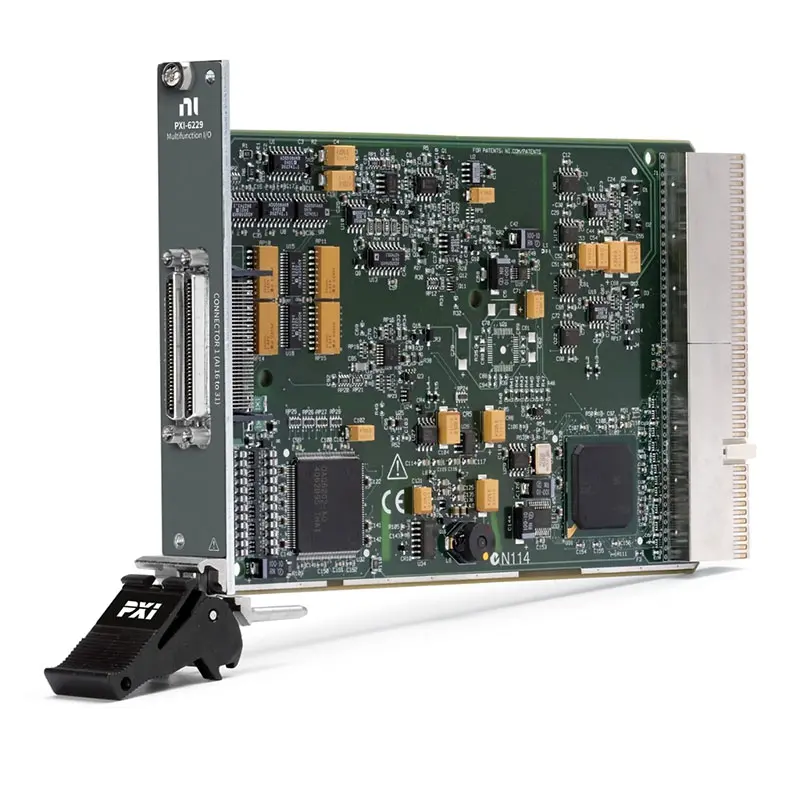
PXI-6229 32-Channel 16-Bit Multifunction PXI DAQ Module
The PXI-6229 is a high-density M Series PXI multifunction data acquisition module designed for laboratory automation, design validation, research and production testing. It combines analog input, analog output, digital I/O, counter/timer and triggering functions in one 3U PXI module.
The PXI-6229 provides 32 single-ended or 16 differential analog inputs with 16-bit resolution and a maximum aggregate sampling rate of 250 kS/s. It also includes four 16-bit analog voltage outputs, 48 bidirectional digital I/O lines and two 32-bit counter/timers.
Thirty-two digital lines support correlated hardware-timed operations at rates up to 1 MHz. NI-DAQmx software and PXI backplane synchronization simplify integration into automated mixed-signal measurement and control systems.
Key Features of the PXI-6229
- 32 single-ended analog input channels
- 16 differential analog input channels
- 16-bit analog input resolution
- 250 kS/s maximum aggregate sampling rate
- Programmable voltage ranges up to ±10 V
- Four 16-bit analog voltage outputs
- 833 kS/s maximum analog output update rate
- 48 bidirectional digital I/O lines
- 32 hardware-timed correlated digital lines
- Up to 1 MHz correlated digital waveform rate
- Two 32-bit counter/timers
- Digital triggering
- PXI trigger-bus synchronization
- Two 68-pin VHDCI connectors
- PXI hybrid-slot configuration available
- SCXI-controlling configuration available
- NI-DAQmx software support
PXI-6229 Technical Specifications
| Product Model | PXI-6229 |
|---|---|
| PXI Hybrid Part Number | 779630-01 |
| PXI/SCXI Combination Chassis Part Number | 779115-01 |
| Product Family | NI M Series multifunction DAQ |
| Product Type | PXI multifunction I/O module |
| Single-Ended Analog Inputs | 32 |
| Differential Analog Inputs | 16 |
| ADC Resolution | 16 bits |
| Maximum Analog Input Sample Rate | 250 kS/s aggregate |
| Analog Input Sampling | Multiplexed, nonsimultaneous |
| Input Coupling | DC |
| Analog Input Ranges | ±0.2 V, ±1 V, ±5 V and ±10 V |
| Maximum Working Voltage | 11 V relative to earth, Measurement Category I |
| Analog Input FIFO | 4,095 samples |
| Analog Output Channels | 4 voltage outputs |
| DAC Resolution | 16 bits |
| Maximum Analog Output Update Rate | 833 kS/s |
| Analog Output Range | ±10 V |
| Digital I/O | 48 bidirectional lines |
| Correlated Digital I/O | 32 lines |
| Maximum Correlated Digital Rate | 1 MHz |
| Static Digital I/O | 16 lines |
| Digital Signaling | 5 V TTL/CMOS compatible |
| Counters/Timers | 2 × 32-bit |
| Triggering | Digital triggering |
| PXI Synchronization | PXI_TRIG, PXI_STAR and PXI_CLK10 |
| Front-Panel Connectors | 2 × 68-pin VHDCI |
| Module Format | 3U, single-slot PXI module |
| Weight | Approximately 171 g |
| Operating Temperature | 0°C to 55°C |
| Software Driver | NI-DAQmx |
| Recommended Replacement | PXIe-6363 |
| Availability Status | Discontinued by NI |
PXI-6229 Part Numbers and Accessories
| Item | Part Number | Description |
|---|---|---|
| PXI-6229 Hybrid Version | 779630-01 | PXI hybrid-slot-compatible multifunction DAQ module |
| PXI-6229 SCXI Control Version | 779115-01 | PXI version capable of controlling SCXI in a PXI/SCXI combination chassis |
| SHC68-68-EPM Cable | Varies by length | Shielded VHDCI-to-68-pin cable recommended for M Series DAQ connections |
| SCB-68A | 782536-01 | Shielded 68-pin screw-terminal block for custom signal wiring |
| CB-68LP | 777145-01 | Low-profile screw-terminal connector block |
| BNC-2110 | 777643-01 | Shielded BNC terminal accessory for analog, digital and timing connections |
| PXIe-6363 | 781052-01 | Recommended X Series PXI Express replacement |
The PXI-6229 has two 68-pin VHDCI front-panel connectors. Accessing every analog, digital, counter and timing signal may require two compatible cables and two terminal accessories.
The module was produced in two backplane configurations. Part number 779630-01 is the PXI hybrid-slot version, while part number 779115-01 is intended for controlling SCXI modules in a PXI/SCXI combination chassis. Confirm the exact version before ordering.
32-Channel Analog Input Architecture
The PXI-6229 provides 32 single-ended voltage inputs or 16 differential inputs. This channel density is useful for automated fixtures containing many power rails, sensor outputs and electronic test points.
The module uses a multiplexed ADC. The selected input channels are connected sequentially to one converter rather than being sampled simultaneously.
For applications requiring simultaneous measurements with a precisely matched phase relationship, select a simultaneous-sampling DAQ or digitizer instead.
16-Bit Analog Input Resolution
The analog inputs use a 16-bit ADC. On the ±10 V range, the nominal 20 V input span is represented by 65,536 digital codes.
The smallest suitable programmable range should be selected for the expected signal. Using more of the ADC span improves effective voltage resolution, provided that signal peaks and offsets remain within the selected range.
Actual accuracy also depends on gain error, offset error, noise, source impedance, temperature and calibration.
250 kS/s Aggregate Sampling Rate
The PXI-6229 supports an aggregate analog input rate up to 250 kS/s. This rate is shared across every channel included in a multichannel acquisition.
When all 32 single-ended channels are scanned at equal rates, the theoretical maximum average rate is approximately 7.8 kS/s per channel. Reducing the number of channels increases the available rate per channel.
High source impedance or large voltage differences between consecutive channels can require a slower conversion rate to achieve accurate settling.
Programmable Analog Input Ranges
The module provides programmable input ranges for signals up to ±10 V, with lower ranges available for smaller signals. Selecting a lower range improves measurement resolution for low-amplitude voltages.
Signals must remain within both the selected measurement range and the maximum working-voltage specification. The PXI-6229 is intended for Measurement Category I signal circuits rather than direct connection to building mains.
Single-Ended and Differential Wiring
Single-ended measurement provides the maximum 32-channel capacity and is appropriate for short, ground-referenced signals with compatible grounding.
Differential measurement uses two terminals per channel and provides improved rejection of common-mode noise. It is generally preferred for floating sources, low-level signals and longer cables.
Floating sources require an appropriate bias-current return path. Without this return path, the input amplifier can drift or saturate and produce unstable readings.
Four 16-Bit Analog Outputs
The PXI-6229 includes four analog voltage outputs for generating control levels, test stimuli, setpoints and waveforms. The channels support software-timed and hardware-timed operation.
The maximum analog output update rate is 833 kS/s. Actual per-channel performance depends on the number of active output channels and task configuration.
The analog outputs are intended for limited-current voltage loads. Use an external buffer or power amplifier when the connected device requires greater current or power.
48 Bidirectional Digital I/O Lines
The module provides 48 TTL/CMOS-compatible digital lines. Each line can be configured as an input or output according to the application.
Digital I/O can control fixture relays through suitable drivers, read switches, monitor device status, select signal routes and exchange logic-level data with a device under test.
The lines must not be connected directly to 24 V industrial signals. Use appropriate level conversion or an isolated digital interface for higher-voltage field wiring.
32 Correlated Digital I/O Lines
Thirty-two digital lines support correlated hardware-timed input and output at rates up to 1 MHz. These lines can acquire or generate digital patterns using a hardware sample clock.
Correlated digital tasks can share triggers or timing relationships with analog input, analog output and counter operations. This supports synchronized mixed-signal testing.
The remaining 16 lines are intended for static digital I/O and programmable timing interface functions.
Two 32-Bit Counter/Timers
The PXI-6229 includes two general-purpose 32-bit counter/timers. They support edge counting, frequency measurement, period measurement, pulse-width measurement, pulse generation and two-edge separation.
The counters can also work with supported quadrature encoders for position and direction measurements. Counter signals are routed through programmable-function interface terminals.
Digital Triggering
Digital triggers can start, pause or synchronize analog input, analog output, digital waveform and counter tasks. Trigger sources can be routed from front-panel PFI terminals or the PXI backplane.
Hardware triggering provides more repeatable timing than starting operations only through software. This is important for production testing and stimulus-response measurements.
PXI Timing and Synchronization
The module can share clock and trigger signals through the PXI chassis. Compatible resources include PXI trigger lines, PXI_STAR and the PXI reference clock.
Multiple PXI-6229 modules or other compatible instruments can begin operations from a shared trigger. The onboard timing system can also reference PXI_CLK10 for improved coordination between devices.
SCXI Control Compatibility
PXI-6229 part number 779115-01 can control SCXI hardware when installed in a compatible PXI/SCXI combination chassis. This configuration supports legacy measurement systems that use SCXI modules for sensor conditioning, isolation and multiplexing.
The hybrid-slot version, part number 779630-01, cannot perform the same SCXI control function in a PXI/SCXI combination chassis. Check the backplane connector and orderable part number before replacing an existing SCXI controller.
NI-DAQmx Software Support
The PXI-6229 is controlled through the NI-DAQmx driver. NI-DAQmx provides channel configuration, timing, triggering, waveform generation, digital I/O and counter functions.
The driver supports LabVIEW, LabWindows/CVI and compatible C, C++, C# and Python programming environments. NI Measurement & Automation Explorer can identify the module, run test panels and manage device configuration.
Because the PXI-6229 is discontinued, confirm compatibility between the module, PXI controller, operating system and NI-DAQmx version before installing it in a new system.
Typical PXI-6229 Applications
- Automated production testing
- Laboratory automation
- Design verification and validation
- Mixed-signal functional testing
- Voltage data acquisition
- Analog stimulus generation
- Digital pattern acquisition and generation
- Electronic component characterization
- Research and educational systems
- Frequency and pulse measurement
- SCXI-based sensor measurement
- Test-fixture control
Automated Production Testing
The PXI-6229 can measure analog voltages, generate stimulus signals, monitor digital states and control test-fixture logic within one automated sequence.
Its four analog outputs and 48 digital lines are useful for fixtures that require multiple control signals. PXI triggering allows the module to coordinate with switches, digital multimeters and programmable power instruments.
Laboratory Data Acquisition
The 32 analog inputs can monitor multiple sensors, supply rails and experimental test points. Analog outputs can generate control voltages while digital lines manage fixture states.
For sensor types that require excitation, amplification, filtering or isolation, use compatible external signal-conditioning hardware.
Mixed-Signal Device Validation
The PXI-6229 can acquire analog responses and digital status signals while generating analog and digital stimuli. Shared timing resources provide consistent coordination among these operations.
This capability supports validation of embedded controllers, power-management circuits, interface boards and other products containing both analog and digital functions.
PXI-6229 Troubleshooting
The module is not detected in NI MAX
Confirm that the PXI-6229 is fully installed in a compatible PXI or hybrid slot. Check chassis power, controller communication and NI-DAQmx installation, then restart the system and rescan the chassis.
The module does not work in a PXI Express hybrid slot
Verify the orderable part number and backplane connector. Part number 779630-01 is the hybrid-compatible configuration. The SCXI-control version uses a different backplane connector.
The module cannot control an SCXI chassis
Confirm that the module is part number 779115-01 and is installed in a supported PXI/SCXI combination chassis. The hybrid version does not provide the same SCXI control capability.
Only some analog or digital channels are available
Verify that both front-panel connectors and the correct cables are installed. The complete I/O set is divided between Connector 0 and Connector 1.
The requested multichannel sampling rate causes an error
The 250 kS/s specification is an aggregate limit. Multiply the requested per-channel rate by the number of channels and confirm that the result does not exceed 250 kS/s.
Analog input readings are noisy
Use shielded twisted-pair wiring, select differential mode where appropriate and separate low-level analog wiring from digital, motor and mains cables. Check grounding and source impedance.
Readings change when scanning additional channels
Reduce the channel-conversion rate to provide more settling time. High source impedance and large voltage steps between adjacent channels can increase multiplexing errors.
An analog output does not reach the requested voltage
Check the connected load resistance and required current. Disconnect the load and measure the output directly to determine whether excessive loading or fixture wiring is causing the problem.
A digital output cannot operate a relay or solenoid
The digital lines provide logic-level signals rather than high-current load power. Use an external transistor, relay driver or isolated output module suitable for the load.
The correlated digital rate is lower than expected
Check system bandwidth, transfer method, pattern size and concurrent tasks. The maximum hardware-timed rate depends on bus and system activity.
PXI-6229 Comparison with Similar DAQ Modules
| Model | Primary Configuration | Best Suited For |
|---|---|---|
| PXI-6221 | 16 AI, 2 AO, 24 DIO, 16-bit | Lower-channel-count multifunction DAQ |
| PXI-6224 | 32 AI, no AO, 48 DIO, 16-bit | Acquisition and digital I/O without analog outputs |
| PXI-6229 | 32 AI, 4 AO, 48 DIO, 16-bit | High-density multifunction measurement and control |
| PXI-6259 | 32 AI, 4 AO, 48 DIO, 1.25 MS/s | Similar I/O with higher analog acquisition speed |
| PXIe-6363 | 32 AI, 4 AO, 48 DIO, 2 MS/s | Modern high-performance PXI Express systems |
PXI-6229 vs PXI-6224
Both modules provide 32 analog inputs and 48 digital I/O lines. The PXI-6229 adds four analog outputs, while the PXI-6224 is intended primarily for acquisition and digital operations.
Choose the PXI-6224 when analog generation is unnecessary. Select the PXI-6229 when the system must produce analog stimuli or control voltages.
PXI-6229 vs PXI-6259
The PXI-6229 and PXI-6259 provide similar channel counts, including 32 analog inputs, four analog outputs and 48 digital I/O lines.
The PXI-6259 offers a higher maximum analog input rate of 1.25 MS/s, while the PXI-6229 supports 250 kS/s. Choose the PXI-6259 when greater analog acquisition speed is required.
PXI-6229 vs PXIe-6363
NI recommends the PXIe-6363 as the modern replacement for the PXI-6229. Both provide 32 analog inputs, four analog outputs and 48 digital I/O lines.
The PXIe-6363 uses the newer X Series architecture and supports analog acquisition rates up to 2 MS/s. It is preferable for new PXI Express systems, while the PXI-6229 remains useful for maintaining legacy fixtures and SCXI configurations.
Recommended Related Products
- PXI-6221 Multifunction DAQ Module
- PXI-6224 32-Channel Multifunction DAQ Module
- PXI-6225 80-Channel Multifunction DAQ Module
- PXI-6259 High-Speed Multifunction DAQ Module
- PXIe-6363 X Series Multifunction DAQ Module
- View More NI PXI and PXI Express Modules
Selecting the Right Multifunction DAQ Module
Choose the PXI-6229 when the application requires 32 analog inputs, four analog outputs, 48 digital I/O lines and two counters at acquisition rates up to 250 kS/s.
Select the PXI-6224 when analog outputs are not required, or the PXI-6259 when higher analog speed is needed. Choose the PXIe-6363 when building a new PXI Express test system.
Why Choose the PXI-6229?
- Combines analog, digital and counter functions
- Provides 32 voltage input channels
- Includes four programmable analog outputs
- Offers 48 bidirectional digital I/O lines
- Supports 32 correlated digital channels
- Provides two 32-bit counter/timers
- Supports PXI triggering and synchronization
- Offers a version for legacy SCXI control
- Integrates with NI-DAQmx and LabVIEW
- Supports existing M Series test systems
Frequently Asked Questions
What is the PXI-6229?
The PXI-6229 is a 16-bit M Series PXI multifunction DAQ module with analog input, analog output, digital I/O and counter/timer capabilities.
How many analog inputs does the PXI-6229 provide?
The module provides 32 single-ended analog inputs or 16 differential analog inputs.
What is the maximum analog input sampling rate?
The maximum aggregate analog input sampling rate is 250 kS/s. This rate is shared by all channels included in a multichannel scan.
Does the PXI-6229 provide analog outputs?
Yes. It provides four 16-bit analog voltage outputs with a maximum update rate of 833 kS/s.
How many digital I/O lines are included?
The module provides 48 bidirectional digital lines. Thirty-two lines support correlated hardware-timed operations at rates up to 1 MHz.
Does it support simultaneous analog sampling?
No. The PXI-6229 uses a multiplexed ADC, so analog input channels are converted sequentially.
Which connectors does the module use?
The PXI-6229 uses two 68-pin VHDCI connectors. Two cables and terminal accessories may be required to access the complete signal set.
What is the hybrid-slot-compatible part number?
The PXI hybrid-slot-compatible PXI-6229 part number is 779630-01.
Which PXI-6229 version can control SCXI?
Part number 779115-01 can control SCXI modules in a compatible PXI/SCXI combination chassis.
Which software controls the PXI-6229?
The module is controlled through NI-DAQmx and can be programmed with LabVIEW, LabWindows/CVI and compatible text-based environments.
What is the recommended replacement?
NI recommends the PXIe-6363 for new systems requiring a similar multifunction I/O configuration with higher PXI Express performance.
Request a Quote for the PXI-6229
Contact us for current availability, condition, lead time and project pricing for the PXI-6229 32-Channel 16-Bit Multifunction PXI DAQ Module. Please specify whether you require part number 779630-01 or the SCXI-controlling 779115-01 version.