



Product Introduction
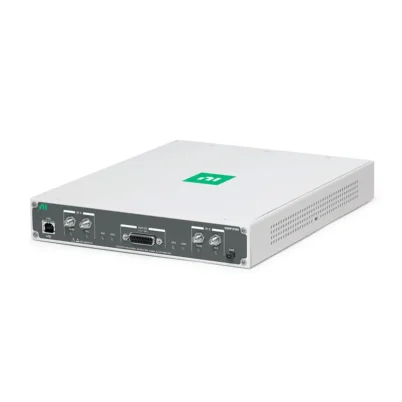
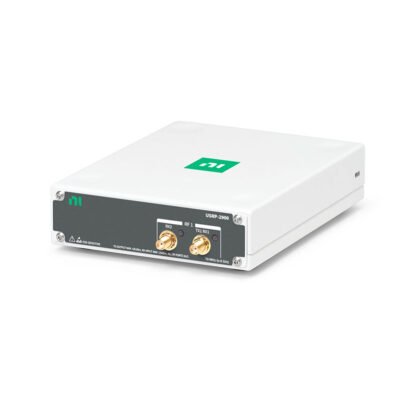
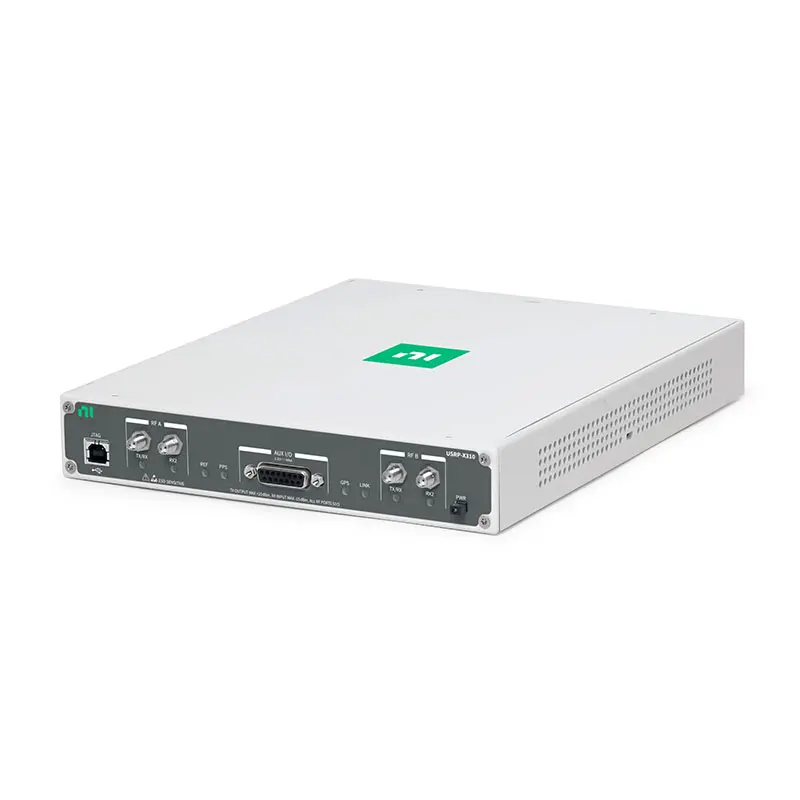
The NI Ettus USRP X310 is a high-performance, scalable software defined radio (SDR) platform designed for advanced wireless communications research, RF prototyping, MIMO development, radar experimentation, spectrum monitoring, signal intelligence research, and FPGA-based real-time signal processing.
The USRP X310 provides two wideband RF daughterboard slots, up to 160 MHz of baseband bandwidth per channel, multiple high-speed host interfaces, and a large user-programmable Xilinx Kintex-7 FPGA. Its modular RF architecture allows engineers to select daughterboards according to the required frequency range, bandwidth, gain, and application.
Because the X310 is a configurable SDR platform rather than a fixed-frequency radio, its final RF specifications depend on the installed daughterboards. With compatible wideband daughterboards such as the UBX-160, the platform can support RF operation from approximately 10 MHz to 6 GHz with up to 160 MHz instantaneous bandwidth.
Product Overview
The USRP X310 belongs to the Ettus Research X Series and is designed for applications requiring high RF bandwidth, multi-channel operation, large FPGA resources, and high-throughput data interfaces.
Unlike integrated SDR models with a permanently defined RF front end, the X310 contains two independent daughterboard slots. Engineers can install compatible daughterboards to configure the system for different frequency ranges and RF applications.
This modular architecture makes the X310 particularly valuable for research laboratories and engineering teams that need to reuse the same SDR base platform for wireless communications, MIMO, radar, spectrum monitoring, direction finding, electronic warfare research, and custom RF systems.
Key Features
Dual RF Daughterboard Slots
The USRP X310 provides two independent RF daughterboard slots for flexible radio configuration.
- 2 RF daughterboard slots
- Support for compatible Ettus RF daughterboards
- Flexible frequency-range configuration
- Multi-channel transmit and receive architectures
- Application-specific RF front ends
Advantage: The RF subsystem can be configured according to the required frequency range and bandwidth instead of being permanently limited to one fixed RF front end.
Up to 160 MHz Bandwidth per Channel
The X310 hardware architecture supports up to approximately 160 MHz of baseband bandwidth per channel when used with compatible RF daughterboards and host interfaces.
- Up to 160 MHz bandwidth per channel
- Wideband I/Q acquisition
- Wideband waveform generation
- High-throughput SDR processing
- Broadband RF experiments
Advantage: Wide bandwidth supports demanding applications such as broadband communications, radar, spectrum monitoring, channel sounding, and advanced RF research.
Configurable RF Frequency Coverage
The RF frequency range of the X310 depends on the installed RF daughterboard.
- Modular RF frequency coverage
- Multiple daughterboard options
- Application-specific frequency ranges
- Wideband transceiver configurations
- Up to 6 GHz coverage with compatible daughterboards
Advantage: Engineers can select an RF daughterboard optimized for the required operating bands rather than replacing the complete SDR platform.
UBX-160 Configuration
When configured with compatible UBX-160 daughterboards, the USRP X310 can provide wideband RF transmit and receive operation over a very broad frequency range.
- 10 MHz to 6 GHz RF coverage
- Up to 160 MHz instantaneous bandwidth
- Full-duplex transceiver operation
- Independent transmit and receive frequencies
- Multi-channel RF applications
Advantage: The X310 with UBX-160 provides an especially versatile configuration for wide-frequency SDR research using a single hardware platform.
Large Kintex-7 FPGA
The USRP X310 incorporates a large Xilinx Kintex-7 FPGA for high-performance digital signal processing and custom radio functionality.
- Xilinx Kintex-7 FPGA
- User-programmable processing resources
- Real-time DSP
- Digital upconversion
- Digital downconversion
- Custom RFNoC processing
- Low-latency signal processing
Advantage: Computationally intensive and latency-sensitive signal-processing algorithms can execute directly on the SDR hardware rather than relying entirely on the host processor.
High-Speed ADC and DAC Architecture
The X310 motherboard provides high-speed data converters for RF daughterboard signal acquisition and generation.
- Dual 14-bit ADC architecture
- Up to 200 MS/s ADC sampling
- Dual 16-bit DAC architecture
- Up to 800 MS/s DAC sampling
- High-speed complex I/Q processing
Advantage: High-speed conversion resources support wideband RF generation and acquisition across multiple channels.
Dual 10 Gigabit Ethernet
The X310 supports dual 10 Gigabit Ethernet interfaces for high-throughput communication with host processing systems.
- 2 × 10 Gigabit Ethernet
- Wideband I/Q streaming
- High-throughput host communication
- Network-based SDR architecture
- Advanced multi-channel applications
Advantage: 10 Gigabit Ethernet provides substantially greater streaming capacity than conventional Gigabit Ethernet for wideband SDR applications.
Dual Gigabit Ethernet
The X310 also supports Gigabit Ethernet interfaces for flexible network-based connectivity.
- 2 × 1 Gigabit Ethernet
- Standard Ethernet infrastructure
- Remote SDR operation
- Network-based device control
- Flexible laboratory deployment
Advantage: Gigabit Ethernet provides convenient connectivity for applications that do not require maximum 10 GigE throughput.
PCI Express Connectivity
The X310 supports PCI Express connectivity for applications requiring high-performance host communication.
- PCI Express interface support
- Low-latency host communication
- High-throughput I/Q data transfer
- Desktop workstation integration
- Advanced SDR systems
Advantage: PCI Express provides another high-performance option for systems requiring low-latency and high-throughput communication between the radio and host.
2×2 MIMO Capability
When configured with two compatible transceiver daughterboards, the X310 can support two transmit and two receive RF channels.
- 2 TX / 2 RX configurations
- 2×2 MIMO research
- Multi-antenna communications
- Spatial multiplexing
- Transmit and receive diversity
Advantage: Multi-channel capability makes the X310 suitable for modern wireless communications research involving multiple antennas and spatial processing.
Full-Duplex RF Operation
Compatible transceiver daughterboards can provide simultaneous transmission and reception for full-duplex SDR applications.
- Simultaneous transmit and receive
- Wireless link prototyping
- Radar transmit/receive experiments
- Bidirectional communications
- Multi-channel RF systems
Advantage: Full-duplex operation enables complete transmitter and receiver systems to be implemented on one SDR platform.
External Timing and Synchronization
The USRP X310 includes timing and reference interfaces for synchronization with other radios and laboratory equipment.
- 10 MHz reference support
- PPS timing support
- External frequency references
- Multi-USRP synchronization
- Coordinated RF acquisition
- Coordinated RF generation
Advantage: Shared references are essential for applications involving synchronized radios, coherent acquisition, MIMO, beamforming, and direction finding.
Optional GPSDO
The X310 architecture can be configured with an optional GPS-disciplined oscillator for applications requiring GPS-referenced frequency and timing.
- Optional GPSDO
- GPS-referenced timing
- Improved frequency accuracy
- Distributed SDR synchronization
- Time-referenced RF measurements
Advantage: GPS-disciplined timing is valuable for distributed receiver networks and applications requiring a common global timing reference.
RFNoC Architecture
The X310 can support RF Network-on-Chip (RFNoC) processing workflows for implementing modular FPGA-based signal-processing functions.
- RFNoC processing architecture
- FPGA DSP blocks
- Custom signal-processing chains
- Real-time data processing
- Reduced host bandwidth requirements
Advantage: RFNoC enables portions of the signal-processing chain to execute directly inside the FPGA, reducing data transfer and host CPU requirements.
UHD Software Support
The USRP X310 is supported by the USRP Hardware Driver (UHD), providing a common software API for radio configuration and data streaming.
- UHD driver support
- C/C++ development
- GNU Radio integration
- Python-based SDR applications
- Custom software development
Advantage: UHD provides an established open SDR software ecosystem for research, prototyping, and deployed radio applications.
Technical Specifications
| Parameter | Description |
|---|---|
| Product Type | High-Performance Modular Software Defined Radio |
| Model | Ettus Research USRP X310 |
| RF Daughterboard Slots | 2 |
| RF Frequency Range | Depends on Installed RF Daughterboards |
| Maximum Supported RF Coverage | Up to 6 GHz with Compatible Daughterboards |
| Example UBX-160 RF Range | 10 MHz to 6 GHz |
| Maximum Baseband Bandwidth | Up to 160 MHz per Channel |
| Maximum RF Channels | Up to 2 TX / 2 RX with Compatible Daughterboards |
| ADC | 2 Channels, 14-bit, 200 MS/s |
| DAC | 2 Channels, 16-bit, 800 MS/s |
| FPGA | Xilinx Kintex-7 XC7K410T |
| 1 Gigabit Ethernet | Dual Interfaces |
| 10 Gigabit Ethernet | Dual Interfaces |
| PCI Express | Supported |
| External Reference | 10 MHz Reference Support |
| External Timing | PPS Support |
| GPSDO | Optional |
| Software Driver | USRP Hardware Driver (UHD) |
| FPGA Framework | RFNoC / Custom FPGA Processing |
| Form Factor | Desktop / Half-Wide 1U Rack-Mountable |
| Primary Applications | Wireless Communications, MIMO, Radar, Spectrum Monitoring, Direction Finding and Advanced SDR Prototyping |
RF Daughterboard Flexibility
The USRP X310 motherboard does not define one fixed RF frequency range. The installed daughterboards determine the final transmit and receive characteristics of the system.
| Daughterboard Example | Typical Capability | Application |
|---|---|---|
| UBX-160 | 10 MHz to 6 GHz, up to 160 MHz instantaneous bandwidth | Broad-frequency wideband SDR |
| UBX-40 | 10 MHz to 6 GHz, up to 40 MHz bandwidth | General wide-frequency RF research |
| Other Compatible Daughterboards | Frequency and bandwidth depend on selected RF front end | Application-specific SDR configurations |
When purchasing an X310 system, the motherboard, RF daughterboards, reference-clock options, host interface, and required accessories should therefore be verified as part of the complete configuration.
Software Ecosystem
The USRP X310 supports an extensive software-defined radio ecosystem for host-based and FPGA-based development.
- UHD: Provides the primary hardware driver and APIs for configuring frequency, gain, sample rate, timing, RF channels, and I/Q streaming.
- GNU Radio: Enables development of graphical and software-based SDR signal-processing chains for communications, spectrum, and RF research.
- C/C++: UHD APIs allow customized high-performance SDR applications to be developed directly in C and C++.
- Python: Compatible software environments can be used to develop scripting, automation, signal-processing, and experimental SDR applications.
- RFNoC: Allows FPGA-based signal-processing blocks and customized data-flow architectures to be implemented within the X310.
Industries
- Wireless Communications
- Telecommunications Research
- Aerospace and Defense
- Electronic Warfare Research
- Radar Development
- RF Engineering
- Spectrum Monitoring
- Universities and Research Laboratories
- Wireless Product Development
Applications
Wireless Communications Research
The modular RF architecture and wide processing bandwidth make the X310 suitable for developing advanced wireless communication technologies.
- Digital modulation research
- OFDM development
- Wireless protocol experimentation
- Physical-layer development
- Channel characterization
2×2 MIMO Research
Two compatible RF daughterboards allow the X310 to support multi-channel MIMO research.
- 2×2 MIMO
- Spatial multiplexing
- Transmit diversity
- Receive diversity
- Multi-antenna communication systems
Radar Research
Wide instantaneous bandwidth and FPGA processing make the X310 useful for experimental radar development.
- FMCW radar
- Pulse radar research
- Radar waveform generation
- Radar signal acquisition
- Real-time FPGA processing
Spectrum Monitoring
Compatible wideband receiver daughterboards can turn the X310 into a flexible platform for spectrum-monitoring applications.
- Wideband spectrum acquisition
- Signal detection
- Interference monitoring
- RF environment analysis
- Signal classification
Direction Finding
Multiple synchronized receive channels can support experimental direction-finding and RF localization systems.
- Direction-of-arrival estimation
- Phase comparison
- Antenna-array processing
- RF localization
- Spatial spectrum analysis
Beamforming Research
Synchronized RF channels can be used to develop multi-antenna beamforming algorithms.
- Digital beamforming
- Transmit beamforming
- Receive beamforming
- Phased-array research
- Spatial signal processing
Electronic Warfare and SIGINT Research
Wide RF coverage, high bandwidth, and FPGA resources make the X310 useful as a research platform for spectrum-oriented and signal-analysis applications.
- Wideband signal acquisition
- Signal detection research
- Signal classification
- Spectrum surveillance research
- Custom RF processing algorithms
FPGA-Based Real-Time Processing
The large Kintex-7 FPGA enables demanding processing functions to execute directly inside the SDR.
- Real-time FFT processing
- Channelization
- Digital filtering
- Signal detection
- Custom triggering
- Data reduction
- Low-latency RF processing
Wireless Testbed Development
The modular architecture makes the X310 particularly useful as the foundation of custom wireless research testbeds.
- Multi-radio testbeds
- Experimental base stations
- Custom wireless networks
- Distributed RF systems
- Research infrastructure
Comparison with Similar USRP Devices
| Model | Main Difference | Best Application |
|---|---|---|
| USRP X310 | Modular high-performance SDR motherboard with two RF daughterboard slots, up to 160 MHz bandwidth per channel, Kintex-7 FPGA, dual 10 GigE, dual 1 GigE, and PCIe. | Advanced configurable SDR and FPGA research |
| NI USRP-2942 | Integrated NI configuration based on the X310 architecture with defined RF front ends covering 400 MHz to 4.4 GHz. | Preconfigured wideband MIMO research |
| NI USRP-2952 | X310-based configuration with 400 MHz to 4.4 GHz RF coverage and integrated GPS-disciplined timing. | Synchronized MIMO and distributed RF systems |
| NI USRP-2955 | X310-based wideband configuration with UBX RF front ends and GPS-disciplined timing for broad-frequency synchronized SDR applications. | Wide-frequency synchronized SDR research |
Recommended Related Products
| NI USRP-2942 | Preconfigured X310-class SDR for users requiring 400 MHz to 4.4 GHz operation and 2 TX / 2 RX RF capability. |
| NI USRP-2952 | GPS-disciplined X310-class SDR for synchronized MIMO and distributed RF applications covering 400 MHz to 4.4 GHz. |
| NI USRP-2955 | Wide-frequency X310-based SDR configuration with UBX front ends and GPSDO for synchronized RF research. |
| USRP X300 | Related X Series SDR motherboard with a smaller Kintex-7 FPGA for applications requiring similar modular RF architecture with fewer FPGA resources. |
Why Choose USRP X310?
- High-performance modular SDR architecture
- Two RF daughterboard slots
- RF coverage determined by interchangeable daughterboards
- Up to 160 MHz baseband bandwidth per channel
- Up to 2 TX / 2 RX with compatible RF daughterboards
- Dual 14-bit, 200 MS/s ADC architecture
- Dual 16-bit, 800 MS/s DAC architecture
- Large Xilinx Kintex-7 XC7K410T FPGA
- Dual 10 Gigabit Ethernet
- Dual 1 Gigabit Ethernet
- PCI Express connectivity
- External clock and PPS synchronization
- Optional GPSDO
- UHD and RFNoC software support
- Ideal for MIMO, radar, spectrum, and FPGA research
Frequently Asked Questions
What is the USRP X310?
The Ettus Research USRP X310 is a high-performance modular software-defined radio platform with two RF daughterboard slots, a large Kintex-7 FPGA, high-speed ADC and DAC resources, and multiple high-throughput host interfaces.
What frequency range does the USRP X310 support?
The X310 itself does not have one fixed RF frequency range because the RF front ends are implemented using interchangeable daughterboards. Compatible daughterboards can provide frequency coverage extending to 6 GHz. For example, the UBX-160 covers approximately 10 MHz to 6 GHz.
Does the USRP X310 include RF daughterboards?
The X310 is fundamentally an SDR motherboard platform with two RF daughterboard slots. The exact sales configuration may or may not include daughterboards, so the installed RF front ends should always be verified when purchasing an X310.
What is the maximum bandwidth of the USRP X310?
The X310 architecture supports up to approximately 160 MHz of baseband bandwidth per channel when configured with compatible wideband daughterboards and an appropriate high-throughput host interface.
How many RF channels can the USRP X310 support?
With two compatible transceiver daughterboards, the X310 can support up to two transmit and two receive RF channels for 2×2 MIMO and other multi-channel SDR applications.
What FPGA does the USRP X310 use?
The USRP X310 uses a Xilinx Kintex-7 XC7K410T FPGA, providing substantially more programmable logic resources than the related X300 platform.
What host interfaces does the USRP X310 support?
The X310 supports multiple high-speed host interfaces including dual 10 Gigabit Ethernet, dual Gigabit Ethernet, and PCI Express connectivity.
Does the USRP X310 support 10 Gigabit Ethernet?
Yes. The X310 provides dual 10 Gigabit Ethernet interfaces for wideband and high-throughput SDR applications.
Does the USRP X310 support PCI Express?
Yes. PCI Express is supported as one of the X310’s high-performance host-interface options.
Can the USRP X310 operate from 10 MHz to 6 GHz?
Yes, when the X310 is configured with a compatible wideband RF daughterboard such as the UBX-160. The 10 MHz to 6 GHz specification belongs to the RF daughterboard configuration rather than to the bare X310 motherboard itself.
Can the USRP X310 be used for MIMO?
Yes. Two compatible transceiver daughterboards can provide two transmit and two receive channels for 2×2 MIMO, spatial diversity, beamforming, and other multi-antenna research applications.
Can the USRP X310 be used for radar research?
Yes. Its wide bandwidth, multiple RF channels, high-speed data converters, and large programmable FPGA make the X310 well suited for experimental radar waveform generation, acquisition, and real-time processing when configured with appropriate RF daughterboards.
Can the USRP X310 be used for spectrum monitoring?
Yes. With suitable receiver daughterboards, the X310 can acquire wideband I/Q data for spectrum monitoring, signal detection, interference analysis, and RF research. Dedicated calibrated instruments may still be required for traceable spectrum measurements and regulatory compliance testing.
Does the USRP X310 support GPSDO?
Yes. GPS-disciplined timing is available as an option for the X310 architecture. GPSDO capability should be verified for the specific unit or configuration being purchased.
What is the difference between USRP X300 and USRP X310?
The X300 and X310 share the same general X Series SDR architecture, RF daughterboard concept, high-speed interfaces, and wideband capabilities. The primary difference is FPGA capacity: the X310 uses the larger Kintex-7 XC7K410T FPGA, making it better suited for FPGA-intensive RFNoC and real-time signal-processing applications.
What is the difference between USRP X310 and NI USRP-2942?
The X310 is the configurable SDR motherboard platform, while NI USRP-2942 represents a defined X310-class RF configuration with specified transceiver front ends and operating frequency range. The X310 offers greater RF configuration flexibility, while a preconfigured NI USRP model provides more clearly defined system-level RF specifications.
What software supports the USRP X310?
The USRP X310 is supported by the USRP Hardware Driver (UHD) and can be used with software environments such as GNU Radio, C/C++, Python-based SDR applications, RFNoC workflows, and other UHD-compatible development tools.
Conclusion
The NI Ettus USRP X310 software defined radio is a high-performance modular SDR platform designed for advanced wireless communications, MIMO, radar, spectrum monitoring, direction finding, electronic warfare research, and FPGA-based signal processing. With two configurable RF daughterboard slots, up to 160 MHz bandwidth per channel, a large Kintex-7 FPGA, dual 10 Gigabit Ethernet, dual Gigabit Ethernet, PCI Express connectivity, and extensive timing and synchronization options, the X310 provides exceptional flexibility for demanding RF research and prototyping applications.