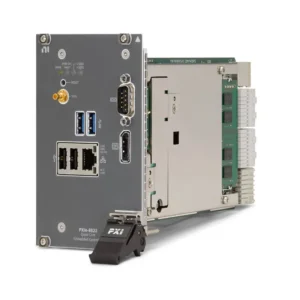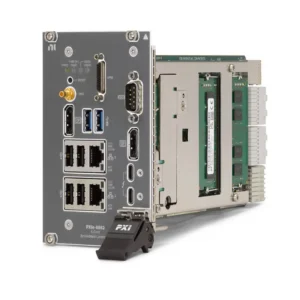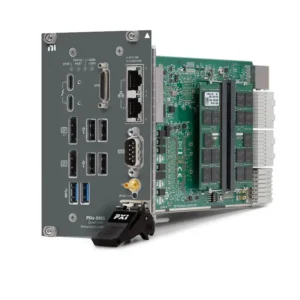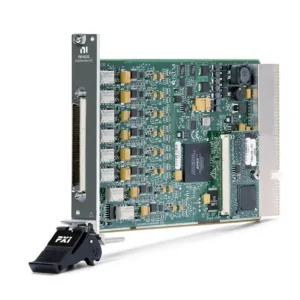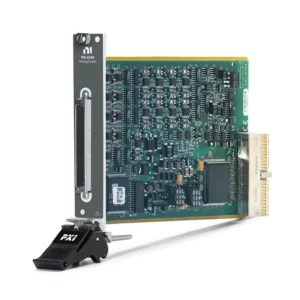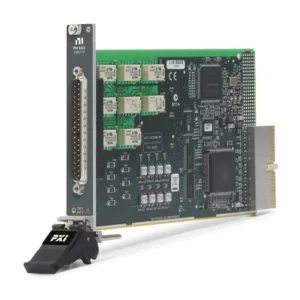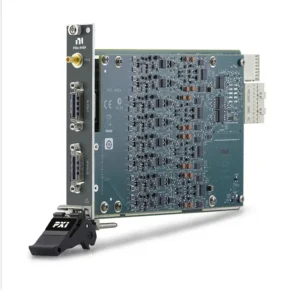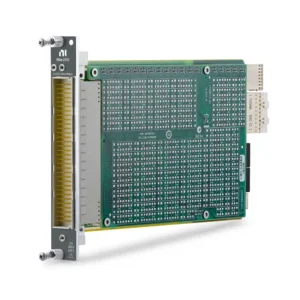




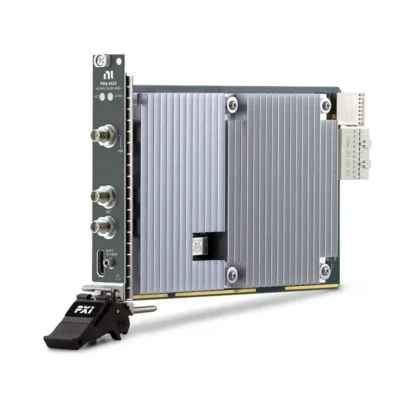
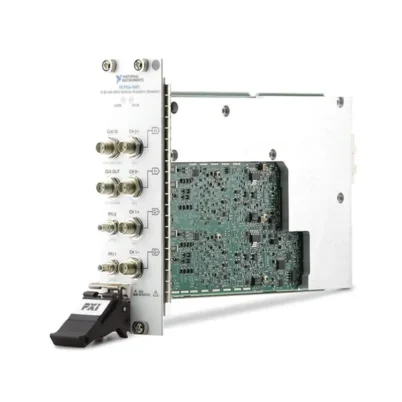
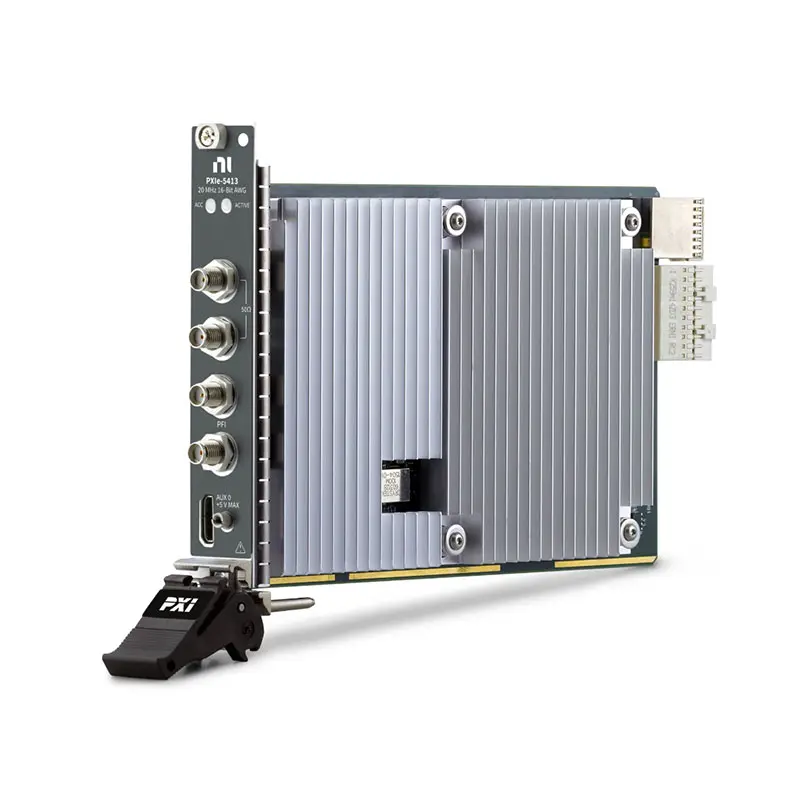
The NI PXIe-5413 is a 16-bit PXI Express arbitrary waveform generator available with one or two independently programmable output channels. It combines 20 MHz bandwidth, an 800 MS/s DAC update rate and output capability up to ±12 V.
The PXIe-5413 generates user-defined arbitrary waveforms and standard sine, square, triangle and ramp signals. Its fractional resampling architecture, high-resolution output and PXI synchronization make it suitable for electronic validation, sensor simulation, semiconductor testing and automated production systems.
Key Features of the NI PXIe-5413
- One- or two-channel arbitrary waveform generator
- 20 MHz maximum analog bandwidth
- 16-bit DAC resolution
- 800 MS/s internal DAC update rate
- Up to 200 MS/s user-programmable arbitrary waveform rate
- Output capability up to ±12 V into high impedance
- Output capability up to ±6 V into 50 Ω
- Fractional resampling architecture
- User-defined arbitrary waveform generation
- Sine, square, triangle and ramp functions
- Arbitrary sequence mode
- Frequency list mode
- 128 MB onboard memory per channel
- Hardware triggering and advanced PXI synchronization
- Independent generation engines on the two-channel model
- SMA analog output connectors
- NI-FGEN software support
PXIe-5413 Technical Specifications
| Product Model | PXIe-5413 |
|---|---|
| Product Type | PXI Express Arbitrary Waveform Generator |
| Part Numbers | 784181-01 and 785114-01 |
| Output Channels | 1 or 2, depending on configuration |
| Output Type | Referenced single-ended |
| Output Connectors | SMA |
| Maximum Bandwidth | 20 MHz |
| DAC Resolution | 16 bits |
| Internal DAC Update Rate | 800 MS/s |
| Maximum User Waveform Rate | 200 MS/s |
| Maximum Output Voltage | ±12 V into high impedance |
| Maximum 50 Ω Output | ±6 V |
| Minimum Output Range | Approximately ±7.75 mV |
| Standard Waveforms | Sine, square, triangle and ramp |
| Arbitrary Waveforms | Supported |
| Fractional Resampling | Supported |
| Arbitrary Sequence Mode | Supported |
| Frequency List Mode | Supported |
| Waveform Scripting | Not supported |
| Continuous Waveform Streaming | Not supported |
| Onboard Memory | 128 MB per channel |
| Spurious-Free Dynamic Range | Up to approximately -92 dB |
| Integrated System Jitter | Approximately 435 fs |
| Digital Upconversion | Not supported |
| User-Programmable FPGA | No |
| Software Driver | NI-FGEN |
| Bus Interface | PXI Express |
| Product Status | Active |
PXIe-5413 Part Numbers and Configurations
| Part Number | Channels | Total Onboard Memory | Memory per Channel | Product Status |
|---|---|---|---|---|
| 784181-01 | 1 | 128 MB | 128 MB | Active |
| 785114-01 | 2 | 256 MB | 128 MB | Active |
Both PXIe-5413 configurations provide the same bandwidth, DAC performance, arbitrary waveform rate and output-voltage capability. Choose 785114-01 when two independently programmable output channels are required.
Arbitrary Waveform Generation
The PXIe-5413 can generate user-defined waveforms created from calculated data, recorded signals or imported waveform files. This enables the reproduction of sensor outputs, electrical transients, noise and other signals that cannot be represented by a standard mathematical function.
Waveform data is downloaded to onboard memory before generation. The single-channel version provides 128 MB of memory, while the two-channel version provides 128 MB for each independent channel.
800 MS/s DAC Architecture
The PXIe-5413 uses an internal DAC rate of 800 MS/s for standard and arbitrary waveform generation. User-defined waveforms can be programmed at rates up to 200 MS/s.
The high internal update rate helps smooth point-to-point transitions and reduce unwanted frequency images, even when the uploaded waveform uses a lower sample rate.
Fractional Resampling
Fractional resampling converts the user waveform rate into the fixed 800 MS/s DAC update rate. This architecture allows waveform frequencies and user sample rates that are not limited to simple integer divisions of the DAC clock.
It provides greater flexibility when creating precise periodic signals and helps maintain consistent dynamic performance across different waveform configurations.
20 MHz Analog Bandwidth
The PXIe-5413 provides up to 20 MHz of analog bandwidth. It is intended for lower-frequency arbitrary waveform generation where output resolution, signal fidelity and voltage range are more important than maximum bandwidth.
Typical uses include sensor simulation, audio and vibration testing, power-electronics control signals and general analog circuit stimulation.
16-Bit Output Resolution
The 16-bit DAC provides 65,536 possible digital output codes. This resolution enables accurate reproduction of small waveform details and fine voltage changes.
Selecting the smallest available output range that accommodates the required waveform amplitude and offset improves effective voltage resolution and signal-to-noise performance.
Wide ±12 V Output Range
The PXIe-5413 supports output signals up to ±12 V into a high-impedance load, corresponding to a maximum voltage swing of 24 Vpk-pk. Into a properly terminated 50 Ω load, the maximum output is approximately ±6 V.
This output capability allows many sensors, electronic control units and analog circuits to be stimulated directly without requiring a separate external amplifier.
Standard Function Generation
The module generates sine, square, triangle and ramp functions without requiring the user to calculate individual waveform samples. Engineers can directly configure frequency, amplitude, offset and phase.
Standard function mode is useful for frequency sweeps, functional verification and initial troubleshooting before creating a custom arbitrary waveform.
Arbitrary Sequence Mode
Arbitrary sequence mode generates stored waveforms or waveform segments in a defined order. Engineers can configure repetitions and transitions between the available waveform records.
This mode supports multistage device stimulation and repeated test patterns while reducing the need for continuous software commands.
Frequency List Mode
Frequency list mode generates a programmed series of frequencies. It is useful for stepped frequency sweeps, filter testing, frequency-response characterization and automated component validation.
PXIe-5413 Scripting and Streaming Limitations
The PXIe-5413 supports arbitrary sequence and frequency list modes but does not provide the advanced waveform scripting and continuous streaming functions available on the PXIe-5423 and PXIe-5433.
Waveform records must fit within the available onboard memory. Select the PXIe-5423 or PXIe-5433 when the application requires complex scripts or waveforms streamed continuously from the controller.
Independent Dual-Channel Generation
The 785114-01 configuration provides two independent generation engines and 128 MB of memory per channel. Each channel can generate a different waveform, frequency, amplitude or sequence.
The two channels can also share hardware timing and trigger resources when simultaneous or synchronized waveform generation is required.
PXI Timing and Synchronization
The PXIe-5413 uses PXI Express timing and trigger resources to coordinate waveform generation with digitizers, oscilloscopes, digital instruments and additional signal generators.
Hardware triggering provides more deterministic timing than software-controlled starts and supports repeatable automated test sequences.
Typical PXIe-5413 Applications
- Automated electronic design validation
- Sensor and transducer simulation
- Automotive ECU testing
- Aerospace subsystem stimulation
- Semiconductor component testing
- Analog circuit validation
- Audio signal generation
- Vibration system stimulation
- Power-electronics control-signal generation
- Fault and transient simulation
- Frequency-response testing
- Automated production test
NI-FGEN Software Support
The PXIe-5413 uses the NI-FGEN instrument driver. Engineers can configure standard functions, arbitrary waveforms, output ranges, triggering, sequences and frequency lists.
Compatible development options include LabVIEW, InstrumentStudio, TestStand, LabWindows/CVI, C/C++, .NET and supported Python environments. Verify software and operating-system compatibility before integration.
PXI Chassis and System Integration
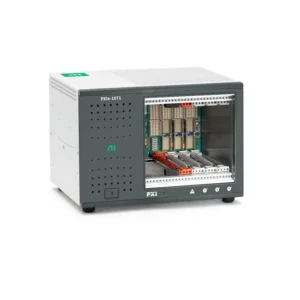
The PXIe-5413 requires a compatible PXI Express chassis and controller. Chassis selection should consider available slots, cooling capacity, controller connectivity and synchronization requirements.
An SCB-19 shielded auxiliary I/O connector block and 50 Ω SMA-to-SMA coaxial cables are available separately for signal routing and connection.
Output Termination and Cabling
Use suitable 50 Ω coaxial cables for the SMA analog outputs. Correct termination helps maintain waveform amplitude and reduces reflections at higher frequencies.
A waveform configured for ±12 V into high impedance appears as approximately ±6 V when connected to a 50 Ω load. Configure the expected load impedance correctly in NI-FGEN.
PXIe-5413 Troubleshooting
Why is the measured output amplitude half the configured value?
The waveform generator may be configured for a high-impedance load while the oscilloscope or DUT is terminated at 50 Ω. Configure the correct load impedance or account for the voltage-divider effect.
Why does the waveform contain unwanted frequency images?
Use an appropriate reconstruction filter, increase the user waveform sample rate and include more waveform samples per cycle. Also verify cable termination and output bandwidth.
Why can a long waveform not be generated?
The waveform may exceed the available 128 MB per-channel memory. The PXIe-5413 does not support continuous waveform streaming; consider the PXIe-5423 or PXIe-5433 for longer streamed waveforms.
Why are two output channels not synchronized?
Configure both channels with a shared hardware trigger and compatible reference clock. Separately initiated software commands can introduce timing differences.
Why is the waveform clipped or distorted?
Check that the combined waveform amplitude and DC offset remain within the selected output range. Confirm the load impedance and ensure that the signal frequency is within the 20 MHz bandwidth.
Why can NI-FGEN not detect the PXIe-5413?
Confirm that the module is installed in a compatible PXI Express slot, the chassis and controller are functioning correctly, and a supported NI-FGEN driver is installed.
PXIe-5413 Comparison with the PXIe-54×3 Family
| Model | Bandwidth | DAC Rate | User Waveform Rate | Memory per Channel | Scripting | Streaming |
|---|---|---|---|---|---|---|
| PXIe-5413 | 20 MHz | 800 MS/s | 200 MS/s | 128 MB | No | No |
| PXIe-5423 | 40 MHz | 800 MS/s | 200 MS/s | 128 MB | Yes | Yes |
| PXIe-5433 | 80 MHz | 800 MS/s | Up to 400 MS/s | 512 MB | Yes | Yes |
Recommended Related Products
- NI PXIe-5423 Arbitrary Waveform Generator – provides 40 MHz bandwidth together with waveform scripting and streaming.
- NI PXIe-5433 Arbitrary Waveform Generator – offers 80 MHz bandwidth, higher user waveform rates and 512 MB of memory per channel.
- NI PXI-5441 Arbitrary Waveform Generator – provides 16-bit waveform generation with onboard signal processing for legacy PXI systems.
- NI PXIe-5114 Oscilloscope – captures generated signals and DUT responses in synchronized PXI test systems.
- NI PXIe-5163 Oscilloscope – provides high-speed waveform acquisition for wider-bandwidth validation.
- NI PXI and PXI Express Modules – browse additional signal generators, digitizers and modular instruments.
How to Select the Correct PXIe-5413
Choose part number 784181-01 for applications requiring one output channel and 128 MB of memory. Select 785114-01 when two independently programmable channels and 256 MB of total memory are required.
Choose the PXIe-5413 when 20 MHz bandwidth and memory-based waveform generation meet the application requirements. Select the PXIe-5423 or PXIe-5433 for higher bandwidth, scripting or continuous streaming.
Why Choose the NI PXIe-5413?
The PXIe-5413 provides 16-bit arbitrary waveform generation, a wide voltage range and precise PXI synchronization at a lower cost than the higher-bandwidth PXIe-54×3 models. It is well suited for general-purpose signal generation and memory-based automated tests.
Frequently Asked Questions
What is the bandwidth of the PXIe-5413?
The PXIe-5413 provides a maximum analog bandwidth of 20 MHz.
What is its DAC update rate?
The internal DAC operates at 800 MS/s. User-defined arbitrary waveforms can be programmed at rates up to 200 MS/s.
How many output channels are available?
Part number 784181-01 provides one channel, while 785114-01 provides two independently programmable channels.
What is the maximum output voltage?
The module supports up to ±12 V into a high-impedance load or approximately ±6 V into 50 Ω.
Does the PXIe-5413 generate arbitrary waveforms?
Yes. It generates user-defined arbitrary waveforms and standard sine, square, triangle and ramp functions.
Does the PXIe-5413 support waveform scripting?
No. It supports arbitrary sequence and frequency list modes but does not provide the advanced scripting available on the PXIe-5423 and PXIe-5433.
Can it stream waveforms continuously from the controller?
No. Waveforms must fit within the available onboard memory. Select a PXIe-5423 or PXIe-5433 when continuous streaming is required.
How much onboard memory does it have?
Each output channel provides 128 MB. The single-channel version has 128 MB total, while the two-channel version has 256 MB total.
Is the PXIe-5413 still an active product?
Yes. NI currently classifies both PXIe-5413 configurations as active products.
Request a Quote for the NI PXIe-5413
Contact us for current availability, lead time and project pricing for the NI PXIe-5413 20 MHz Arbitrary Waveform Generator. Please specify whether you require the one-channel 784181-01 or two-channel 785114-01 configuration.