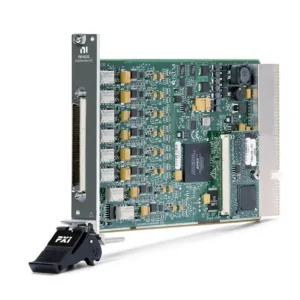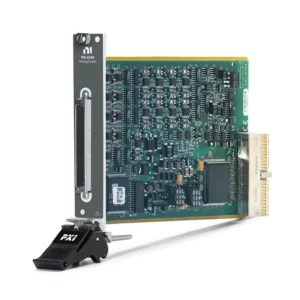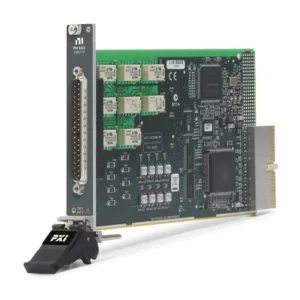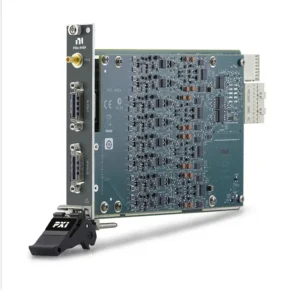




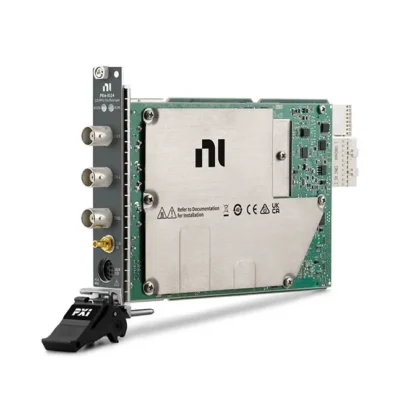
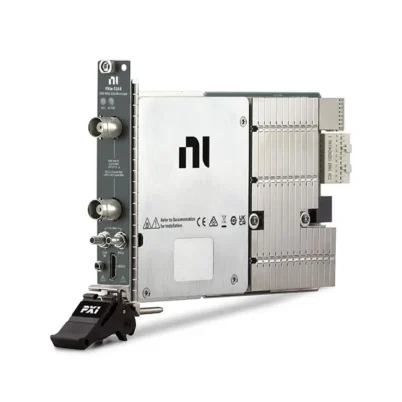
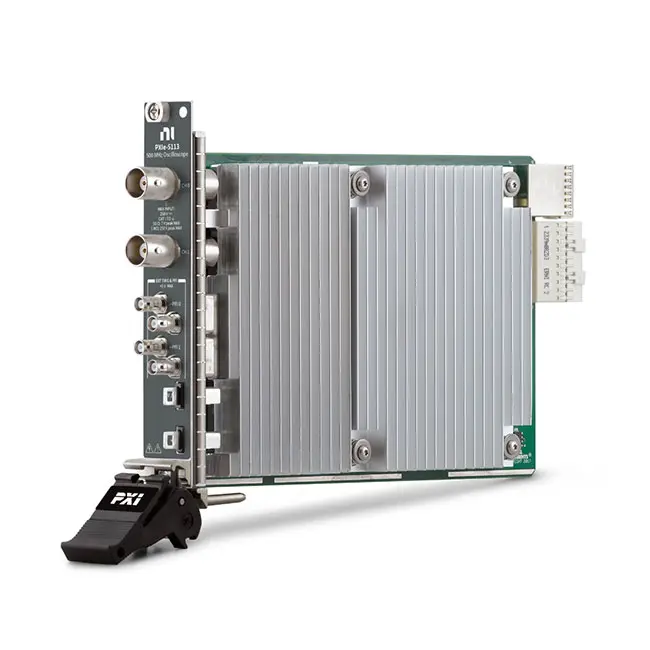
The PXIe-5113 is a high-speed, two-channel PXI Express oscilloscope designed for automated validation, production testing and high-bandwidth waveform acquisition. It combines up to 500 MHz analog bandwidth, a maximum sampling rate of 3 GS/s and 8-bit vertical resolution.
The PXIe-5113 provides programmable coupling, input impedance, voltage range, bandwidth filtering and advanced triggering. It is available with 64 MB or 512 MB of onboard memory, while selected versions include CableSense technology for detecting changes and discontinuities in connected cables and signal paths.
Key Features of the PXIe-5113
- Two simultaneously sampled analog input channels
- 500 MHz typical analog bandwidth
- Up to 3 GS/s sampling in single-channel time-interleaved mode
- Up to 1.5 GS/s real-time sampling with both channels enabled
- 8-bit vertical resolution
- Selectable 50 Ω and 1 MΩ input impedance
- Full-scale input ranges from 40 mVpp to 40 Vpp
- AC and DC input coupling
- 350 MHz bandwidth filter and 20 MHz noise filter
- 64 MB or 512 MB onboard memory options
- Up to 100,000 records with the 512 MB configuration
- Edge, glitch, hysteresis, runt, width and window triggering
- Four bidirectional front-panel PFI connections
- Optional CableSense signal-path diagnostics
- NI-TClk multi-instrument synchronization
- Compatible with NI-SCOPE and InstrumentStudio
PXIe-5113 Technical Specifications
| Product Model | PXIe-5113 |
|---|---|
| Product Type | PXI Express Oscilloscope |
| Number of Channels | 2 simultaneously sampled channels |
| Maximum Analog Bandwidth | 500 MHz typical; 475 MHz warranted on the applicable 50 Ω path |
| Two-Channel Sample Rate | Up to 1.5 GS/s per channel |
| Single-Channel Sample Rate | Up to 3 GS/s in time-interleaved sampling mode |
| Vertical Resolution | 8 bits |
| Input Configuration | Referenced single-ended |
| Input Impedance | 50 Ω or 1 MΩ |
| Input Coupling | AC or DC |
| Full-Scale Input Ranges | 0.04, 0.1, 0.2, 0.4, 1, 2, 4, 10, 20 and 40 Vpp |
| Bandwidth Filters | 350 MHz filter and 20 MHz noise filter |
| Onboard Memory | 64 MB or 512 MB shared among enabled channels |
| Maximum Records | Up to 100,000 with the 512 MB option |
| Timebase Frequency | 1.5 GHz |
| Sample Clock Jitter | 1.1 ps RMS |
| Analog Input Connectors | 2 × BNC |
| PFI Connectors | 4 × HD-BNC |
| Bus Interface | PXI Express, Gen 1 ×4 |
| Slot Compatibility | PXI Express or hybrid peripheral slot |
| Operating Temperature | 0°C to 55°C |
PXIe-5113 Part Numbers and Options
| Part Number | Onboard Memory | CableSense |
|---|---|---|
| 786375-01 | 64 MB | No |
| 786375-11 | 64 MB | Yes |
| 786405-01 | 512 MB | No |
| 786405-11 | 512 MB | Yes |
The correct part number should be selected according to the required memory capacity and whether CableSense diagnostics are needed. The 512 MB versions are recommended for long records, multi-record acquisition and applications that capture large volumes of waveform data.
500 MHz High-Bandwidth Waveform Acquisition
The PXIe-5113 provides up to 500 MHz typical analog bandwidth, making it suitable for high-speed electronic signals, fast pulses and communication interfaces. The 50 Ω signal path provides 475 MHz warranted bandwidth under the specified operating conditions.
A selectable 350 MHz filter can restrict measurement bandwidth when the full 500 MHz response is unnecessary. A separate 20 MHz noise filter helps reduce high-frequency noise during lower-bandwidth measurements.
3 GS/s Time-Interleaved Sampling
The PXIe-5113 supports real-time sampling rates from approximately 22.89 kS/s to 1.5 GS/s. Both input channels can be sampled simultaneously at rates up to 1.5 GS/s per channel.
When only one channel is enabled, time-interleaved sampling mode combines the available converters to provide a maximum rate of 3 GS/s. This configuration is useful when the highest time resolution is more important than acquiring two channels simultaneously.
Flexible Voltage Measurement Ranges
The PXIe-5113 offers full-scale input ranges from 40 mVpp to 40 Vpp. Smaller ranges provide increased sensitivity for low-amplitude signals, while larger ranges accommodate higher-voltage waveforms.
The 50 Ω input path supports ranges up to 10 Vpp, while the 1 MΩ input path extends to 40 Vpp. Programmable vertical offset allows users to examine smaller waveform variations around a larger DC operating level.
Although the 1 MΩ input provides additional overload protection, the maximum permitted voltage is frequency-dependent. Suitable probes and attenuation must be used whenever the connected signal may exceed the module’s measurement or overload limits.
Selectable 50 Ω and 1 MΩ Inputs
Each input channel supports programmable 50 Ω and 1 MΩ impedance:
- 50 Ω input is appropriate for impedance-matched RF, communication and high-speed coaxial signal paths.
- 1 MΩ input reduces circuit loading and supports compatible passive oscilloscope probes.
Correct impedance selection helps preserve signal amplitude and minimize reflections. A source calibrated for a 50 Ω load may display a different amplitude when connected to a 1 MΩ input.
AC/DC Coupling and Bandwidth Filtering
DC coupling preserves both the AC and DC components of the measured waveform. AC coupling removes the DC component, allowing smaller alternating signal components to be examined more easily.
The PXIe-5113 includes programmable full-bandwidth, 350 MHz and 20 MHz filter configurations. Selecting the narrowest suitable bandwidth can improve signal-to-noise performance without removing relevant waveform content.
Advanced Triggering Options
The PXIe-5113 provides multiple trigger modes for isolating specific waveform conditions:
- Edge triggering
- Glitch triggering
- Hysteresis triggering
- Runt triggering
- Pulse-width triggering
- Window triggering
- Digital triggering
- Immediate triggering
- Software triggering
Supported trigger sources include CH 0, CH 1, four front-panel PFI connections and PXI backplane trigger lines. Reference, arm, start and advance triggers support complex automated acquisition sequences.
Deep Memory and Multi-Record Acquisition
The PXIe-5113 is available with 64 MB or 512 MB of onboard waveform memory. Memory is shared among the enabled channels, so the available record length per channel depends on the number of active inputs and acquisition configuration.
The 512 MB version supports up to 100,000 records in onboard memory, depending on record length and enabled channels. Multi-record acquisition reduces communication overhead when capturing many triggered events, making it valuable for pulse analysis, device characterization and production testing.
CableSense Signal-Path Diagnostics
Selected PXIe-5113 part numbers include CableSense technology. CableSense uses the oscilloscope’s signal path to detect changes, faults or discontinuities in connected cables and fixtures.
The function can help identify loose connections, damaged cables and changes from a known test configuration before they produce unreliable measurement results. It is especially useful in automated test systems where cable faults can cause intermittent failures and unnecessary downtime.
CableSense-enabled versions generate a nominal 0.4 V diagnostic pulse with a typical 1.3 ns rise time. CableSense support for the PXIe-5113 requires a compatible NI-SCOPE version.
PXI Timing and NI-TClk Synchronization
The PXIe-5113 uses PXI Express timing and triggering resources to coordinate acquisition with other modular instruments. NI-TClk can align supported oscilloscopes, waveform generators and other PXI modules using shared reference clocks and backplane triggers.
Channel-to-channel skew is less than 60 ps under the specified conditions. With NI-TClk and manual adjustment, multiple identical PXIe-5113 modules can achieve closely aligned acquisitions for multi-channel systems.
Typical PXIe-5113 Applications
- Automated electronic device validation
- High-speed digital signal characterization
- Production-line functional testing
- Pulse and transient analysis
- Communication interface testing
- Semiconductor device characterization
- Power electronics switching measurements
- Automotive electronic system testing
- Cable and test-fixture condition monitoring
- Synchronized multi-instrument PXI systems
NI-SCOPE and InstrumentStudio Support
The PXIe-5113 is supported by the NI-SCOPE instrument driver. NI-SCOPE provides functions for channel configuration, triggering, waveform acquisition, data transfer, measurement and calibration.
Supported development environments include LabVIEW, LabWindows/CVI, Measurement Studio, C/C++ and .NET languages such as C# and VB.NET, subject to driver and operating-system compatibility.
InstrumentStudio provides an interactive interface for configuring channels, triggers and acquisitions without developing a program. NI Measurement & Automation Explorer can be used to identify the module, perform self-tests and access device configuration tools.
PXI Express Chassis Integration
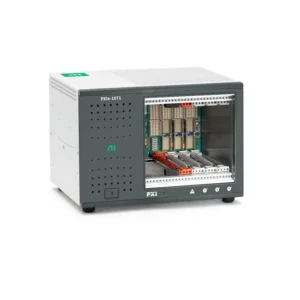
The PXIe-5113 is a one-slot, 3U PXI Express module that can be installed in a PXI Express or compatible hybrid peripheral slot. It requires a PXI Express chassis and either an embedded PXI controller or an externally connected computer.
Verify slot compatibility, controller bandwidth and chassis cooling before installation. For specified measurement performance, allow at least 15 minutes of warm-up time and complete self-calibration after power cycling or restarting the controller.
PXIe-5113 Troubleshooting
Why is the PXIe-5113 not detected?
Confirm that the module is installed in a compatible PXI Express or hybrid slot. Install a supported NI-SCOPE driver, restart the system and check the module in NI Measurement & Automation Explorer.
Why is the maximum sample rate limited to 1.5 GS/s?
The 3 GS/s rate requires single-channel time-interleaved sampling mode. When both analog channels are enabled, the maximum rate is 1.5 GS/s per channel.
Why does the waveform appear clipped?
Select a larger voltage range, adjust the vertical offset or use an appropriate attenuating probe. Confirm that signal peaks remain within the selected measurement range and maximum input limits.
Why does the measured amplitude appear incorrect?
Check the configured impedance and probe attenuation. A signal source designed for 50 Ω termination can produce an unexpected amplitude when connected to a 1 MΩ input.
How can waveform noise be reduced?
Enable the 20 MHz or 350 MHz filter when full bandwidth is unnecessary. Proper grounding, shielded cables, suitable termination, shorter connections and waveform averaging can also improve signal quality.
Why is CableSense unavailable?
Confirm that the installed PXIe-5113 part number includes CableSense and that the installed NI-SCOPE version supports the feature. Standard -01 versions do not include CableSense.
Why is the available record length lower than expected?
Onboard memory is shared among enabled channels. Disabling an unused channel or reducing the number of records can increase the memory available for each acquisition.
PXIe-5113 Comparison with Similar PXI Oscilloscopes
| Model | Channels | Bandwidth | Maximum Sample Rate | Resolution | Recommended Use |
|---|---|---|---|---|---|
| PXIe-5113 | 2 | 500 MHz | 3 GS/s | 8-bit | Cost-effective high-bandwidth testing |
| PXIe-5111 | 2 | 350 MHz | 3 GS/s | 8-bit | Lower-bandwidth high-speed acquisition |
| PXIe-5114 | 2 | 125 MHz | 250 MS/s | 8-bit | Cost-sensitive general waveform acquisition |
| PXIe-5162 | 2 or 4 | Up to 1.5 GHz | Up to 5 GS/s | 10-bit | Higher-bandwidth and faster signal analysis |
| PXIe-5163 | 2 | 200 MHz | 1 GS/s | 14-bit | Higher-resolution waveform measurement |
Recommended Related Products
- PXIe-5111 – Recommended when 350 MHz bandwidth is sufficient but sampling up to 3 GS/s is still required.
- PXIe-5114 – A lower-cost option for applications requiring up to 125 MHz bandwidth.
- PXIe-5162 – Suitable for signals requiring bandwidth up to 1.5 GHz, faster sampling and 10-bit resolution.
- PXIe-5163 – A 14-bit alternative for applications prioritizing vertical resolution over maximum bandwidth.
How to Select the Right PXIe-5113 Configuration
Choose a 64 MB version for shorter records and standard automated measurements. Select a 512 MB version when the application requires longer acquisition times, large records or extensive multi-record capture.
Choose a CableSense-enabled -11 part number when automated signal-path verification and cable-fault detection are required. Standard -01 versions provide the same primary oscilloscope measurement specifications without CableSense.
Why Choose the PXIe-5113?
- Combines 500 MHz bandwidth with sampling up to 3 GS/s
- Provides flexible 50 Ω and 1 MΩ input configurations
- Supports wide voltage ranges and programmable vertical offset
- Offers 64 MB and 512 MB memory options
- Provides advanced waveform trigger conditions
- Offers optional CableSense signal-path diagnostics
- Integrates with PXI timing and NI-TClk synchronization
- Supports interactive and automated test applications
Frequently Asked Questions
What is the PXIe-5113?
The PXIe-5113 is a two-channel, 8-bit PXI Express oscilloscope with up to 500 MHz analog bandwidth and a maximum sampling rate of 3 GS/s.
What part numbers are available?
The available part numbers are 786375-01, 786375-11, 786405-01 and 786405-11.
How much onboard memory does the PXIe-5113 provide?
Depending on the part number, the module provides 64 MB or 512 MB of memory shared among enabled channels.
Can both channels sample at 3 GS/s simultaneously?
No. The 3 GS/s rate is available in single-channel time-interleaved sampling mode. With both channels enabled, the maximum sample rate is 1.5 GS/s per channel.
Which PXIe-5113 versions include CableSense?
Part numbers 786375-11 and 786405-11 include CableSense. Part numbers ending in -01 do not include this feature.
What input impedance options are supported?
Each channel supports programmable 50 Ω and 1 MΩ input impedance.
What is the maximum full-scale input range?
The maximum full-scale input range is 40 Vpp on the supported 1 MΩ input path. The 50 Ω path supports ranges up to 10 Vpp.
Does the PXIe-5113 have an onboard user-programmable FPGA?
No. The PXIe-5113 is a conventional PXI oscilloscope and does not provide a user-programmable FPGA.
Which software driver supports the PXIe-5113?
The module uses the NI-SCOPE instrument driver. CableSense support requires a compatible driver version.
Can the PXIe-5113 operate independently?
No. It must be installed in a compatible PXI Express chassis and used with an embedded controller or externally connected computer.
Is the PXIe-5113 suitable for automated production testing?
Yes. Its high sampling rate, flexible triggering, deep memory, CableSense options and NI-SCOPE APIs make it well suited to automated validation and production test systems.
Request a Quote for the PXIe-5113
Contact us for current availability, lead time and project pricing for the PXIe-5113 PXI Express Oscilloscope. Please provide the required memory capacity and indicate whether CableSense is needed. We can also help confirm compatible PXI chassis, controllers, probes, cables and synchronized instrumentation.