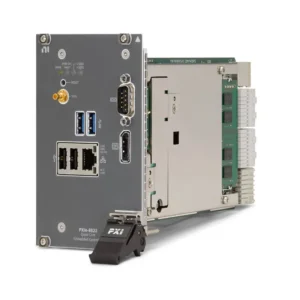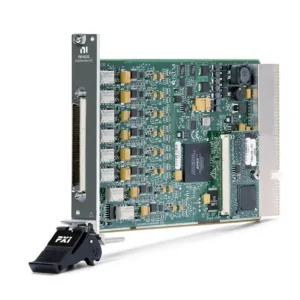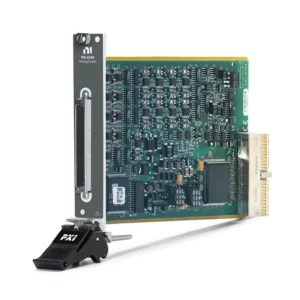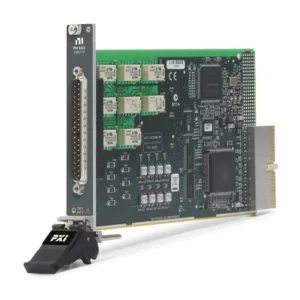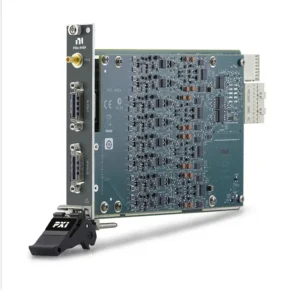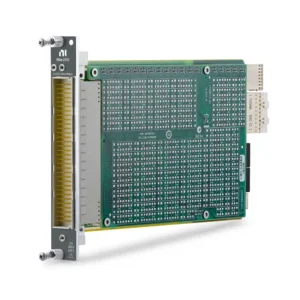






PXIe-4330 8-Channel Strain and Bridge Input Module
The PXIe-4330 is an 8-channel, 24-bit PXI Express strain and bridge input module with integrated signal conditioning for bridge-based sensors. It supports strain gauges, load cells, pressure transducers, torque sensors and other Wheatstone bridge devices.
All eight channels sample simultaneously at rates up to 25.6 kS/s per channel. Each channel provides independently programmable excitation, remote sensing, bridge completion, digital filtering and shunt calibration.
Key Features of the PXIe-4330
- 8 simultaneous strain and bridge input channels
- 24-bit analog input resolution
- 25.6 kS/s maximum sampling rate per channel
- Dedicated delta-sigma ADC for each channel
- Full-, half- and quarter-bridge support
- 120 Ω, 350 Ω and 1 kΩ quarter-bridge completion
- Independent programmable excitation for every channel
- Excitation settings from 0.625 V to 10 V
- Remote excitation sensing
- Internal and external shunt calibration options
- Per-channel anti-alias and digital filtering
- Simultaneous sampling for synchronized measurements
- NI-DAQmx driver support
PXIe-4330 Technical Specifications
| Product Model | PXIe-4330 |
|---|---|
| Part Number | 781346-01 |
| Product Type | PXI Express Strain and Bridge Input Module |
| Input Channels | 8 differential bridge input channels |
| ADC Resolution | 24 bit |
| ADC Type | Delta-sigma with analog prefiltering |
| Sampling Mode | Simultaneous |
| Maximum Sample Rate | 25.6 kS/s per channel |
| Input Ranges | ±25 mV/V and ±100 mV/V |
| Bridge Configurations | Full, half and quarter bridge |
| Quarter-Bridge Completion | 120 Ω, 350 Ω and 1 kΩ |
| Excitation Type | Balanced constant differential voltage |
| Excitation Settings | 0.625 V, 1 V, 1.5 V, 2 V, 2.5 V, 2.75 V, 3.3 V, 5 V, 7.5 V and 10 V |
| Shunt Calibration Resistors | 33.333 kΩ, 50 kΩ and 100 kΩ |
| Common-Mode Input Range | ±2 V |
| Common-Mode Rejection | 85 dB, DC to 1 kHz |
| FIFO Buffer | 1,023 samples |
| Data Transfers | DMA and programmed I/O |
| Bus Type | PXI Express |
| Operating Temperature | 0°C to 55°C |
PXIe-4330 Part Number and Accessories
| Item | Part Number | Description |
|---|---|---|
| PXIe-4330 | 781346-01 | 8-channel, 24-bit strain and bridge input module |
| TB-4330 | 781347-01 | Front-mount terminal block for PXIe-4330 and PXIe-4331 |
| RM-24999 | 785840-01 | Rack-mount terminal block for PXIe-4330 and PXIe-4331 |
| Shielded Rack-Mount Cable | 786341-01 | 1 m shielded cable for connecting the module to RM-24999 |
| Shielded Rack-Mount Cable | 786341-03 | 3 m shielded cable for connecting the module to RM-24999 |
| Shielded Rack-Mount Cable | 786341-05 | 5 m shielded cable for connecting the module to RM-24999 |
The TB-4330 mounts directly on the front of the module. The RM-24999 is intended for rack-mounted systems and requires a compatible shielded cable.
Simultaneous Bridge Measurements
The PXIe-4330 includes a dedicated 24-bit ADC for each of its eight input channels. All channels acquire data simultaneously, preserving the timing and phase relationships between multiple bridge sensors.
This is important for structural testing, load distribution measurements and dynamic systems where data from several sensors must be compared at the same instant.
Full-, Half- and Quarter-Bridge Support
The module supports full-, half- and quarter-bridge configurations. Bridge mode can be selected independently for each channel through the measurement software.
Internal bridge completion simplifies connection of quarter- and half-bridge sensors by reducing the need for external precision completion resistors.
Quarter-Bridge Completion
The PXIe-4330 provides internal quarter-bridge completion for 120 Ω, 350 Ω and 1 kΩ strain gauges. The appropriate resistance must be selected to match the connected sensor.
Incorrect completion resistance can cause offset, scaling errors or invalid measurements. Confirm the nominal gauge resistance before configuring the channel.
Programmable Excitation Voltage
Every input channel provides an independently programmable balanced excitation source. Available settings include 0.625 V, 1 V, 1.5 V, 2 V, 2.5 V, 2.75 V, 3.3 V, 5 V, 7.5 V and 10 V.
Independent excitation allows different sensor types and bridge resistances to be used on the same module. The maximum suitable excitation depends on the bridge configuration and resistance.
Remote Excitation Sensing
Remote sensing compensates for voltage loss in the excitation wiring between the module and the bridge sensor. Separate sense connections measure the actual excitation voltage at the sensor.
This feature improves measurement accuracy when sensors are installed far from the PXI system or when excitation cables have significant resistance.
Shunt Calibration
The PXIe-4330 supports software-selectable internal and external shunt calibration on individual channels. Internal shunt values include 33.333 kΩ, 50 kΩ and 100 kΩ.
Shunt calibration introduces a known electrical imbalance into the bridge. The resulting measurement can be used to verify wiring, channel scaling, bridge completion and the operation of the measurement chain.
Anti-Alias and Digital Filtering
Each PXIe-4330 channel includes analog prefiltering and digital filtering. These filters reduce out-of-band noise and help prevent high-frequency signals from appearing incorrectly in the acquired data.
Filter behavior is associated with the configured sampling rate and should be selected according to the expected signal bandwidth.
Strain Gauge Measurements
The module can acquire full-, half- and quarter-bridge strain gauges. Integrated excitation, bridge completion, remote sensing and shunt calibration reduce the need for separate external signal-conditioning hardware.
Accurate strain measurements require the correct gauge factor, bridge configuration, nominal resistance, excitation voltage and mechanical scaling.
Load Cell and Force Measurements
Full-bridge load cells can be connected directly to the PXIe-4330. The module measures the sensor output in mV/V and uses the configured sensitivity or calibration data to convert the reading into force or weight.
Remote sensing can improve accuracy when load cells are connected through long cables.
Pressure and Torque Measurements
Bridge-based pressure transducers and torque sensors are also supported. Individual channel configuration allows sensors with different excitation, sensitivity and physical units to operate on the same module.
Manufacturer calibration values should be entered correctly to convert the electrical bridge output into pressure or torque units.
Typical Applications
- Strain gauge measurement
- Load cell and force testing
- Bridge-based pressure measurement
- Torque sensor acquisition
- Structural and fatigue testing
- Automotive component validation
- Aerospace structural testing
- Material testing systems
- Mechanical load monitoring
- Automated production testing
NI-DAQmx Software Support
The PXIe-4330 is supported by the NI-DAQmx driver. NI-DAQmx provides configuration for bridge type, excitation, gauge resistance, shunt calibration, timing, triggering, filtering and engineering-unit scaling.
Applications can be developed using LabVIEW, Python, C, C# and other supported programming environments.
FlexLogger Integration
FlexLogger can configure and record strain, force, pressure and torque measurements without requiring a complete custom application. Users can define sensor sensitivities, engineering units, sample rates, alarms and logging conditions.
This makes the PXIe-4330 suitable for interactive validation, structural testing and long-duration measurement systems.
PXI Express System Integration
The PXIe-4330 requires a compatible PXI Express chassis and controller. Multiple modules can be synchronized to build higher-channel-count strain and bridge measurement systems.
Visit the NI PXI Modules category to explore related PXI measurement hardware.
Troubleshooting the PXIe-4330
The module is not detected
Confirm that the PXIe-4330 is installed in a compatible PXI Express slot. Check the chassis controller, PXI Platform Services and NI-DAQmx installation.
The bridge measurement has a large offset
Verify the bridge configuration, completion resistance, sensor wiring and initial bridge balance. Check for damaged gauges or incorrect terminal assignments.
The strain reading has the wrong polarity
Check the orientation of the active gauge and the AI+ and AI− connections. Reverse the signal wiring or adjust the software configuration when necessary.
The excitation voltage is lower than expected
Confirm that the selected excitation is compatible with the bridge resistance and configuration. Check for excessive cable resistance, short circuits or sensor loading.
Measurements are noisy or unstable
Use shielded sensor cables, verify grounding, reduce cable movement and select an appropriate sampling rate. Remote sensing can improve results with long excitation wiring.
Shunt calibration produces an unexpected result
Check the selected shunt resistance, bridge completion setting, gauge resistance and wiring. Confirm that the software scaling matches the physical sensor.
PXIe-4330 Comparison
| Model | Channels | Resolution | Maximum Rate | Primary Use |
|---|---|---|---|---|
| PXIe-4330 | 8 | 24 bit | 25.6 kS/s per channel | General strain and bridge measurements |
| PXIe-4331 | 8 | 24 bit | 102.4 kS/s per channel | Higher-speed dynamic bridge measurements |
| PXIe-4339 | 8 | 24 bit | 25.6 kS/s per channel | Modern bridge and strain measurement systems |
| PXIe-4340 | 4 | 24 bit | 25.6 kS/s per channel | LVDT and RVDT sensor measurements |
Recommended Related Products
- PXIe-4331 – 8-channel bridge input module with a higher 102.4 kS/s sampling rate
- PXIe-4339 – 8-channel strain and bridge input module with multiple terminal block options
- PXIe-4340 – dedicated input module for LVDT and RVDT sensors
- PXIe-4357 – high-density module for RTD temperature measurements
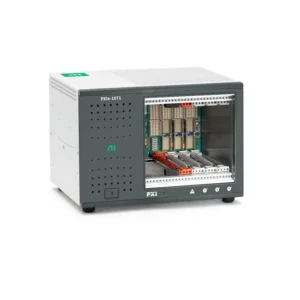
- PXIe-1092 – PXI Express chassis for modular measurement systems
Selecting the PXIe-4330
Choose the PXIe-4330 when an application requires eight simultaneous bridge measurements with integrated excitation, bridge completion, remote sensing and shunt calibration at rates up to 25.6 kS/s per channel.
If higher sampling speed is required for dynamic strain measurements, consider the PXIe-4331. For LVDT or RVDT sensors, use the PXIe-4340.
PXIe-4330 vs PXIe-4331
The PXIe-4330 and PXIe-4331 both provide eight simultaneous, 24-bit bridge input channels with programmable excitation, bridge completion, remote sensing and shunt calibration.
The primary difference is maximum sampling rate. The PXIe-4330 supports up to 25.6 kS/s per channel, while the PXIe-4331 supports up to 102.4 kS/s per channel. The PXIe-4331 is better suited to higher-frequency dynamic measurements.
Why Choose the PXIe-4330?
- Eight simultaneous 24-bit bridge input channels
- Integrated full-, half- and quarter-bridge support
- Independent programmable excitation per channel
- 120 Ω, 350 Ω and 1 kΩ bridge completion
- Remote sensing for long sensor cables
- Internal and external shunt calibration
- Front-mount and rack-mount terminal options
Frequently Asked Questions
What is the PXIe-4330 used for?
The PXIe-4330 is used to measure strain gauges, load cells, force sensors, bridge-based pressure transducers and torque sensors.
How many input channels does it provide?
The module provides eight simultaneous strain and bridge input channels.
What is the maximum sampling rate?
The PXIe-4330 supports sampling rates up to 25.6 kS/s per channel.
Which bridge configurations are supported?
The module supports full-, half- and quarter-bridge configurations.
Which quarter-bridge resistances are supported?
Internal completion is available for 120 Ω, 350 Ω and 1 kΩ quarter-bridge sensors.
Does the PXIe-4330 provide sensor excitation?
Yes. Each channel provides independently programmable balanced excitation from 0.625 V to 10 V.
Does the PXIe-4330 support shunt calibration?
Yes. It provides software-selectable internal and external shunt calibration options for individual channels.
Which terminal block is compatible with the PXIe-4330?
The TB-4330 front-mount terminal block and RM-24999 rack-mount terminal block are compatible with the PXIe-4330.
What is the PXIe-4330 part number?
The standard NI part number for the PXIe-4330 is 781346-01.
Request a Quote for the PXIe-4330
Contact us for current availability, lead time and project pricing for the PXIe-4330 Strain and Bridge Input Module. We can also help confirm compatible terminal blocks, cables, PXI chassis and related sensor measurement modules.