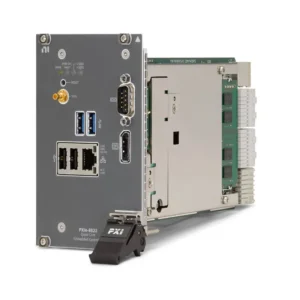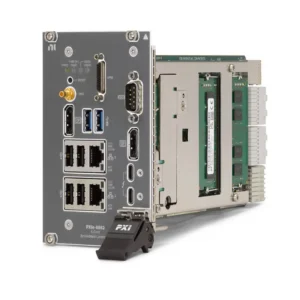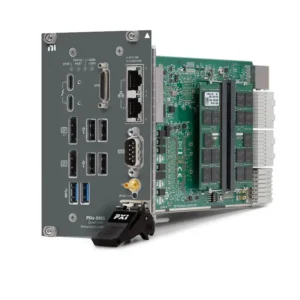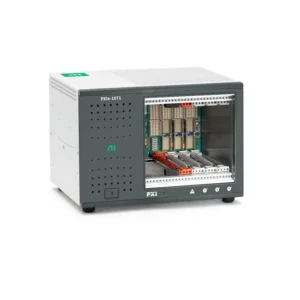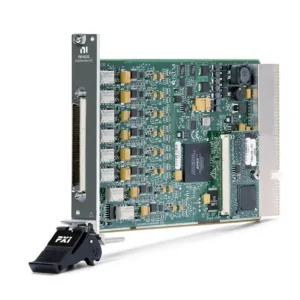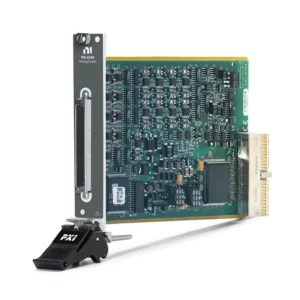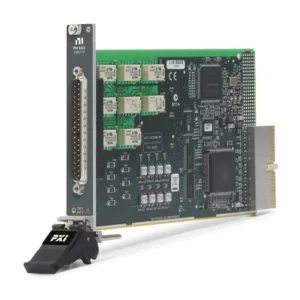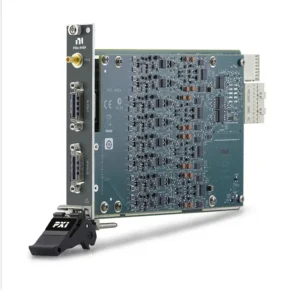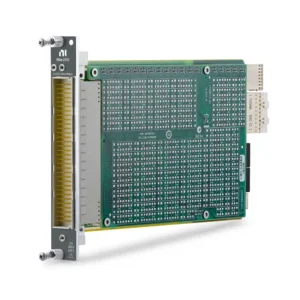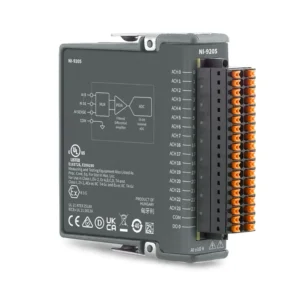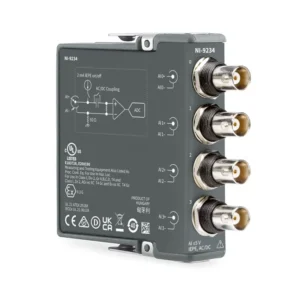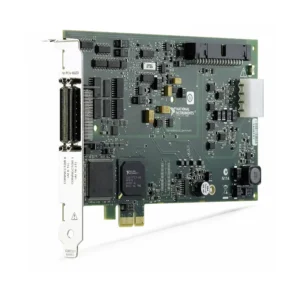




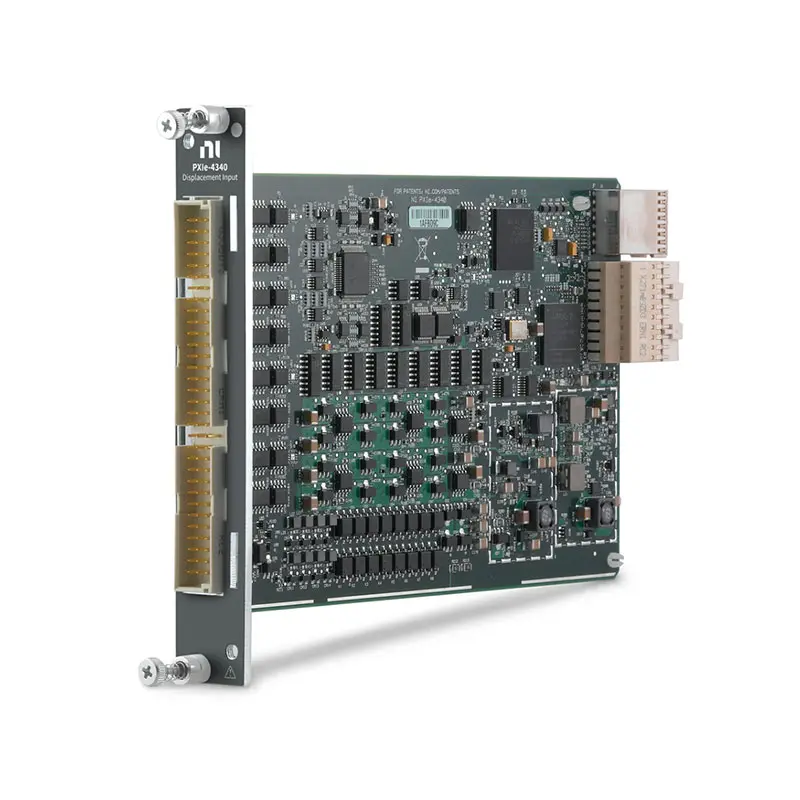
PXIe-4340 4-Channel AC LVDT Displacement Input Module
The PXIe-4340 is a four-channel PXI Express displacement input module designed for AC LVDT, AC RVDT, resolver and synchro measurements. It combines 24-bit delta-sigma converters, simultaneous sampling, programmable sensor excitation and digital filtering in a single PXI module.
Each channel can independently configure its excitation voltage and frequency, allowing different compatible displacement or position sensors to operate from the same module. The PXIe-4340 supports 4-wire, 5-wire and 6-wire LVDT and RVDT configurations and samples all four channels at up to 25.6 kS/s per channel.
Key Features of the PXIe-4340
- Four AC displacement measurement channels
- 24-bit delta-sigma analog-to-digital converters
- 25.6 kS/s maximum sample rate per channel
- Simultaneous sampling on all four channels
- ±7 Vrms analog input range
- Supports AC LVDT sensors
- Supports AC RVDT sensors
- Supports resolver and synchro measurements
- Supports 4-wire, 5-wire and 6-wire LVDT/RVDT wiring
- Independent excitation configuration for each channel
- 1 Vrms to 7 Vrms programmable excitation
- 0.5 Vrms excitation-voltage increments
- 400 Hz to 10 kHz programmable excitation frequency
- 10 Hz excitation-frequency increments
- 30 mA excitation current drive
- Remote-sense excitation support
- Open-coil detection
- Excitation overcurrent protection
- Internal self-calibration
- Hardware-timed single-point operation
- PXI Express timing and synchronization
- NI-DAQmx software support
PXIe-4340 Technical Specifications
| Product Model | PXIe-4340 |
|---|---|
| Part Number | 785068-01 |
| Product Type | PXI Express displacement input module |
| Supported Sensors | AC LVDT, AC RVDT, resolver and synchro |
| Supported LVDT/RVDT Wiring | 4-wire, 5-wire and 6-wire |
| Number of Analog Input Channels | 4 |
| ADC Resolution | 24 bits |
| ADC Type | Delta-sigma |
| Sampling Architecture | Simultaneous |
| Sample-Rate Range | 1 S/s to 25.6 kS/s per channel |
| Maximum Sample Rate | 25.6 kS/s per channel |
| Analog Input Range | ±7 Vrms |
| Maximum Working Voltage | 4 Vrms, signal plus common mode |
| Differential Input Impedance | 200 kΩ |
| Linearity | 0.01% |
| Crosstalk | -100 dB |
| Input Protection | ±30 V |
| FIFO Buffer | 1,023 samples |
| Data Transfers | DMA and programmed I/O |
| Excitation Type | Balanced constant differential voltage |
| Excitation Configuration | Software selectable per channel |
| Excitation Voltage Range | 1 Vrms to 7 Vrms |
| Excitation Voltage Resolution | 0.5 Vrms |
| Excitation Frequency Range | 400 Hz to 10 kHz |
| Excitation Frequency Resolution | 10 Hz |
| Excitation Current Drive | 30 mA |
| Excitation Output Impedance | 3 Ω |
| Maximum Excitation Gain Error | 5% |
| Maximum Excitation DC Offset | ±10 mV |
| Excitation Protection | ±30 V |
| Maximum Remote-Sense Lead Drop | 10% of configured excitation voltage |
| Open-Coil Detection Time | 200 ms |
| Excitation Open-Coil Threshold | Greater than 5 kΩ |
| Hardware-Timed Single-Point Rate | 1 S/s to 25.6 kS/s |
| HWTSP Base Latency | 63.68 µs plus demodulation latency |
| Internal Timebase | 100 MHz |
| Internal Timebase Accuracy | ±50 ppm |
| Reference Clock Sources | Onboard 100 MHz clock or PXIe_CLK100 |
| Terminal Block | TB-4340 |
| Bus Interface | PXI Express |
| Operating Temperature | 0°C to 55°C |
| Software Support | NI-DAQmx |
PXIe-4340 Part Number and Terminal Block
| Item | Part Number | Description |
|---|---|---|
| PXIe-4340 | 785068-01 | Four-channel, 24-bit AC LVDT displacement input module |
| TB-4340 | 784087-01 | 96-pin female DIN to 42-position screw-terminal front-mount terminal block |
The TB-4340 mounts directly to the front of the PXIe-4340 and provides screw-terminal access for sensor inputs, excitation, remote-sense and related signals. The terminal block supports signals through the module’s 7 Vrms measurement range.
Verify the sensor wiring configuration, coil connections, excitation requirements and cable shielding before connecting an LVDT, RVDT, resolver or synchro.
Four Simultaneously Sampled Channels
The PXIe-4340 provides four independent displacement measurement channels. Each channel uses its own 24-bit delta-sigma converter, allowing all four channels to be sampled at the same time.
Simultaneous conversion preserves the timing relationship between multiple position measurements. This is useful when comparing actuator motion, shaft position or mechanical movement across several measurement points.
24-Bit Delta-Sigma Conversion
Each input channel uses a 24-bit delta-sigma ADC. This architecture provides high resolution and integrated digital filtering for precision displacement and position measurement.
Effective measurement resolution depends on excitation settings, sensor sensitivity, sample rate, filter bandwidth, electrical noise and mechanical installation. The full nominal ADC resolution should not be interpreted as guaranteed noise-free measurement resolution.
25.6 kS/s per Channel
The module supports sample rates from 1 S/s to 25.6 kS/s on every channel. All four channels can operate simultaneously at the maximum rate.
Higher sample rates are useful for observing dynamic position changes and vibration-related displacement. Lower rates provide narrower digital-filter bandwidth for slowly changing measurements.
±7 Vrms Analog Input Range
The PXIe-4340 accepts differential sensor signals through an absolute range of ±7 Vrms. This range supports the secondary-coil signals produced by many AC-excited displacement sensors.
The maximum signal-plus-common-mode working voltage and input-protection limits must also be observed. Do not rely only on the nominal input range when evaluating sensor faults or wiring transients.
AC LVDT Measurements
A linear variable differential transformer produces an AC output related to the position of a movable core. The PXIe-4340 supplies the required primary-coil excitation and demodulates the secondary-coil response into a displacement measurement.
The sensor sensitivity and calibration information are required to convert the electrical ratio into engineering units such as millimeters or inches.
AC RVDT Measurements
A rotary variable differential transformer operates on a similar principle to an LVDT but measures angular displacement. The PXIe-4340 can excite compatible AC RVDTs and measure their position-dependent secondary output.
The usable angular range and transfer function depend on the individual RVDT. Configure the scaling according to the manufacturer’s calibration data.
Resolver Measurements
Resolvers provide sine and cosine output signals that vary with shaft position. Several PXIe-4340 channels can acquire the required secondary signals while the module supplies compatible excitation.
Angular position can be calculated from the sine and cosine measurements. Resolver applications must consider channel synchronization, wiring, transformation ratio and excitation requirements.
Synchro Measurements
The PXIe-4340 can be used with compatible low-voltage synchro signals. Multiple channels acquire the required secondary outputs, while software calculates position from the measured relationships.
Traditional synchro systems may operate at voltages exceeding the module ratings. Use suitable external scaling and isolation when the sensor signal or excitation exceeds the PXIe-4340 specifications.
4-Wire LVDT and RVDT Support
In a 4-wire configuration, the sensor uses one primary excitation pair and one secondary output pair. The PXIe-4340 measures the resulting differential secondary signal and demodulates it relative to the excitation.
Verify whether the sensor’s internal secondary-coil arrangement produces an output compatible with the selected four-wire measurement configuration.
5-Wire LVDT and RVDT Support
A 5-wire sensor generally provides one excitation pair and three secondary connections, with the secondary coils sharing a common point. The module supports the required measurements and excitation configuration.
Follow the sensor manufacturer’s polarity markings carefully. Reversed secondary connections can invert the reported displacement direction.
6-Wire LVDT and RVDT Support
A 6-wire configuration provides separate connections for the primary excitation and both secondary coils. This arrangement gives access to each secondary signal and is common in precision LVDT and RVDT installations.
The PXIe-4340 and TB-4340 provide the connections required to support this configuration. Correct phase and coil identification are essential for valid displacement results.
Independent Per-Channel Excitation
Excitation voltage and frequency are configured independently for each channel. Sensors with different excitation requirements can therefore be connected to separate channels of one module.
Independent excitation is also useful when evaluating sensor performance at several frequencies or when replacing an existing signal conditioner that used application-specific settings.
1 Vrms to 7 Vrms Excitation Voltage
The excitation voltage can be programmed from 1 Vrms to 7 Vrms in 0.5 Vrms increments. The balanced differential output can drive up to 30 mA within the module’s operating limits.
Use the voltage recommended by the sensor manufacturer. Excessive excitation can cause sensor heating, saturation or measurement error, while insufficient excitation reduces the available output signal.
400 Hz to 10 kHz Excitation Frequency
The excitation frequency can be configured from 400 Hz to 10 kHz in 10 Hz increments. This wide range supports many AC LVDT, RVDT, resolver and synchro sensors.
Excitation frequency affects sensor output, phase response, digital-filter bandwidth and measurement latency. Select a value within the sensor’s specified operating range.
Remote-Sense Excitation
Remote-sense connections allow the module to monitor the excitation voltage closer to the sensor. This helps compensate for voltage drop in long excitation leads.
The maximum supported remote-sense lead drop is 10% of the configured excitation voltage. Use appropriate cable conductors if sensor current and cable length create a larger voltage drop.
Open-Coil Detection
Open-coil diagnostics help detect broken wires, disconnected sensors and open LVDT or RVDT windings. The specified detection time is approximately 200 ms.
Open-coil detection should be interpreted with the selected sensor and wiring configuration. Resolver and synchro systems that share excitation across several channels may report unused excitation connections as open.
Excitation Overcurrent Protection
The PXIe-4340 monitors current on the excitation terminals. If an excessive current is detected, an internal relay disables the affected excitation output for approximately one second.
The overcurrent condition is reported to software. Inspect the wiring and sensor coil resistance before restarting the measurement because repeated overloads may indicate a short circuit or incompatible sensor.
Excitation Overvoltage Protection
The excitation connections include protection through ±30 V. This helps protect the module against certain wiring errors and transients within the specified limit.
External protection may still be required in harsh industrial environments. Keep sensor cables away from high-energy switching circuits and use suitable shielding and grounding.
Self-Calibration
Internal self-calibration corrects gain and offset drift without requiring an external calibration source for routine adjustment. Performing self-calibration after the system reaches a stable operating temperature can improve measurement accuracy.
Self-calibration does not replace periodic external calibration. Follow the applicable calibration interval and quality-system requirements for traceable measurements.
Digital Demodulation and Filtering
The module digitally demodulates the AC sensor response to determine position. Its filter behavior depends on excitation frequency and configured sample rate.
Higher excitation frequencies provide wider available demodulation bandwidth and shorter latency. Lower excitation frequencies may be required by the sensor but produce a narrower measurement bandwidth.
Demodulation Bandwidth
| Excitation Frequency | Demodulation Filter -3 dB Bandwidth |
|---|---|
| 400 Hz to below 625 Hz | 110 Hz |
| 625 Hz to below 1.25 kHz | 219 Hz |
| 1.25 kHz to below 2.5 kHz | 438 Hz |
| 2.5 kHz to below 5 kHz | 876 Hz |
| 5 kHz to 10 kHz | 1,750 Hz |
The final aggregate bandwidth may also be limited by the selected sample rate and additional digital filtering. Confirm the required mechanical signal bandwidth before configuring the excitation and acquisition rates.
Hardware-Timed Single-Point Operation
The PXIe-4340 supports hardware-timed single-point acquisition from 1 S/s to 25.6 kS/s. This mode is suitable for compatible real-time monitoring and closed-loop control applications.
Total HWTSP latency includes a 63.68 µs base term plus demodulation latency. Demodulation latency decreases as excitation frequency increases.
Demodulation Latency
| Excitation Frequency | Demodulation Latency |
|---|---|
| 400 Hz to below 625 Hz | 9,661.44 µs |
| 625 Hz to below 1.25 kHz | 4,787.20 µs |
| 1.25 kHz to below 2.5 kHz | 2,350.08 µs |
| 2.5 kHz to below 5 kHz | 1,131.52 µs |
| 5 kHz to below 10 kHz | 496.64 µs |
When latency is important, evaluate both the sensor’s supported excitation frequency and the module’s demodulation delay. A higher excitation frequency cannot be used unless the sensor is designed for it.
PXI Express Synchronization
The PXIe-4340 can use its onboard 100 MHz clock or the PXI Express PXIe_CLK100 reference. This allows multiple modules and instruments to share a common timebase.
Hardware synchronization is useful when displacement must be correlated with force, strain, temperature, vibration or other measurements in a structural or electromechanical test.
Analog Reference Triggering
An analog input channel can be used as a reference-trigger source. Triggering allows a buffered acquisition to capture displacement data before and after a defined position-related event.
Trigger level and signal behavior should be selected with consideration for noise, sensor scaling and the expected direction of movement.
Typical PXIe-4340 Applications
- Linear displacement measurement
- Angular position measurement
- AC LVDT sensor acquisition
- AC RVDT sensor acquisition
- Resolver measurement
- Synchro measurement
- Actuator position testing
- Hydraulic and pneumatic system validation
- Aerospace control-surface testing
- Automotive component validation
- Industrial machinery monitoring
- Structural test systems
- Production sensor calibration
- Closed-loop position monitoring
Hydraulic Actuator Testing
LVDT sensors are commonly installed inside hydraulic actuators to measure piston or rod position. The PXIe-4340 can excite and acquire these sensors during static, dynamic and endurance testing.
Position data can be synchronized with pressure, force and command signals to evaluate actuator response, hysteresis and mechanical performance.
Aerospace Position Measurement
Aerospace systems use LVDTs, RVDTs, resolvers and synchros to monitor control surfaces, valves, actuators and rotating assemblies. The PXIe-4340 provides configurable excitation and precision acquisition for compatible low-voltage sensors.
The complete test system should follow the required aerospace grounding, shielding, calibration and safety procedures.
Automotive Component Validation
The module can measure position in steering, braking, suspension and actuator test systems that use compatible AC displacement sensors.
PXI synchronization allows displacement to be correlated with load, current, vibration, CAN communication and controller commands during automated validation.
Production Sensor Calibration
A production calibration system can move an LVDT or RVDT through known positions and record the corresponding electrical output. Software can determine sensitivity, linearity, offset and usable measurement range.
Different excitation conditions can be evaluated automatically because voltage and frequency are programmable for each channel.
NI-DAQmx Software Support
The PXIe-4340 is controlled through the NI-DAQmx driver. NI-DAQmx provides functions for selecting the sensor type, configuring excitation, setting the acquisition rate, reading displacement data and monitoring diagnostic conditions.
The driver supports LabVIEW and compatible text-based development environments. NI Measurement & Automation Explorer can identify the module and assist with initial hardware configuration.
FlexLogger Integration
FlexLogger can be used in compatible systems to configure measurements, visualize displacement channels and record test data without developing a complete custom application.
Confirm that the installed FlexLogger and NI-DAQmx versions support the PXIe-4340 and the required measurement configuration.
LabVIEW Real-Time Integration
The PXIe-4340 can operate with a compatible PXI real-time controller for deterministic acquisition and hardware-timed single-point measurements.
Closed-loop applications must account for ADC conversion, demodulation, filtering, software execution and actuator-response latency.
PXIe-4340 Troubleshooting
The PXIe-4340 is not detected in NI MAX
Confirm that the module is fully installed in a compatible PXI Express slot. Check chassis power, controller communication and NI-DAQmx installation, then restart the system and rescan the hardware.
The displacement reading does not change
Check the primary excitation connections, secondary-coil wiring and sensor movement. Confirm that excitation is enabled and that the sensor is compatible with the configured frequency and voltage.
The displacement direction is reversed
Reverse the applicable secondary-coil polarity in the wiring or measurement configuration. Verify the sensor manufacturer’s phase and lead-color information before changing connections.
The module reports an open coil
Inspect the cable and sensor winding for an open circuit. Confirm the selected 4-wire, 5-wire or 6-wire configuration and account for unused excitation lines in resolver or synchro arrangements.
The module reports excitation overcurrent
Disconnect the sensor and measure its primary-coil resistance. Check for shorted wiring, excessive excitation voltage or an incompatible sensor. The module temporarily disables excitation after detecting overcurrent.
The measurement is noisy
Check cable shielding, grounding, sensor mounting and excitation settings. Reduce the sample rate when narrower digital-filter bandwidth is acceptable.
The measurement changes with cable length
Use the remote-sense connections to compensate for excitation-lead voltage drop. Verify that the lead drop remains within 10% of the configured excitation voltage.
The sensor output is clipped
Confirm that the secondary output remains within ±7 Vrms across the complete displacement range. Reduce excitation if the sensor output exceeds the module’s input range.
The response is slower than expected
Review the excitation frequency, demodulation latency and digital-filter bandwidth. Lower excitation frequencies create longer demodulation delays.
Two channels show different phase or delay
Confirm that both channels use the intended excitation and sample configurations. Use PXI synchronization and account for any sensor-specific phase differences.
PXIe-4340 Comparison with Related Sensor Modules
| Model | Primary Measurement | Best Suited For |
|---|---|---|
| PXIe-4340 | AC LVDT, RVDT, resolver and synchro | Direct AC displacement and angular-position measurements |
| PXIe-4330 | Strain and bridge-based sensors | Load cells, strain gauges and bridge transducers |
| PXIe-4331 | High-speed strain and bridge measurements | Dynamic structural and load measurements |
| PXIe-4339 | High-accuracy bridge and voltage measurements | Precision bridge sensors and wide input ranges |
| PXIe-4353 | Thermocouple temperature | High-channel-count temperature measurements |
| PXIe-4357 | RTD temperature | Precision resistance-temperature measurements |
PXIe-4340 vs PXIe-4330
The PXIe-4340 is designed specifically for AC-excited displacement and position sensors such as LVDTs and RVDTs. The PXIe-4330 is designed for strain gauges, load cells and other bridge-based sensors.
Choose the PXIe-4340 when the sensor requires AC excitation and demodulation. Select the PXIe-4330 when the transducer uses a resistive Wheatstone-bridge configuration.
PXIe-4340 vs General Analog Input Modules
A general analog input module can acquire an LVDT secondary voltage only when external excitation, demodulation and signal conditioning are provided. The PXIe-4340 integrates these functions directly.
Select the PXIe-4340 when programmable AC excitation, remote sensing, demodulation and sensor diagnostics are required. A general analog input module may be suitable when an external LVDT conditioner already provides a standard DC voltage output.
Recommended Related Products
- PXIe-4330 Strain and Bridge Input Module
- PXIe-4331 High-Speed Strain and Bridge Input Module
- PXIe-4339 Bridge and Voltage Input Module
- PXIe-4353 Thermocouple Input Module
- PXIe-4357 RTD Input Module
- View More NI PXI and PXI Express Modules
Selecting the Right Displacement Measurement Module
Choose the PXIe-4340 when the application uses an AC LVDT, AC RVDT, resolver or synchro with excitation requirements between 1 Vrms and 7 Vrms and 400 Hz to 10 kHz.
Before ordering, confirm the sensor wiring, primary-coil current, secondary output level, excitation voltage, excitation frequency, number of required measurement channels and TB-4340 terminal-block requirement.
Why Choose the PXIe-4340?
- Directly supports AC LVDT and RVDT sensors
- Supports resolver and synchro measurements
- Provides four simultaneously sampled channels
- Uses high-resolution 24-bit delta-sigma ADCs
- Samples every channel at up to 25.6 kS/s
- Provides independently programmable excitation
- Supports 4-wire, 5-wire and 6-wire sensors
- Includes remote-sense excitation connections
- Detects open coils and excitation overcurrent
- Supports self-calibration and PXI synchronization
- Integrates with NI-DAQmx and LabVIEW
Frequently Asked Questions
What is the PXIe-4340?
The PXIe-4340 is a four-channel, 24-bit PXI Express displacement input module for AC LVDT, AC RVDT, resolver and synchro measurements.
What is the PXIe-4340 part number?
The standard NI part number for the PXIe-4340 is 785068-01.
How many analog input channels does it provide?
The module provides four simultaneously sampled analog input channels.
What is the maximum sample rate?
Each channel can sample at up to 25.6 kS/s, and all four channels can operate simultaneously at that rate.
What is the ADC resolution?
The PXIe-4340 uses 24-bit delta-sigma analog-to-digital converters.
What is the analog input range?
The absolute analog input range is ±7 Vrms.
Which LVDT wiring configurations are supported?
The module supports 4-wire, 5-wire and 6-wire AC LVDT and RVDT sensors.
Can the excitation settings be configured independently?
Yes. Excitation voltage and frequency can be configured separately for each channel.
What excitation voltage does it provide?
Excitation is programmable from 1 Vrms to 7 Vrms in 0.5 Vrms steps.
What excitation frequencies are supported?
The frequency is programmable from 400 Hz to 10 kHz in 10 Hz increments.
What is the maximum excitation current?
The excitation output can drive up to 30 mA within the specified operating conditions.
Does the PXIe-4340 support remote sensing?
Yes. Remote-sense connections can compensate for excitation-voltage drop in sensor leads within the supported limit.
Can it detect disconnected sensors?
Yes. Open-coil detection can identify compatible open sensor windings or disconnected wiring.
Does it provide overcurrent protection?
Yes. Excitation is temporarily disabled and the condition is reported to software when excessive output current is detected.
Which terminal block is compatible?
The compatible front-mount terminal block is the TB-4340, part number 784087-01.
Which software controls the PXIe-4340?
The module uses NI-DAQmx and can be integrated with LabVIEW, LabVIEW Real-Time, FlexLogger and compatible text-based programming environments.
Request a Quote for the PXIe-4340
Contact us for current availability, lead time and project pricing for the PXIe-4340 4-Channel 24-Bit AC LVDT Displacement Input Module. We can also help confirm the TB-4340 terminal block, PXI Express chassis and sensor wiring requirements for your LVDT, RVDT, resolver or synchro measurement system.