



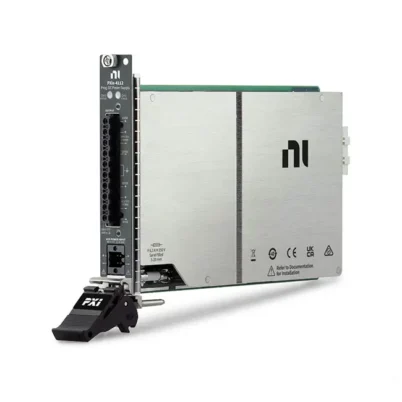
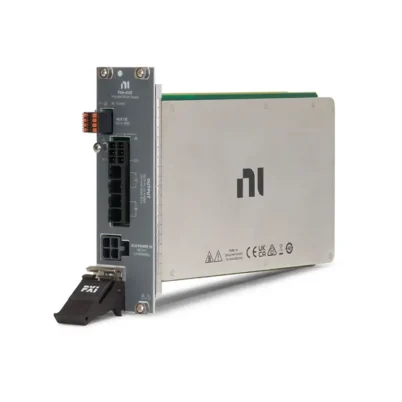
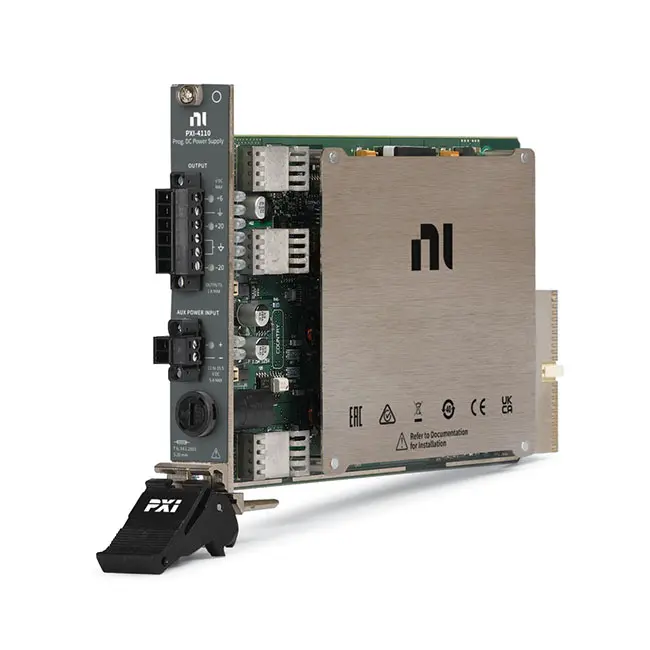
Product Introduction
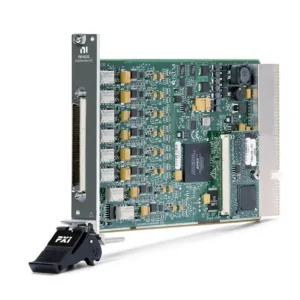
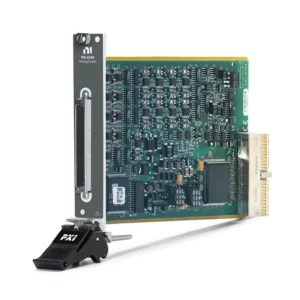
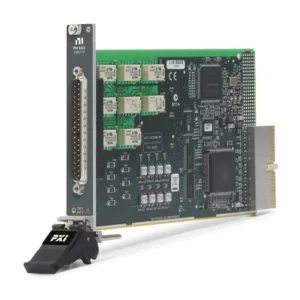
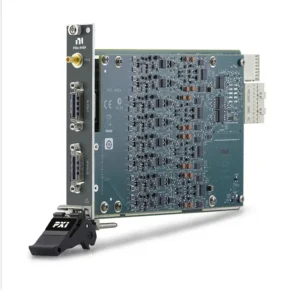
The NI PXI-4110 is a three-channel programmable DC power supply designed for automated test, design validation, manufacturing test, electronic device characterization, and other applications requiring software-controlled DC power.
The PXI-4110 provides three programmable output channels: a 0 V to 6 V non-isolated channel, a 0 V to +20 V isolated channel, and a -20 V to 0 V isolated channel. Each channel can provide up to 1 A when operated within the applicable power limits.
In addition to programmable voltage output and current limiting, the PXI-4110 provides voltage and current readback measurement capability. This allows the module to supply power to a device under test while monitoring its electrical behavior within the same automated test sequence.
Product Overview
The National Instruments PXI-4110 is a general-purpose, single-quadrant programmable DC power supply for PXI automated test systems.
Its three output channels are designed to support common electronic power requirements such as logic rails and positive/negative analog supply rails.
The basic output architecture is:
- Channel 0: 0 V to 6 V, up to 1 A, non-isolated
- Channel 1: 0 V to +20 V, up to 1 A, isolated
- Channel 2: -20 V to 0 V, up to 1 A, isolated
This configuration makes the PXI-4110 particularly useful for DUTs requiring multiple DC supply rails from a compact PXI instrument.
Key Features
Three Programmable DC Output Channels
The PXI-4110 integrates three programmable DC power supply channels into a single-slot PXI module.
This allows one instrument to provide multiple power rails to a DUT without requiring several separate programmable power supplies.
Typical applications include:
- Electronic circuit power
- Positive and negative analog rails
- Logic supply rails
- DUT biasing
- Automated power sequencing
- Manufacturing functional test
Channel 0: 0 V to 6 V Output
Channel 0 provides a programmable output from 0 V to 6 V with current capability up to 1 A.
This channel is non-isolated and is well suited for common low-voltage DUT power requirements.
Typical voltage rails can include:
- 1.8 V
- 2.5 V
- 3.3 V
- 5 V
Channel 1: 0 V to +20 V Output
Channel 1 provides a programmable positive output from 0 V to +20 V.
With the appropriate auxiliary power source, Channel 1 can provide up to 1 A and 20 W.
This channel is isolated from the PXI bus ground, providing additional flexibility for DUT power configurations.
Channel 2: -20 V to 0 V Output
Channel 2 provides a programmable negative output from -20 V to 0 V.
With auxiliary power, the channel can provide up to 1 A and 20 W within its specified operating limits.
The negative output is particularly useful for circuits requiring bipolar power rails.
Positive and Negative Power Rails
Channels 1 and 2 make the PXI-4110 suitable for devices requiring positive and negative supply rails.
For example:
Channel 1 → +15 V
Channel 2 → -15 V
This configuration can be useful for operational amplifiers, analog circuits, sensor conditioning electronics, and other devices requiring bipolar DC supplies.
Channels Can Be Combined
The isolated output architecture allows channels to be combined for applications requiring different voltage or current configurations.
For example, Channels 1 and 2 can be configured to provide a potential difference of up to approximately 40 V between their output terminals when operated within the specified limits.
The complete series or parallel configuration should always follow NI connection requirements and applicable electrical limits.
Up to 1 A Per Channel
All three PXI-4110 output channels support current up to 1 A under the applicable power and auxiliary-supply conditions.
This provides sufficient current for many electronic circuits, modules, sensors, and embedded devices used in automated validation and production testing.
Programmable Voltage Setpoint
The output voltage of each channel can be configured programmatically.
Automated test software can therefore change DUT supply conditions without manual adjustment.
For example:
3.0 V → 3.3 V → 3.6 V
This can be useful for testing DUT behavior across different supply conditions.
Programmable Current Limit
The PXI-4110 provides programmable current-limit functionality.
A test application can configure the maximum allowed output current according to the DUT requirements.
Current limiting is useful for:
- Protecting DUTs during development
- Detecting abnormal current consumption
- Production pass/fail testing
- Power-up validation
- Fault-condition testing
Constant Voltage Operation
The PXI-4110 can operate in constant voltage (CV) mode.
In normal voltage-source operation, the module regulates the programmed output voltage while the DUT draws the required current within the configured current limit and instrument capabilities.
Constant Current Operation
The PXI-4110 also supports constant current (CC) behavior when the load reaches the configured current limit.
This provides controlled DUT power delivery and helps protect devices from excessive current.
Voltage Readback Measurement
The PXI-4110 provides voltage measurement readback capability.
This allows automated software to verify the actual output voltage while the DUT is powered.
A typical sequence can be:
Set Voltage → Enable Output → Measure Voltage → Compare Against Limit
Current Readback Measurement
The module also provides current readback measurement.
This allows test software to monitor how much current the DUT consumes from the power supply.
Current consumption can be used as an important production test parameter because abnormal current may indicate:
- Short circuits
- Incorrect assembly
- Damaged components
- Incorrect operating states
- DUT functional failures
Single-Quadrant Power Supply
The PXI-4110 is a single-quadrant programmable power supply.
It is primarily designed to source power to a DUT rather than operate as a bidirectional source-and-sink instrument.
Applications requiring advanced four-quadrant sourcing and sinking should generally consider a suitable PXI Source Measure Unit instead.
Auxiliary Power Support
The PXI-4110 can operate using PXI backplane power, but higher output power on Channels 1 and 2 requires an auxiliary power source.
NI offers the APS-4100 Auxiliary Power Source for this purpose.
The PXI-4110 ordering configuration with part number 779647-11 includes the APS-4100 auxiliary power source.
Technical Specifications
| Parameter | Specification |
|---|---|
| Product Type | PXI Programmable DC Power Supply |
| Model | NI PXI-4110 |
| Part Numbers | 779647-10 / 779647-11 |
| Number of Channels | 3 |
| Power Supply Type | Single-Quadrant Programmable DC Power Supply |
| Channel 0 Voltage Range | 0 V to 6 V |
| Channel 0 Maximum Current | 1 A |
| Channel 0 Maximum Power | 6 W |
| Channel 0 Isolation | Non-Isolated |
| Channel 1 Voltage Range | 0 V to +20 V |
| Channel 1 Maximum Current | 1 A |
| Channel 1 Maximum Power with Auxiliary Supply | 20 W |
| Channel 1 Isolation | Isolated |
| Channel 2 Voltage Range | -20 V to 0 V |
| Channel 2 Maximum Current | 1 A |
| Channel 2 Maximum Power with Auxiliary Supply | 20 W |
| Channel 2 Isolation | Isolated |
| Maximum Total Output Power with APS-4100 | 46 W |
| Maximum Total Output Power without APS-4100 | 9 W |
| Voltage Programming | Supported |
| Current Limit Programming | Supported |
| Voltage Readback | Supported |
| Current Readback | Supported |
| Auxiliary Power Support | Yes |
| Bus Connector | PXI Hybrid |
| Module Size | 3U, One-Slot PXI Module |
| Dimensions | 2.0 cm × 13.0 cm × 21.6 cm |
| Typical Weight | 323 g |
| Output Connector | 6-Position 3.81 mm MINI-COMBICON |
| Driver | NI-DCPower |
PXI-4110 Output Channel Architecture
| Channel | Voltage | Current | Maximum Power with Auxiliary Supply | Isolation |
|---|---|---|---|---|
| Channel 0 | 0 to 6 V | 1 A | 6 W | Non-Isolated |
| Channel 1 | 0 to +20 V | 1 A | 20 W | Isolated |
| Channel 2 | -20 to 0 V | 1 A | 20 W | Isolated |
PXI-4110 with APS-4100 Auxiliary Power
An important consideration when selecting the PXI-4110 is whether the application requires the APS-4100 Auxiliary Power Source.
Without auxiliary power, Channels 1 and 2 have substantially lower available output power.
| Configuration | Total Output Power | Application |
|---|---|---|
| PXI-4110 with APS-4100 | Up to 46 W | Higher-Power DUT Applications |
| PXI-4110 without APS-4100 | Up to 9 W | Lower-Power DUT Applications |
When the PXI-4110 is powered only from the PXI chassis, Channels 1 and 2 have reduced power capability. The auxiliary supply is therefore important when the application requires the full output capability of the isolated channels.
PXI-4110 Part Number 779647-11
NI part number 779647-11 identifies the PXI-4110 configuration supplied with the APS-4100 Auxiliary Power Source.
This configuration is appropriate when the application requires the higher available output power of Channels 1 and 2.
PXI-4110 Part Number 779647-10
NI part number 779647-10 identifies the PXI-4110 configuration without the APS-4100 Auxiliary Power Source.
The PXI-4110 hardware still supports auxiliary power, but the external APS-4100 is not included with this ordering configuration.
How Does the PXI-4110 Work?
The PXI-4110 receives software commands from the PXI controller and generates programmable DC power for the connected DUT.
A typical architecture is:
Test Software → PXI Controller → PXI-4110 → DUT
The same test application can configure output voltage, set current limits, enable or disable outputs, and read back voltage and current measurements.
Powering a DUT with Multiple Voltage Rails
Many electronic devices require several power rails simultaneously.
For example, a DUT may require:
- +5 V digital supply
- +15 V analog supply
- -15 V analog supply
The PXI-4110 can provide these three rails from a single PXI module:
Channel 0 → +5 V
Channel 1 → +15 V
Channel 2 → -15 V
This makes the module particularly useful for mixed analog and digital electronic devices.
40 V Operation Using Isolated Channels
Because Channels 1 and 2 are isolated, they can be configured to create a larger voltage difference between their output terminals.
For example:
Channel 1 = +20 V
Channel 2 = -20 V
Potential Difference = 40 V
This provides additional flexibility for DUTs requiring voltage ranges beyond a single 20 V channel.
Connection polarity, isolation, grounding, current limits, and power limits must be observed when combining outputs.
Design Validation Applications
The PXI-4110 is designed for automated design validation applications where DUT behavior must be evaluated under different power conditions.
Typical tests can include:
- Nominal voltage testing
- Minimum supply voltage testing
- Maximum supply voltage testing
- Current consumption measurements
- Power-up testing
- Power-down testing
- Supply variation testing
- Functional validation
Manufacturing Test Applications
The PXI-4110 is also well suited for manufacturing and production test systems.
Automated software can configure the required DUT supply rails, power the product, measure current consumption, perform functional tests, and record pass/fail results.
A typical production sequence can be:
- Connect the DUT.
- Configure voltage and current limits.
- Enable the required PXI-4110 channels.
- Measure DUT current consumption.
- Perform functional measurements.
- Compare results against test limits.
- Disable the outputs.
- Record the test result.
Current Consumption Testing
Current consumption is an important indicator of DUT condition.
For example:
| Measured Current | Possible Interpretation |
|---|---|
| Within Expected Range | Normal DUT Operation |
| Very Low Current | Open Circuit, Missing Component or DUT Not Operating |
| Excessive Current | Short Circuit, Assembly Fault or Component Failure |
The PXI-4110’s integrated current readback capability allows these measurements to be incorporated directly into automated test sequences.
Power Sequencing
Some DUTs require multiple supply rails to be enabled or disabled in a specific sequence.
Because the PXI-4110 channels are software programmable, test applications can implement controlled power sequencing.
For example:
Step 1 → Enable 5 V
Step 2 → Enable +15 V
Step 3 → Enable -15 V
Step 4 → Begin Functional Test
The required sequence and timing should be defined according to the DUT specification and the timing capabilities of the complete test system.
PXI-4110 vs PXIe-4113
The PXI-4110 and PXIe-4113 are both programmable DC power supplies, but they target different output requirements.
| Feature | PXI-4110 | PXIe-4113 |
|---|---|---|
| Platform | PXI | PXI Express |
| Primary Architecture | Triple-Output DC Power Supply | Programmable DC Power Supply |
| PXI-4110 Primary Advantage | Three Power Rails in One Module | Different Voltage/Power Requirements |
| Best Selection Basis | Required Voltage, Current, Power, Channel Count and DUT Architecture | |
PXI-4110 vs PXI Source Measure Unit
A programmable power supply and a Source Measure Unit serve overlapping but different measurement requirements.
| Feature | PXI-4110 | Typical PXI SMU |
|---|---|---|
| Primary Function | DUT Power Supply | Precision Source and Measurement |
| Channels | 3 | Model Dependent |
| Voltage / Current Readback | Yes | Yes |
| Precision Parametric Measurement | General-Purpose | Higher Precision |
| Four-Quadrant Operation | No | Available on Suitable Models |
| Best Application | Powering DUTs | Precision Semiconductor and Component Characterization |
PXI-4110 in a Complete PXI System
The PXI-4110 can provide programmable DUT power within a complete PXI system.
A typical automated test system may include:
- PXI Chassis
- PXI Controller
- PXI-4110 Programmable Power Supply
- PXI Modules
- PXI digital multimeters
- PXI oscilloscopes
- PXI switching modules
- PXI data acquisition modules
This architecture allows DUT power, stimulus, signal routing, and measurement functions to be controlled from one automated PXI platform.
Software and Driver Support
The PXI-4110 is supported by NI-DCPower.
Test applications can programmatically control:
- Output voltage
- Current limit
- Output enable and disable
- Voltage measurement
- Current measurement
- Channel configuration
This allows the PXI-4110 to be integrated into automated test applications developed with compatible NI software and programming environments.
PXI-4110 Selection Considerations
Before selecting the PXI-4110, engineers should evaluate:
- Required number of power channels
- Required positive and negative voltage rails
- Maximum DUT current
- Total required output power
- Need for APS-4100 auxiliary power
- Isolation requirements
- Voltage and current readback requirements
- Power sequencing requirements
- PXI chassis compatibility
- Software and driver requirements
Industries
- Automated Test Equipment
- Electronic Manufacturing
- Semiconductor Test
- Automotive Electronics
- Aerospace and Defense
- Communication Equipment
- Industrial Electronics
- Research and Development
Applications
Design Validation
The PXI-4110 can provide programmable DUT supply voltages for evaluating electronic products across different operating conditions.
Manufacturing Test
Three programmable channels allow multiple DUT supply rails to be integrated into automated production test sequences.
DUT Power Supply
The module can provide low-voltage, positive, and negative DC rails for compatible electronic devices.
Current Consumption Measurement
Integrated current readback allows DUT power consumption to be monitored during automated testing.
Bipolar Power Rail Generation
The +20 V and -20 V isolated channels are suitable for electronic circuits requiring positive and negative supply rails.
Automated Power Sequencing
Software control allows multiple output channels to be enabled, disabled, and adjusted as part of automated DUT power sequences.
Recommended Related Products
| NI PXI-4110 | Three-channel programmable PXI DC power supply with 0–6 V, +20 V, and -20 V outputs. |
| NI PXIe-4113 | PXI Express programmable DC power supply for automated DUT power and electronic test applications. |
| NI PXIe-4143 | Precision PXI Source Measure Unit for applications requiring more advanced sourcing and measurement capability. |
| NI PXIe-4147 | High-current PXI Source Measure Unit for semiconductor and precision electronic device characterization. |
| NI PXIe-4162 | High-density PXI Source Measure Unit for multi-channel semiconductor parametric test. |
Why Choose NI PXI-4110?
- Three programmable DC power supply channels
- 0 V to 6 V low-voltage output
- 0 V to +20 V isolated output
- -20 V to 0 V isolated output
- Up to 1 A per channel
- Up to 46 W total output power with APS-4100
- Programmable voltage setpoints
- Programmable current limits
- Voltage readback measurement
- Current readback measurement
- Positive and negative DUT power rails
- Channels can be combined for additional flexibility
- Compact one-slot 3U PXI architecture
- NI-DCPower software support
- Suitable for design validation and manufacturing test
Frequently Asked Questions
What is the NI PXI-4110?
The NI PXI-4110 is a three-channel, single-quadrant programmable DC power supply for PXI automated test systems. It provides programmable voltage output, current limiting, and voltage/current readback measurement.
How many channels does the PXI-4110 have?
The PXI-4110 provides three programmable DC output channels.
What are the voltage ranges of the PXI-4110?
Channel 0 provides 0 V to 6 V, Channel 1 provides 0 V to +20 V, and Channel 2 provides -20 V to 0 V.
What is the maximum current of the PXI-4110?
Each channel supports up to 1 A when operated within the applicable channel and total power limits.
What is the maximum output power of the PXI-4110?
With the APS-4100 auxiliary power source, the PXI-4110 provides up to 46 W total output power. Without auxiliary power, the available total output power is substantially lower.
Does the PXI-4110 require the APS-4100?
Not for all applications. The PXI-4110 can operate using PXI chassis power, but the APS-4100 is required when the higher output power capability of Channels 1 and 2 is needed.
What is the difference between 779647-10 and 779647-11?
Both part numbers identify PXI-4110 configurations. 779647-11 includes the APS-4100 Auxiliary Power Source, while 779647-10 does not include the auxiliary power supply.
Can the PXI-4110 output +20 V and -20 V?
Yes. Channel 1 provides up to +20 V and Channel 2 provides down to -20 V within the specified operating conditions.
Can the PXI-4110 provide 40 V?
The isolated Channels 1 and 2 can be combined to create a potential difference of up to approximately 40 V between their appropriate output terminals. The connection must follow NI’s specified wiring and operating limits.
Can the PXI-4110 measure current?
Yes. The PXI-4110 provides current readback measurement, allowing DUT current consumption to be monitored programmatically.
Can the PXI-4110 measure voltage?
Yes. Voltage readback functionality allows software to monitor the output voltage during automated testing.
Is the PXI-4110 an SMU?
No. The PXI-4110 is primarily a programmable DC power supply. A Source Measure Unit is generally more appropriate when an application requires higher-precision sourcing and measurement, four-quadrant operation, or semiconductor parametric characterization.
Is the PXI-4110 isolated?
The PXI-4110 has two isolated output channels and one non-isolated output channel. Channels 1 and 2 are isolated, while Channel 0 is non-isolated.
What driver does the PXI-4110 use?
The PXI-4110 is supported by the NI-DCPower instrument driver.
Can the PXI-4110 be used for production testing?
Yes. The PXI-4110 is designed for applications including manufacturing test and design validation, where programmable DUT power and current monitoring can be integrated into automated test sequences.
Can the PXI-4110 power analog circuits requiring positive and negative rails?
Yes. Channels 1 and 2 can provide positive and negative DC supply rails, making the PXI-4110 suitable for many analog circuits requiring bipolar power.
What should I check before purchasing a PXI-4110?
Before purchasing the PXI-4110, verify the required output voltages, current per channel, total output power, isolation requirements, need for APS-4100 auxiliary power, PXI chassis compatibility, connector requirements, software compatibility, and whether part number 779647-10 or 779647-11 is appropriate.
Conclusion
The NI PXI-4110 3-Channel Programmable DC Power Supply combines three programmable output channels, up to 1 A per channel, positive and negative supply capability, programmable current limiting, and integrated voltage/current readback in a compact PXI module. With the APS-4100 auxiliary power source, the module can provide up to 46 W total output power. These capabilities make the PXI-4110 well suited for design validation, manufacturing test, DUT power sequencing, current consumption measurement, and general automated electronic test systems.