



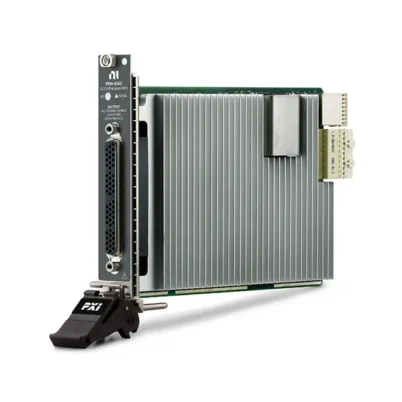

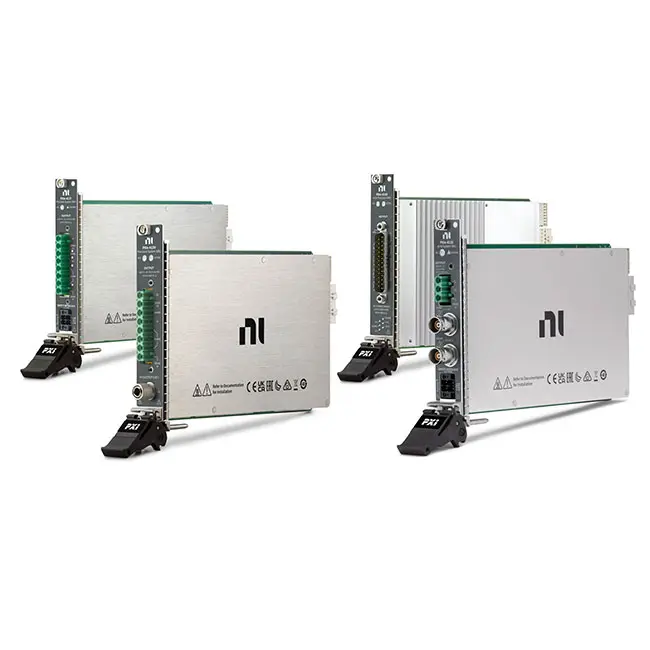
Product Introduction
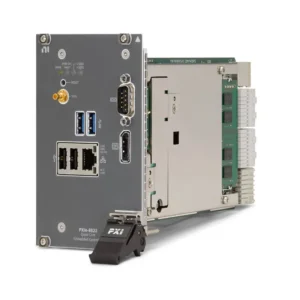
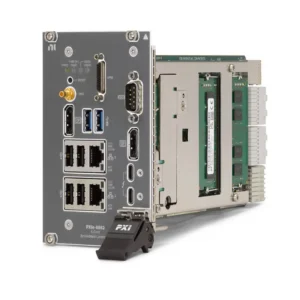
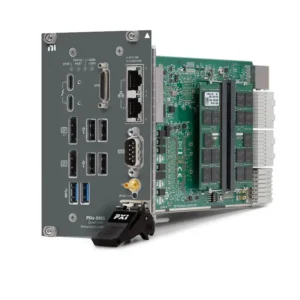
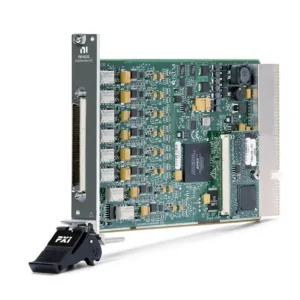
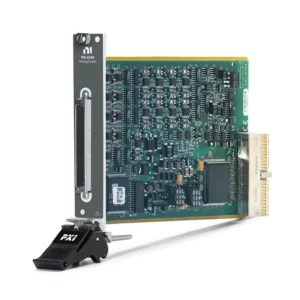
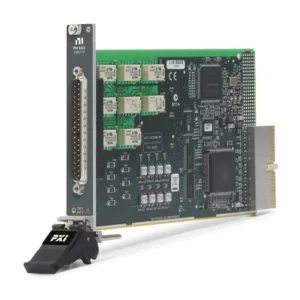
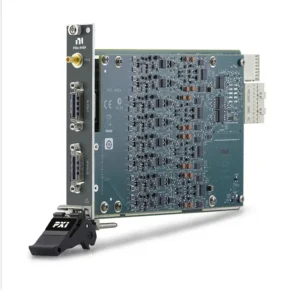
The NI PXIe-4147 is a 4-channel precision PXI Express Source Measure Unit (SMU) designed for high-current semiconductor characterization, RF device testing, electronic validation, automated production test, and other applications requiring fast and accurate DC sourcing and measurement.
The PXIe-4147 provides four precision SMU channels, with each channel supporting voltage operation from -8 V to +8 V and DC current from -3 A to +3 A. Each channel can source or sink up to 24 W of DC power, making the module particularly suitable for low-voltage devices with relatively high current requirements.
In addition to its high current capability, the PXIe-4147 provides 100 fA current sensitivity, four-quadrant operation, integrated remote four-wire sensing, high-speed sequencing, and NI SourceAdapt technology. These capabilities make it suitable for both precision parametric measurements and high-throughput automated test systems.
Product Overview
The National Instruments PXIe-4147 combines programmable voltage and current sourcing with precision voltage and current measurement in a compact PXI Express module.
Unlike a conventional programmable DC power supply, an SMU is designed to provide both stimulus and measurement functions.
Each PXIe-4147 channel can be used to:
- Source voltage and measure current
- Source current and measure voltage
- Source electrical power
- Sink electrical power
- Perform automated I-V sweeps
- Monitor DUT current consumption
- Capture transient electrical behavior
With four channels in a single module, the PXIe-4147 is especially useful for high-pin-count devices and applications requiring several independently programmable DC rails.
Key Features
Four Precision SMU Channels
The PXIe-4147 provides four independently programmable Source Measure Unit channels.
This multi-channel architecture allows one module to provide several programmable DUT supply or bias connections.
A typical configuration may be:
Channel 0 → DUT Supply Rail 1
Channel 1 → DUT Supply Rail 2
Channel 2 → DUT Bias Rail
Channel 3 → Auxiliary Supply or Measurement
The exact configuration depends on the electrical requirements of the device under test.
±8 V Voltage Range
Each PXIe-4147 channel supports a voltage range from approximately -8 V to +8 V.
This bipolar voltage capability is useful for low-voltage semiconductor devices, RF integrated circuits, digital electronics, sensors, and other components requiring positive or negative bias conditions.
±3 A DC Current Range
One of the most important characteristics of the PXIe-4147 is its high current capability.
Each channel supports DC current from approximately -3 A to +3 A within the specified operating envelope.
This makes the PXIe-4147 particularly useful for low-voltage devices requiring considerably more current than conventional low-power precision SMUs.
24 W Source Power Per Channel
Each PXIe-4147 channel can provide up to 24 W maximum DC source power.
This combination of low voltage and high current makes the module suitable for powering and characterizing devices such as:
- RF integrated circuits
- Power-management devices
- Processors
- FPGAs
- Digital ICs
- Communication devices
- Electronic modules
24 W Sink Power Per Channel
The PXIe-4147 also provides up to 24 W maximum DC sink power per channel.
Sink capability allows the SMU to absorb power from the DUT rather than only supplying power.
This is an important advantage in four-quadrant applications and when characterizing devices capable of sourcing current.
Four-Quadrant Operation
The PXIe-4147 supports four-quadrant operation, allowing the instrument to source and sink current under both positive and negative voltage conditions.
| Quadrant | Voltage | Current | Typical Operation |
|---|---|---|---|
| I | Positive | Positive | Source Power |
| II | Positive | Negative | Sink Power |
| III | Negative | Negative | Source Power |
| IV | Negative | Positive | Sink Power |
Four-quadrant operation makes the PXIe-4147 significantly more flexible than a conventional unidirectional programmable DC power supply.
100 fA Current Sensitivity
The PXIe-4147 provides current sensitivity down to approximately 100 fA.
This wide measurement capability allows the same instrument family to address applications involving both high-current DUT operation and much smaller current measurements.
This can be valuable when a DUT operates across several power states, such as:
- Shutdown
- Sleep
- Standby
- Idle
- Normal operation
- Maximum load
Integrated Remote Four-Wire Sensing
Each PXIe-4147 channel provides integrated remote four-wire sensing.
Four-wire sensing helps compensate for voltage drops caused by test cables, connectors, fixtures, and interconnect resistance.
This is particularly important in high-current applications because even relatively small resistance can create significant voltage drops.
A simplified connection is:
Force HI / Force LO → Deliver Current
Sense HI / Sense LO → Measure DUT Voltage
SourceAdapt Technology
The PXIe-4147 supports NI SourceAdapt technology, which allows engineers to customize the transient response of the SMU.
Different DUTs can present significantly different electrical loads, including capacitive and inductive characteristics.
SourceAdapt allows the source response to be optimized for the connected load to improve:
- Stability
- Settling behavior
- Transient response
- Measurement speed
- Test repeatability
High-Speed Sequencing
The PXIe-4147 includes high-speed sequencing capabilities for automated source-measure applications.
Engineers can create sequences containing different voltage, current, compliance, and measurement conditions and execute them without requiring slow software interaction for every individual test point.
This capability can significantly improve throughput in automated production and semiconductor test systems.
Instrument Synchronization
The PXIe-4147 can be synchronized with other compatible PXI instruments.
This is useful when a test system combines SMUs with:
- PXI switches
- Digital pattern instruments
- Oscilloscopes
- Digitizers
- RF signal generators
- Vector signal transceivers
- Other Source Measure Units
Hardware-based synchronization helps coordinate stimulus and measurement operations within complex automated test sequences.
Technical Specifications
| Parameter | Specification |
|---|---|
| Product Type | Precision PXI Source Measure Unit |
| Model | NI PXIe-4147 |
| Part Number | 786888-01 |
| Platform | PXI Express |
| Number of SMU Channels | 4 |
| Voltage Range | -8 V to +8 V |
| DC Current Range | -3 A to +3 A |
| Maximum DC Source Power | 24 W Per Channel |
| Maximum DC Sink Power | 24 W Per Channel |
| Current Sensitivity | 100 fA |
| Operation | 4-Quadrant |
| Remote Sense | Integrated Four-Wire Sense Per Channel |
| SourceAdapt | Supported |
| Voltage Source | Supported |
| Current Source | Supported |
| Voltage Measurement | Supported |
| Current Measurement | Supported |
| Source Operation | Supported |
| Sink Operation | Supported |
| Bus Interface | PXI Express |
| Primary Applications | Semiconductor Test, RF Device Test, I-V Characterization and Automated Production Test |
What Is a Source Measure Unit?
A Source Measure Unit, or SMU, combines programmable electrical sourcing with precision voltage and current measurement.
An SMU can typically perform several functions:
- Programmable voltage source
- Programmable current source
- Voltage measurement
- Current measurement
- Electronic load
Combining these functions in one instrument makes SMUs particularly useful for automated semiconductor and electronic component characterization.
PXIe-4147 for High-Current Device Testing
The ±3 A DC current capability is a major differentiator of the PXIe-4147 within the PXI SMU family.
Many modern electronic devices operate at relatively low supply voltages while drawing substantial current.
Examples include:
- RF power devices
- RF integrated circuits
- Processors
- FPGAs
- Digital ICs
- Communication chipsets
- Power-management devices
The PXIe-4147 combines this high-current capability with precision measurement, making it suitable for both powering the DUT and analyzing its electrical behavior.
PXIe-4147 for Semiconductor Test
The PXIe-4147 is well suited for semiconductor characterization and production test applications that require relatively high current.
Typical applications include:
- RF IC characterization
- Power-management IC testing
- Processor power testing
- FPGA power characterization
- ASIC validation
- Device power-state measurements
- Automated I-V characterization
- Production parametric test
RF Semiconductor Testing
RF devices frequently require stable DC bias while RF stimulus and measurements are performed by separate instruments.
A typical RF semiconductor test architecture may include:
PXIe-4147 → DUT DC Bias and Current Measurement
PXI VST → RF Stimulus and RF Measurement
Digital Instrument → DUT Control
This architecture allows DC power behavior and RF performance to be evaluated within the same automated PXI test system.
RF Front-End Validation
The PXIe-4147 can provide programmable DC power and current monitoring for RF front-end devices.
Typical DUTs may include:
- Power amplifiers
- Low-noise amplifiers
- RF front-end modules
- RF transceivers
- Wireless communication ICs
- RF switches
The SMU can monitor how DUT current consumption changes with RF power, frequency, modulation, and operating state.
Power Amplifier Testing
RF power amplifiers can require relatively high DC current while operating at low supply voltages.
The PXIe-4147 is particularly suitable for compatible RF PA applications because of its combination of:
- Up to ±3 A DC current
- Up to ±8 V voltage operation
- Precision current measurement
- Fast transient response
- Remote four-wire sensing
- SourceAdapt technology
The module can provide DC bias while an RF instrument measures parameters such as output power, gain, efficiency, and spectral performance.
Power Consumption Characterization
Modern electronic devices can have rapidly changing current consumption depending on their operating state.
The PXIe-4147 can be used to characterize current consumption under conditions such as:
- Startup
- Idle
- Standby
- Sleep
- Transmit
- Receive
- Maximum processing load
- Shutdown
This is useful for validating battery-powered, wireless, embedded, and semiconductor devices.
Transient Current Measurement
Many semiconductor devices exhibit rapid changes in current consumption.
The PXIe-4147 is designed for high-speed source-measure applications, allowing engineers to capture transient device characteristics that may be missed by slower power-supply measurement systems.
This capability can help analyze:
- Power-up behavior
- Mode transitions
- Processor activity
- RF transmit bursts
- Digital load changes
- Power-management events
I-V Characterization
The PXIe-4147 can perform automated current-voltage characterization of compatible devices.
A voltage sweep can be represented as:
V1 → Measure I1
V2 → Measure I2
V3 → Measure I3
V4 → Measure I4
… → Generate I-V Curve
Software-controlled sourcing and measurement allow this process to be automated across multiple channels.
Voltage Sweep Measurements
The PXIe-4147 can source a programmed sequence of voltage levels while measuring DUT current.
A typical automated test can:
- Configure the voltage range.
- Configure current compliance.
- Apply the first voltage level.
- Measure DUT current.
- Change the source voltage.
- Repeat the measurement.
- Continue through the required sweep.
- Analyze the resulting electrical characteristics.
Current Sweep Measurements
The PXIe-4147 can also source programmed current levels while measuring DUT voltage.
This operating mode can be useful for:
- Diode testing
- LED characterization
- Resistive device testing
- Sensor characterization
- Electronic component validation
Power Management IC Testing
Power-management ICs often require several independent voltage rails and accurate current monitoring.
The four-channel PXIe-4147 architecture can provide multiple programmable source-measure connections from a single PXI module.
Typical PMIC tests may include:
- Input current measurement
- Output behavior
- Quiescent current
- Power-state current
- Startup characteristics
- Shutdown behavior
- Load-response testing
- Voltage margin testing
Processor and FPGA Power Testing
Processors and FPGAs often operate from several low-voltage supply rails and can draw substantial current.
The four PXIe-4147 channels can be allocated to different DUT rails where the voltage, current, and power requirements are within the module specifications.
A simplified architecture could be:
Channel 0 → Core Voltage
Channel 1 → I/O Voltage
Channel 2 → Auxiliary Voltage
Channel 3 → Additional DUT Rail
Remote Sense for High-Current Applications
Remote sensing becomes increasingly important as DUT current increases.
For example, if test cabling has resistance, the voltage delivered by the instrument can differ from the actual voltage present at the DUT.
The integrated four-wire sensing capability allows the PXIe-4147 to monitor voltage closer to the DUT connection and compensate for voltage drops within the supported operating limits.
PXIe-4147 vs Programmable Power Supply
| Feature | PXIe-4147 | Programmable Power Supply |
|---|---|---|
| Instrument Type | Precision SMU | DC Power Supply |
| Voltage Source | Yes | Yes |
| Current Source | Yes | Model Dependent |
| Precision Current Measurement | Yes | Generally More Limited |
| 4-Quadrant Operation | Yes | Usually No |
| Source and Sink | Yes | Model Dependent |
| I-V Characterization | Excellent | Not Primary Application |
| Best Application | Precision Power and Device Characterization | General DUT Power |
PXIe-4147 vs PXIe-4151
Both instruments are PXI Source Measure Units, but their electrical architectures target different applications.
| Feature | PXIe-4147 | PXIe-4151 |
|---|---|---|
| Primary Architecture | Multi-Channel High-Current SMU | Single-Channel Precision SMU |
| SMU Channels | 4 | 1 |
| PXIe-4147 Voltage Range | ±8 V | Different Operating Range |
| PXIe-4147 DC Current Range | ±3 A | Different Operating Range |
| Primary Strength | High Current + Multiple Channels | Single-Channel Precision Source-Measure Applications |
| Best Application | RF IC and High-Current Semiconductor Test | Precision Device Characterization |
PXIe-4147 vs PXIe-4162
The PXIe-4147 and PXIe-4162 represent two different approaches to multi-channel PXI source-measure testing.
| Feature | PXIe-4147 | PXIe-4162 |
|---|---|---|
| SMU Channels | 4 | 12 |
| Maximum Voltage | ±8 V | Higher Voltage Capability |
| Maximum DC Current | ±3 A | Lower Current per Channel |
| Primary Advantage | High Current per Channel | High Channel Density |
| Typical Application | RF IC / High-Current DUT Test | High-Density Semiconductor Test |
PXIe-4147 in RF Test Systems
The PXIe-4147 can be combined with PXI RF instruments to create an integrated RF semiconductor or wireless device test system.
A typical system may contain:
- PXIe-4147 precision SMU
- PXI Vector Signal Transceiver
- PXI RF signal generator
- PXI RF analyzer
- Digital pattern instrument
- PXI switching modules
- PXI timing and synchronization hardware
This architecture allows RF stimulus, RF measurement, digital control, and DC power characterization to be performed within one PXI platform.
PXIe-4147 with a Vector Signal Transceiver
Combining the PXIe-4147 with a PXI Vector Signal Transceiver can provide a powerful platform for RF front-end and semiconductor validation.
A typical configuration is:
PXIe-4147 → DUT DC Power and Current Measurement
PXI VST → RF Generation and Analysis
This allows engineers to correlate DUT current consumption with RF performance.
PXIe-4147 with Digital Pattern Instruments
Many modern RF and semiconductor devices contain digital control interfaces.
A digital pattern instrument can configure or communicate with the DUT while the PXIe-4147 provides DC power and measures current consumption.
This combination is useful for automated RF front-end, semiconductor, and mixed-signal device testing.
PXIe-4147 with PXI Switching
PXI switching can route SMU channels to multiple DUT connections or test sites.
A simplified architecture is:
PXIe-4147 → PXI Switch → DUT / Multiple Test Points
For precision and high-current applications, switch selection should account for:
- Maximum current
- Maximum voltage
- Contact resistance
- Leakage current
- Thermal EMF
- Power dissipation
- Switching topology
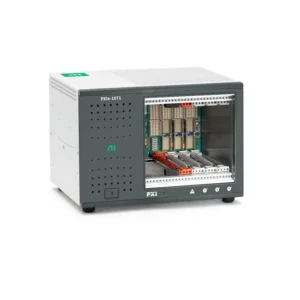
PXIe-4147 in a Complete PXI System
The PXIe-4147 can serve as the high-current precision DC source-measure instrument within a complete PXI system.
A typical system may include:
- PXI Chassis
- PXI Controller
- PXIe-4147 Source Measure Unit
- PXI Modules
- PXI Vector Signal Transceivers
- PXI digital pattern instruments
- PXI switching modules
- PXI oscilloscopes and digitizers
This architecture enables DC, RF, digital, waveform, and functional measurements to be coordinated within one automated test platform.
Software and Automation
The PXIe-4147 is designed for software-controlled automated testing.
Test applications can program parameters such as:
- Source voltage
- Source current
- Voltage limits
- Current compliance
- Measurement ranges
- Source sequences
- Voltage sweeps
- Current sweeps
- Measurement timing
- Transient response
Software control enables repeatable test procedures across characterization, validation, and production environments.
PXIe-4147 Accessories and Connectivity
The PXIe-4147 uses dedicated connectivity hardware designed for its multi-channel precision source-measure architecture.
When building a system, verify the compatibility of:
- Breakout accessories
- Low-leakage cables
- DUT fixtures
- Remote sense connections
- PXI switching hardware
Correct cabling is particularly important when combining high current capability with precision low-current measurement requirements.
PXI Chassis Selection
Chassis power and cooling should be considered carefully when using high-current SMUs.
Before installing the PXIe-4147, verify:
- PXI Express slot compatibility
- Available chassis power
- Cooling capacity
- Number of SMU modules
- Required simultaneous current output
- Other installed PXI instruments
For systems requiring maximum simultaneous current capability across multiple SMU channels, chassis selection can be particularly important.
SMU Selection Considerations
Before selecting the PXIe-4147, engineers should evaluate:
- Required number of SMU channels
- Maximum DUT voltage
- Maximum DUT current
- Source power requirements
- Sink power requirements
- Current sensitivity
- Measurement accuracy
- Measurement speed
- Transient response
- Remote sensing requirements
- Compliance requirements
- PXI chassis power
- DUT cabling and fixture requirements
Industries
- Semiconductor Test
- RF and Wireless Test
- Electronic Manufacturing
- Automated Test Equipment
- Consumer Electronics
- Communication Equipment
- Automotive Electronics
- Aerospace and Defense
- Research and Development
Applications
RF Semiconductor Test
The PXIe-4147 provides high-current programmable DC power and precision current measurement for compatible RF semiconductor devices.
RF Front-End Validation
Four independent SMU channels can provide power and bias to RF front-end devices while PXI RF instruments perform signal generation and analysis.
Power Amplifier Testing
The ±3 A current capability makes the PXIe-4147 particularly useful for compatible low-voltage RF power amplifiers and other high-current RF devices.
Semiconductor Characterization
Four-quadrant source-measure capability supports automated DC characterization of semiconductor devices.
I-V Characterization
Programmable voltage and current sweeps allow automated generation of DUT I-V characteristics.
Power Consumption Measurement
The PXIe-4147 can monitor DUT current consumption across startup, standby, active, transmit, receive, and other operating states.
Automated Production Test
High-speed sequencing and PXI synchronization make the module suitable for repeatable semiconductor and electronic production test.
Recommended Related Products
| NI PXIe-4147 | 4-channel, ±8 V, ±3 A precision PXI Source Measure Unit for high-current semiconductor and RF device testing. |
| NI PXIe-4162 | 12-channel high-density PXI Source Measure Unit for applications requiring more independent SMU channels and multi-site semiconductor testing. |
| NI PXIe-4151 | Single-channel precision PXI SMU for applications requiring a different voltage, current, power, and measurement architecture. |
| NI PXIe-4113 | PXI programmable DC power supply for applications focused primarily on providing DUT power. |
| NI PXI Modules | PXI instrumentation for source measurement, RF testing, switching, waveform acquisition, data acquisition, and automated test. |
Why Choose NI PXIe-4147?
- 4 precision SMU channels
- ±8 V voltage range
- ±3 A DC current range
- 24 W maximum DC source power per channel
- 24 W maximum DC sink power per channel
- 100 fA current sensitivity
- 4-quadrant operation
- Integrated remote four-wire sensing
- NI SourceAdapt technology
- High-speed sequencing
- Precision voltage and current sourcing
- Precision voltage and current measurement
- Suitable for RF semiconductor testing
- Suitable for high-current DUT characterization
- PXI Express modular architecture
Frequently Asked Questions
What is the NI PXIe-4147?
The NI PXIe-4147 is a four-channel precision PXI Express Source Measure Unit designed for programmable voltage and current sourcing and precision electrical measurement.
How many SMU channels does the PXIe-4147 have?
The PXIe-4147 provides four independent SMU channels.
What is the voltage range of the PXIe-4147?
The PXIe-4147 provides a voltage range from approximately -8 V to +8 V.
What is the maximum DC current of the PXIe-4147?
The PXIe-4147 provides a DC current range from approximately -3 A to +3 A per channel, subject to the instrument’s operating and power limits.
What is the maximum DC power of the PXIe-4147?
Each PXIe-4147 channel can source up to approximately 24 W and sink up to approximately 24 W within its specified operating envelope.
What is the current sensitivity of the PXIe-4147?
The PXIe-4147 provides current sensitivity down to approximately 100 fA.
Does the PXIe-4147 support four-quadrant operation?
Yes. The PXIe-4147 supports four-quadrant operation, allowing it to source and sink current under positive and negative voltage conditions within its operating limits.
Does the PXIe-4147 support remote sensing?
Yes. Each channel includes integrated remote four-wire sensing to improve voltage accuracy at the DUT, particularly when cable and fixture resistance create voltage drops.
What is SourceAdapt?
SourceAdapt is an NI technology that allows the SMU transient response to be customized for different DUT load characteristics, helping optimize stability, settling behavior, and test speed.
Can the PXIe-4147 perform I-V characterization?
Yes. The PXIe-4147 can perform programmable voltage and current sweeps while measuring DUT response, making it suitable for automated I-V characterization.
Can the PXIe-4147 be used for RF device testing?
Yes. The module is particularly useful for supplying DC power and monitoring current consumption in RF ICs, power amplifiers, RF front-end modules, and other compatible RF devices.
Can the PXIe-4147 be used with a PXI VST?
Yes. A PXI Vector Signal Transceiver can generate and analyze RF signals while the PXIe-4147 supplies DUT power and measures current consumption.
Can the PXIe-4147 test power amplifiers?
Yes, provided the DUT voltage, current, and power requirements are within the PXIe-4147 operating limits. Its ±3 A current capability makes it particularly useful for compatible low-voltage RF power amplifier applications.
Can the PXIe-4147 test processors and FPGAs?
Yes. For compatible devices, its four channels can provide programmable low-voltage power to multiple DUT rails while measuring current consumption.
What is the difference between PXIe-4147 and PXIe-4162?
The PXIe-4147 provides four channels with substantially higher current capability per channel, while the PXIe-4162 provides twelve SMU channels and is optimized for higher channel density. The PXIe-4147 is therefore particularly attractive for high-current DUTs, while the PXIe-4162 is useful for high-density and multi-site applications.
Is the PXIe-4147 a programmable power supply?
The PXIe-4147 can provide programmable DUT power, but it is fundamentally a precision Source Measure Unit. Unlike a conventional power supply, it combines sourcing, sinking, precision measurement, four-quadrant operation, and advanced transient-response capabilities.
What accessories are required for the PXIe-4147?
The required accessories depend on the test-system architecture. Appropriate breakout hardware, low-leakage cabling, DUT fixtures, and remote-sense connections should be selected according to the application.
What should I check before purchasing a PXIe-4147?
Before purchasing a PXIe-4147, verify the required voltage, current, source and sink power, number of channels, current sensitivity, measurement speed, remote sensing, transient response, DUT cabling, PXI Express chassis power and cooling, software compatibility, and the exact NI ordering part number.
Conclusion
The NI PXIe-4147 4-Channel Precision PXI Source Measure Unit combines ±8 V voltage operation, ±3 A DC current capability, 24 W source and sink power per channel, 100 fA current sensitivity, four-quadrant operation, integrated remote sensing, high-speed sequencing, and SourceAdapt technology. These capabilities make the PXIe-4147 particularly well suited for RF semiconductor testing, power amplifier characterization, IC power testing, I-V measurements, transient current analysis, electronic validation, and high-throughput automated production test systems.