






Quick Answer: PXI is a modular platform for automated test, measurement, data acquisition, control, and instrumentation. A PXI system combines a chassis, an embedded or remote controller, plug-in instrument modules, software, and accessories. The backplane provides data communication, power, clocks, and hardware trigger resources so multiple instruments can operate as one coordinated system. PXI Express, commonly called PXIe, extends the platform with PCI Express bandwidth and enhanced timing while preserving the modular system concept.
What Does PXI Mean?
PXI stands for PCI eXtensions for Instrumentation. It is an open modular instrumentation standard designed for high-performance automated test and measurement systems.
PXI combines computer-based measurement with a rugged modular chassis. Instead of using several separate bench instruments connected by external buses, engineers can install digitizers, digital multimeters, waveform generators, RF instruments, switching modules, power supplies, source measure units, data acquisition devices, FPGA modules, and communication interfaces into one coordinated platform.
A complete PXI system typically contains:
- A PXI or PXIe chassis
- An embedded controller or remote-control interface
- One or more instrument modules
- Drivers, test software, and operating system
- Cables, terminal blocks, fixtures, and accessories
How Does a PXI System Work?
The controller runs the operating system, drivers, test application, analysis, data storage, and user interface. The controller communicates with modules through the chassis backplane.
Each module performs a specialized function. A digitizer captures waveforms, a waveform generator stimulates the device under test, a DMM measures precision voltage or resistance, a switch routes signals, and an RF instrument generates or analyzes wireless signals.
The chassis backplane connects these components. It distributes power and provides data paths, reference clocks, trigger lines, and synchronization resources. This allows instruments to exchange data and coordinate operations with less external cabling than a traditional rack of standalone equipment.
ChassisProvides slots, power, cooling, data communication, clocks, and trigger resources.
ControllerRuns the operating system, drivers, applications, analysis, storage, and network connections.
ModulesPerform measurement, generation, switching, RF, digital, power, FPGA, and interface functions.
SoftwareConfigures hardware, sequences tests, analyzes data, records results, and manages automation.
The Main Components of a PXI System
PXI Chassis
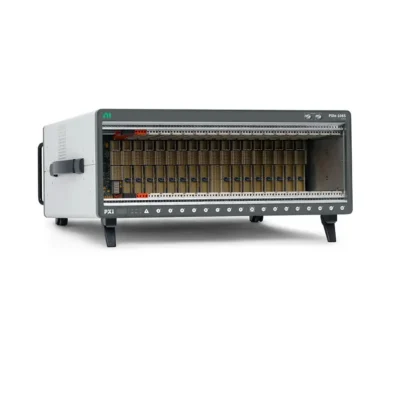
The PXI chassis is the mechanical and electrical foundation. It contains the system slot, peripheral slots, power supply, cooling system, backplane data buses, and timing resources.
Chassis differ in slot count, PXI or PXIe architecture, hybrid-slot support, per-slot bandwidth, aggregate system bandwidth, power, cooling, timing connections, size, noise, and environmental rating.
PXI Controller
The PXI controller manages the system. It can be installed directly in the chassis or implemented as an external computer connected through a compatible remote interface.
An embedded controller creates a compact self-contained platform. Remote control allows the chassis to use a desktop, workstation, server, or supported laptop.
PXI Modules
PXI modules are plug-in instruments and interfaces. Available categories include:
- Oscilloscopes and digitizers
- Digital multimeters
- Waveform and signal generators
- RF generators, analyzers, and transceivers
- Data acquisition modules
- Digital I/O and high-speed digital instruments
- Switches, multiplexers, matrices, and relays
- Programmable power supplies, loads, and source measure units
- FPGA and reconfigurable I/O modules
- Timing and synchronization modules
- Serial, CAN, LIN, Ethernet, GPIB, and other interfaces
PXI Software
Software configures modules, routes triggers, acquires data, generates signals, performs analysis, sequences tests, stores results, and connects the system to databases or manufacturing systems.
The complete software stack can include an operating system, platform services, instrument drivers, development tools, test-management software, runtimes, FPGA tools, and application-specific packages.
PXI vs PXIe: What Is the Difference?
Traditional PXI uses a parallel PCI-based data bus. PXI Express uses PCI Express point-to-point serial links and switches, providing significantly higher data bandwidth and additional timing resources.
| Feature | PXI | PXI Express |
|---|---|---|
| Data architecture | Parallel PCI | PCI Express links and switches |
| Typical bandwidth | Suitable for many switching, DMM, relay, and low-rate applications | Better suited to digitizers, RF, FPGA, streaming, and high-speed digital test |
| Reference clocks | PXI_CLK10 | PXI_CLK10 plus PXIe_CLK100 and related resources |
| Trigger resources | Shared trigger bus and star trigger | Shared triggers plus enhanced differential star resources |
| Module support | Traditional PXI modules | PXIe modules and selected PXI modules in compatible hybrid slots |
| Best fit | Legacy systems and lower-bandwidth instrumentation | Modern high-performance test and measurement |
Compatibility warning: A PXI module does not work in every PXIe slot. A PXIe module cannot operate in a traditional PXI-only chassis. Check the exact connector, slot type, power, cooling, driver, and software requirements.
What Is the PXI Backplane?
The backplane is the internal connection system behind the module slots. It carries data, distributes clocks and triggers, supplies power, and supports module identification and system enumeration.
In PXIe systems, modules connect through PCI Express links and switches. Some slots may have dedicated connections, while other slots share an upstream switch link. Therefore, the total advertised chassis bandwidth is not automatically available to every module at the same time.
Read PXI Backplane Explained for detailed information about buses, switch topology, slots, clocks, and triggers.
PXI Slot Types Explained
| Slot Type | Purpose | Important Consideration |
|---|---|---|
| System slot | Accepts an embedded controller or compatible remote-control interface | Controller type must match the chassis architecture |
| PXI peripheral slot | Accepts compatible traditional PXI modules | Uses the PXI/PCI interface |
| PXIe peripheral slot | Accepts compatible PXIe modules | PCIe generation and lane width can vary |
| Hybrid peripheral slot | Supports PXIe modules and selected hybrid-compatible PXI modules | Does not support every legacy PXI module |
| System timing slot | Supports compatible timing modules and dedicated star resources | Used for advanced multi-module synchronization |
How Does PXI Timing and Synchronization Work?
PXI is designed to coordinate several instruments through shared hardware timing resources. A test application can route triggers and distribute reference clocks without relying only on nondeterministic software commands.
Common resources include:
- PXI_CLK10 reference clock
- PXIe_CLK100 differential reference clock
- Shared PXI trigger bus lines
- PXI star trigger
- PXIe differential star triggers
- External reference-clock and trigger connections
- Timing and synchronization modules
A hardware trigger defines when an event begins. A shared reference clock keeps compatible device timebases frequency-related. Both may be required when modules must start together and remain aligned.
See PXI Trigger Bus Explained and the PXI Timing and Synchronization Guide.
What Are the Main Advantages of PXI?
Modular Instrumentation
Engineers can select only the measurement and control functions required for the application. Modules can be replaced or expanded without replacing the entire platform.
High Data Throughput
PXIe provides PCIe-class data movement between modules, controller memory, processing, and storage. This supports high-speed digitizers, RF instruments, FPGA processing, and continuous streaming.
Hardware Synchronization
Backplane clocks and trigger resources allow multiple instruments to operate with predictable timing relationships and less external timing cabling.
High Channel Density
A single chassis can hold many measurement, generation, switching, and control channels in a compact bench or rack footprint.
Automation and Software Integration
PXI systems are designed for automated test sequences, parallel measurements, analysis, reporting, databases, manufacturing execution systems, and remote management.
Scalability
A platform can begin with a small module set and expand to larger chassis, additional instruments, multiple synchronized chassis, or replicated production stations.
What Are the Limitations of PXI?
- The initial chassis and controller cost can exceed a simple benchtop or USB measurement setup.
- Module, slot, controller, driver, and operating-system compatibility require careful planning.
- High-performance modules can create significant power, cooling, bandwidth, and storage requirements.
- Theoretical chassis bandwidth does not guarantee sustained application throughput.
- System integration requires software, fixtures, cables, switching, calibration, and documentation.
- Older validated systems may depend on legacy operating systems or drivers.
Common PXI Applications
| Application | Typical PXI Functions |
|---|---|
| Automated production test | Switching, DMM, generation, digitizing, power, digital I/O, and sequencing |
| RF and wireless validation | RF generation, analysis, transceiver, timing, FPGA processing, and calibration |
| Semiconductor test | SMUs, digital instruments, switching, timing, and parallel DUT execution |
| Aerospace and defense | Avionics interfaces, RF, data acquisition, fault insertion, and hardware-in-the-loop |
| Automotive test | Bus interfaces, sensor simulation, power, switching, acquisition, and HIL |
| Research and validation | Digitizers, waveform generation, synchronized measurement, and custom FPGA processing |
| Structural and dynamic test | Synchronized acquisition, sensor conditioning, timing, and continuous data storage |
PXI vs Benchtop Instruments
Benchtop instruments are convenient for interactive laboratory measurements and often include a front panel, display, and controls. PXI is optimized for software-controlled automation, instrument density, synchronization, and scalable system integration.
| Decision Factor | PXI | Benchtop Instruments |
|---|---|---|
| Automation | Designed for integrated software-controlled systems | Can be automated through external interfaces |
| Synchronization | Dedicated backplane clocks and triggers | Usually requires external trigger and clock cabling |
| Density | Many instruments in one chassis | More bench or rack space per instrument |
| Manual operation | Often depends on software interface | Usually includes front-panel controls |
| Expansion | Add compatible modules and slots | Add separate instruments and communication links |
PXI vs CompactDAQ
CompactDAQ is generally optimized for portable or distributed sensor measurement using C Series modules with integrated signal conditioning. PXI is generally optimized for high-performance modular instrumentation, automated test, high throughput, and coordination of different instrument types.
Choose CompactDAQ when the project is primarily a sensor and data acquisition problem. Choose PXI when it is primarily a multi-instrument, high-speed, tightly synchronized, or production-test problem.
Read CompactDAQ vs PXI for a detailed comparison.
How to Choose a PXI System
Use the following order:
- Define the device under test and test objectives.
- List every signal and test function.
- Select measurement, generation, switching, power, and interface modules.
- Decide whether PXI, PXIe, or a hybrid architecture is required.
- Calculate slot count, data rate, power, and cooling.
- Select a compatible chassis and create a slot map.
- Select an embedded or remote controller.
- Design the clock, trigger, and synchronization architecture.
- Verify drivers, operating system, software, and licenses.
- Complete the bill of materials with cables, fixtures, calibration, and spares.
Use How to Choose a PXI System, How to Choose a PXI Chassis, How to Choose a PXI Controller, and How to Choose PXI Modules for detailed selection steps.
How to Calculate PXI Data Throughput
Estimate the raw data generated by every simultaneously streaming module. For an acquisition module, a basic estimate is:
Channels × samples per second × bytes per sample
Add all input and output traffic, then allow margin for protocol overhead, DMA transfers, buffering, analysis, display, file formatting, and future expansion.
Compare the workload against:
- Module interface bandwidth
- Per-slot PXIe link
- Chassis switch topology
- Controller-to-chassis link
- Processor and memory bandwidth
- Sustained storage performance
- Network logging capacity
PXI Compatibility Checklist
Confirm the complete configuration before purchasing:
- PXI, PXIe, or hybrid slot compatibility
- Controller and system-slot compatibility
- Module width and adjacent-slot requirements
- PCIe generation, lane width, and switch topology
- Per-slot and aggregate data bandwidth
- Total power and power available per slot
- Cooling capacity at maximum ambient temperature
- Reference clocks, trigger lines, and star resources
- Operating system, driver, firmware, API, and licenses
- Cables, terminal blocks, adapters, and fixtures
- Calibration, warranty, lead time, lifecycle, and spares
Frequently Asked Questions About PXI
Is PXI a computer?
A complete PXI system includes computer functionality through an embedded controller or an external host. The chassis and instrument modules form the modular test platform controlled by that computer.
Is PXI the same as PXIe?
No. PXIe is the PCI Express-based evolution of PXI. The platforms share a modular instrumentation concept but differ in data interfaces, timing resources, slot connectors, and module compatibility.
Can PXI modules from different manufacturers share one chassis?
Potentially, when each module follows the relevant standard and is compatible with the slot, controller, operating system, driver, power, cooling, and software environment. Driver APIs and synchronization features can still differ.
Does every PXIe slot have the same bandwidth?
No. PCIe generation, lane width, switch connection, and shared upstream links can vary by slot. Review the chassis block diagram.
Can PXI systems run in real time?
Yes, when the controller, operating system, drivers, modules, and application support real-time execution. A standard desktop operating system is not hard real time.
Can several PXI chassis be synchronized?
Yes. Multi-chassis systems can distribute clocks and triggers or use timing modules and supported synchronization methods. Actual skew and phase performance depend on the complete architecture.
Is PXI suitable for portable systems?
PXI is commonly used in bench, rack, production, and transportable systems. Portability depends on chassis size, weight, power, cooling, ruggedness, controller, and case design.
Can I buy used PXI equipment?
Yes. Verify the exact model, hardware revision, condition, calibration, accessories, driver support, slot compatibility, functional test results, warranty, and return terms.
Common PXI System Problems
Typical problems include controller boot failure, undetected modules, incorrect slot compatibility, remote-link failure, driver conflicts, trigger-routing errors, clock drift, buffer overflow, low throughput, overheating, and calibration issues.
See Common PXI System Problems and Solutions for a structured troubleshooting process.
Final Summary
PXI is a modular automated test and measurement platform that combines a chassis, controller, instrument modules, software, and accessories. Its main strengths are high instrument density, software automation, PCIe-class data movement, hardware synchronization, modular expansion, and system integration.
PXIe is generally preferred for new high-bandwidth or tightly synchronized systems, while traditional PXI remains useful for legacy and lower-bandwidth applications. The correct platform depends on the signals, instruments, slots, throughput, timing, software, power, cooling, environment, and lifecycle requirements of the complete test system.
Continue Your PXI Research
Explore PXI systems, PXI chassis, PXI controllers, and PXI modules at PXI Source. For purchasing guidance, read the PXI System Buying Guide.
Explore PXI systems, PXI chassis, PXI controllers, and PXI modules at PXI Source. For purchasing guidance, read the PXI System Buying Guide.
Categories
Latest Articles
Products on Sale


Need Help Choosing a Product?
Contact our sales team for product selection, pricing, availability and lead-time information.
sales@pxisource.com