



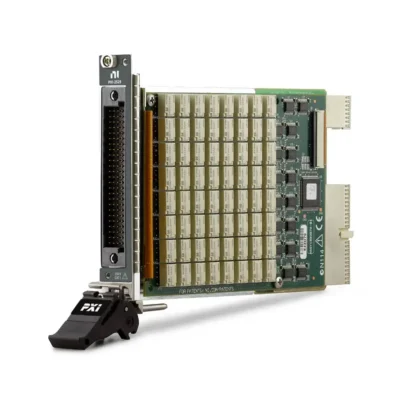
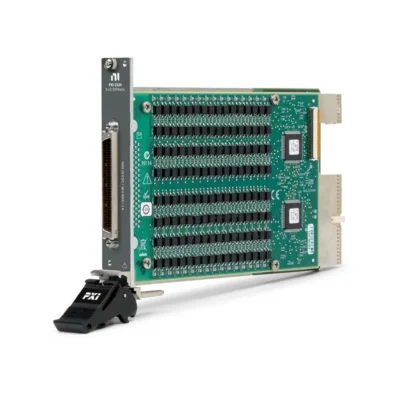
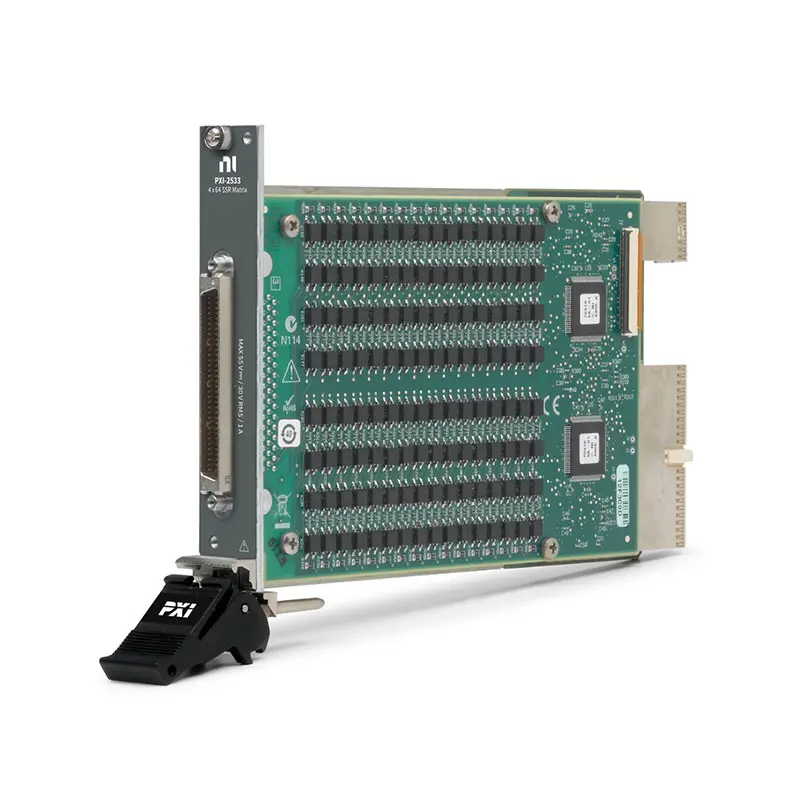
Product Introduction
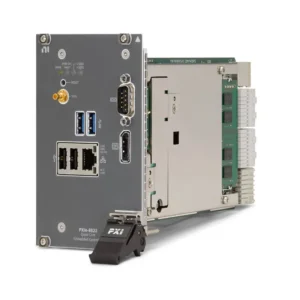
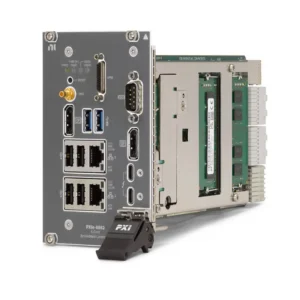
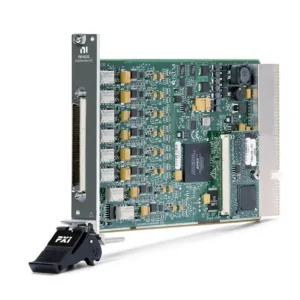
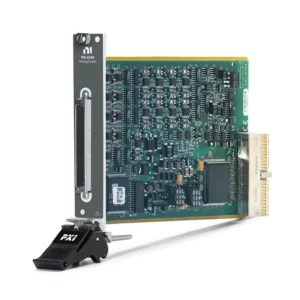
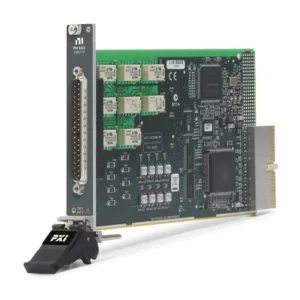
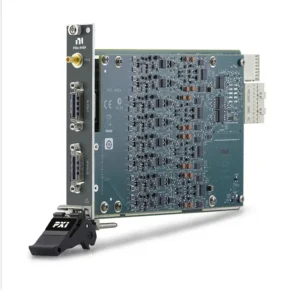
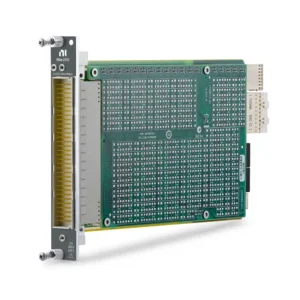
The NI PXI-2533 is a high-density PXI multiplexer switch module designed for automated test, data acquisition, signal routing, electronic validation, production test, and high-channel-count measurement systems.
The PXI-2533 uses solid-state FET switching technology and provides a flexible switching architecture that can be configured for multiple multiplexer and matrix topologies. This allows engineers to route a large number of low-voltage signals between devices under test and measurement instruments while minimizing the number of dedicated instruments required in the system.
With its high channel density and programmable switching architecture, the PXI-2533 is particularly useful in automated test systems requiring fast, repeatable, software-controlled signal routing.
Product Overview
The National Instruments PXI-2533 is a PXI high-density multiplexer and matrix switch module based on FET switching technology.
Its flexible topology allows the module to support different signal-routing configurations depending on the application.
Typical applications include:
- Automated signal routing
- High-channel-count data acquisition
- Electronic device validation
- Production test
- Functional test systems
- Semiconductor test
- Multipoint measurements
- Matrix signal routing
- Automated test equipment
Key Features
High-Density PXI Switching
The PXI-2533 provides a high-density switching architecture for PXI automated test systems.
High channel density is particularly valuable when many DUT test points must share a smaller number of measurement instruments.
Instead of dedicating an instrument to every test point, the switch can dynamically connect the required signal to the appropriate instrument.
4×64 1-Wire Multiplexer Configuration
One of the primary configurations of the PXI-2533 is a 4×64 1-wire multiplexer.
This topology provides four independent multiplexer banks with 64 channels per bank, allowing a large number of signals to be routed within a single PXI switching module.
A typical measurement architecture can be represented as:
Multiple DUT Signals → PXI-2533 → Measurement Instrument → Test Software
256-Crosspoint Matrix Architecture
The PXI-2533 can also be configured as a 256-crosspoint matrix, providing flexible signal-routing capability for applications where connections must be dynamically established between multiple signal paths.
Matrix switching is useful for:
- Flexible DUT routing
- Automated functional testing
- Multi-instrument test systems
- Signal path reconfiguration
- Research and development
- Production validation
Configurable Switching Topologies
The PXI-2533 supports multiple switching topologies, allowing engineers to optimize the module for different test requirements.
Depending on the system configuration, the switch can be used for high-density multiplexing or matrix-based signal routing.
This flexibility can reduce the number of separate switching modules required in complex automated test systems.
Solid-State FET Switching
The PXI-2533 uses field-effect transistor (FET) switching technology rather than conventional electromechanical relays.
FET switching provides important advantages for applications requiring frequent switching operations.
- Fast switching
- No mechanical relay contacts
- High switching-cycle capability
- Quiet operation
- Suitable for repetitive automated testing
- Compact high-density switching architecture
Fast Automated Signal Routing
Because the PXI-2533 uses solid-state switching, signal paths can be changed rapidly under software control.
Fast switching is particularly valuable in production test systems where hundreds or thousands of switching operations may occur during repeated test sequences.
Software-Controlled Switching
The PXI-2533 can be controlled programmatically as part of an automated PXI test system.
Test software can automatically:
- Connect DUT signals
- Disconnect signal paths
- Change multiplexer channels
- Configure matrix connections
- Coordinate switching with measurements
- Execute automated test sequences
PXI Platform Integration
The PXI-2533 integrates switching functionality directly into a modular PXI test system.
The module can operate alongside:
- PXI digital multimeters
- PXI data acquisition modules
- PXI digitizers
- PXI source measurement units
- PXI programmable power supplies
- PXI digital I/O modules
- PXI waveform generators
- Other PXI switching modules
Technical Specifications
| Parameter | Description |
|---|---|
| Product Type | PXI Multiplexer / Matrix Switch Module |
| Model | NI PXI-2533 |
| Platform | PXI |
| Switch Technology | Solid-State FET |
| Primary Multiplexer Configuration | 4×64 1-Wire Multiplexer |
| Matrix Capability | 256-Crosspoint Matrix |
| Switching Architecture | Configurable Multiplexer / Matrix |
| Software-Controlled Switching | Supported |
| High-Density Signal Routing | Supported |
| Primary Applications | Automated Test, DAQ Signal Routing, Functional Test and Electronic Validation |
What Is a PXI Multiplexer Switch?
A PXI multiplexer switch allows multiple input signals to share one or more measurement instruments.
For example, a test system may need to measure voltage at dozens of DUT test points using a single digital multimeter.
Instead of installing a separate DMM for every measurement point, the system can use a PXI switch:
DUT Channels → PXI-2533 → PXI DMM → Measurement Software
The PXI-2533 selects the required DUT channel, routes it to the measurement instrument, and then changes to the next channel according to the automated test sequence.
What Is a Matrix Switch?
A matrix switch provides flexible connections between multiple signal paths.
Unlike a basic multiplexer, which typically selects one channel from a group, a matrix architecture can provide more flexible routing between rows and columns.
This makes matrix switching useful when an automated test system needs to dynamically change connections between DUT signals and test equipment.
Multiplexer vs Matrix Switching
| Feature | Multiplexer | Matrix |
|---|---|---|
| Primary Function | Select Signals | Flexible Signal Routing |
| Typical Architecture | Many Channels to Common | Rows Connected to Columns |
| Routing Flexibility | Moderate | High |
| Typical Application | Sequential Measurement | Dynamic Test Connections |
| Example | Multiple DUT Points to DMM | Multiple DUT Points to Multiple Instruments |
Why Use FET Switching?
The PXI-2533 uses semiconductor FET switches instead of mechanically operated relay contacts.
This technology is particularly suitable for applications requiring high switching speed and frequent switching cycles.
| Feature | FET Switching | Electromechanical Relay |
|---|---|---|
| Mechanical Contacts | No | Yes |
| Switching Speed | Fast | Generally Slower |
| Mechanical Wear | None | Present |
| Switching Cycle Capability | Very High | Limited by Relay Life |
| Signal Voltage Capability | Generally Lower | Can Be Higher |
| High-Density Design | Excellent | Device Dependent |
The correct switching technology should be selected according to signal voltage, current, bandwidth, resistance, switching speed, and lifetime requirements.
High-Channel-Count Data Acquisition
The PXI-2533 can be used to expand the number of signals that can be measured by a data acquisition or measurement instrument.
A typical architecture can be represented as:
64+ Sensors / Test Points → PXI-2533 → DAQ or DMM → PXI Controller
The switch sequentially routes signals to the measurement instrument, allowing one instrument to acquire data from many test points.
Digital Multimeter Signal Routing
One of the most common applications for high-density PXI switching is routing signals to a digital multimeter.
A PXI DMM combined with the PXI-2533 can create a high-channel-count measurement system for:
- DC voltage measurements
- Resistance measurements
- Continuity testing
- Component validation
- Production test
- Functional testing
The exact measurement capability depends on the DMM, switch topology, signal characteristics, and system configuration.
Automated Functional Testing
Functional test systems frequently need to connect different DUT nodes to measurement or stimulus instruments during different stages of a test sequence.
The PXI-2533 can automate these routing operations.
For example:
- Connect DUT test point A to the measurement instrument.
- Perform the required measurement.
- Disconnect test point A.
- Connect test point B.
- Perform the next measurement.
- Continue through the automated sequence.
This approach reduces manual wiring and improves test repeatability.
Production Test Applications
Production test systems require fast, repeatable, and reliable switching between DUT test points.
The FET-based PXI-2533 is particularly suitable for applications involving frequent switching operations.
Typical production applications include:
- PCB functional testing
- Electronic assembly testing
- Device validation
- Continuity testing
- Automated measurement routing
- Manufacturing test fixtures
- End-of-line testing
Semiconductor Test Applications
Semiconductor characterization and production test systems often require flexible routing between DUT pins and measurement instruments.
The PXI-2533 can provide high-density signal switching within compatible semiconductor test architectures.
Potential applications include:
- Device characterization
- Pin routing
- Continuity measurements
- Functional validation
- Automated production testing
- Multi-device test fixtures
Electronic Validation
During electronic product development, engineers may need to measure many internal signals using a limited number of instruments.
The PXI-2533 allows test software to dynamically connect selected test points to the appropriate measurement instrument.
This makes the module useful for:
- Design verification
- Board-level validation
- Prototype testing
- Subsystem validation
- Automated regression testing
Reducing Instrument Count
A switching system can reduce the number of measurement instruments required for high-channel-count testing.
For example, instead of using 64 separate voltage measurement channels, a multiplexer can route 64 DUT signals sequentially to a smaller number of precision measurement instruments.
This can reduce:
- System hardware cost
- Rack space
- Instrument count
- System complexity
- Calibration requirements
PXI-2533 in a Complete PXI System
The PXI-2533 is typically used as the signal-routing layer within a complete PXI automated test platform.
A system may include:
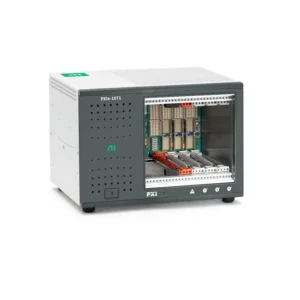
- PXI chassis
- PXI embedded or remote controller
- PXI-2533 switch module
- PXI digital multimeter
- PXI data acquisition module
- PXI digitizer
- PXI programmable power supply
- PXI source measurement unit
- Digital I/O modules
- Additional switching modules
This architecture allows measurement, stimulus, switching, data acquisition, and control functions to be integrated into one modular test platform.
Typical Automated Measurement Architecture
A high-channel-count automated measurement system using the PXI-2533 may operate as follows:
DUT Test Points → PXI-2533 Switch → PXI DMM / DAQ → PXI Controller → Test Software
The software controls both the switch and measurement instrument, allowing each DUT signal to be measured automatically according to the required test sequence.
Software Integration
The PXI-2533 can be integrated into NI software-based automated test environments.
Typical software applications may use:
- NI-SWITCH
- LabVIEW
- LabWindows/CVI
- TestStand
- Compatible programming environments
NI-SWITCH provides software control for compatible NI switch modules and allows applications to configure routes and manage switching operations programmatically.
Switch Executive Integration
In complex automated test systems, NI Switch Executive can be used with compatible switching hardware to simplify route configuration and management.
Instead of controlling individual relay or FET connections directly, engineers can define logical routes and use software to manage the underlying switching configuration.
This can simplify development when a system contains multiple switching modules and many interconnected signal paths.
Important Signal Considerations
Before selecting the PXI-2533 for a test application, engineers should verify that the characteristics of the signal are compatible with the switch module.
Important parameters include:
- Maximum switching voltage
- Maximum switching current
- Maximum switching power
- On resistance
- Bandwidth
- Leakage current
- Signal frequency
- Required switching speed
- Topology requirements
These parameters are particularly important for FET-based switches because their electrical characteristics differ from electromechanical relay switches.
FET Switch vs Relay Switch Selection
The PXI-2533 is optimized for high-density, fast, repetitive switching applications. It is not automatically the best choice for every signal-routing requirement.
An electromechanical relay-based PXI switch may be more appropriate when an application requires higher voltage, higher current, very low leakage, or different isolation characteristics.
The PXI-2533 is particularly attractive when the priorities are:
- High channel density
- Fast switching
- Very high switching-cycle requirements
- Compact PXI integration
- Automated low-voltage signal routing
Industries
- Automated Test Equipment
- Semiconductor Test
- Electronic Manufacturing
- Automotive Electronics
- Aerospace and Defense
- Industrial Electronics
- Research and Development
- Laboratory Automation
- Electronic Validation
Applications
High-Channel-Count Signal Routing
The PXI-2533 provides dense programmable signal routing for automated test systems containing many DUT test points.
Multiplexed Measurements
Multiple signals can be sequentially routed to a shared measurement instrument such as a digital multimeter or DAQ device.
Matrix Switching
The configurable matrix architecture supports flexible signal connections for functional test and electronic validation applications.
Production Testing
Solid-state FET switching makes the PXI-2533 suitable for repetitive switching operations in automated production test environments.
Electronic Validation
Engineers can dynamically route different DUT signals to measurement instruments during automated design verification and validation.
Semiconductor Testing
High-density switching can support compatible semiconductor characterization and production test applications requiring programmable signal routing.
Comparison with Other PXI Switch Modules
The PXI-2533 should be selected primarily when the application requires high-density FET-based multiplexing or matrix switching.
| Requirement | PXI-2533 Suitability |
|---|---|
| High Channel Density | Excellent |
| Fast Switching | Excellent |
| Frequent Switching Cycles | Excellent |
| Multiplexer Applications | Excellent |
| Matrix Signal Routing | Supported |
| Automated Production Test | Excellent |
| High-Voltage Switching | Consider Alternative Relay Modules |
| High-Current Switching | Consider Alternative Relay Modules |
Recommended Related Products
When designing a PXI switching system, related switch modules should be selected according to required topology, signal level, switching technology, channel density, and application.
| NI PXI-2533 | High-density FET multiplexer and matrix switch for fast automated low-voltage signal routing. |
| NI PXIe-2725 | PXI programmable resistor module suitable for applications requiring software-controlled resistance simulation. |
| NI PXIe-2727 | PXI Express programmable resistor module for sensor simulation and automated electronic test applications. |
Why Choose NI PXI-2533?
- High-density PXI switching architecture
- 4×64 1-wire multiplexer configuration
- 256-crosspoint matrix capability
- Solid-state FET switching
- Fast switching performance
- No mechanical relay contacts
- High switching-cycle capability
- Software-controlled signal routing
- Suitable for high-channel-count measurements
- Suitable for DMM and DAQ signal routing
- Flexible multiplexer and matrix applications
- Suitable for automated production testing
- Suitable for electronic validation
- Suitable for semiconductor test systems
- Integrated PXI architecture
Frequently Asked Questions
What is the NI PXI-2533?
The NI PXI-2533 is a high-density PXI multiplexer and matrix switch module designed for automated signal routing in test and measurement systems.
What type of switch does the PXI-2533 use?
The PXI-2533 uses solid-state FET switching technology.
What is the main topology of the PXI-2533?
One of the primary PXI-2533 configurations is a 4×64 1-wire multiplexer. The module also supports configurable matrix-based signal-routing applications.
What does 4×64 1-wire mean?
A 4×64 1-wire configuration provides four multiplexer banks with 64 signal channels per bank. It is designed for high-density routing of single-wire signals to common measurement paths.
What does 256-crosspoint matrix mean?
A crosspoint represents a programmable connection within a switching matrix. A 256-crosspoint architecture provides a large number of software-controlled connection points for flexible signal routing.
Is the PXI-2533 a mechanical relay switch?
No. The PXI-2533 uses semiconductor FET switches rather than conventional electromechanical relay contacts.
What are the advantages of FET switching?
FET switches provide fast switching, no mechanical contact wear, high switching-cycle capability, and high channel density. These characteristics make them particularly useful for repetitive automated test applications.
Can the PXI-2533 be used with a digital multimeter?
Yes. One common application is routing multiple DUT signals to a shared PXI or external digital multimeter. The complete signal requirements should be checked against the specifications of both the switch and DMM.
Can the PXI-2533 be used with a DAQ module?
Yes. The PXI-2533 can be used as a signal-routing layer for compatible data acquisition applications where multiple signals must share measurement channels.
Can the PXI-2533 be used for production testing?
Yes. Its high channel density, software-controlled routing, and solid-state switching architecture make it suitable for repetitive automated production test applications.
Can the PXI-2533 be used for semiconductor testing?
Yes. The module can be used in compatible semiconductor characterization and automated test systems requiring high-density signal routing.
What software is used with the PXI-2533?
The PXI-2533 can be controlled using NI switching software such as NI-SWITCH and integrated into automated applications developed with LabVIEW, TestStand, LabWindows/CVI, and other compatible programming environments.
Is the PXI-2533 suitable for high-voltage switching?
The PXI-2533 is primarily optimized for high-density FET-based signal routing rather than high-voltage power switching. Engineers should verify the signal voltage, current, power, and isolation requirements against the official hardware specifications before connecting a DUT.
What is the difference between a PXI multiplexer and a PXI matrix switch?
A multiplexer is typically used to select one or more signals from a larger group and route them to common measurement paths. A matrix provides more flexible connections between multiple rows and columns. The PXI-2533 supports configurable switching architectures for different automated test requirements.
What applications are suitable for the PXI-2533?
Typical applications include high-channel-count data acquisition, DMM signal routing, automated functional test, PCB validation, production testing, semiconductor test, electronic validation, and other systems requiring programmable signal switching.
What should I check before purchasing a PXI-2533?
Before purchasing a PXI-2533, verify the required switching topology, number of channels, signal voltage, current, power, bandwidth, on resistance, leakage requirements, switching speed, connector and terminal block requirements, PXI chassis compatibility, and NI-SWITCH software compatibility.
Conclusion
The NI PXI-2533 High-Density PXI Multiplexer Switch Module provides flexible FET-based signal routing for automated test and measurement systems. Its configurable 4×64 1-wire multiplexer and matrix switching capabilities make it suitable for high-channel-count measurements, DMM and DAQ signal routing, production testing, electronic validation, semiconductor test, and other applications requiring fast and repeatable programmable switching within a PXI platform.