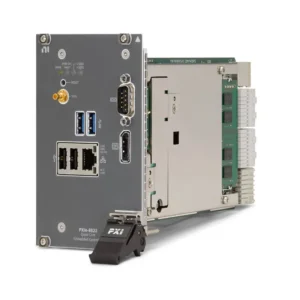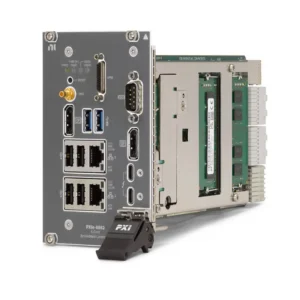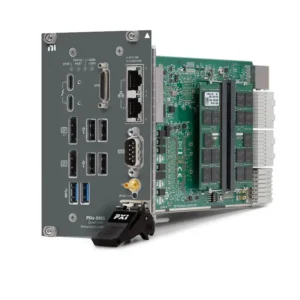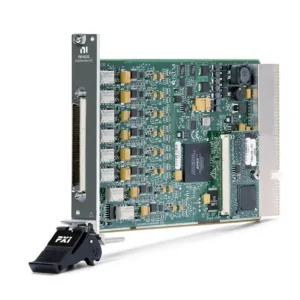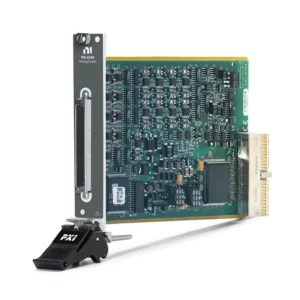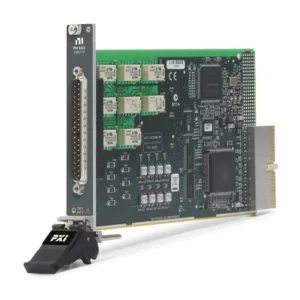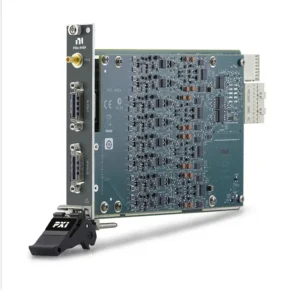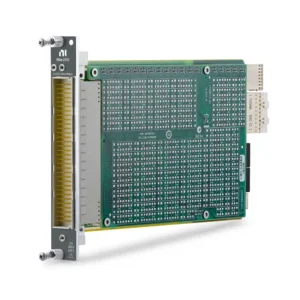






PXIe-7857 Multifunction Reconfigurable I/O Module
The PXIe-7857, also known as the PXIe-7857R, is a multifunction R Series reconfigurable I/O module featuring a user-programmable Xilinx Kintex-7 160T FPGA and 512 MB of onboard DRAM.
It provides eight 16-bit analog inputs with dedicated ADCs, eight 16-bit analog outputs and 48 bidirectional digital I/O lines. The combination of deterministic FPGA processing, high-speed I/O and onboard memory makes the PXIe-7857 suitable for hardware-in-the-loop testing, sensor simulation and real-time control.
Key Features of the PXIe-7857
- Xilinx Kintex-7 160T user-programmable FPGA
- 512 MB onboard DRAM
- Eight 16-bit analog input channels
- 1 MS/s maximum sampling rate per analog input
- Dedicated ADC for every analog input channel
- Eight 16-bit analog output channels
- 1 MS/s maximum analog output update rate
- ±1 V, ±2 V, ±5 V and ±10 V analog input ranges
- ±10 V analog output range
- 48 bidirectional digital I/O lines
- Selectable digital logic levels from 1.2 V to 3.3 V
- High-speed digital operation up to 80 MHz
- Multirate sampling and individual channel triggering
- Peer-to-peer data streaming support
- Programmable with the LabVIEW FPGA Module
PXIe-7857 Technical Specifications
| Product Model | PXIe-7857 / PXIe-7857R |
|---|---|
| Part Number | 784146-01 |
| Product Type | Multifunction Reconfigurable I/O Module |
| Product Family | NI R Series Multifunction RIO |
| Bus Interface | PXI Express |
| FPGA | Xilinx Kintex-7 160T |
| Onboard DRAM | 512 MB |
| Analog Input Channels | 8 |
| Analog Input Resolution | 16 bits |
| ADC Type | Successive approximation register |
| Maximum Analog Input Rate | 1 MS/s per channel |
| Analog Input Ranges | ±1 V, ±2 V, ±5 V and ±10 V |
| Analog Input Modes | Differential, RSE or NRSE |
| Analog Input Coupling | DC |
| Analog Output Channels | 8 |
| Analog Output Resolution | 16 bits |
| Maximum Analog Output Rate | 1 MS/s per channel |
| Analog Output Range | ±10 V |
| Digital I/O Channels | 48 bidirectional lines |
| High-Speed Digital Channels | 32 lines at up to 80 MHz |
| Low-Speed Digital Channels | 16 lines at up to 10 MHz |
| Digital Logic Levels | 1.2 V, 1.5 V, 1.8 V, 2.5 V or 3.3 V |
| Maximum Digital Update Period | 12.5 ns |
| Maximum Clock Rate | 80 MHz |
| Peer-to-Peer Streaming | Supported |
| I/O Connectors | 2 × 68-pin VHDCI |
| Operating Temperature | 0°C to 55°C |
| Form Factor | Single-slot 3U PXI Express |
PXIe-7857 Part Number and Accessories
| Model or Accessory | Part Number | Description |
|---|---|---|
| PXIe-7857 | 784146-01 | Kintex-7 160T R Series module with 512 MB DRAM |
| SCB-68 HSDIO | 782914-01 | Shielded connector block for high-speed digital I/O |
| SCB-68A | 782536-01 | Shielded connector block for multifunction I/O |
| SHC68-C68-RDIO2 | 156166-01 | 1 m shielded R Series high-speed digital cable |
| SHC68-C68-RDIO2 | 156166-02 | 2 m shielded R Series high-speed digital cable |
| SHC68-68-RMIO | 189588-01 | 1 m shielded multifunction R Series cable |
| SHC68-68-RMIO | 189588-02 | 2 m shielded multifunction R Series cable |
Kintex-7 FPGA Processing
The PXIe-7857 uses a Xilinx Kintex-7 160T FPGA for deterministic onboard processing and direct I/O control. Engineers can implement custom timing, triggering, communication protocols, signal processing and control algorithms in FPGA hardware.
FPGA execution avoids the timing variation introduced by a desktop operating system. This makes the module suitable for applications requiring repeatable response times, hardware-level decisions and tightly controlled I/O sequences.
512 MB Onboard DRAM
The principal difference between the PXIe-7857 and PXIe-7856 is the inclusion of 512 MB onboard DRAM. This memory can support larger data buffers, waveform storage and FPGA applications that must temporarily retain more data than FPGA block memory can accommodate.
Onboard DRAM is useful for high-speed acquisition, waveform replay, record processing and situations where continuous host transfer cannot always keep pace with the FPGA data rate.
Eight Independent Analog Inputs
The PXIe-7857 provides eight 16-bit analog inputs with dedicated successive-approximation ADCs. Each channel can sample at rates up to 1 MS/s without sharing a multiplexed converter.
Dedicated ADCs support simultaneous sampling, multirate acquisition and independent channel triggering. Engineers can sample fast-changing signals at higher rates while handling slower channels with separate FPGA timing.
Software-Selectable Analog Input Ranges
Each analog input supports ±1 V, ±2 V, ±5 V and ±10 V ranges. Selecting a narrower range improves effective voltage resolution when the measured signal does not use the full ±10 V span.
The module supports differential, referenced single-ended and nonreferenced single-ended wiring. The most appropriate mode depends on source grounding, cable length, noise and common-mode voltage.
Eight Analog Outputs
The PXIe-7857 provides eight 16-bit analog outputs with a ±10 V range and maximum update rates of 1 MS/s per channel. FPGA logic can directly control each output without waiting for a host-computer command.
Analog outputs can simulate sensors, generate actuator commands, reproduce stored waveforms and provide closed-loop control signals. The 512 MB DRAM can store longer waveform or stimulus sequences for FPGA-controlled generation.
48 Bidirectional Digital I/O Lines
The digital interface consists of 32 high-speed channels capable of operating at up to 80 MHz and 16 lower-speed channels supporting frequencies up to 10 MHz.
Logic levels can be configured for 1.2 V, 1.5 V, 1.8 V, 2.5 V or 3.3 V operation. This flexibility allows the PXIe-7857 to interface with a variety of embedded controllers, communication devices and custom digital electronics.
Peer-to-Peer Data Streaming
The PXIe-7857 supports direct peer-to-peer data streaming with compatible PXI Express modules. Measurement data can be transferred between devices without first passing through the host application’s memory.
Peer-to-peer streaming can reduce latency and processor load in systems that combine the PXIe-7857 with digitizers, signal generators, RF instruments or other FPGA modules.
Typical PXIe-7857 Applications
- Hardware-in-the-loop simulation
- Electronic control unit testing
- Sensor and actuator simulation
- High-speed closed-loop control
- Custom protocol communication
- Power electronics validation
- Motor and inverter testing
- Aerospace and automotive system validation
- Real-time waveform generation
- High-speed buffered data acquisition
- Rapid control prototyping
- Semiconductor functional testing
LabVIEW FPGA Programming
The PXIe-7857 is customized using the LabVIEW FPGA Module and a compatible NI R Series driver. FPGA I/O nodes provide direct access to analog inputs, analog outputs, digital lines and onboard resources.
A host application can communicate with the compiled FPGA personality using controls, indicators, interrupts, DMA FIFOs and peer-to-peer streams. FPGA and DRAM resource use should be planned according to data rate, buffering and latency requirements.
SCB-68A and SCB-68 HSDIO Connectivity
The multifunction I/O connector can connect to the SCB-68A through an SHC68-68-RMIO cable. This combination provides accessible terminals for analog inputs, analog outputs and lower-speed digital signals.
The dedicated digital connector can connect to an SCB-68 HSDIO through an SHC68-C68-RDIO2 cable. Using the recommended shielded connection system helps maintain signal integrity for high-speed digital applications.
PXI Express Chassis Integration
The PXIe-7857 occupies one 3U PXI Express peripheral slot. It can use PXI Express timing, triggering and peer-to-peer resources to coordinate with other modules in the chassis.
The module can be combined with digitizers, signal generators, power supplies, RF instruments and additional FPGA modules to create a synchronized automated test system.
PXIe-7857 Troubleshooting
The module is not detected in NI MAX
Confirm that the PXIe-7857 is fully seated in a compatible PXI Express slot. Verify the chassis, controller, NI R Series driver and LabVIEW FPGA support, then refresh the hardware list in NI Measurement & Automation Explorer.
The FPGA VI will not compile
Verify that the selected compilation target is the PXIe-7857 with a Kintex-7 160T FPGA. Review logic, DSP and memory utilization if the design exceeds the available FPGA resources.
The DRAM interface does not work as expected
Confirm that the FPGA design uses the correct memory interface and address range. Check arbitration, read/write timing and memory-transfer logic before integrating DRAM access with high-speed I/O loops.
The analog input uses the wrong voltage range
Review the input Voltage Range property in the FPGA project or property node. The available ranges are ±1 V, ±2 V, ±5 V and ±10 V.
The analog output voltage is lower than expected
Verify that the FPGA value is converted using the analog output calibration coefficients. Incorrect raw-data scaling can produce a voltage that does not match the requested ±10 V output value.
High-speed digital signals are unreliable
Use the recommended shielded digital cable and SCB-68 HSDIO connector block. Confirm the selected logic level, cable length, grounding and signal timing requirements of the connected device.
PXIe-7857 Compared with Related R Series Modules
| Model | FPGA | Maximum AI Rate | Onboard DRAM | Best Suited For |
|---|---|---|---|---|
| PXIe-7857 | Kintex-7 160T | 1 MS/s | 512 MB | Buffered FPGA acquisition and waveform applications |
| PXIe-7856 | Kintex-7 160T | 1 MS/s | None | Deterministic multifunction I/O without DRAM |
| PXIe-7846 | Kintex-7 160T | 500 kS/s | None | Lower-speed multifunction FPGA applications |
| PXI-7851 | Virtex-5 LX30 | 750 kS/s | None | Maintaining legacy PXI R Series systems |
| PCIe-7857 | Kintex-7 160T | 1 MS/s | 512 MB | Desktop PCI Express installations |
Recommended Related Products
- PXIe-7856 Multifunction RIO Module – A similar Kintex-7 module without onboard DRAM.
- PXIe-7846 Multifunction RIO Module – A 500 kS/s alternative for lower-speed FPGA applications.
- PXI-7851 Multifunction RIO Module – A Virtex-5 model for maintaining legacy PXI systems.
- PCIe-7857 Multifunction RIO Module – A PCI Express card version with 512 MB DRAM for desktop systems.
- PXIe-7820 Digital Reconfigurable I/O Module – A digital-only FPGA module for custom protocols and interfaces.
- PXIe-1092 PXI Express Chassis – A modular chassis for synchronized FPGA-based test systems.
Additional FPGA, data acquisition and control products are available in the NI PXI Modules category.
Selecting the PXIe-7857
Choose the PXIe-7857 when an application requires deterministic FPGA control, 1 MS/s multifunction analog I/O, configurable digital interfaces and a large onboard buffer.
If onboard DRAM is not required, the PXIe-7856 provides similar I/O and FPGA capabilities. The PXIe-7846 may be appropriate when a 500 kS/s analog input rate is sufficient.
PXIe-7857 vs PXIe-7856
The PXIe-7857 and PXIe-7856 both use a Kintex-7 160T FPGA and provide eight analog inputs, eight analog outputs, 48 digital I/O lines and 1 MS/s analog operation.
The key difference is memory: the PXIe-7857 includes 512 MB of onboard DRAM, while the PXIe-7856 does not include DRAM. Select the PXIe-7857 for larger buffers, stored waveforms and memory-intensive FPGA applications.
Why Choose the PXIe-7857?
- Combines analog input, analog output and digital I/O
- Includes 512 MB DRAM for high-volume data buffering
- Provides deterministic Kintex-7 FPGA processing
- Uses a dedicated ADC for each analog input
- Supports multiple analog input ranges
- Supports digital logic levels from 1.2 V to 3.3 V
- Provides direct peer-to-peer PXI Express streaming
Frequently Asked Questions
What is the PXIe-7857 used for?
The PXIe-7857 is used for hardware-in-the-loop testing, sensor simulation, high-speed control, custom protocol implementation and buffered FPGA data acquisition.
How many analog channels does it provide?
The module provides eight 16-bit analog inputs and eight 16-bit analog outputs.
What is the maximum analog sampling rate?
Each analog input supports sampling rates up to 1 MS/s using a dedicated ADC.
How much onboard DRAM does the PXIe-7857 include?
The module includes 512 MB of onboard DRAM for FPGA-controlled data buffering and waveform storage.
How many digital I/O lines are available?
The PXIe-7857 provides 48 bidirectional digital I/O lines, including 32 high-speed and 16 lower-speed channels.
Which digital logic levels are supported?
The digital connectors can be configured for 1.2 V, 1.5 V, 1.8 V, 2.5 V or 3.3 V logic.
Does the PXIe-7857 support peer-to-peer streaming?
Yes. It supports direct data transfer to compatible PXI Express modules through peer-to-peer streaming.
What is the main difference between PXIe-7857 and PXIe-7856?
The PXIe-7857 includes 512 MB of onboard DRAM. The PXIe-7856 provides similar FPGA and I/O capabilities but does not include DRAM.
What is the part number for the PXIe-7857?
The standard NI part number for the PXIe-7857 is 784146-01.
Request a Quote for the PXIe-7857
Contact us for current availability, lead time and project pricing for the PXIe-7857 Kintex-7 Multifunction Reconfigurable I/O Module. We can also help identify compatible cables, SCB-68 connector blocks, PXI Express chassis and related R Series modules.