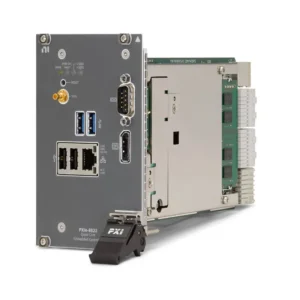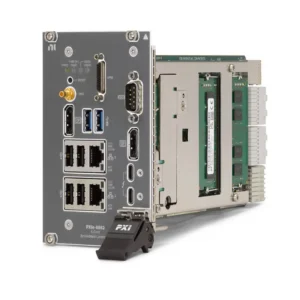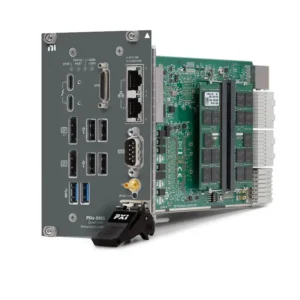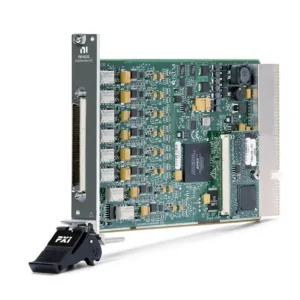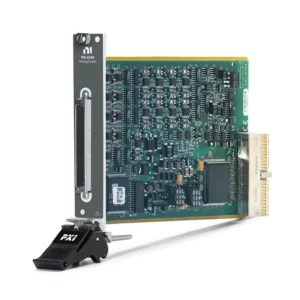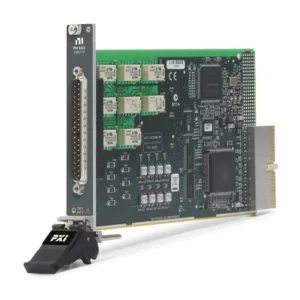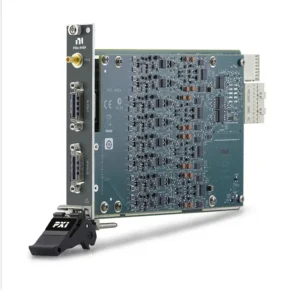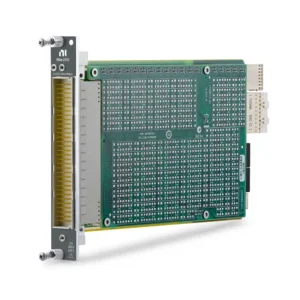





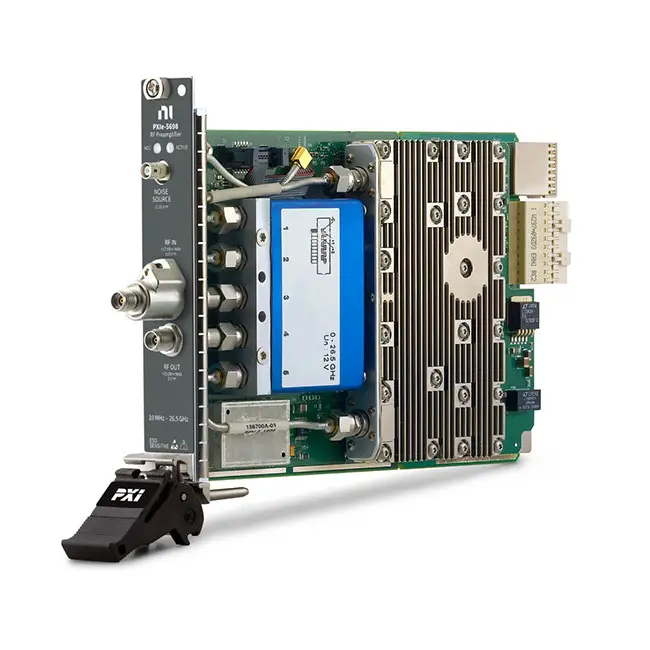
PXIe-5698 26.5 GHz PXI RF Preamplifier
The PXIe-5698 is a single-channel PXI Express RF preamplifier covering frequencies from 10 MHz to 26.5 GHz. Designed primarily to extend the sensitivity of the NI PXIe-5668 vector signal analyzer, it can also operate as a standalone RF preamplifier in compatible PXI systems.
With up to 32 dB of gain and a typical noise figure of 3.6 dB at 1 GHz, the PXIe-5698 helps engineers measure weak RF and microwave signals. An integrated mechanical relay provides a bypass path when amplification is not required, eliminating the need to reconnect external RF cables.
Key Features of the PXIe-5698
- 10 MHz to 26.5 GHz operating frequency range
- Up to 32 dB RF gain
- 3.6 dB noise figure at 1 GHz
- Single RF amplification channel
- Software-selectable preamplifier and bypass modes
- Mechanical relay bypass signal path
- –12 dBm output 1 dB compression point
- Designed for integration with the PXIe-5668 vector signal analyzer
- Can be used as a standalone RF preamplifier
- Single-slot PXI Express module
PXIe-5698 Technical Specifications
| Product Model | PXIe-5698 |
|---|---|
| Part Number | 784096-01 |
| Product Type | PXI RF Preamplifier |
| Frequency Range | 10 MHz to 26.5 GHz |
| Number of Channels | 1 |
| Maximum Gain | 32 dB |
| Noise Figure | 3.6 dB at 1 GHz |
| Output 1 dB Compression Point | –12 dBm |
| Bypass Mode | Mechanical relay bypass path |
| Bus Interface | PXI Express |
| Slot Requirements | 1 PXI Express slot |
| Primary Compatible Instrument | NI PXIe-5668 vector signal analyzer |
Frequency-Dependent Gain Performance
The gain provided by the PXIe-5698 varies across its operating frequency range. Its highest minimum gain is available through the lower RF bands, while gain gradually decreases at microwave frequencies.
| Frequency Range | Minimum Enabled Gain |
|---|---|
| 10 MHz to 200 MHz | 23 dB |
| Above 200 MHz to 2 GHz | 32 dB |
| Above 2 GHz to 3 GHz | 29 dB |
| Above 3 GHz to 3.6 GHz | 26 dB |
| Above 3.6 GHz to 6 GHz | 23 dB |
| Above 6 GHz to 9 GHz | 20 dB |
| Above 9 GHz to 14 GHz | 16 dB |
| Above 14 GHz to 20 GHz | 13 dB |
| Above 20 GHz to 24 GHz | 11 dB |
| Above 24 GHz to 26 GHz | 10 dB |
These values are minimum enabled gain specifications at 23°C ±5°C. Engineers should account for the applicable gain, bypass insertion loss and measurement uncertainty at the frequency used by their application.
Improving RF Measurement Sensitivity
When installed ahead of a compatible RF analyzer, the PXIe-5698 amplifies low-level signals before they reach the analyzer input. This can improve overall system sensitivity and help reveal signals that would otherwise be close to the analyzer noise floor.
The module is particularly useful for spectrum monitoring, low-power transmitter testing, microwave component characterization and other applications involving weak RF signals. Because the gain and noise performance change with frequency, system-level correction should be applied when accurate amplitude measurements are required.
Mechanical Relay Bypass Path
The built-in bypass path allows the RF signal to pass through the module without active amplification. A mechanical relay switches between enabled and bypass modes, allowing the same test configuration to accommodate both weak and stronger signals.
This capability reduces cable changes, simplifies automated test sequences and helps maintain a consistent RF signal path. The bypass path introduces frequency-dependent insertion loss that should be included in system calibration.
PXIe-5668 Vector Signal Analyzer Integration
The PXIe-5698 is designed to complement the PXIe-5668 vector signal analyzer. This combination supports sensitive RF spectrum and signal analysis across a frequency range extending to 26.5 GHz.
When selecting this configuration, verify the required RF cables, PXI Express chassis capacity, analyzer options and software versions. Careful system-level calibration is recommended to compensate for cable loss, preamplifier gain and bypass-path insertion loss.
Typical PXIe-5698 Applications
- Weak RF and microwave signal detection
- Spectrum monitoring and interference analysis
- Low-power transmitter measurements
- Receiver sensitivity testing
- Noise figure measurement systems
- RF component characterization
- Aerospace and defense signal analysis
- Wireless communication research
- Automated RF validation systems
- Production RF test equipment
Software and Driver Support
The PXIe-5698 can be used in NI RF measurement systems with supported NI-RFSA and RFmx software configurations. Compatible RFmx measurement personalities include spectrum analysis, demodulation, LTE analysis and supported noise figure measurement workflows.
Software support depends on the host controller, operating system, PXI chassis and associated RF analyzer. Confirm driver and application software compatibility before installing the module in an existing system.
PXI Chassis and System Integration
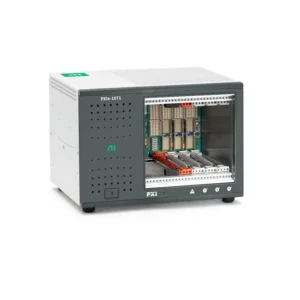
The PXIe-5698 occupies one PXI Express slot and requires a compatible PXI Express chassis. Suitable chassis options include the PXIe-1092 and other NI PXI Express chassis with adequate slot availability, cooling and controller support.
For best RF performance, use cables and adapters rated for the complete operating frequency range. Cable loss, connector condition, bend radius and connection repeatability can materially affect measurements at microwave frequencies.
Installation and Troubleshooting
Unexpectedly Low Signal Gain
Confirm that the preamplifier is enabled rather than placed in bypass mode. Check the expected gain for the applied frequency because the module does not provide the same gain across its complete 26.5 GHz range.
Inaccurate Amplitude Measurements
Include preamplifier gain, bypass insertion loss, RF cable loss and adapter loss in the measurement correction. Inspect connectors for damage or contamination and verify that all RF connections are tightened to the recommended torque.
Signal Compression or Distortion
The PXIe-5698 is intended for low-level signals and has an output 1 dB compression point of –12 dBm. Use bypass mode or external attenuation when the amplified signal could approach the module’s compression range.
Module Not Detected
Verify that the module is installed in a compatible PXI Express slot and that the required NI drivers are installed. Check the chassis, embedded controller or remote controller connection before refreshing the hardware configuration.
PXIe-5698 Product Comparison
| Product | Primary Function | Recommended Use |
|---|---|---|
| PXIe-5698 | 10 MHz to 26.5 GHz RF preamplifier | Amplifying weak RF signals before analysis |
| PXIe-5668 | Vector signal analyzer | RF spectrum and modulation measurements |
| PXIe-5699 | Programmable RF attenuator | Reducing and controlling higher-level RF signals |
| PXIe-5842 | Vector signal transceiver | Integrated RF signal generation and analysis |
Recommended Related Products
- PXIe-5668 Vector Signal Analyzer – the primary RF analyzer designed for integration with the PXIe-5698
- PXIe-5699 RF Attenuator – provides programmable attenuation for RF signal-level control
- PXIe-5842 Vector Signal Transceiver – supports wideband RF signal generation and analysis
- PXIe-5633 Vector Network Analyzer – suitable for microwave component and network measurements
- PXIe-1092 PXI Express Chassis – provides a platform for modular PXI RF test systems
Additional compatible hardware is available in our NI PXI modules category.
How to Select the PXIe-5698
Choose the PXIe-5698 when your test system must measure low-level RF signals between 10 MHz and 26.5 GHz and the analyzer alone does not provide sufficient sensitivity. Confirm that the available gain at the target frequency meets the application requirement.
Also evaluate the expected input level and resulting output level. If the amplified signal could approach compression, the bypass path or an RF attenuator may be more appropriate. System calibration is important when amplitude accuracy is a primary requirement.
Why Choose the PXIe-5698?
The PXIe-5698 combines broad microwave frequency coverage, low-noise amplification and relay-controlled bypass switching in a compact single-slot PXI Express module. It is a practical solution for improving the sensitivity of automated RF measurement systems without repeatedly changing the external signal path.
Frequently Asked Questions
What is the frequency range of the PXIe-5698?
The PXIe-5698 operates from 10 MHz to 26.5 GHz.
How much gain does the PXIe-5698 provide?
It provides up to 32 dB of gain. The available gain is frequency-dependent and decreases across the upper microwave bands.
What is the PXIe-5698 used for?
It is used to amplify weak RF and microwave signals before they enter a signal analyzer, improving system sensitivity for low-level measurements.
Can the PXIe-5698 operate in bypass mode?
Yes. An integrated mechanical relay provides a bypass path that removes active amplification without requiring the RF cables to be reconnected.
Can the PXIe-5698 be used as a standalone preamplifier?
Yes. Although it is designed primarily for the PXIe-5668 vector signal analyzer, it can also be controlled and used as a standalone PXI RF preamplifier in a compatible system.
What is the part number for the PXIe-5698?
The standard NI part number for the PXIe-5698 is 784096-01.
Request a Quote for the PXIe-5698
Contact us for current availability, lead time and project pricing for the PXIe-5698 26.5 GHz PXI RF Preamplifier. We can also help identify compatible vector signal analyzers, PXI chassis, RF cables and related modules for your test system.