



Product Introduction
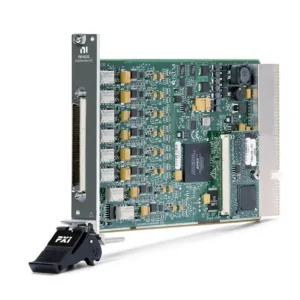
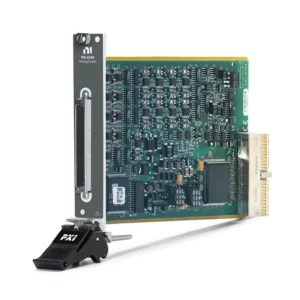
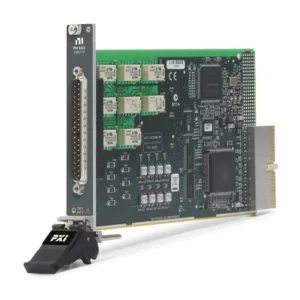
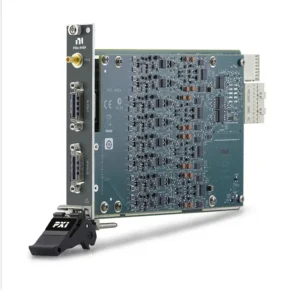
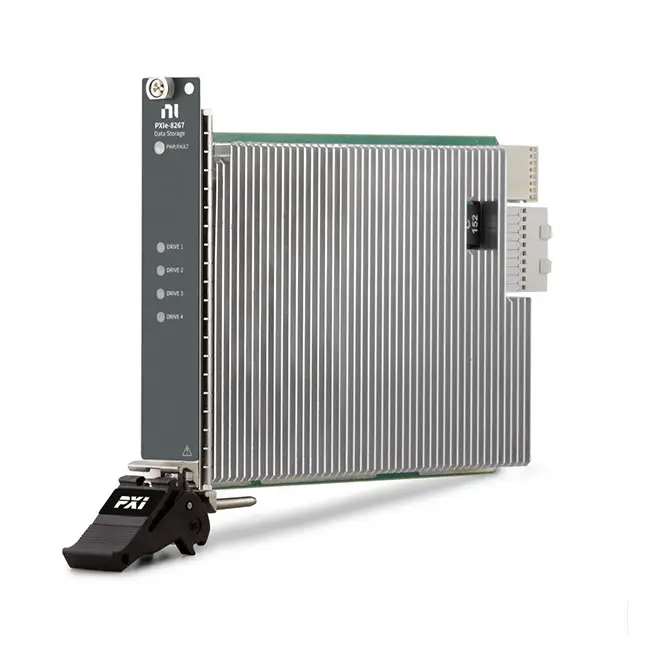
The NI PXIe-8267 is a high-speed PXI Express data storage module designed for applications requiring large-capacity, sustained data recording and playback directly within a PXI system.
The PXIe-8267 provides 4 TB of NVMe solid-state storage and supports sustained sequential read/write throughput of up to 5 GB/s. The module combines four M.2 NVMe SSDs within a compact single-slot PXI Express form factor.
With its high storage bandwidth and integrated PXI Express architecture, the PXIe-8267 is particularly suitable for RF record and playback, signal intelligence, high-speed digitizer streaming, multi-sensor acquisition, waveform recording, and other data-intensive automated test applications.
Product Overview
The National Instruments PXIe-8267 is designed to solve one of the primary challenges in high-speed PXI measurement systems: continuously storing large volumes of acquired data without allowing the storage subsystem to become the system bottleneck.
High-speed digitizers, RF instruments, FlexRIO devices, and multi-channel acquisition systems can generate extremely large data streams. Conventional system drives may not provide sufficient sustained write performance for these applications.
The PXIe-8267 provides dedicated high-throughput NVMe storage inside the PXI Express chassis, allowing measurement systems to stream large datasets to disk or retrieve previously recorded data for playback and analysis.
Key Features
4 TB Storage Capacity
The PXIe-8267 provides 4 TB of total solid-state storage capacity.
- 4 TB total storage capacity
- Solid-state storage architecture
- No mechanical hard-disk components
- Designed for high-volume measurement data
- Suitable for long-duration data recording
Advantage: Large onboard storage capacity allows substantial amounts of measurement data to be captured directly within the PXI system.
Four M.2 NVMe SSDs
The PXIe-8267 incorporates four M.2 NVMe solid-state drives.
- 4 M.2 SSD drives
- NVMe storage technology
- High-speed solid-state architecture
- Low storage access latency
- High sustained data throughput
Advantage: NVMe technology provides substantially higher data-transfer performance than traditional SATA-based storage architectures.
Up to 5 GB/s Sustained Throughput
One of the most important specifications of the PXIe-8267 is its maximum sustained sequential read/write throughput of 5 GB/s.
- Up to 5 GB/s sustained throughput
- High-speed sequential read operations
- High-speed sequential write operations
- Continuous data streaming
- Large waveform recording
- High-speed playback
Advantage: High sustained throughput makes the PXIe-8267 suitable for applications where large measurement datasets must be continuously written to or read from storage.
Stream-to-Disk Applications
The PXIe-8267 is designed for stream-to-disk applications where acquired measurement data must be continuously recorded.
- High-speed measurement recording
- RF signal recording
- Digitizer waveform capture
- Multi-sensor data logging
- Long-duration acquisition
- High-bandwidth experimental recording
Advantage: Instead of limiting acquisition duration to instrument onboard memory, stream-to-disk architectures can continuously transfer measurement data into high-capacity storage.
Stream-from-Disk Applications
The PXIe-8267 can also support applications where stored data must be read at high speed for playback or further processing.
- RF signal playback
- Recorded waveform playback
- Test-scenario replay
- Large dataset processing
- Signal reconstruction workflows
Single-Slot PXI Express Form Factor
Despite providing four NVMe drives and 4 TB of storage capacity, the PXIe-8267 occupies only one PXI Express slot.
- 1-slot module width
- PXI Express interface
- High storage density
- Compact modular architecture
- Preserves chassis slots for measurement instruments
Advantage: The single-slot design allows engineers to add high-performance storage without consuming several valuable PXI chassis slots.
High-Speed PXI Express Interface
The PXIe-8267 connects directly to the PXI Express backplane, allowing high-speed data transfer between the storage subsystem and the PXI system.
Actual system-level throughput depends on the PXI Express chassis, controller, PCI Express topology, acquisition hardware, software architecture, and other system components.
Solid-State Storage
The PXIe-8267 uses solid-state drives rather than mechanical hard disk drives.
- No rotating disks
- High data-transfer performance
- Fast access to recorded datasets
- Suitable for high-performance test systems
- Compact storage architecture
Technical Specifications
| Parameter | Description |
|---|---|
| Product Type | PXI Express High-Speed Data Storage Module |
| Model | NI PXIe-8267 |
| Part Number | 785308-01 |
| Bus Interface | PXI Express |
| Storage Capacity | 4 TB |
| Drive Type | NVMe SSD |
| Drive Form Factor | M.2 |
| Number of Drives | 4 |
| Sustained Throughput | Up to 5 GB/s |
| Read / Write | High-Speed Sequential Read and Write |
| Module Width | 1 PXI Express Slot |
| Stream-to-Disk | Supported |
| Stream-from-Disk | Supported |
| Primary Applications | RF Recording, Playback, Signal Intelligence, High-Speed DAQ and Multi-Sensor Data Acquisition |
What Is a PXI Data Storage Module?
A PXI data storage module provides dedicated high-speed storage directly within a modular PXI measurement system.
In high-performance test systems, measurement instruments can generate data faster than conventional storage devices can continuously record it. This can limit acquisition duration or require large amounts of temporary memory.
A high-speed storage module such as the PXIe-8267 provides a dedicated storage subsystem optimized for sustained data streaming.
Why Storage Throughput Matters
Storage capacity and storage throughput are different specifications.
Capacity determines how much data can be stored, while throughput determines how quickly data can be continuously written to or read from the storage system.
| Specification | PXIe-8267 | Why It Matters |
|---|---|---|
| Capacity | 4 TB | Determines total recording duration |
| Sustained Throughput | Up to 5 GB/s | Determines how quickly data can be continuously recorded or played back |
| Storage Technology | NVMe SSD | Provides high-performance solid-state data access |
| Number of Drives | 4 | Provides a multi-drive high-throughput storage architecture |
Stream-to-Disk Explained
In a stream-to-disk application, measurement data is continuously transferred from an acquisition device through the PXI Express system and written to the storage subsystem.
A simplified data path can be represented as:
Sensor / RF Signal → PXI Measurement Module → PXI Express Backplane → System Memory / Data Path → PXIe-8267 Storage
This architecture is useful when the amount of acquired data exceeds the onboard memory capacity of the measurement instrument.
RF Record and Playback
RF systems can generate extremely large datasets, particularly when recording wide-bandwidth IQ data.
The PXIe-8267 can provide high-speed storage for RF record and playback applications where sustained disk throughput is required.
- RF signal recording
- IQ data capture
- Wideband RF recording
- Signal replay
- Wireless research
- Spectrum monitoring
Signal Intelligence Applications
Signal intelligence and spectrum-monitoring systems may need to continuously capture large amounts of RF or digital data for later analysis.
- Wideband signal capture
- Long-duration RF recording
- Spectrum monitoring
- Recorded-signal analysis
- Signal characterization
The combination of 4 TB storage and high sustained throughput makes the PXIe-8267 suitable for data-intensive signal recording systems.
High-Speed Digitizer Recording
High-speed PXI digitizers can generate hundreds of megabytes or several gigabytes of data per second depending on sample rate, resolution, and channel count.
The PXIe-8267 can be incorporated into these systems to provide sustained storage for long waveform acquisitions.
- High-speed waveform capture
- Continuous digitizer recording
- Transient recording
- Long-duration acquisition
- Large waveform datasets
Multi-Sensor Data Acquisition
Large measurement systems may combine data from many sensors or acquisition modules simultaneously.
As the number of channels and sampling rates increase, aggregate system data rates can become substantial.
- Multi-channel sensor acquisition
- High-speed data logging
- Structural test data recording
- Experimental data capture
- Large-scale measurement systems
Storage Capacity and Recording Time
Approximate recording duration depends on the actual sustained data rate of the measurement system.
| Continuous Data Rate | Approximate 4 TB Recording Time |
|---|---|
| 100 MB/s | Approximately 11 Hours |
| 250 MB/s | Approximately 4.4 Hours |
| 500 MB/s | Approximately 2.2 Hours |
| 1 GB/s | Approximately 67 Minutes |
| 2 GB/s | Approximately 33 Minutes |
| 5 GB/s | Approximately 13 Minutes |
These values are simplified theoretical estimates based on nominal storage capacity. Actual usable recording time can vary according to formatted capacity, file-system overhead, metadata, application architecture, data formatting, system bandwidth, and other factors.
PXI System Bandwidth Considerations
Installing a PXIe-8267 does not automatically guarantee that every PXI system will achieve 5 GB/s end-to-end data transfer.
Overall performance depends on the complete data path, including:
- PXI Express chassis bandwidth
- Slot PCI Express connectivity
- PXI controller performance
- Measurement module bandwidth
- System memory performance
- Software architecture
- File-system configuration
- Data processing requirements
For high-throughput applications, the complete PXI system architecture should therefore be evaluated rather than considering only the storage-module specification.
PXIe-8267 and FlexRIO
The PXIe-8267 can be used in PXI systems containing high-speed FlexRIO FPGA and adapter modules for applications requiring large-volume data recording.
However, system designers should note that the PXIe-8267 does not provide direct peer-to-peer data transfer support with FlexRIO devices. Data transfer architectures can instead use mechanisms such as DMA FIFOs or onboard DRAM depending on the specific hardware and application.
The appropriate data path should be designed according to the required sustained throughput, PXI chassis topology, controller performance, FPGA architecture, and application software.
Cooling and Chassis Requirements
The PXIe-8267 is a high-performance storage module and requires appropriate PXI chassis cooling.
When selecting a chassis, verify that the selected slot provides sufficient cooling capacity for the PXIe-8267. High-performance storage devices can generate significantly more heat than conventional low-bandwidth PXI modules.
A compatible high-performance PXI Express chassis should be selected according to NI’s specified module power and cooling requirements.
Industries
- Wireless Communications
- Aerospace and Defense
- Signal Intelligence
- Radar Testing
- Electronic Warfare Research
- Automotive Testing
- High-Speed Data Acquisition
- Research Laboratories
- Automated Test Equipment
Applications
RF Signal Recording
The PXIe-8267 can store high-bandwidth RF measurement data generated by compatible PXI RF instruments.
- Wideband RF capture
- IQ recording
- Spectrum monitoring
- Wireless research
- Signal intelligence
RF Playback
Recorded datasets can be retrieved from high-speed storage for compatible signal playback and analysis workflows.
- Recorded signal replay
- RF scenario reproduction
- Repeatable laboratory testing
- Algorithm validation
High-Speed Data Acquisition
The PXIe-8267 is suitable for measurement systems where continuous acquisition produces more data than can be retained in instrument onboard memory.
- Continuous waveform acquisition
- High-speed digitizer recording
- Multi-channel data logging
- Long-duration measurements
Signal Intelligence
High sustained storage bandwidth makes the PXIe-8267 useful for systems that capture large amounts of signal data for later processing and analysis.
Research and Development
Research systems can use the PXIe-8267 to capture large datasets generated by RF, FPGA, digitizer, and sensor instrumentation.
- Wireless research
- Algorithm development
- Experimental signal recording
- Large dataset acquisition
- Offline signal analysis
PXIe-8267 vs Standard System Storage
| Feature | PXIe-8267 | Typical System Drive |
|---|---|---|
| Primary Purpose | High-Speed Measurement Data Storage | Operating System and General Storage |
| Storage Capacity | 4 TB | System Dependent |
| Drive Technology | NVMe SSD | System Dependent |
| Sustained Throughput | Up to 5 GB/s | System Dependent |
| PXI Integration | Dedicated PXI Express Module | Controller Based |
| Best Application | Stream-to-Disk / Stream-from-Disk | OS, Software and General File Storage |
Recommended Related Products
| NI PXIe-8267 | 4 TB NVMe PXI Express storage module for high-throughput stream-to-disk and stream-from-disk applications. |
| NI PXIe-1095 | High-performance PXI Express chassis suitable for building large-bandwidth measurement and data-streaming systems. |
| NI PXIe-1085 | High-bandwidth PXI Express chassis for data-intensive instrumentation and automated measurement systems. |
| NI PXIe-8880 | High-performance embedded PXI Express controller suitable for demanding measurement, processing, and data-streaming systems. |
| NI PXIe-7976 | FlexRIO FPGA module for high-performance FPGA-based acquisition, processing, and custom instrumentation applications. |
| NI PXIe-5785 | High-performance FlexRIO transceiver solution for RF and high-speed signal acquisition applications that can generate large measurement datasets. |
Why Choose NI PXIe-8267?
- 4 TB total storage capacity
- 4 M.2 NVMe SSDs
- Up to 5 GB/s sustained throughput
- High-speed sequential read and write
- Designed for stream-to-disk applications
- Designed for stream-from-disk applications
- Single-slot PXI Express form factor
- Suitable for RF record and playback
- Suitable for signal intelligence
- Supports high-speed digitizer recording workflows
- Suitable for multi-sensor data acquisition
- Designed for data-intensive PXI systems
- Solid-state storage architecture
- High storage density
- Ideal for large measurement datasets
Frequently Asked Questions
What is the NI PXIe-8267?
The NI PXIe-8267 is a high-speed PXI Express data storage module that provides 4 TB of NVMe SSD storage and sustained sequential read/write throughput up to 5 GB/s.
What is the part number of the PXIe-8267?
The NI PXIe-8267 part number is 785308-01.
How much storage does the PXIe-8267 provide?
The PXIe-8267 provides 4 TB of total storage capacity.
What type of drives does the PXIe-8267 use?
The PXIe-8267 uses M.2 NVMe solid-state drives and contains four drives.
What is the maximum sustained throughput of the PXIe-8267?
NI specifies maximum sustained sequential read/write throughput of up to 5 GB/s for the PXIe-8267.
How many PXI slots does the PXIe-8267 require?
The PXIe-8267 occupies one PXI Express slot.
What is stream-to-disk?
Stream-to-disk refers to continuously transferring acquired measurement data from an instrument or acquisition system to storage rather than retaining the complete dataset in instrument onboard memory.
Can the PXIe-8267 be used for RF recording?
Yes. RF record and playback is one of the primary application areas for the PXIe-8267, particularly when large quantities of wideband measurement data must be stored continuously.
Can the PXIe-8267 be used with FlexRIO?
Yes, the PXIe-8267 can be incorporated into systems containing FlexRIO hardware. However, the PXIe-8267 does not support direct peer-to-peer data transfer with FlexRIO devices. System architecture should account for the required intermediate data-transfer path.
Does installing a PXIe-8267 guarantee 5 GB/s recording?
No. The 5 GB/s specification represents the storage module’s maximum sustained sequential throughput. Actual end-to-end recording performance depends on the PXI chassis, controller, PCI Express topology, acquisition hardware, software architecture, data processing, and file-system configuration.
Does the PXIe-8267 require a specific PXI chassis?
The PXIe-8267 requires a compatible PXI Express chassis with sufficient slot bandwidth, power, and cooling. For high-throughput applications, chassis bandwidth and slot topology should also be evaluated carefully.
Does the PXIe-8267 require additional cooling?
The PXIe-8267 is a high-performance storage module and requires a PXI chassis providing sufficient slot cooling capacity. Verify the chassis cooling specification before system integration.
What applications are suitable for the PXIe-8267?
Typical applications include RF record and playback, signal intelligence, wideband signal recording, spectrum monitoring, high-speed digitizer streaming, multi-sensor data acquisition, long-duration waveform recording, and research systems generating large datasets.
What should I check before purchasing a PXIe-8267?
Before purchasing a PXIe-8267, verify the part number, required 4 TB capacity, sustained data-rate requirements, PXI Express chassis compatibility, chassis slot bandwidth, controller performance, cooling capacity, acquisition hardware bandwidth, and the complete system data-transfer architecture.
Conclusion
The NI PXIe-8267 High-Speed Data Storage Module combines 4 TB of NVMe SSD capacity, four M.2 solid-state drives, up to 5 GB/s sustained sequential read/write throughput, and a compact single-slot PXI Express architecture. It is designed for demanding stream-to-disk and stream-from-disk applications including RF recording and playback, signal intelligence, high-speed digitizer acquisition, multi-sensor data logging, and large-scale measurement data capture.