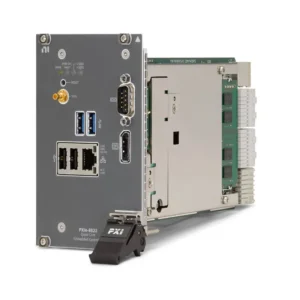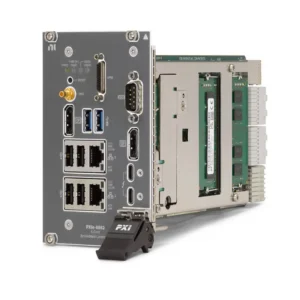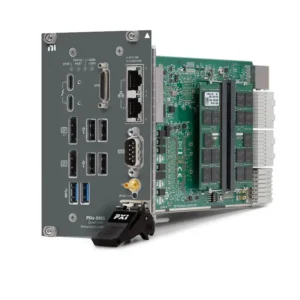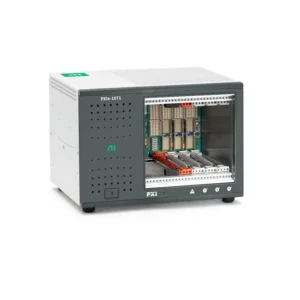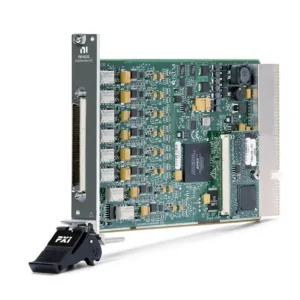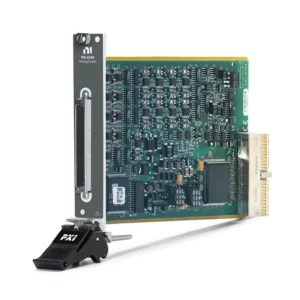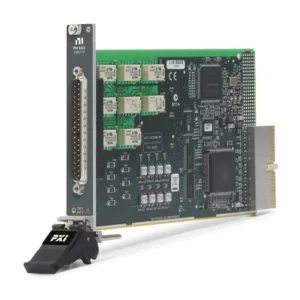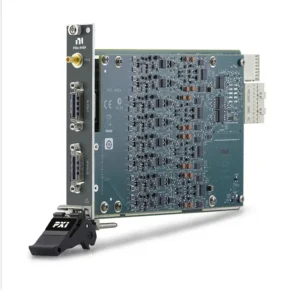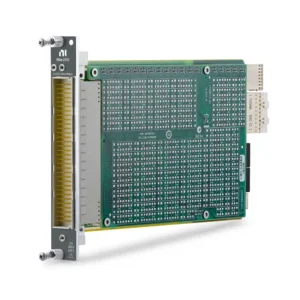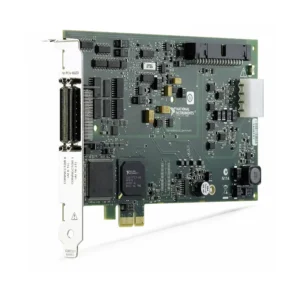




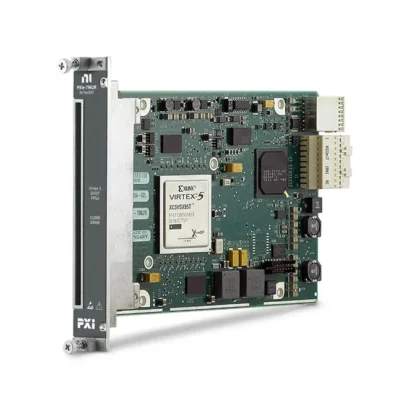
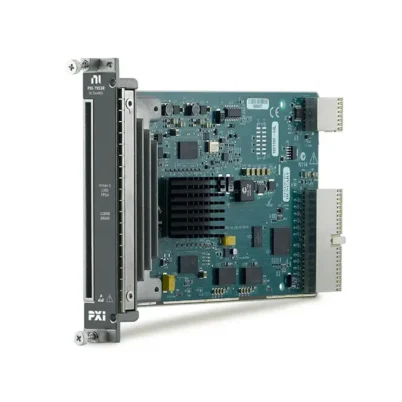
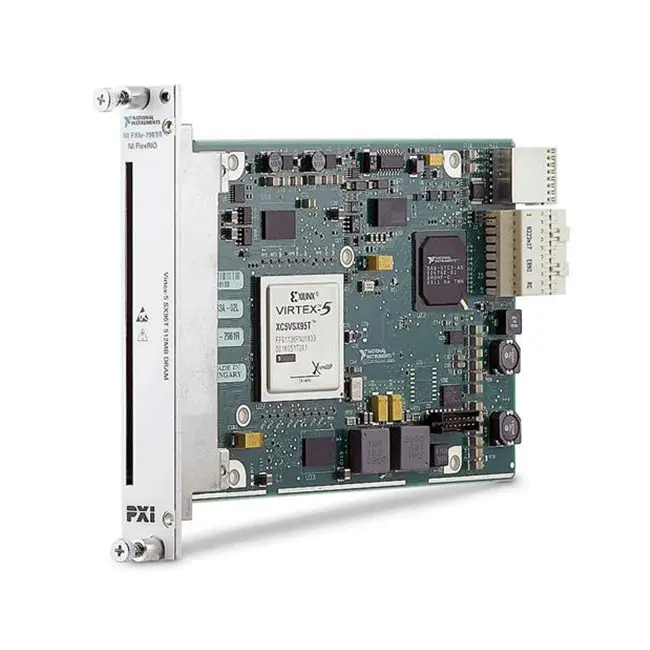
PXIe-7961R Virtex-5 SX50T FlexRIO FPGA Module
The PXIe-7961R, also listed as the PXIe-7961, is a PXI Express FlexRIO FPGA module designed for custom high-speed data acquisition, real-time signal processing, digital protocol implementation and hardware-in-the-loop testing. It features a user-programmable Xilinx Virtex-5 SX50T FPGA and a high-speed interface for compatible FlexRIO adapter modules.
Unlike the PXIe-7962R, the PXIe-7961R does not include external onboard DRAM. It relies on FPGA block RAM, DMA transfer and the connected PXI Express system for data movement and storage. This makes it most suitable for streaming, deterministic processing and applications that do not require large FPGA-side waveform buffers.
Key Features of the PXIe-7961R
- Xilinx Virtex-5 SX50T user-programmable FPGA
- 8,160 FPGA slices
- 32,640 lookup tables and flip-flops
- 288 DSP48 arithmetic slices
- 4,752 kbits of embedded block RAM
- No external onboard DRAM
- 132 single-ended I/O lines or 66 differential pairs
- Up to 1 Gb/s per line in supported LVDS configurations
- Up to 400 Mb/s in supported single-ended configurations
- PCI Express Gen 1 ×4 backplane interface
- More than 800 MB/s streaming into or out of the module
- More than 1.4 GB/s aggregate bidirectional streaming
- Up to 16 DMA channels
- Peer-to-peer data streaming support
- PXIe_CLK100 reference-clock support
- Programmable with the LabVIEW FPGA Module
PXIe-7961R Technical Specifications
| Product Model | PXIe-7961R / PXIe-7961 |
|---|---|
| Part Number | 781205-01 |
| Product Type | PXI Express FlexRIO FPGA module |
| FPGA | Xilinx Virtex-5 SX50T |
| FPGA Slices | 8,160 |
| Lookup Tables and Flip-Flops | 32,640 |
| DSP48 Slices | 288 |
| DSP Multiplier Size | 25 × 18 bits |
| Embedded Block RAM | 4,752 kbits |
| Onboard DRAM | None |
| Adapter Interface | 132 single-ended lines or 66 differential pairs |
| Maximum LVDS Data Rate | Up to 1 Gb/s per line in supported configurations |
| Maximum Single-Ended Data Rate | Up to 400 Mb/s in supported configurations |
| PXI Backplane Interface | PCI Express Gen 1 ×4 |
| Default FPGA Timebase | 40 MHz |
| Reference Clock | PXI Express 100 MHz reference clock, PXIe_CLK100 |
| Timebase Accuracy | ±50 ppm |
| Timebase Jitter | 250 ps peak-to-peak |
| Module Streaming Rate | More than 800 MB/s into or out of the module |
| Simultaneous Bidirectional Streaming | More than 700 MB/s per direction |
| Aggregate Bidirectional Rate | More than 1.4 GB/s |
| Maximum DMA Channels | 16 |
| Peer-to-Peer Streaming | Supported |
| Maximum +3.3 V Power Requirement | 3 A |
| Maximum +12 V Power Requirement | 2 A |
| Programming Environment | LabVIEW FPGA Module |
| Device Driver | NI FlexRIO |
| Dimensions | Approximately 16.1 cm × 10.8 cm |
| Module Format | 3U PXI Express module |
| Product Status | Discontinued |
| Recommended Migration Model | PXIe-7976R |
PXIe-7961R Part Number and Identification
| Identifier Type | Number | Description |
|---|---|---|
| Orderable Part Number | 781205-01 | PXIe-7961R FlexRIO FPGA module with Virtex-5 SX50T |
| Assembly Number | 198733-03L | PXIe-7961R circuit-card assembly with 66 LVDS pairs and SX50T FPGA |
Use 781205-01 when requesting a quotation for the complete PXIe-7961R module. The 198733-03L number identifies the internal circuit-card assembly and is not normally used as the commercial ordering number.
FlexRIO Modular Architecture
The PXIe-7961R is an FPGA carrier within the first-generation FlexRIO modular-I/O platform. It provides FPGA processing, PXI Express communication, timing resources and a high-density adapter interface.
A compatible FlexRIO adapter module supplies the application-specific analog, digital, RF or camera I/O. This separation allows engineers to combine the same FPGA carrier with different signal interfaces.
Adapter Module Required for External I/O
The PXIe-7961R does not provide fixed front-panel measurement channels by itself. It must be combined with a compatible adapter module before it can acquire or generate external signals.
The adapter determines channel count, sample rate, resolution, voltage range, logic standard and front-panel connector type. Both the FPGA carrier and adapter part numbers should be specified when ordering a complete system.
Virtex-5 SX50T FPGA
The module uses a Xilinx Virtex-5 SX50T FPGA optimized for digital signal-processing applications. FPGA code executes directly in hardware, providing deterministic timing and parallel operation.
The same FPGA type is used in the PXIe-7962R. The primary difference between these two modules is the presence of 512 MB external DRAM on the PXIe-7962R.
8,160 FPGA Slices
The Virtex-5 SX50T provides 8,160 slices for implementing state machines, custom protocols, timing engines, control logic and parallel data paths.
NI documentation also describes the target as providing 32,640 lookup tables and flip-flops. Actual availability depends on FPGA-code architecture, clock domains, data types and compilation optimization.
288 DSP48 Slices
The PXIe-7961R includes 288 DSP48 slices for implementing hardware-accelerated arithmetic. These resources can perform multiplication, filtering, digital mixing and other signal-processing operations.
Parallel FPGA processing allows multiple operations to run at the same time, supporting continuous data streams and deterministic latency.
4,752 kbits of Block RAM
The FPGA provides 4,752 kbits of embedded block RAM. This low-latency memory can implement FIFOs, lookup tables, delay lines, packet buffers and intermediate algorithm storage.
Because the PXIe-7961R has no external DRAM, block RAM is its primary FPGA-side storage resource. Applications requiring large data buffers may need continuous DMA streaming or a different FlexRIO module.
No Onboard DRAM
The PXIe-7961R does not contain the 512 MB external DRAM available on the PXIe-7962R, PXIe-7965R and PXIe-7966R. This distinction is important when choosing a replacement module.
The PXIe-7961R is appropriate for processing pipelines that operate continuously and transfer results through DMA or peer-to-peer streaming. It is less suitable for applications that must retain large waveforms locally on the FPGA carrier.
66 Differential Adapter Pairs
The adapter interface provides 66 differential general-purpose I/O pairs. These lines can also be configured as 132 single-ended signals or as a combination of differential and single-ended connections.
The interface is located between the FPGA carrier and FlexRIO adapter. It should not be interpreted as 132 directly accessible front-panel channels without an appropriate adapter.
High-Speed LVDS Operation
The FlexRIO adapter interface supports data rates up to 1 Gb/s per line in compatible LVDS configurations. Single-ended configurations can support rates up to 400 Mb/s under applicable conditions.
Actual I/O rate depends on the adapter module, FPGA implementation, signal direction, electrical standard and timing constraints.
Compatible FlexRIO Adapter Modules
The PXIe-7961R can be used with compatible first-generation FlexRIO adapter modules for high-speed analog input, analog output, digital I/O, RF conversion and camera interfacing.
Compatibility should be verified from the adapter documentation and supported NI FlexRIO software. Newer integrated-I/O modules and some Kintex-7 FlexRIO products use different hardware architectures.
PCI Express Gen 1 ×4 Interface
The module communicates with the PXI Express chassis through a PCI Express Gen 1 ×4 backplane connection. This provides high-speed transfer between the FPGA and PXI controller.
Actual throughput depends on the chassis topology, controller, selected slot, DMA configuration and efficiency of the FPGA and host applications.
High-Speed DMA Streaming
The PXIe-7961R can stream data at more than 800 MB/s into or out of the module in a supported PXI Express system. Since it does not include external DRAM, efficient DMA streaming is especially important for high-rate acquisition applications.
When transferring in both directions simultaneously, supported configurations can exceed 700 MB/s per direction and achieve more than 1.4 GB/s aggregate throughput.
Up to 16 DMA Channels
The module supports as many as 16 DMA channels. Separate channels can carry acquisition data, processed results, generated waveforms and control information.
Multiple channels share the available PCI Express bandwidth. Adding more streams does not increase the maximum physical throughput of the module.
Peer-to-Peer Streaming
NI peer-to-peer technology allows the PXIe-7961R to exchange data directly with compatible PXI Express instruments without routing every transfer through the controller CPU and host memory.
A digitizer can stream data directly to the FPGA for processing, or the PXIe-7961R can send processed data to another FPGA module or compatible signal generator.
Benefits of Peer-to-Peer Transfer
Direct module-to-module streaming can reduce controller workload and system latency. It is useful for closed-loop testing, real-time event detection and applications where host-based processing cannot meet timing requirements.
The instruments, chassis topology, slot selection and software configuration must all support the requested peer-to-peer route.
PXI Express Timing and Synchronization
The PXIe-7961R uses the PXIe_CLK100 reference clock and provides a default FPGA timebase of 40 MHz. The published timebase accuracy is ±50 ppm with 250 ps peak-to-peak jitter.
FPGA-derived clocks and PXI trigger resources can coordinate acquisition, generation and processing with other instruments in the chassis.
Deterministic FPGA Processing
FPGA algorithms execute with clock-cycle timing and are not dependent on nondeterministic operating-system scheduling. This enables precise triggering, protocol timing and low-latency control.
Acquisition, filtering, event detection and data transfer can operate concurrently using separate parallel logic paths.
LabVIEW FPGA Programming
The PXIe-7961R is programmed using the LabVIEW FPGA Module and compatible NI FlexRIO software. Developers create FPGA logic, compile it for the Virtex-5 SX50T target and download the generated bitfile to the module.
Recompiling an older project may require a legacy LabVIEW FPGA release and the corresponding Xilinx toolchain. Verify software compatibility before changing a validated deployment.
Using Existing FPGA Bitfiles
A previously compiled bitfile may continue to operate when the FPGA carrier, adapter, driver and host application remain unchanged and compatible.
A bitfile compiled for the PXIe-7962R, PXIe-7965R, PXIe-7966R or a Kintex-7 module should not be assumed to run on the PXIe-7961R. FPGA bitfiles are created for a specific target.
Typical PXIe-7961R Applications
- High-speed streaming acquisition
- Inline digital signal processing
- Custom digital protocol implementation
- High-speed digital I/O
- Real-time event detection
- Software-defined radio processing
- Communications-system testing
- Machine vision and camera interfacing
- Hardware-in-the-loop testing
- Peer-to-peer instrument processing
- Research instrumentation
- Laboratory automation
Streaming Data Acquisition
When combined with a compatible digitizer adapter, the PXIe-7961R can process incoming samples and continuously transfer selected data to the PXI controller.
FPGA filtering, decimation and event detection can reduce the amount of data sent to the host. This is particularly helpful because the module does not provide external DRAM for large local waveform storage.
Real-Time Signal Processing
The FPGA’s 288 DSP48 slices support filters, mixers, multipliers and other mathematical processing. Algorithms operate directly in hardware with deterministic timing.
Applications include digital downconversion, pulse detection, channel filtering and custom modulation processing.
Custom Protocol Interfaces
A compatible digital adapter allows the PXIe-7961R to implement proprietary and nonstandard communication interfaces. FPGA logic can control exact edge timing, framing and response behavior.
This is useful for testing devices that cannot be controlled with a conventional digital pattern instrument.
Hardware-in-the-Loop Testing
The PXIe-7961R can implement deterministic models, trigger logic and protocol functions within a hardware-in-the-loop system. Peer-to-peer streaming can connect it directly to other compatible instruments.
System latency depends on the FPGA program, adapter, communication path and chassis configuration.
Machine Vision Applications
With an appropriate camera adapter, the PXIe-7961R can process image data directly in the FPGA. Pixel-level processing can reduce the data volume before transfer to the controller.
The selected camera standard, adapter data rate and FPGA resource requirements should be verified during system design.
PXIe-7961R Troubleshooting
The PXIe-7961R Is Not Detected in NI MAX
Confirm that the module is fully installed in a compatible PXI Express slot. Check chassis power, controller communication and NI FlexRIO installation, then rescan the system in NI Measurement & Automation Explorer.
The Adapter Module Is Not Recognized
Verify that the adapter is compatible with the PXIe-7961R and correctly seated. Check the adapter documentation and supported FlexRIO driver version.
The FPGA Bitfile Will Not Download
Confirm that the bitfile was compiled for the PXIe-7961R and installed adapter. A bitfile created for another FPGA target cannot normally be loaded.
The FPGA Project Does Not Compile
Check the LabVIEW, LabVIEW FPGA, NI FlexRIO and Xilinx compilation-tool versions. Virtex-5 FPGA targets may require a legacy development environment.
The Application Reports Missing DRAM
The PXIe-7961R does not include external onboard DRAM. A project using DRAM resources must be redesigned for block RAM and streaming or migrated to a module with DRAM.
DMA Data Is Lost During Acquisition
Review host buffer size, DMA FIFO depth, controller performance and consumer-loop timing. The host application must read data quickly enough to prevent FIFO overflow.
DMA Throughput Is Lower Than Expected
Check the PXI Express slot, chassis topology, DMA configuration, packet size and FPGA loop timing. Avoid frequent small transfers that increase software overhead.
Peer-to-Peer Streaming Does Not Start
Confirm that both modules support peer-to-peer streaming and that the chassis provides a valid route. Verify endpoint configuration, FIFO data type and writer-to-reader compatibility.
The FPGA Design Exceeds Available Resources
Review lookup-table, flip-flop, DSP and block-RAM use in the compilation report. Reduce parallel processing, reuse arithmetic resources or select a larger FPGA module.
The Module Becomes Unstable During Continuous Operation
Verify chassis airflow, fan settings and adjacent-module cooling. Sustained FPGA processing and high-speed adapter operation can increase thermal load.
PXIe-7961R Comparison with Similar FlexRIO FPGA Modules
| Model | FPGA and Memory | Best Suited For |
|---|---|---|
| PXIe-7961R | Virtex-5 SX50T, no external DRAM | Streaming and deterministic processing without large FPGA-side buffers |
| PXIe-7962R | Virtex-5 SX50T, 512 MB DRAM | SX50T applications requiring large acquisition or generation buffers |
| PXIe-7965R | Virtex-5 SX95T, 512 MB DRAM | More complex signal-processing algorithms |
| PXIe-7966R | Virtex-5 SX95T-2, 512 MB DRAM | Highest-performance applications in the PXIe-796x family |
| PXIe-7976R | Kintex-7 K410T, 2 GB DRAM | Newer applications requiring more FPGA resources and memory |
PXIe-7961R vs PXIe-7962R
The PXIe-7961R and PXIe-7962R use the same Virtex-5 SX50T FPGA and provide identical DSP and block-RAM resources. The primary difference is onboard DRAM.
The PXIe-7961R has no external DRAM, while the PXIe-7962R provides two 256 MB banks for a total of 512 MB. Choose the PXIe-7962R when large FPGA-side buffers are required.
PXIe-7961R vs PXIe-7965R
The PXIe-7965R uses a larger Virtex-5 SX95T FPGA with 14,720 slices, 640 DSP48 slices and 512 MB of DRAM.
Select the PXIe-7965R for more complex algorithms and buffered data processing. Choose the PXIe-7961R for validated SX50T streaming applications that do not require external DRAM.
PXIe-7961R vs PXIe-7966R
The PXIe-7966R provides a larger SX95T-2 FPGA and 512 MB of onboard DRAM. It offers more than twice the DSP resources of the PXIe-7961R.
The PXIe-7966R is better suited to demanding processing algorithms, while the PXIe-7961R provides a smaller SX50T target for continuous streaming applications.
PXIe-7961R vs PXIe-7976R
The PXIe-7976R uses a newer Kintex-7 K410T FPGA, includes 2 GB of DRAM and provides significantly greater processing and transfer performance.
NI identified the PXIe-7976R as the migration option for the discontinued PXIe-7961R. Migration generally requires FPGA-code modification, recompilation and adapter compatibility verification.
Recommended Related Products
- PXIe-7962R Virtex-5 SX50T FlexRIO FPGA Module
- PXIe-7965R Virtex-5 SX95T FlexRIO FPGA Module
- PXIe-7966R Virtex-5 SX95T-2 FlexRIO FPGA Module
- PXIe-7972R Kintex-7 FlexRIO FPGA Module
- PXIe-7976R Kintex-7 K410T FlexRIO FPGA Module
- NI-6585 200 MHz LVDS FlexRIO Adapter Module
- View More NI PXI and PXI Express Modules
Selecting the Right FlexRIO FPGA Module
Choose the PXIe-7961R when maintaining an existing Virtex-5 SX50T application that continuously processes or streams data and does not require external DRAM.
Select the PXIe-7962R when the same FPGA architecture requires large waveform buffers. For new designs, consider the PXIe-7976R or a current FlexRIO integrated-I/O product, subject to adapter and software requirements.
Purchasing a Discontinued PXIe-7961R
NI discontinued the PXIe-7961R, with the final purchase period ending in 2024. Available inventory may consist of unused surplus, previously installed or refurbished modules.
Before ordering, verify the 781205-01 part number, serial number, adapter compatibility and software requirements. A used module should be tested for PXI enumeration, FPGA bitfile download, DMA transfer, peer-to-peer communication and operation with the intended adapter.
Why Choose the PXIe-7961R?
- Maintains compatibility with legacy Virtex-5 SX50T projects
- Provides deterministic FPGA-based timing and processing
- Includes 288 DSP48 arithmetic resources
- Supports modular analog, digital and camera adapters
- Provides up to 66 differential adapter-interface pairs
- Streams more than 800 MB/s in supported systems
- Supports as many as 16 DMA channels
- Provides peer-to-peer instrument communication
- Integrates with LabVIEW FPGA and PXI Express systems
Frequently Asked Questions
What Is the PXIe-7961R?
The PXIe-7961R is a PXI Express FlexRIO FPGA carrier module with a user-programmable Xilinx Virtex-5 SX50T FPGA.
Are PXIe-7961 and PXIe-7961R the Same Product?
Yes. Some product listings omit the R, but both names refer to the same reconfigurable FlexRIO FPGA module.
What Is the PXIe-7961R Part Number?
The standard commercial part number is 781205-01.
Which FPGA Does the PXIe-7961R Use?
It uses a Xilinx Virtex-5 SX50T FPGA with 8,160 slices, 288 DSP48 slices and 4,752 kbits of block RAM.
Does the PXIe-7961R Have Onboard DRAM?
No. The PXIe-7961R does not provide external onboard DRAM. Its FPGA-side memory consists primarily of embedded block RAM.
What Is the Difference Between PXIe-7961R and PXIe-7962R?
Both use the same SX50T FPGA, but the PXIe-7962R adds 512 MB of onboard DRAM.
Does the Module Include Analog Inputs?
No. Analog, digital or camera I/O is supplied by a compatible FlexRIO adapter module.
How Many Adapter Interface Lines Are Available?
The module provides 132 single-ended signals that can also operate as 66 differential pairs.
Does It Support Peer-to-Peer Streaming?
Yes. The PXIe-7961R supports direct data exchange with compatible PXI Express instruments in a supported chassis configuration.
What Is the Maximum Streaming Rate?
The module can exceed 800 MB/s in one direction. Simultaneous bidirectional operation can exceed 700 MB/s per direction.
Which Software Is Required?
Development normally requires compatible NI FlexRIO, LabVIEW and LabVIEW FPGA software, together with the appropriate Xilinx compilation tools.
Can PXIe-7961R Bitfiles Run on the PXIe-7962R?
No direct compatibility should be assumed even though the modules use the same FPGA type. The project and bitfile should be built and validated for the exact target and adapter configuration.
What Replaced the PXIe-7961R?
NI identified the PXIe-7976R as the migration model, although FPGA code, adapter compatibility and software requirements must be evaluated.
Is the PXIe-7961R Still Manufactured?
No. The PXIe-7961R is discontinued and availability is generally limited to surplus or previously installed equipment.
Request a Quote for the PXIe-7961R
Contact us for current availability, condition and project pricing for the PXIe-7961R Virtex-5 SX50T FlexRIO FPGA Module. We can also help verify the 781205-01 part number, compatible adapter module, software requirements and PXIe-7976R migration options for your system.