



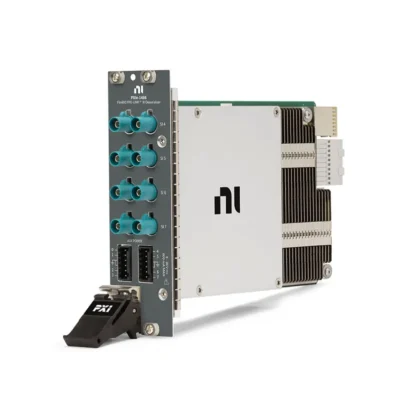
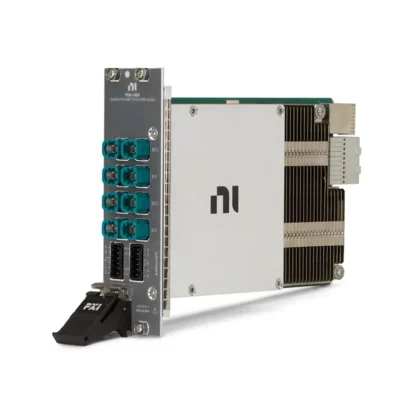
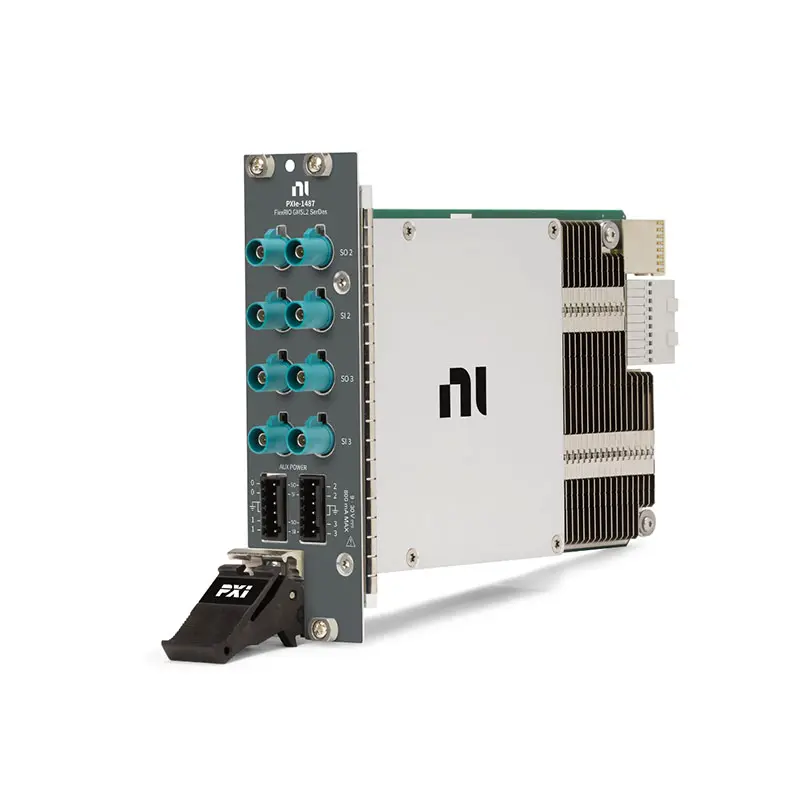
Product Introduction
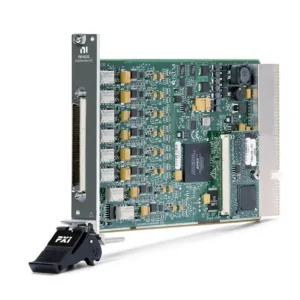
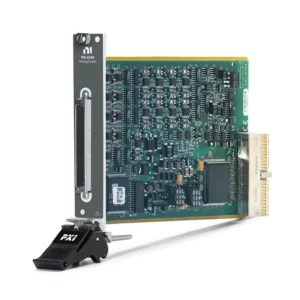
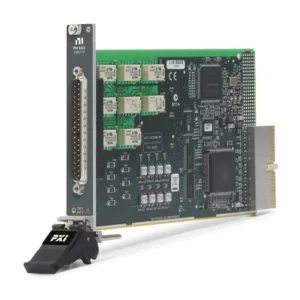
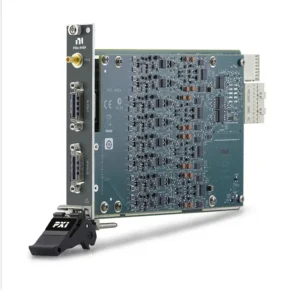
The NI PXIe-1487 is a PXI FlexRIO GMSL interface module designed for high-throughput automotive vision, Advanced Driver Assistance Systems (ADAS), autonomous driving (AD), camera sensor testing, ECU validation, in-vehicle data logging, video playback, and hardware-in-the-loop (HIL) applications.
The PXIe-1487 combines a GMSL2 high-speed serial interface with a user-programmable Xilinx FPGA, providing engineers with a flexible platform for interfacing modern automotive camera sensors and electronic control units with PXI-based test systems.
Depending on the selected hardware configuration, the PXIe-1487 is available with 8 input channels, 8 output channels, or 4 input and 4 output channels. This enables the module to support camera data acquisition, sensor simulation, ECU video injection, data logging, and playback applications.
Product Overview
The National Instruments PXIe-1487 is a specialized FlexRIO automotive camera interface designed around the Gigabit Multimedia Serial Link (GMSL) technology used in high-bandwidth automotive imaging systems.
Modern ADAS and autonomous-driving systems rely on multiple high-resolution cameras to provide environmental information to vehicle ECUs and domain controllers. Testing these systems requires specialized hardware capable of receiving, transmitting, processing, recording, and replaying automotive camera data.
The PXIe-1487 provides this interface within the modular PXI Express platform while also providing FPGA-based processing and synchronization capabilities for advanced automotive test systems.
Key Features
GMSL2 Interface
The PXIe-1487 supports GMSL2 serial-link technology for interfacing compatible automotive cameras and electronic control units.
- GMSL2 serial interface
- Automotive camera connectivity
- High-bandwidth image data transfer
- Camera sensor acquisition
- ECU video injection
- ADAS and autonomous-driving validation
Advantage: The GMSL2 interface allows the PXIe-1487 to connect directly with compatible automotive imaging devices used in modern ADAS and autonomous-driving architectures.
Multiple I/O Configurations
The PXIe-1487 is available in several channel configurations to support different automotive camera test architectures.
| Configuration | Typical Application |
|---|---|
| 8 Input | Camera Acquisition and In-Vehicle Data Logging |
| 8 Output | Camera Simulation, Playback and ECU Testing |
| 4 Input / 4 Output | Bidirectional Camera and ECU Test Systems |
The appropriate configuration should be selected according to whether the application requires receiving camera data, generating simulated camera data, or performing both functions.
8-Channel Input Configuration
An 8-input PXIe-1487 configuration can receive GMSL2 data from up to eight compatible input channels.
This configuration is particularly suitable for:
- In-vehicle camera data logging
- Camera sensor testing
- Multi-camera acquisition
- ADAS sensor recording
- Vision system development
- Automotive research
8-Channel Output Configuration
An 8-output configuration is designed for applications where the PXI system must transmit or replay camera data toward an ECU or other compatible device.
Typical applications include:
- Camera sensor simulation
- Recorded video playback
- ECU video injection
- ADAS controller validation
- Hardware-in-the-loop testing
- Automated regression testing
4 Input / 4 Output Configuration
The 4-input/4-output PXIe-1487 configuration combines receive and transmit functionality within the same module.
This configuration is useful for systems requiring bidirectional GMSL2 communication or a combination of camera acquisition and playback functionality.
User-Programmable Xilinx FPGA
A major advantage of the PXIe-1487 is its user-programmable FPGA.
The module incorporates a Xilinx FPGA that enables engineers to implement application-specific processing and interface logic directly in hardware.
- Real-time image processing
- Custom data manipulation
- Protocol-specific processing
- Low-latency signal processing
- Custom triggering
- Hardware-level synchronization
- Application-specific FPGA algorithms
This FPGA-based architecture makes the PXIe-1487 significantly more flexible than a conventional fixed-function automotive camera interface.
Xilinx Kintex UltraScale+ FPGA
The PXIe-1487 architecture uses a Xilinx Kintex UltraScale+ KU11P FPGA for high-performance real-time processing.
The FPGA provides the processing resources required for high-throughput automotive vision applications and allows engineers to customize the behavior of the module for specialized test requirements.
4 GB DRAM
The PXIe-1487 includes 4 GB of DRAM for high-throughput data processing and buffering applications.
Local memory is particularly valuable when working with high-bandwidth image streams where large amounts of data must be buffered or processed in real time.
PCI Express Gen 3 x8 Host Interface
The PXIe-1487 uses a PCI Express Gen 3 x8 interface to transfer high-bandwidth data between the FlexRIO module and the PXI host system.
- PCI Express Gen 3
- x8 host interface
- High-throughput image streaming
- PXI backplane data transfer
- Multi-camera data acquisition
The high-throughput host interface is particularly important when multiple high-resolution camera streams must be transferred to storage or processing hardware.
Power over Coax Support
The PXIe-1487 supports Power over Coax (PoC), allowing compatible automotive cameras to receive power through the same coaxial connection used for communication.
This simplifies automotive camera test configurations and more closely represents the electrical architecture used in production vehicles.
- Power over Coax support
- Camera power control
- Automotive camera simulation
- Integrated camera connectivity
- Automated power control
External Power Support
For applications requiring additional camera power capability, the PXIe-1487 also supports externally supplied Power over Coax configurations.
This provides additional flexibility when testing cameras with different voltage and current requirements.
I²C Back-Channel Communication
The PXIe-1487 provides access to I²C back-channel communication through the GMSL interface.
I²C communication is commonly used for configuration and control of automotive cameras, serializers, deserializers, and associated devices.
This capability allows test applications to:
- Configure camera sensors
- Access device registers
- Control serializers and deserializers
- Read device status
- Automate camera initialization
GPIO Back-Channel Communication
The PXIe-1487 also supports general-purpose input/output communication through the GMSL back channel.
GPIO capability can be used for device control, synchronization, status monitoring, and application-specific camera or ECU functions.
LabVIEW FPGA Support
The PXIe-1487 is supported by the NI FlexRIO software environment and provides LabVIEW FPGA examples for developing customized automotive camera test applications.
LabVIEW FPGA allows engineers to develop application-specific FPGA functionality without designing dedicated custom hardware.
Technical Specifications
| Parameter | Description |
|---|---|
| Product Type | PXI FlexRIO GMSL Interface Module |
| Model | NI PXIe-1487 |
| Platform | PXI Express / FlexRIO |
| Serial Interface | GMSL2 |
| Available Channel Configurations | 8 Input, 8 Output, or 4 Input / 4 Output |
| Maximum Channel Count | 8 |
| FPGA | Xilinx Kintex UltraScale+ KU11P |
| User-Programmable FPGA | Yes |
| DRAM | 4 GB |
| Host Interface | PCI Express Gen 3 x8 |
| Power over Coax | Supported |
| I²C Back-Channel Communication | Supported |
| GPIO Back-Channel Communication | Supported |
| Pixel Mode | Supported, Configuration Dependent |
| Tunneling Mode | Supported on Applicable Configurations |
| Software | NI FlexRIO / LabVIEW FPGA |
| Primary Applications | ADAS, Autonomous Driving, Camera Testing, ECU Testing, Data Logging, Playback and HIL |
PXIe-1487 Part Numbers and Configurations
The PXIe-1487 is available in multiple hardware configurations. The exact part number should therefore be verified before ordering because channel direction, serializer, deserializer, and operating mode vary by configuration.
| Part Number | I/O Configuration | Serializer / Deserializer |
|---|---|---|
| 787457-01 | 4 Input / 4 Output | MAX9295A / MAX9296A |
| 787456-01 | 8 Input | MAX9296A Deserializer |
| 787458-01 | 8 Output | MAX9295A Serializer |
| 788714-01 | 4 Input / 4 Output | MAX96717 / MAX96716A |
| 788715-01 | 8 Output | MAX96717 Serializer |
| 788716-01 | 8 Input | MAX96716A Deserializer |
| 788719-01 | 8 Output | MAX96717F Serializer |
| 788781-01 | 4 Input / 4 Output | MAX96717F / MAX96716A |
What Is GMSL2?
GMSL2 is a high-speed serial communication technology commonly used to transfer video, control, and related data between automotive cameras, displays, ECUs, and other vehicle electronic systems.
Automotive camera systems typically require high data throughput while operating over practical vehicle cable lengths and supporting control communication between cameras and processing units.
GMSL2 provides a suitable architecture for these applications and is widely used in modern ADAS and autonomous-driving camera systems.
What Is FlexRIO?
NI FlexRIO is a hardware platform that combines high-performance I/O with user-programmable FPGA processing.
Instead of providing only fixed instrument functionality, FlexRIO allows engineers to customize hardware behavior according to application requirements.
For the PXIe-1487, this means GMSL2 camera data can be interfaced with FPGA-based processing, synchronization, and PXI system resources.
ADAS Camera Testing
Modern Advanced Driver Assistance Systems use multiple cameras to detect vehicles, pedestrians, road markings, traffic signs, and surrounding objects.
The PXIe-1487 can provide the GMSL2 interface required to integrate compatible automotive cameras into automated ADAS validation systems.
Typical camera test functions include:
- Camera data acquisition
- Image stream validation
- Camera initialization
- Power control
- I²C communication
- GPIO control
- Multi-camera synchronization
- Automated regression testing
Camera Sensor Simulation
For ECU testing, it may not be practical or desirable to connect physical cameras during every test.
An output-configured PXIe-1487 can be used as part of a camera sensor simulation system that provides prerecorded or simulated image data to an ECU.
A simplified architecture can be represented as:
Simulation / Recorded Video → PXI System → PXIe-1487 → GMSL2 → ADAS ECU
This allows engineers to repeatedly expose an ECU to controlled camera data during automated validation.
ECU Video Injection
Video injection is particularly important when testing ADAS and autonomous-driving processing ECUs.
Instead of requiring a physical camera and real-world scene for every validation scenario, recorded or simulated camera streams can be injected directly into the ECU.
This approach enables:
- Repeatable testing
- Automated regression testing
- Corner-case validation
- Fault scenario testing
- Software version comparison
- ECU algorithm validation
In-Vehicle Data Logging
Input versions of the PXIe-1487 are suitable for acquiring and recording data from compatible GMSL2 automotive cameras.
Typical applications include:
- Road-test data collection
- ADAS sensor recording
- Multi-camera data logging
- Autonomous-driving dataset collection
- Vehicle development
Recorded data can subsequently be used for offline analysis or replayed into an ECU during laboratory validation.
Lab-Based Playback
Recorded vehicle camera data can be replayed in a laboratory environment to reproduce road-test scenarios.
A typical workflow can be represented as:
Recorded Camera Dataset → PXI Playback System → PXIe-1487 → GMSL2 → ECU
This allows the same scenario to be repeated consistently across ECU software versions, design changes, and regression tests.
Hardware-in-the-Loop Testing
The PXIe-1487 is particularly valuable for hardware-in-the-loop systems used to validate ADAS and autonomous-driving ECUs.
In an HIL system, the real ECU can receive simulated camera streams while other PXI hardware reproduces vehicle networks, sensors, electrical signals, and environmental conditions.
A complete ADAS HIL system may include:
- PXIe-1487 GMSL2 interface modules
- PXI controllers
- CAN and LIN interfaces
- Automotive Ethernet interfaces
- Analog and digital I/O
- Fault insertion hardware
- Sensor simulation hardware
- Real-time simulation systems
Input vs Output PXIe-1487
| Configuration | Data Direction | Typical Use |
|---|---|---|
| 8 Input | Camera → PXI | Camera Test / Data Logging |
| 8 Output | PXI → ECU | Playback / Camera Simulation / HIL |
| 4 Input / 4 Output | Bidirectional | Combined Acquisition and Simulation |
Selecting the correct direction is critical when purchasing a PXIe-1487. An input-only module intended for camera acquisition should not be confused with an output-only configuration intended for ECU video injection.
PXIe-1487 vs PXIe-1486
The PXIe-1487 and PXIe-1486 belong to the same family of NI FlexRIO automotive camera interface modules, but they support different serial-link technologies.
| Feature | PXIe-1487 | PXIe-1486 |
|---|---|---|
| Interface Family | GMSL | FPD-Link |
| Primary Serial Link | GMSL2 | FPD-Link III |
| Automotive Camera Testing | Yes | Yes |
| ECU Video Injection | Yes, Applicable Output Configuration | Yes, Applicable Output Configuration |
| Data Logging | Yes, Applicable Input Configuration | Yes, Applicable Input Configuration |
| User-Programmable FPGA | Yes | Yes |
| Primary Selection Factor | GMSL Camera / ECU Interface | FPD-Link Camera / ECU Interface |
The correct module should be selected according to the serializer/deserializer technology used by the target camera or ECU.
PXIe-1487 vs PXIe-1489
Both the PXIe-1487 and newer PXIe-1489 are FlexRIO automotive camera interface modules, but they target different generations and configurations of GMSL technology.
| Feature | PXIe-1487 | PXIe-1489 |
|---|---|---|
| Primary Interface | GMSL2 | GMSL3 |
| Automotive Vision | Supported | Supported |
| FPGA Processing | Supported | Supported |
| Camera Acquisition | Configuration Dependent | Configuration Dependent |
| Camera Simulation | Configuration Dependent | Configuration Dependent |
| Primary Selection Factor | GMSL2 System | Newer GMSL3 System |
Always verify the serializer, deserializer, channel direction, supported operating mode, and target camera or ECU before selecting between automotive camera interface modules.
Power over Coax in Automotive Camera Testing
Automotive camera architectures frequently use Power over Coax to provide both communication and electrical power through the camera connection.
The PXIe-1487 provides PoC control capabilities that allow test systems to reproduce this environment.
This is useful when engineers need to:
- Power physical cameras
- Control camera power sequencing
- Measure camera behavior during startup
- Automate power-cycle testing
- Validate camera initialization
Real-Time FPGA Processing
The user-programmable FPGA can process incoming or outgoing data directly in hardware.
Compared with transferring all data to a host CPU before processing, FPGA-based processing can provide low-latency and deterministic behavior.
Potential FPGA applications include:
- Image preprocessing
- Custom synchronization
- Data manipulation
- Trigger generation
- Frame processing
- Custom protocol handling
PXIe-1487 in a Complete ADAS Test System
The PXIe-1487 can operate as the automotive camera interface within a larger PXI-based ADAS validation platform.
A typical system architecture may include:
Camera Data / Simulation → PXIe-1487 → ADAS ECU → Vehicle Network Interface → PXI Measurement System → Automated Test Software
Additional PXI hardware can provide CAN, LIN, Automotive Ethernet, analog I/O, digital I/O, power, switching, fault insertion, and other functions required for comprehensive ECU validation.
Software and Driver Support
The PXIe-1487 uses the NI FlexRIO driver and supports FPGA-based application development.
NI provides LabVIEW FPGA examples that provide access to functions including:
- Power over Coax control
- I²C back-channel communication
- GPIO communication
- GMSL channel control
- FPGA-based processing
The exact supported software versions should be verified against the current NI compatibility documentation when configuring a new system.
Industries
- Automotive Electronics
- Advanced Driver Assistance Systems
- Autonomous Driving
- Electric Vehicles
- Automotive Camera Development
- ECU Development
- Vehicle Validation
- Research and Development
- Automated Test Equipment
Applications
ADAS Camera Testing
The PXIe-1487 provides a GMSL2 interface for acquiring data from and interfacing with compatible automotive camera systems.
ECU Testing
Output configurations can provide simulated or recorded camera data to compatible ADAS ECUs for automated validation.
In-Vehicle Data Logging
Input configurations can acquire GMSL2 camera streams for vehicle data collection and ADAS development.
Lab-Based Playback
Recorded automotive camera datasets can be replayed through the PXIe-1487 to reproduce vehicle scenarios in the laboratory.
Hardware-in-the-Loop Testing
The PXIe-1487 can provide camera sensor simulation and high-speed vision interfaces within ADAS and autonomous-driving HIL systems.
Automated Regression Testing
Repeatable camera datasets can be injected into ECUs to evaluate software changes and perform automated regression validation.
Recommended Related Products
| NI PXIe-1487 | GMSL2 PXI FlexRIO interface module for automotive cameras, ADAS ECUs, data logging, playback, and HIL applications. |
| NI PXIe-1486 | FlexRIO FPD-Link interface module for automotive camera and ECU applications using FPD-Link technology. |
| NI PXIe-1489 | Newer FlexRIO GMSL interface module designed for automotive camera applications requiring GMSL3 connectivity. |
| NI PXIe-8623 | Automotive Ethernet interface module suitable for integrating Ethernet-enabled ECUs into ADAS and vehicle validation systems. |
Why Choose NI PXIe-1487?
- GMSL2 automotive camera interface
- Up to 8 channels
- 8-input configurations available
- 8-output configurations available
- 4-input / 4-output configurations available
- User-programmable FPGA
- Xilinx Kintex UltraScale+ KU11P FPGA
- 4 GB DRAM
- PCI Express Gen 3 x8 host interface
- Power over Coax support
- I²C back-channel communication
- GPIO communication
- High-throughput vision processing
- Designed for ADAS and autonomous-driving applications
- Suitable for camera testing
- Suitable for ECU video injection
- Suitable for in-vehicle data logging
- Suitable for lab-based playback
- Suitable for HIL validation
Frequently Asked Questions
What is the NI PXIe-1487?
The NI PXIe-1487 is a PXI FlexRIO GMSL interface module that combines GMSL2 automotive camera connectivity with a user-programmable FPGA for ADAS, autonomous-driving, camera, ECU, data logging, playback, and HIL applications.
Does the PXIe-1487 support GMSL2?
Yes. The PXIe-1487 supports GMSL2 serial links for compatible automotive cameras and ECUs.
How many channels does the PXIe-1487 have?
Depending on the selected part number, the PXIe-1487 is available with 8 inputs, 8 outputs, or 4 inputs and 4 outputs.
What is the difference between an input and output PXIe-1487?
Input configurations are primarily used to receive data from automotive cameras for acquisition and data logging. Output configurations transmit camera data toward an ECU for camera simulation, playback, and HIL testing.
Does the PXIe-1487 contain an FPGA?
Yes. The PXIe-1487 uses a user-programmable Xilinx Kintex UltraScale+ KU11P FPGA.
How much DRAM does the PXIe-1487 provide?
The PXIe-1487 includes 4 GB of DRAM for high-throughput data processing and buffering.
What is the PXIe-1487 host interface?
The module uses a PCI Express Gen 3 x8 interface to the host, providing high-throughput data transfer through the PXI platform.
Does the PXIe-1487 support Power over Coax?
Yes. The PXIe-1487 supports Power over Coax for compatible automotive camera applications.
Does the PXIe-1487 support I²C communication?
Yes. The FlexRIO driver provides access to I²C back-channel communication for compatible GMSL2 devices.
Can the PXIe-1487 be used for ADAS testing?
Yes. ADAS and autonomous-driving camera and ECU validation are primary applications for the PXIe-1487.
Can the PXIe-1487 simulate an automotive camera?
Yes. An appropriate output configuration can be used to transmit simulated or previously recorded camera data to a compatible ECU as part of an automated test or HIL system.
Can the PXIe-1487 record automotive camera data?
Yes. Appropriate input configurations can acquire GMSL2 camera streams for in-vehicle data logging and laboratory applications.
Can the PXIe-1487 be used for HIL testing?
Yes. Hardware-in-the-loop testing is one of the primary applications identified for the PXIe-1487, particularly for ADAS and autonomous-driving ECU validation.
What is the difference between PXIe-1487 and PXIe-1486?
The primary difference is the automotive serial interface. The PXIe-1487 is designed for GMSL applications, particularly GMSL2, while the PXIe-1486 is designed for FPD-Link applications.
What is the difference between PXIe-1487 and PXIe-1489?
The PXIe-1487 is primarily a GMSL2 interface module, while the newer PXIe-1489 targets GMSL3 automotive camera interfaces. The correct model depends on the serializer/deserializer architecture of the target camera or ECU.
What should I check before purchasing a PXIe-1487?
Before purchasing a PXIe-1487, verify the exact part number, required input/output channel direction, serializer and deserializer type, GMSL generation, Pixel or Tunneling mode requirements, target camera or ECU compatibility, Power over Coax requirements, PXI chassis compatibility, and required FlexRIO and LabVIEW FPGA software environment.
Conclusion
The NI PXIe-1487 PXI FlexRIO GMSL2 Interface Module combines high-speed automotive camera connectivity with a user-programmable FPGA, 4 GB DRAM, PCI Express Gen 3 x8 host connectivity, Power over Coax, I²C back-channel communication, and GPIO control. With 8-input, 8-output, and 4-input/4-output configurations available, it provides a flexible platform for ADAS camera testing, autonomous-driving development, ECU video injection, in-vehicle data logging, lab-based playback, and hardware-in-the-loop validation.