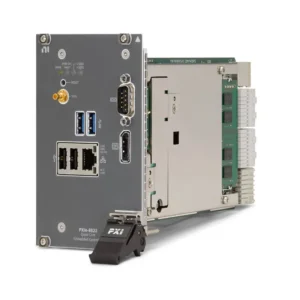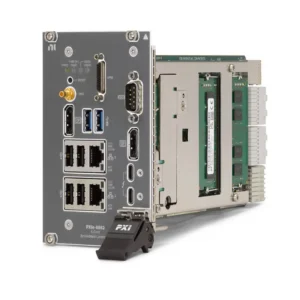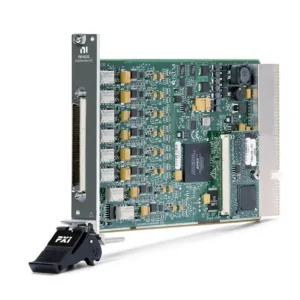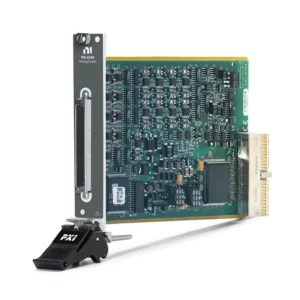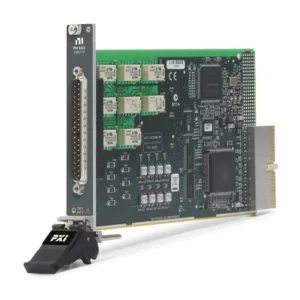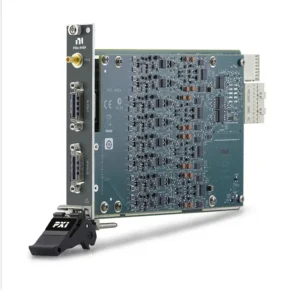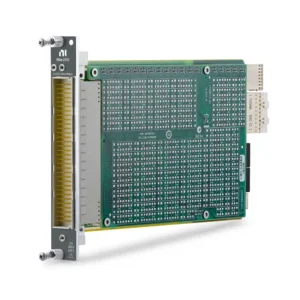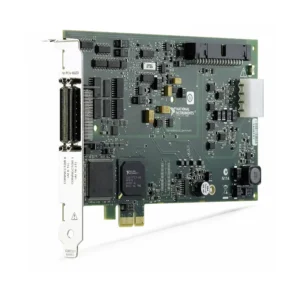




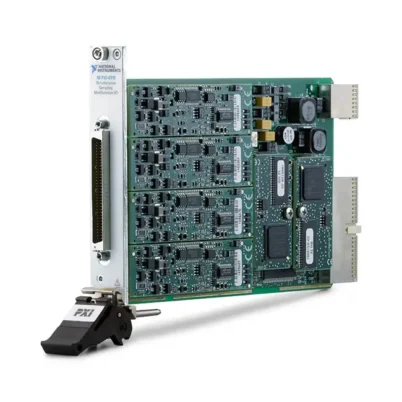
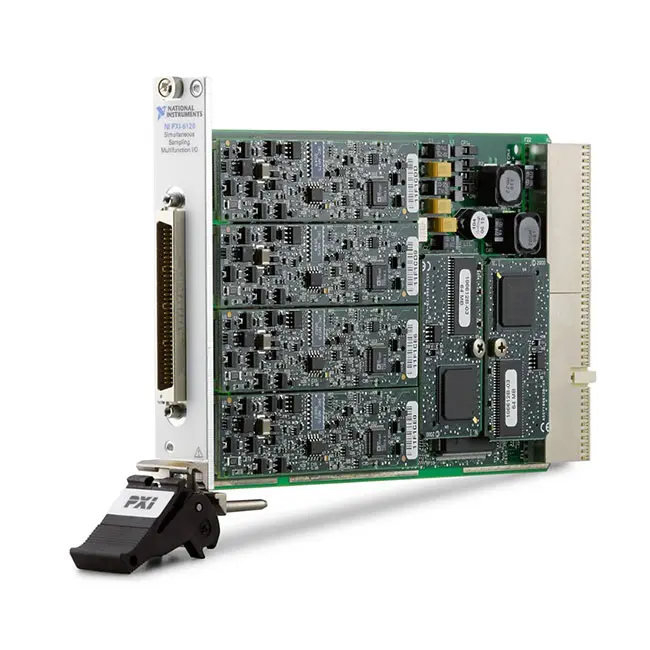
PXI-6120 4-Channel Simultaneous-Sampling Multifunction DAQ Module
The PXI-6120 is an S Series PXI multifunction data acquisition module designed for simultaneous high-resolution voltage measurements and synchronized control. It provides four pseudodifferential analog inputs with 16-bit resolution and a maximum sampling rate of 800 kS/s per channel.
In addition to analog acquisition, the PXI-6120 includes two 16-bit analog outputs, eight correlated digital I/O lines and two 24-bit counter/timers. Its wide input ranges, simultaneous-sampling architecture and analog and digital triggering make it suitable for automotive testing, stimulus-response measurements, radar, sonar, ultrasound and automated test equipment.
Key Features of the PXI-6120
- Four simultaneously sampled analog input channels
- 16-bit analog input resolution
- 800 kS/s maximum sampling rate per channel
- Pseudodifferential input configuration
- Software-selectable AC or DC input coupling
- Input ranges from ±200 mV to ±42 V
- 100 kHz analog input filters
- Two 16-bit analog output channels
- 4 MS/s maximum single-channel analog output rate
- 2.5 MS/s maximum dual-channel analog output rate
- ±10 V analog output range
- Eight TTL/CMOS-compatible digital I/O lines
- Correlated digital acquisition and generation
- Two 24-bit counter/timers
- 20 MHz counter timebase
- Analog and digital triggering
- Large onboard acquisition and generation memory
- PXI trigger-bus synchronization
- PXI hybrid-slot compatible
- 68-pin male SCSI-II front connector
- NI-DAQmx software support
PXI-6120 Technical Specifications
| Product Model | PXI-6120 |
|---|---|
| Part Number | 778396-01 |
| Product Family | NI S Series simultaneous-sampling multifunction DAQ |
| Bus Interface | PXI hybrid |
| Analog Input Channels | 4 pseudodifferential channels |
| Simultaneous Sampling | Yes |
| Analog Input Resolution | 16 bits |
| Maximum Sampling Rate | 800 kS/s per channel |
| Minimum Sampling Rate | No specified minimum |
| Analog Input Ranges | Software-selectable ranges from ±200 mV to ±42 V |
| Input Coupling | Software-selectable AC or DC |
| Input Filter | 100 kHz |
| Maximum Working Voltage | 42 V |
| Analog Output Channels | 2 voltage outputs |
| Analog Output Resolution | 16 bits |
| Single-Channel Output Rate | 4 MS/s maximum |
| Dual-Channel Output Rate | 2.5 MS/s per channel maximum |
| Analog Output Range | ±10 V |
| Analog Output Coupling | DC |
| Digital I/O Lines | 8 bidirectional TTL/CMOS-compatible lines |
| Digital Pattern Rate | Up to 10 Mwords/s under supported conditions |
| Counter/Timers | 2 |
| Counter Resolution | 24 bits |
| Counter Timebase | 20 MHz |
| Triggering | Analog and digital |
| Synchronization | PXI trigger bus and reference-clock synchronization |
| Front Connector | 68-pin male SCSI-II type |
| Operating Temperature | 0°C to 50°C |
| Calibration Interval | 1 year recommended |
| Software Support | NI-DAQmx |
| Lifecycle Status | Discontinued with limited NI support |
| Recommended NI Replacement | PXIe-6386, part number 785926-01 |
PXI-6120 Part Number and Accessories
| Item | Part Number | Description |
|---|---|---|
| PXI-6120 | 778396-01 | Four-channel, 16-bit simultaneous-sampling PXI multifunction DAQ module |
| SH68-68-EP Cable | Varies by length | Shielded 68-pin cable recommended for connecting the PXI-6120 to compatible accessories |
| SCB-68A | 782536-01 | Shielded 68-pin connector block with screw-terminal signal access |
| BNC-2110 | 777643-01 | BNC terminal block for analog, digital and timing signal connections |
| BNC-2120 | 777960-01 | Desktop BNC accessory with signal access and built-in test functions |
The PXI-6120 uses a 68-pin SCSI-II type connector rather than the newer 68-pin VHDCI connector found on many later PXI DAQ modules. Verify the module-side connector and cable model before ordering accessories.
Four Simultaneously Sampled Analog Inputs
The PXI-6120 provides four independent analog-to-digital converters so that every analog input can be sampled at the same point in time. Unlike multiplexed DAQ devices, it does not sequentially switch a single ADC between channels.
This simultaneous architecture preserves phase and timing relationships between signals. It is valuable when comparing stimulus and response waveforms, measuring propagation delay or analyzing signals from synchronized sensors.
16-Bit Analog Input Resolution
Each analog input uses a 16-bit ADC, providing 65,536 theoretical quantization levels across the selected range. Selecting the narrowest suitable input range allows the acquired signal to use more of the available converter resolution.
Actual measurement performance also depends on noise, source impedance, grounding, cabling, calibration and environmental conditions. Shielded cables and differential-style connections are recommended for precision acquisition.
800 kS/s per Channel
All four channels can sample at up to 800 kS/s per channel. Because the inputs are sampled simultaneously, the complete module can acquire as many as 3.2 million analog samples per second while maintaining alignment between channels.
The sample rate should be selected according to signal bandwidth, required time resolution, acquisition duration and storage capacity. Lower sample rates can be used for longer recordings or signals with more limited bandwidth.
Wide Input Ranges up to ±42 V
The PXI-6120 provides software-selectable input ranges extending from low-level ±200 mV measurements to signals as large as ±42 V. Its wide-voltage capability is particularly useful for automotive and electromechanical test systems.
The ±42 V range does not provide galvanic isolation and does not permit the safety ratings to be exceeded. External isolation, attenuation or signal conditioning may be required for high-energy circuits, hazardous voltages and signals with large common-mode potential.
Pseudodifferential Input Architecture
The four analog inputs use a pseudodifferential configuration. Each channel measures its input relative to a local reference while providing improved common-mode rejection compared with a basic ground-referenced single-ended connection.
This arrangement helps reduce errors caused by moderate ground-potential differences. The connected signals must still remain within the specified input and common-mode limits.
Software-Selectable AC and DC Coupling
Input coupling can be selected through software. DC coupling preserves both the changing waveform and its DC component, while AC coupling blocks the steady DC level and emphasizes dynamic signal content.
AC coupling can improve measurement resolution when a relatively small changing signal is superimposed on a larger DC offset. DC coupling should be selected when the absolute voltage level is part of the required measurement.
100 kHz Input Filtering
The analog inputs incorporate filtering intended to restrict high-frequency noise and improve measurement quality for signals within the module’s useful bandwidth. Filtering also helps reduce aliasing from signal content above the selected sampling bandwidth.
The PXI-6120 is appropriate for moderate-bandwidth waveform measurements. Applications requiring substantially higher analog bandwidth should consider a faster S Series or PXI Express simultaneous-sampling module.
Two 16-Bit Analog Outputs
The PXI-6120 includes two voltage output channels with 16-bit resolution and a ±10 V output range. One channel can update at up to 4 MS/s, while both channels can operate at up to 2.5 MS/s per channel.
Analog outputs can generate stimulus waveforms for component testing, actuator simulation and closed-loop experiments. Their timing can be coordinated with analog acquisition and digital I/O through shared clocks and triggers.
Synchronized Stimulus and Response Testing
The combination of simultaneous analog inputs and high-speed analog outputs allows the PXI-6120 to generate a stimulus while measuring the resulting response. This supports frequency-response testing, control-system evaluation and automated component characterization.
Shared timing resources help establish a repeatable relationship between waveform generation and acquisition. Test software can initiate both operations from a common trigger or reference clock.
Eight Correlated Digital I/O Lines
The module provides eight bidirectional TTL/CMOS-compatible digital lines. These lines can be used as static control signals or correlated with analog input samples and analog output updates.
Correlated digital I/O is useful for controlling external devices, recording digital status and coordinating test events with acquired analog waveforms. The digital lines are logic-level interfaces and should not be connected directly to industrial voltage signals.
Two 24-Bit Counter/Timers
Two 24-bit counter/timers support event counting, pulse generation, frequency measurement, period measurement, pulse-width measurement and encoder-related applications.
The counters use an onboard 20 MHz timebase and can route timing signals through available PFI and PXI trigger resources. Counter functions can also be synchronized with other operations in an NI-DAQmx task.
Analog Triggering
Analog triggering allows an acquisition to begin when a monitored signal crosses a configured level or satisfies the supported trigger condition. This helps capture transient waveforms without continuously storing unrelated data.
Trigger level, polarity and hysteresis should be configured according to the expected signal amplitude and noise. Excessive noise near the threshold can cause repeated or premature triggers.
Digital Triggering
The PXI-6120 also accepts digital start, reference and timing signals through its programmable function interfaces and PXI trigger resources. Digital triggering provides a repeatable way to coordinate acquisition with an external event or other PXI instruments.
Trigger routing can be configured through NI-DAQmx without requiring an external timing cable when compatible modules share the PXI chassis backplane.
PXI Backplane Synchronization
The module can use the PXI reference clock and trigger bus to synchronize multiple PXI-6120 modules or coordinate operation with other compatible measurement instruments.
Its phase-locked loop can align the module timing circuitry with the PXI backplane reference. This supports time-correlated measurements across multiple modules and increases the number of simultaneous acquisition channels available in one system.
Onboard Acquisition Memory
Onboard memory buffers acquired and generated data before it is transferred across the PXI bus. This helps the module maintain high-speed operation when host-bus transfers are temporarily delayed.
The sustainable acquisition duration depends on the sample rate, number of active channels, transfer performance and host storage system. For continuous high-speed logging, verify that the controller and disk can sustain the required data throughput.
Typical PXI-6120 Applications
- Automotive electrical-system testing
- 42 V automotive measurements
- Stimulus-response testing
- Radar signal acquisition
- Sonar measurement
- Ultrasonic testing
- Control-system validation
- Transient waveform capture
- Power electronics testing
- Electromechanical system testing
- Automated production testing
- Laboratory data acquisition
- Multichannel phase measurement
Automotive Testing
The ±42 V input capability allows the PXI-6120 to acquire many automotive electrical signals without an external voltage divider. Four simultaneous channels can measure related supply, sensor and actuator waveforms while preserving their timing relationships.
The complete test fixture should still include appropriate current limiting, transient suppression and isolation. Automotive circuits can produce voltage spikes that exceed the module’s normal measurement range.
Radar, Sonar and Ultrasonic Testing
Simultaneous analog acquisition is useful for comparing signals from multiple receivers and transducers. The module can record signal timing, amplitude and phase relationships across four synchronized channels.
For ultrasonic stimulus-response systems, the analog outputs can generate a control or reference waveform while the analog inputs acquire conditioned receiver signals. External amplification and protection may be required for transducer excitation.
Power and Electromechanical Measurements
The PXI-6120 can simultaneously measure voltage and current-proportional signals in power converters, motors and actuator systems. Synchronized channels make it possible to calculate phase, power and transient response from time-aligned data.
Current measurement requires an appropriate shunt, current transformer or conditioned current sensor. High-voltage power systems require external isolation and measurement accessories rated for the circuit.
NI-DAQmx Software Support
The PXI-6120 is supported by the NI-DAQmx driver. NI-DAQmx provides functions for configuring channels, input ranges, coupling, sample clocks, triggers, analog outputs, digital I/O and counter operations.
The driver supports LabVIEW, LabWindows/CVI, C/C++ and compatible .NET development environments. NI Measurement & Automation Explorer can be used to identify the module, configure the system and perform basic self-tests.
PXI System Integration
The PXI-6120 installs in a compatible PXI or PXI hybrid slot. It can operate with embedded controllers, remote PXI control systems and other PXI measurement modules.
Before installation, confirm chassis compatibility, available cooling, controller support and NI-DAQmx version. Because this is a discontinued model, compatibility with a current operating system should be checked before selecting it for a new system.
PXI-6120 Lifecycle and Replacement
The PXI-6120 is discontinued and is currently listed by NI with limited support. It remains useful for maintaining existing test systems whose software, wiring and calibration procedures were developed around the module.
NI identifies the PXIe-6386, part number 785926-01, as the recommended replacement. Replacement is not necessarily a direct drop-in process because the newer module has different channel counts, performance, connector requirements and software behavior.
PXI-6120 Troubleshooting
The PXI-6120 is not detected in NI MAX
Confirm that the module is fully seated in a compatible PXI slot. Check chassis power, controller communication and the installed NI-DAQmx version. Restart the system and refresh the hardware list in NI MAX.
Analog input values are inaccurate
Verify the configured input range, coupling mode and channel wiring. Check source impedance, cable shielding, common-mode voltage and the module’s calibration status. Allow the system to reach a stable operating temperature before precision measurements.
The acquired waveform is clipped
Select a wider input range or reduce the signal amplitude. Confirm that the signal and any transient overshoot remain within the selected range and absolute input limits.
Channels appear to have a timing offset
Confirm that all signals are connected to analog inputs on the simultaneous-sampling module and are acquired in the same NI-DAQmx task. Check external signal conditioning for unequal propagation delay between channels.
The analog output waveform is distorted
Check the output load, generation rate, cable capacitance and waveform frequency. Make sure the connected load does not exceed the analog output current capability and allow appropriate settling time for large voltage transitions.
The acquisition reports a buffer overflow
Reduce the sample rate, shorten the acquisition, increase the host buffer or improve the data-transfer and disk-writing process. Avoid performing slow display or file operations in the acquisition loop.
Analog triggering is unreliable
Review the trigger level, slope and hysteresis. Check whether signal noise repeatedly crosses the configured threshold. Increase hysteresis or condition the trigger signal when necessary.
The digital lines do not control a 24 V device
The digital I/O lines use TTL/CMOS logic levels and cannot directly switch 24 V industrial loads. Add a compatible external buffer, relay driver or isolated digital interface.
Multiple PXI modules are not synchronized
Verify that all modules use the intended PXI reference clock and trigger route. Configure timing in NI-DAQmx and check that no other task or module reserves the selected trigger line.
PXI-6120 Comparison with Similar DAQ Modules
| Model | Analog Inputs | Resolution | Maximum Sample Rate | Primary Advantage |
|---|---|---|---|---|
| PXI-6115 | 4 simultaneous | 12 bits | 10 MS/s/ch | Faster acquisition for higher-bandwidth waveforms |
| PXI-6120 | 4 simultaneous | 16 bits | 800 kS/s/ch | Wide ±42 V ranges and integrated analog outputs |
| PXI-6122 | 4 simultaneous | 16 bits | 500 kS/s/ch | Higher-accuracy moderate-speed acquisition |
| PXI-6123 | 8 simultaneous | 16 bits | 500 kS/s/ch | Additional simultaneous analog input channels |
| PXI-6132 | 4 simultaneous | 14 bits | 2.5 MS/s/ch | Higher sample rate with four channels |
| PXI-6143 | 8 simultaneous | 16 bits | 250 kS/s/ch | Eight high-resolution simultaneous inputs |
| PXIe-6386 | 8 simultaneous | 16 bits | 14 MS/s/ch | Modern PXI Express replacement with substantially higher performance |
PXI-6120 vs PXI-6122
The PXI-6122 also provides four 16-bit simultaneous analog inputs, but its maximum sample rate is 500 kS/s per channel. The PXI-6120 increases the rate to 800 kS/s per channel and includes two high-speed analog outputs.
Choose the PXI-6120 for synchronized stimulus-response applications and wide-range measurements. Choose the PXI-6122 when its accuracy and input characteristics better match a measurement-only application.
PXI-6120 vs PXI-6123
The PXI-6123 provides eight simultaneous 16-bit inputs at up to 500 kS/s per channel. The PXI-6120 provides four inputs at the higher rate of 800 kS/s per channel and adds two analog outputs.
Select the PXI-6123 when additional input-channel density is required. Select the PXI-6120 when faster four-channel acquisition and analog stimulus generation are more important.
PXI-6120 vs PXI-6132
The PXI-6132 provides four simultaneous inputs at up to 2.5 MS/s per channel with 14-bit resolution. The PXI-6120 operates at 800 kS/s but provides 16-bit input resolution and wide input ranges up to ±42 V.
Choose the PXI-6132 for faster waveform acquisition. Choose the PXI-6120 when higher resolution, wide-voltage measurement or integrated analog outputs are required.
PXI-6120 vs PXIe-6386
The PXIe-6386 is the NI-recommended replacement for the discontinued PXI-6120. It provides eight simultaneous 16-bit inputs at up to 14 MS/s per channel, two analog outputs and additional digital I/O.
The PXIe-6386 offers substantially higher performance and current platform support, but it is not a direct wiring replacement. Review the chassis interface, terminal accessory, pinout, input ranges and application code before migration.
Recommended Related Products
- PXIe-6386 8-Channel Simultaneous-Sampling Multifunction DAQ Module
- PXI-6115 4-Channel 10 MS/s Simultaneous-Sampling DAQ Module
- PXI-6122 4-Channel 16-Bit Simultaneous-Sampling DAQ Module
- PXI-6123 8-Channel Simultaneous-Sampling DAQ Module
- PXI-6132 4-Channel 2.5 MS/s Simultaneous-Sampling DAQ Module
- PXI-6133 8-Channel 2.5 MS/s Simultaneous-Sampling DAQ Module
- PXI-6143 8-Channel 16-Bit Simultaneous-Sampling DAQ Module
- View More NI PXI and PXI Express Modules
Selecting the Right Simultaneous-Sampling DAQ Module
Choose the PXI-6120 when maintaining an existing system that requires four 16-bit simultaneous analog inputs, 800 kS/s sampling, two high-speed analog outputs and input ranges extending to ±42 V.
For new systems, consider the PXIe-6386 for greater channel count, much higher sample rates and current PXI Express support. Select the PXI-6123 or PXI-6143 when additional simultaneous inputs are more important than output capability.
Why Choose the PXI-6120?
- Samples four analog channels simultaneously
- Provides 16-bit input resolution
- Acquires each channel at up to 800 kS/s
- Measures input signals up to ±42 V
- Supports AC and DC input coupling
- Includes two 16-bit high-speed analog outputs
- Provides eight correlated digital I/O lines
- Includes two 24-bit counter/timers
- Supports analog and digital triggering
- Synchronizes with other instruments through the PXI backplane
- Maintains compatibility with established NI-DAQmx test systems
Frequently Asked Questions
What is the PXI-6120?
The PXI-6120 is a simultaneous-sampling PXI multifunction DAQ module with four 16-bit analog inputs, two analog outputs, eight digital I/O lines and two counter/timers.
What is the PXI-6120 part number?
The standard NI part number for the PXI-6120 is 778396-01.
What is the maximum analog input sample rate?
Each of the four analog inputs can sample at up to 800 kS/s while maintaining simultaneous acquisition across all channels.
Does the PXI-6120 use multiplexed inputs?
No. It uses independent ADC paths to sample all four pseudodifferential analog inputs simultaneously.
What is the maximum analog input voltage range?
The widest software-selectable measurement range is ±42 V. The specified input and common-mode limits must still be observed.
Does the PXI-6120 support AC coupling?
Yes. Its analog inputs support software-selectable AC or DC coupling.
Does the PXI-6120 provide analog outputs?
Yes. It provides two 16-bit, ±10 V analog outputs. One channel can update at up to 4 MS/s, or both can operate at up to 2.5 MS/s per channel.
How many digital I/O lines are available?
The module provides eight bidirectional TTL/CMOS-compatible digital I/O lines that can be correlated with analog operations.
How many counters does the PXI-6120 include?
It includes two 24-bit counter/timers with a 20 MHz timebase.
Which connector does the PXI-6120 use?
The front panel has one 68-pin male SCSI-II type connector. Verify cable compatibility because this differs from the VHDCI connector used by many newer modules.
Which software controls the PXI-6120?
The module is controlled through NI-DAQmx and can be integrated with LabVIEW, LabWindows/CVI, C/C++ and compatible .NET environments.
Is the PXI-6120 discontinued?
Yes. NI lists the PXI-6120 as discontinued with limited support. It may still be available from existing inventory or the secondary market.
What is the recommended replacement for the PXI-6120?
NI recommends the PXIe-6386, part number 785926-01. Review mechanical, electrical and software differences before migrating an existing system.
Request a Quote for the PXI-6120
Contact us for current availability, condition, lead time and project pricing for the PXI-6120 4-Channel 16-Bit Simultaneous-Sampling Multifunction DAQ Module. We can also help identify compatible 68-pin cables, BNC accessories, PXI chassis and newer PXI Express replacement modules.