



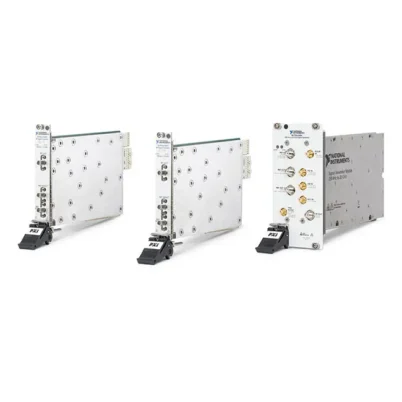
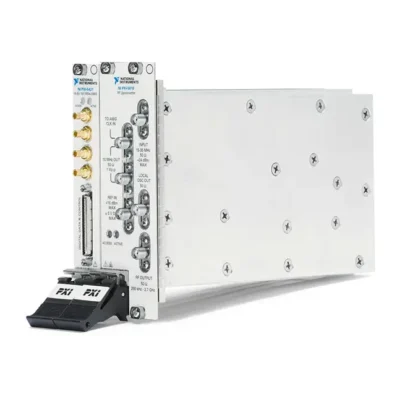
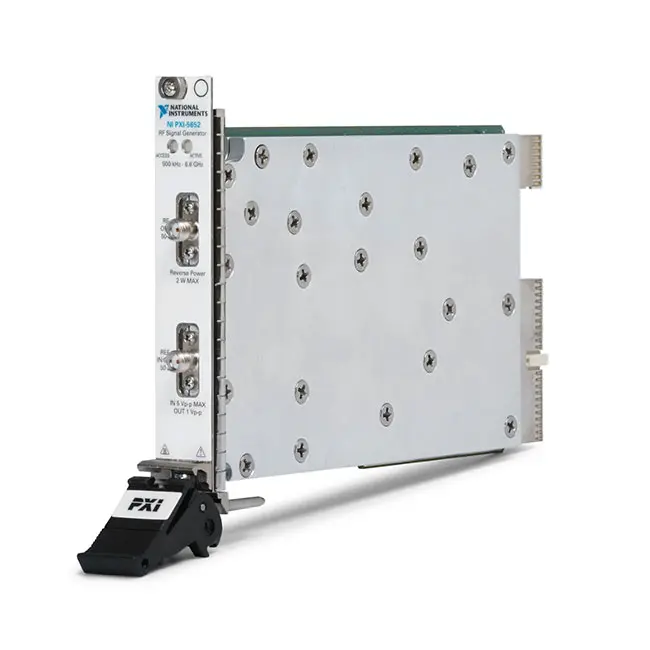
Product Introduction
The NI PXI-5652 is a PXI RF analog signal generator designed for RF component testing, wireless communications development, automated validation, semiconductor testing, and laboratory applications. It provides continuous-wave RF signal generation across a broad frequency range from 500 kHz to 6.6 GHz.
In addition to continuous-wave generation, the PXI-5652 supports frequency modulation (FM), 2-FSK, and on-off keying (OOK), making it suitable for basic modulated RF stimulus applications. With programmable frequency and power, external reference clock capability, PXI integration, and NI-RFSG software support, the PXI-5652 provides a flexible RF source for automated test systems.
Product Overview
The NI PXI-5652 belongs to the NI 5650/5651/5652 RF signal generator family and provides the widest frequency coverage within this product series, extending operation to 6.6 GHz.
The module is designed primarily as a continuous-wave RF source. Engineers can program output frequency and amplitude through software and incorporate the generator into automated PXI test sequences alongside RF analyzers, digitizers, switching modules, power meters, and other modular instrumentation.
Its integrated modulation functions also allow the PXI-5652 to generate basic FM, FSK, and OOK signals without requiring a separate arbitrary waveform generator for applications where these modulation formats meet the test requirement.
Key Features
500 kHz to 6.6 GHz Frequency Range
The PXI-5652 provides broad RF frequency coverage for testing a wide variety of RF and wireless devices.
- 500 kHz to 6.6 GHz specified frequency range
- Software-programmable RF frequency
- Low-frequency RF generation
- Microwave-frequency signal generation
- Multi-band RF testing
Advantage: A single PXI RF source can cover numerous frequency bands, reducing the need for multiple dedicated signal generators.
Continuous-Wave RF Generation
The PXI-5652 is optimized for generating stable continuous-wave RF signals for characterization and automated testing.
- CW RF signal generation
- Programmable carrier frequency
- Programmable RF amplitude
- Automated frequency sweeps
- RF component characterization
Advantage: Provides a programmable RF source for gain, frequency-response, sensitivity, and general RF characterization applications.
Software-Programmable RF Amplitude
The PXI-5652 provides programmable output amplitude with less than 0.1 dB resolution.
- Less than 0.1 dB amplitude resolution
- Software-controlled RF power
- Wide programmable dynamic range
- Automated level sweeps
- Repeatable RF stimulus
Advantage: Fine amplitude control supports automated characterization across multiple RF input levels.
FM Modulation
The PXI-5652 includes integrated frequency modulation capability for basic analog modulation applications.
- Frequency modulation support
- Sine modulation waveform
- Triangle modulation waveform
- Square modulation waveform
- 1 Hz to 100 kHz modulation waveform frequency
Advantage: Integrated FM capability eliminates the need for additional modulation hardware in compatible test applications.
2-FSK Generation
The PXI-5652 supports two-level frequency-shift keying for digital communications and RF testing.
- 2-FSK modulation
- PRBS pattern support
- User-defined bit patterns
- Programmable symbol rates
- Digital RF stimulus generation
Advantage: Provides basic digitally modulated RF signals directly from the RF generator for communications testing.
On-Off Keying Support
The PXI-5652 also supports OOK modulation for applications requiring switched RF carrier patterns.
- OOK modulation support
- PRBS waveform generation
- User-defined bit streams
- Programmable symbol rates
- RF burst-style testing
Advantage: Enables automated testing of devices that use amplitude-switched or carrier-on/carrier-off signaling.
Fast Frequency Tuning
The PXI-5652 provides programmable frequency switching with settling performance suitable for automated RF sweeps and multi-frequency tests.
- Fast frequency changes
- Automated frequency sweeps
- Multi-band testing
- Production test optimization
- Programmable loop bandwidth
Advantage: Faster tuning helps reduce overall test time when measurements must be repeated across many frequencies.
10 MHz Reference Clock
The PXI-5652 includes internal and external reference clock functionality for frequency synchronization.
- 10 MHz internal reference
- 10 MHz reference output
- 10 MHz external reference input
- Frequency synchronization
- Multi-instrument test integration
Advantage: Reference clock connectivity allows the RF generator to share a common frequency reference with other test instruments.
50 Ω RF Interface
The RF output is designed for standard 50 Ω RF test systems.
- 50 Ω nominal output impedance
- Standard RF measurement architecture
- RF component connectivity
- Coaxial test system integration
- Laboratory and production test use
Advantage: Provides straightforward integration with commonly used RF test equipment and devices under test.
PXI Modular Architecture
The PXI-5652 integrates into PXI chassis alongside other modular test instruments.
- Single-slot PXI module
- Compact modular architecture
- Automated RF test integration
- Multi-instrument PXI systems
- Scalable test platforms
Advantage: RF generation can be combined with acquisition, switching, timing, digital, and DC instrumentation within a single automated test platform.
NI-RFSG Software Support
The PXI-5652 is programmed using the NI-RFSG instrument driver.
- NI-RFSG driver support
- LabVIEW integration
- Automated RF configuration
- Frequency and power control
- Modulation configuration
Advantage: Provides a standardized NI software interface for developing RF signal generation and automated test applications.
Technical Specifications
| Parameter | Description |
|---|---|
| Product Type | PXI RF Analog Signal Generator |
| Frequency Range | 500 kHz to 6.6 GHz |
| Primary Generation Mode | Continuous-Wave RF |
| Modulation | FM, 2-FSK and OOK |
| Amplitude Resolution | <0.1 dB |
| Output Impedance | 50 Ω |
| Reference Frequency | 10 MHz |
| External Reference Input | 10 MHz ±10 ppm |
| RF Reverse Power Handling | Up to 0.5 W / +27 dBm Under Specified Conditions |
| Maximum DC at RF Output | 25 V |
| Module Size | 3U, 1-Slot PXI |
| Weight | 415 g |
| Calibration Interval | 1 Year |
| Driver | NI-RFSG |
| Primary Applications | RF Test, Wireless Validation, Semiconductor Testing and Automated Measurement |
RF Output Amplitude Range
The specified programmable output amplitude range varies according to carrier frequency.
| Frequency Range | Specified Amplitude Range |
|---|---|
| 500 kHz to <10 MHz | -90 dBm to +5 dBm |
| 10 MHz to <50 MHz | -90 dBm to +8 dBm |
| 50 MHz to <500 MHz | -90 dBm to +10 dBm |
| 500 MHz to <1.3 GHz | -90 dBm to +10 dBm |
| 1.3 GHz to <1.6 GHz | -90 dBm to +10 dBm |
| 1.6 GHz to <2.9 GHz | -80 dBm to +8 dBm |
| 2.9 GHz to <3.3 GHz | -70 dBm to +8 dBm |
| 3.3 GHz to <3.7 GHz | -60 dBm to +7 dBm |
| 3.7 GHz to <5.0 GHz | -40 dBm to +5 dBm |
| 5.0 GHz to <6.6 GHz | -40 dBm to 0 dBm |
Software Ecosystem
The NI PXI-5652 integrates with NI RF software for configuration, automated signal generation, measurement sequencing, and system development.
- NI-RFSG: Provides the primary programming interface for frequency, power, modulation, reference clock, and RF output control.
- LabVIEW: Enables graphical development of automated RF generation, characterization, sweep, and validation applications.
- NI MAX: Supports hardware identification, configuration, diagnostics, and system management.
- TestStand: Can coordinate RF generation with additional PXI measurements in automated production and validation sequences.
- Custom Programming Environments: Compatible NI-RFSG APIs can be incorporated into customized RF test software.
Industries
- RF and Wireless Testing
- Semiconductor Testing
- Aerospace and Defense
- Automotive Electronics
- Electronic Manufacturing
- Telecommunications
- Research and Development
- Automated Test
Applications
RF Component Characterization
The PXI-5652 can provide programmable RF stimulus for characterization of RF components and subsystems.
- Amplifier testing
- Filter characterization
- Mixer testing
- Receiver sensitivity testing
- Frequency-response measurements
Wireless Device Testing
Its broad frequency range supports RF stimulus across many commonly used wireless frequency bands.
- Receiver testing
- Wireless subsystem validation
- RF front-end characterization
- Communications research
Semiconductor Test
The PXI-5652 can be integrated into automated semiconductor characterization platforms requiring programmable RF carrier generation.
- RFIC characterization
- Device frequency sweeps
- Receiver testing
- Automated RF validation
Local Oscillator Generation
The stable programmable RF output can be used as a local oscillator source in compatible RF test architectures.
- RF frequency conversion
- Mixer test systems
- Custom receiver architectures
- Modular RF instrumentation
Frequency Sweep Testing
Software-programmable frequency control makes the PXI-5652 useful for automated swept-frequency measurements.
- Frequency-response characterization
- Multi-band DUT testing
- RF component sweeps
- Production test automation
Basic Modulated RF Testing
Integrated FM, FSK, and OOK functions support applications requiring basic modulation directly from the signal generator.
- FM receiver testing
- 2-FSK device testing
- OOK receiver validation
- Basic communications experiments
Comparison with Similar NI RF Signal Generators
| Model | Main Difference | Best Application |
|---|---|---|
| NI PXI-5652 | RF analog signal generator covering 500 kHz to 6.6 GHz with CW, FM, 2-FSK, and OOK generation. | Broad-frequency CW and basic modulated RF testing |
| NI PXI-5651 | Related NI RF analog signal generator with a lower maximum operating frequency. | Lower-frequency RF testing |
| NI PXI-5650 | Entry model in the NI 565x RF signal generator family with reduced frequency coverage. | General lower-frequency RF stimulus |
| NI PXIe-5652 | PXI Express implementation of the 6.6 GHz NI RF analog signal generator architecture. | PXI Express RF test systems |
Recommended Related Products
| NI PXIe-5652 | PXI Express RF signal generator for systems requiring a newer PXI Express platform with similar 6.6 GHz frequency coverage. |
| NI PXI-5922 | High-resolution PXI digitizer for precision waveform acquisition and mixed RF/baseband measurement applications. |
| NI PXI-5900 | Differential amplifier for signal conditioning in compatible PXI oscilloscope and digitizer systems. |
| NI PXI-6683 | PXI timing and synchronization module for systems requiring coordinated timing between RF and additional measurement instruments. |
Why Choose PXI-5652?
- 500 kHz to 6.6 GHz frequency coverage
- Continuous-wave RF generation
- FM modulation capability
- 2-FSK generation
- OOK modulation support
- Less than 0.1 dB amplitude resolution
- 50 Ω RF architecture
- 10 MHz reference clock input and output
- Single-slot PXI form factor
- NI-RFSG software support
- Suitable for automated RF frequency and power sweeps
- Ideal for RF component and wireless device testing
Frequently Asked Questions
What is the NI PXI-5652?
The NI PXI-5652 is a PXI RF analog signal generator designed to generate programmable continuous-wave and basic modulated RF signals from 500 kHz to 6.6 GHz.
What frequency range does the PXI-5652 support?
The specified RF output frequency range of the PXI-5652 is 500 kHz to 6.6 GHz. The hardware is tunable below the specified lower limit under certain conditions, but amplitude performance below the specified range is not calibrated.
Does the PXI-5652 support modulation?
Yes. The PXI-5652 supports frequency modulation, two-level frequency-shift keying, and on-off keying in addition to continuous-wave RF generation.
Does the PXI-5652 support FM?
Yes. The PXI-5652 provides integrated FM with sine, triangle, and square modulation waveforms and supports modulation waveform frequencies from 1 Hz to 100 kHz.
Does the PXI-5652 support FSK?
Yes. The module supports 2-FSK modulation using PRBS sequences or user-defined bit patterns.
Does the PXI-5652 support OOK?
Yes. The PXI-5652 supports on-off keying with both PRBS patterns and user-defined bit sequences.
What is the maximum output power of the PXI-5652?
The specified maximum RF output amplitude depends on carrier frequency. For example, the specified range reaches +10 dBm across several lower-frequency bands, while the specified upper output level decreases at higher frequencies and is 0 dBm from 5.0 GHz to below 6.6 GHz. Maximum available power can be somewhat higher than the specified amplitude range.
Does the PXI-5652 support an external reference clock?
Yes. The PXI-5652 supports a 10 MHz external reference input and also provides a 10 MHz internal reference output for synchronization with compatible RF and measurement instruments.
What driver does the PXI-5652 use?
The PXI-5652 uses the NI-RFSG instrument driver for software configuration and control of frequency, output power, modulation, and other RF generator functions.
What is the difference between PXI-5652 and PXIe-5652?
Both devices provide RF analog signal generation with frequency coverage extending to 6.6 GHz. The primary architectural difference is the system bus: the PXI-5652 is designed for PXI systems, while the PXIe-5652 is designed for PXI Express systems. Chassis compatibility and the overall test platform should therefore be considered when selecting between them.
Is the PXI-5652 a vector signal generator?
The PXI-5652 is primarily an RF analog signal generator designed for CW and basic modulation formats such as FM, 2-FSK, and OOK. Applications requiring complex arbitrary I/Q modulation typically use a dedicated vector signal generator architecture.
Conclusion
The NI PXI-5652 RF analog signal generator provides a flexible RF stimulus source for automated testing, wireless device validation, RF component characterization, semiconductor testing, and laboratory research. With 500 kHz to 6.6 GHz frequency coverage, programmable output amplitude, CW generation, FM, 2-FSK, OOK modulation, 10 MHz reference synchronization, and NI-RFSG integration, the PXI-5652 is well suited for modular PXI RF test systems requiring broad frequency coverage and programmable RF signal generation.