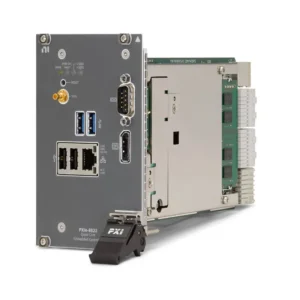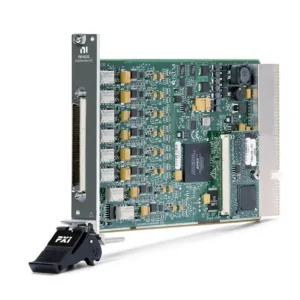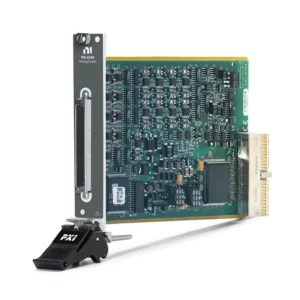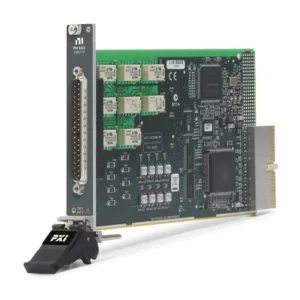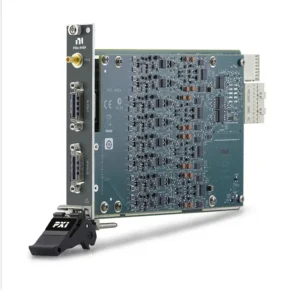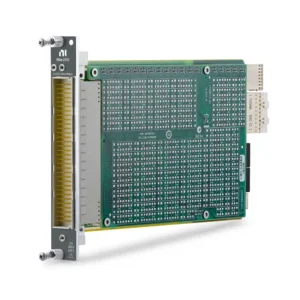




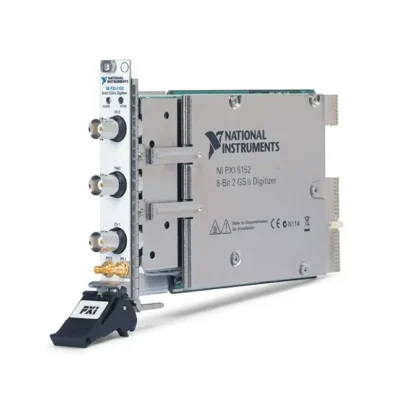
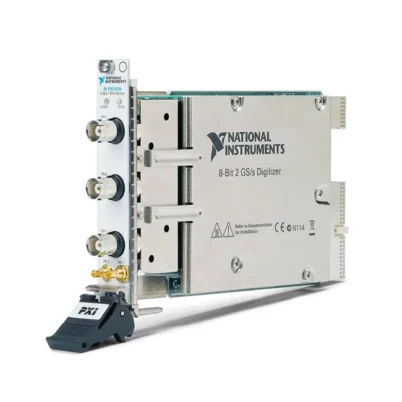
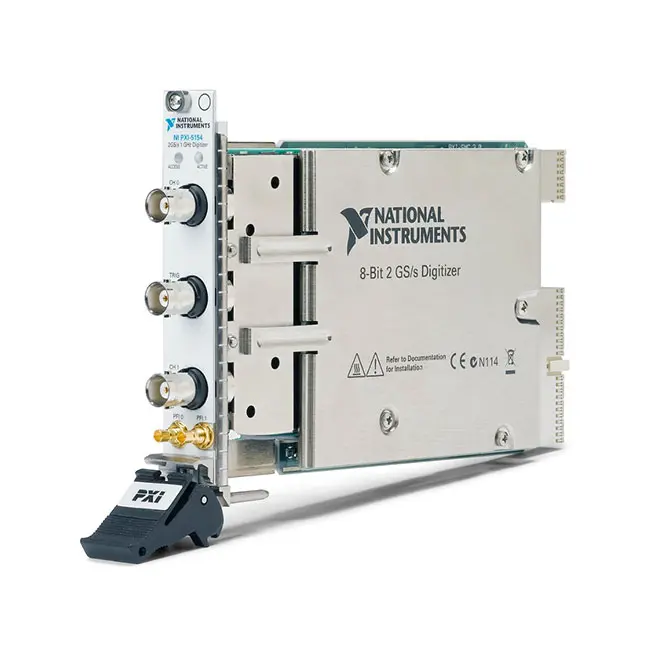
PXI-5153 2 GS/s 500 MHz 8-Bit PXI Oscilloscope
The NI PXI-5153 is a high-speed two-channel PXI oscilloscope and waveform digitizer designed for automated electronic testing, communications measurements, semiconductor validation and fast transient acquisition. It provides 8-bit resolution, 500 MHz analog bandwidth and simultaneous sampling at up to 1 GS/s on each input channel.
When only one input channel is required, time-interleaved sampling provides a 2 GS/s real-time sampling rate. For stable repetitive signals, random-interleaved sampling increases the effective rate to as much as 20 GS/s. The PXI-5153 also provides 50 Ω inputs, ranges from 100 mVpp to 5 Vpp, advanced triggering and up to 256 MB of onboard memory per channel.
Key Features of the PXI-5153
- Two simultaneously sampled analog input channels
- 8-bit vertical resolution
- 1 GS/s real-time sampling on both channels
- 2 GS/s single-channel time-interleaved sampling
- Up to 20 GS/s random-interleaved sampling for repetitive signals
- 500 MHz analog input bandwidth
- Approximately 600 ps rise and fall time
- 50 Ω terminated analog inputs
- Input ranges from 100 mVpp to 5 Vpp
- AC, DC and ground input coupling
- Programmable vertical offset
- Software-selectable 20 MHz noise filter
- 8 MB, 64 MB or 256 MB memory per channel
- Pretrigger and post-trigger acquisition
- Multiple-record waveform capture
- Edge, window, hysteresis and digital triggering
- Hardware trigger rearming
- PXI Star Trigger and backplane trigger support
- Front-panel PFI trigger and event connections
- NI-TClk multimodule synchronization
- Built-in self-calibration
- NI-SCOPE driver support
PXI-5153 Technical Specifications
| Product Model | PXI-5153 |
|---|---|
| Product Type | High-speed PXI oscilloscope and digitizer |
| Analog Input Channels | 2 |
| Sampling Architecture | Simultaneous dual-channel or time-interleaved single-channel sampling |
| Vertical Resolution | 8 bits |
| Two-Channel Real-Time Sample Rate | Up to 1 GS/s per channel |
| Single-Channel Real-Time Sample Rate | 2 GS/s in TIS mode |
| Random-Interleaved Sample Rate | Up to 20 GS/s for repetitive signals |
| Maximum Analog Bandwidth | 500 MHz minimum, under specified conditions |
| Rise and Fall Time | Approximately 600 ps |
| Analog Input Impedance | 50 Ω |
| Input VSWR | Approximately 1.2 from DC to 500 MHz |
| Input Coupling | AC, DC or ground |
| Input Voltage Ranges | 100 mVpp, 200 mVpp, 500 mVpp, 1 Vpp, 2 Vpp and 5 Vpp |
| Maximum Input Overload | 7 Vrms with peaks not exceeding 10 V |
| AC-Coupling Cutoff | Approximately 114 kHz |
| Bandwidth-Limit Filter | Software-selectable 20 MHz noise filter |
| Channel Crosstalk | Less than −80 dB at 10 MHz and less than −60 dB at 100 MHz |
| Onboard Memory Options | 8 MB, 64 MB or 256 MB per channel |
| Minimum Record Length | 1 sample |
| Maximum Number of Records | Up to 100,000, depending on memory configuration |
| Trigger Types | Edge, window, hysteresis, digital, immediate and software |
| Digital Trigger Sources | PXI trigger lines, PXI Star Trigger and front-panel PFI |
| Internal Timebase | 1 GHz voltage-controlled SAW oscillator |
| Reference Clock | PXI backplane reference or supported external reference |
| Analog Input Connectors | 2 × BNC |
| External Trigger Connector | BNC |
| PFI Connectors | Front-panel SMB connectors |
| Self-Calibration | Gain, offset, triggering and timing calibration |
| External Calibration Interval | 2 years |
| Recommended Warm-Up Time | 15 minutes |
| Software Driver | NI-SCOPE 3.5 or later compatible version |
| Bus Interface | PXI; compatible with supported PXI Express hybrid slots |
| Module Format | 3U PXI module |
| Operating Temperature | 0°C to 55°C under specified cooling conditions |
PXI-5153 Part Numbers and Memory Options
| Product Configuration | Part Number | Onboard Memory |
|---|---|---|
| PXI-5153 Standard Memory | 780317-01 | 8 MB per channel |
| PXI-5153 Extended Memory | 780317-02 | 64 MB per channel |
| PXI-5153 Deep Memory | 780317-03 | 256 MB per channel |
| 50 Ω BNC Cable | Configuration dependent | Coaxial cable for high-speed impedance-matched signal connections |
| External Trigger Cable | Configuration dependent | BNC cable for high-speed trigger connections |
| SMB PFI Cable | Configuration dependent | Cable for digital trigger and event routing |
The three PXI-5153 ordering configurations provide the same bandwidth, sampling rate, channel count and input architecture. Their principal difference is the onboard acquisition memory installed for each channel.
Dual 1 GS/s Simultaneous Inputs
With both analog channels enabled, the PXI-5153 samples each input at up to 1 GS/s. Simultaneous acquisition preserves the phase and timing relationship between the two signals.
This mode is appropriate for comparing a stimulus and response, measuring propagation delay and analyzing two related high-speed signals during the same transient event.
2 GS/s Single-Channel Sampling
Time-interleaved sampling combines both ADC paths to provide a 2 GS/s real-time rate on one selected input channel. TIS captures a nonrepetitive waveform in a single event.
Because both ADC resources are required, the second channel is unavailable during 2 GS/s TIS acquisition.
20 GS/s Random-Interleaved Sampling
For stable repetitive waveforms, random-interleaved sampling can produce effective rates up to 20 GS/s. Samples from multiple signal repetitions are combined into a higher-density reconstructed waveform.
RIS is not suitable for one-time, modulated or changing signals. Use 1 GS/s dual-channel or 2 GS/s single-channel real-time mode for these events.
500 MHz Analog Bandwidth
The PXI-5153 provides a warranted minimum analog bandwidth of 500 MHz across its input ranges under specified conditions. This represents a substantial bandwidth increase over the 300 MHz PXI-5152.
The module can capture fast digital edges, communications waveforms, pulses and transient events. Cables, fixtures and connectors must also support the required bandwidth.
Approximately 600 ps Rise Time
The analog front end provides a rise and fall time of approximately 600 ps under the specified input conditions. This supports timing and edge measurements on high-speed electronic signals.
The observed rise time combines the response of the PXI-5153 with the actual source, cable and fixture. The digitizer cannot recover signal bandwidth removed elsewhere in the measurement path.
8-Bit Vertical Resolution
The PXI-5153 provides 256 theoretical quantization levels across the selected input range. Its architecture is optimized for high-speed timing and waveform capture.
Select the smallest full-scale range that safely contains the signal to maximize amplitude sensitivity. Include overshoot and unexpected transient peaks when choosing the range.
Dedicated 50 Ω Inputs
Unlike models offering both terminated and high-impedance paths, the PXI-5153 analog inputs use 50 Ω impedance. This architecture is optimized for high-frequency coaxial systems and flat broadband performance.
The signal source and coaxial cable should also use 50 Ω impedance. Proper termination minimizes reflections and helps maintain the specified frequency response.
Input Ranges from 100 mVpp to 5 Vpp
Six ranges are available: 100 mVpp, 200 mVpp, 500 mVpp, 1 Vpp, 2 Vpp and 5 Vpp. Each input can be configured independently.
Programmable vertical offset allows a selected range to be positioned around a nonzero signal level within the instrument’s permitted offset and input limits.
AC, DC and Ground Coupling
DC coupling preserves the complete waveform and its DC level. AC coupling removes the DC component, with a low-frequency cutoff of approximately 114 kHz due to the terminated high-speed signal path.
Ground coupling disconnects the external signal from the internal acquisition path and provides an internal baseline reference.
20 MHz Noise Filter
A software-selectable 20 MHz filter reduces broadband noise for applications where the signal content is below 20 MHz.
Disable the noise filter when measuring fast pulse edges or frequency components extending toward the full 500 MHz bandwidth.
Low Channel Crosstalk
Channel-to-channel crosstalk is specified below −80 dB at 10 MHz and below −60 dB at 100 MHz. Low crosstalk helps prevent a large signal on one input from appearing as an unwanted component on the other.
External cable routing, grounding and fixture isolation must also be designed to prevent coupling outside the module.
Deep Onboard Memory
The PXI-5153 is available with 8 MB, 64 MB or 256 MB of memory per channel. Deep memory provides longer acquisition windows at 1 GS/s and 2 GS/s.
In single-channel TIS mode, the active channel uses the selected memory capacity. In dual-channel mode, the stated memory is available independently for both channels.
Multiple-Record Acquisition
Multiple-record acquisition stores individual waveform segments surrounding separate trigger events. It does not need to capture the inactive time between events.
The 64 MB and 256 MB versions can store up to 100,000 records under supported record-length conditions. This is useful for radar pulses, serial bursts and switching events.
Pretrigger and Post-Trigger Capture
Pretrigger samples record the signal before the trigger condition, while post-trigger samples capture the subsequent event. The trigger position can be configured within the waveform record.
This helps engineers diagnose intermittent problems by showing the conditions leading to a fault or threshold crossing.
Advanced Triggering
The PXI-5153 supports edge, window, hysteresis, digital, immediate and software triggering. Trigger sources include analog inputs, the external trigger connector, PXI trigger lines and PFI connections.
Window triggering detects when a signal enters or exits a selected voltage band. Hysteresis reduces false triggers caused by noise near the threshold.
PFI Trigger and Event Routing
Front-panel PFI connectors can accept acquisition triggers or export instrument events. Supported outputs include ready-for-start, end-of-record and acquisition-complete signals.
PFI routing helps coordinate the digitizer with external instruments and devices that do not connect directly to the PXI trigger bus.
PXI Clock and Trigger Synchronization
The internal timing architecture uses a 1 GHz voltage-controlled SAW oscillator. The module can use PXI backplane clock and trigger resources for coordination with other instruments.
The PXI Star Trigger provides a low-skew connection from the chassis timing slot to compatible peripheral modules.
NI-TClk Multimodule Synchronization
NI-TClk aligns clocks and triggers across compatible PXI oscilloscopes, waveform generators and digital instruments. Multiple PXI-5153 modules can create phase-coherent acquisition systems with additional channels.
For best performance, use compatible modules, common configuration values and a chassis with appropriate timing and cooling capabilities.
Built-In Self-Calibration
Software-controlled self-calibration corrects gain, offset, triggering and timing errors for the analog input ranges. A 15-minute warm-up period is required before performing self-calibration or precision measurements.
External calibration adjusts the onboard reference values and trigger levels. NI recommends a two-year external calibration interval.
High-Speed Digital Validation
The 500 MHz bandwidth and 2 GS/s single-channel rate support measurements of clock signals, pulse trains and digital control waveforms. Engineers can calculate rise time, fall time, pulse width, overshoot and propagation delay.
A controlled-impedance fixture is important because probe and cable discontinuities can create ringing that does not originate in the device under test.
Communications Testing
The 50 Ω inputs and broadband response make the PXI-5153 suitable for baseband and intermediate-frequency communications signals.
Waveform data can be processed in software to calculate frequency-domain content, timing, power and application-specific modulation parameters.
Semiconductor Testing
The PXI-5153 can capture fast output transitions, clock signals and transient responses from semiconductor devices. Multiple-record acquisition supports repetitive production-test events.
External attenuation or protection may be required when test-system switching produces voltage beyond the digitizer’s input rating.
Radar and Pulsed Measurements
Deep memory and hardware trigger rearming allow the module to capture sequences of radar, sonar and other pulsed signals.
Multiple-record mode stores the waveform surrounding each pulse without consuming memory on long inactive intervals.
Scientific Research
The module can acquire optical detector outputs, laser pulses, ultrasonic waveforms and other fast experimental signals. External triggers can synchronize acquisition with the experimental event.
NI-SCOPE provides access to raw waveform data for custom analysis, filtering and feature extraction.
Automated Production Testing
The PXI-5153 integrates into automated systems requiring repeatable high-speed waveform measurements. Software can calculate amplitude, timing, frequency and pulse parameters and compare them with pass-or-fail limits.
PXI synchronization allows the digitizer to operate with signal generators, switching modules and digital instruments in one coordinated sequence.
NI-SCOPE Software Support
The PXI-5153 is controlled through the IVI-compliant NI-SCOPE instrument driver. NI-SCOPE provides functions for configuring channels, sampling, ranges, coupling, triggers, memory and synchronization.
The driver supports LabVIEW, LabWindows/CVI, Measurement Studio and compatible C, C++ and .NET environments. The soft front panel provides interactive acquisition and waveform display.
Typical PXI-5153 Applications
- High-speed waveform acquisition
- 500 MHz electronic signal testing
- Automated production testing
- High-speed digital validation
- Communications waveform analysis
- Semiconductor testing
- Radar and sonar pulse acquisition
- Aerospace and defense testing
- Consumer electronics validation
- Scientific research
- Optical pulse measurements
- Ultrasonic signal acquisition
- Multiple-record event capture
- Mixed-signal testing
- Phase-coherent multichannel acquisition
PXI-5153 Troubleshooting
The PXI-5153 is not detected in NI MAX
Confirm that the module is fully installed in a compatible PXI or PXI Express hybrid peripheral slot. Check chassis power, controller communication and NI-SCOPE installation, then restart NI Measurement & Automation Explorer.
The maximum dual-channel rate is only 1 GS/s
This is normal. The maximum rate with both channels enabled is 1 GS/s per channel. Disable one channel and enable TIS mode to acquire at 2 GS/s.
The waveform is clipped
Select a larger input range or adjust the vertical offset. Confirm that the complete signal remains within the full-scale range and overload rating.
The measured amplitude is approximately half the expected value
The PXI-5153 uses 50 Ω inputs. Confirm that the signal source amplitude specification assumes a 50 Ω load and that the cable and source are terminated correctly.
The signal contains reflections or ringing
Use 50 Ω coaxial cables, short signal paths and controlled-impedance fixtures. Eliminate unterminated branches and unnecessary adapters.
Low-frequency signals are attenuated in AC coupling
The AC-coupled 50 Ω input has a cutoff of approximately 114 kHz. Select DC coupling when lower-frequency or DC information must be preserved.
The signal disappears when the 20 MHz filter is enabled
The noise filter attenuates signal content above 20 MHz. Disable it when measuring higher-frequency waveforms or fast edges.
RIS produces an unstable waveform
Use random-interleaved sampling only for stable repetitive signals. Select real-time sampling for single-shot, burst or changing signals.
Multiple modules are not synchronized
Confirm that the modules share a reference clock and trigger source. Configure the NI-TClk group and verify chassis timing-resource routing.
PXI-5153 Comparison with Similar PXI Oscilloscopes
| Model | Primary Configuration | Best Suited For |
|---|---|---|
| PXI-5152 | 2 channels, 8-bit, 300 MHz, 1 GS/s dual or 2 GS/s single channel | High-speed systems requiring 50 Ω or 1 MΩ inputs |
| PXI-5153 | 2 channels, 8-bit, 500 MHz, 1 GS/s dual or 2 GS/s single channel | Higher-bandwidth 50 Ω transient and communications testing |
| PXI-5154 | High-speed 8-bit PXI oscilloscope with increased sampling performance | Applications requiring faster real-time acquisition |
| PXI-5124 | 2 channels, 12-bit, 150 MHz, 200 MS/s | Improved amplitude resolution at lower bandwidth |
| PXIe-5160 | 2 channels, 10-bit, 500 MHz, 2.5 GS/s | Newer PXI Express systems requiring higher resolution |
| PXIe-5162 | High-speed PXI Express oscilloscope | Wider-bandwidth modern automated test systems |
PXI-5153 vs PXI-5152
Both modules provide dual 1 GS/s sampling, 2 GS/s single-channel TIS and 8-bit resolution. The PXI-5153 increases bandwidth from 300 MHz to 500 MHz but provides only 50 Ω analog inputs.
Choose the PXI-5153 for wider-bandwidth terminated signal systems. Select the PXI-5152 when 1 MΩ high-impedance input compatibility is required.
PXI-5153 vs PXI-5154
The PXI-5154 is intended for applications requiring higher sampling performance, while the PXI-5153 provides 500 MHz bandwidth and 2 GS/s single-channel real-time acquisition.
Select the PXI-5153 when its speed and bandwidth meet the test requirement. Choose the PXI-5154 when additional acquisition speed is required.
PXI-5153 vs PXIe-5160
The PXIe-5160 provides 10-bit resolution, 2.5 GS/s sampling on both channels and approximately 500 MHz bandwidth through a PXI Express interface. The PXI-5153 provides 8-bit resolution and conventional PXI connectivity.
Choose the PXI-5153 for maintaining existing PXI systems. Consider the PXIe-5160 for newer systems requiring higher resolution and backplane throughput.
Recommended Related Products
- PXI-5152 2 GS/s 300 MHz Oscilloscope
- PXI-5154 High-Speed PXI Oscilloscope
- PXI-5124 12-Bit 200 MS/s Digitizer
- PXI-5142 14-Bit Communications Digitizer
- PXIe-5160 2.5 GS/s PXI Express Oscilloscope
- PXIe-5162 High-Speed PXI Express Oscilloscope
- PXIe-1078 9-Slot PXI Express Chassis
- View More NI PXI Oscilloscopes and Digitizers
Selecting the Right PXI Oscilloscope
Choose the PXI-5153 when the application requires 500 MHz bandwidth, two simultaneous 1 GS/s channels or one 2 GS/s real-time channel. It is optimized for terminated high-speed signals and controlled-impedance fixtures.
Select the PXI-5152 when a 1 MΩ high-impedance input is required. Consider a 12-bit or 14-bit digitizer when amplitude resolution is more important than bandwidth and sampling speed.
Choose the 8 MB version for short waveforms, the 64 MB version for medium records and the 256 MB version for long acquisitions or large multirecord tests.
Why Choose the PXI-5153?
- Provides two simultaneous 1 GS/s input channels
- Supports 2 GS/s single-channel real-time sampling
- Offers 20 GS/s RIS for repetitive signals
- Provides 500 MHz analog bandwidth
- Offers approximately 600 ps rise time
- Supports 50 Ω high-frequency signal systems
- Provides up to 256 MB memory per channel
- Includes advanced analog and digital triggering
- Supports NI-TClk multimodule synchronization
- Integrates with NI-SCOPE and LabVIEW
Frequently Asked Questions
What is the PXI-5153?
The PXI-5153 is a two-channel, 8-bit PXI oscilloscope with 500 MHz bandwidth, 1 GS/s simultaneous sampling per channel and 2 GS/s single-channel sampling.
Can both channels sample at 2 GS/s?
No. Both channels can sample simultaneously at up to 1 GS/s each. The 2 GS/s rate is available when one channel is enabled in TIS mode.
What is the equivalent-time sampling rate?
Random-interleaved sampling provides effective rates up to 20 GS/s for stable repetitive signals.
What is the analog input bandwidth?
The PXI-5153 provides a warranted minimum analog bandwidth of 500 MHz under specified conditions.
Does the PXI-5153 support a 1 MΩ input?
No. The analog input channels use 50 Ω impedance and are optimized for terminated high-frequency signals.
What input ranges are available?
The input ranges are 100 mVpp, 200 mVpp, 500 mVpp, 1 Vpp, 2 Vpp and 5 Vpp.
Which part number has 8 MB per channel?
Part number 780317-01 provides 8 MB of onboard memory per channel.
Which part number has 64 MB per channel?
Part number 780317-02 provides 64 MB of onboard memory per channel.
Which part number has 256 MB per channel?
Part number 780317-03 provides 256 MB of onboard memory per channel.
Can multiple PXI-5153 modules be synchronized?
Yes. Multiple compatible modules can share PXI clocks and triggers through NI-TClk synchronization.
Which driver controls the PXI-5153?
The PXI-5153 is controlled through the NI-SCOPE instrument driver.
Can the PXI-5153 operate in a PXI Express chassis?
Yes. It can operate in a compatible PXI Express hybrid peripheral slot, but not in a PXI Express-only slot without the hybrid connector.
Request a Quote for the PXI-5153
Contact us for current availability, memory configuration, product condition, calibration status, lead time and project pricing for the PXI-5153 2 GS/s 500 MHz 8-Bit PXI Oscilloscope. We can also help identify compatible 50 Ω cables, attenuators, PXI chassis, controllers and related high-speed digitizers.