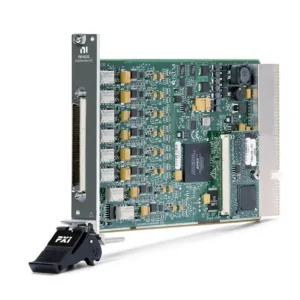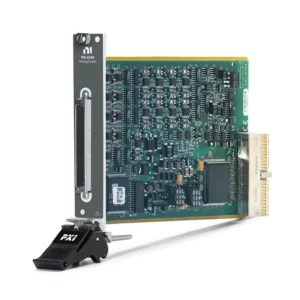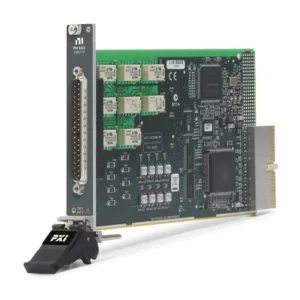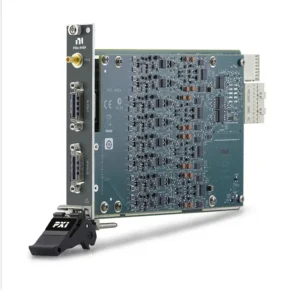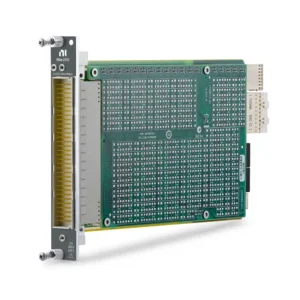




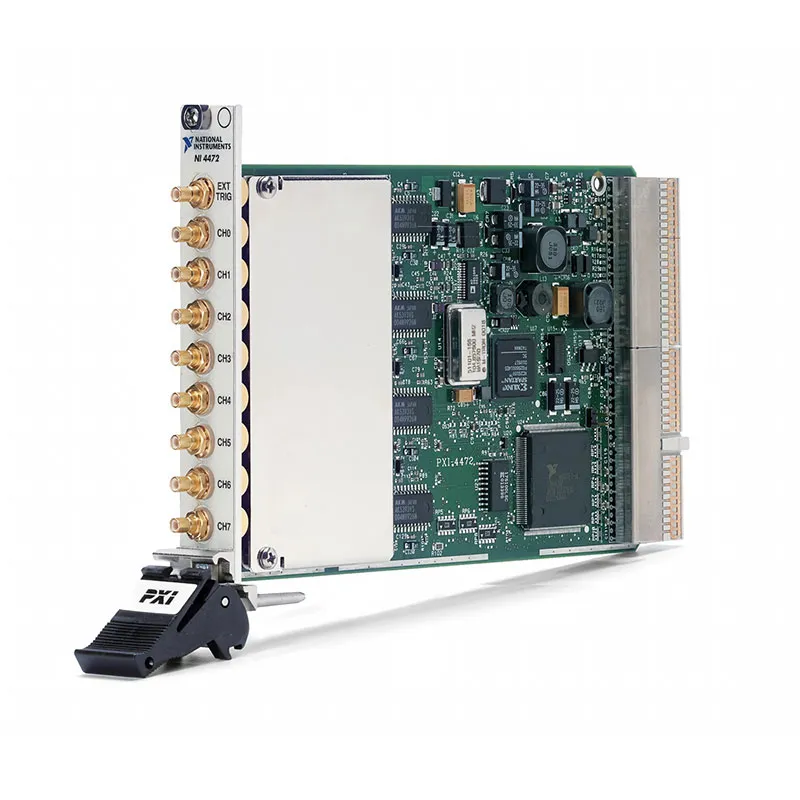
PXI-4472 8-Channel 24-Bit Dynamic Signal Acquisition Module
The NI PXI-4472 is an eight-channel dynamic signal acquisition module designed for precise sound, vibration and other high-dynamic-range measurements. Each input channel uses a 24-bit delta-sigma analog-to-digital converter and can be sampled simultaneously at rates up to 102.4 kS/s.
The module combines low-noise analog inputs, automatically adjusting antialiasing filters and integrated IEPE signal conditioning. It can connect directly to compatible IEPE accelerometers and microphones, simplifying the measurement chain used for vibration analysis, acoustic testing, machine condition monitoring and structural evaluation.
All eight channels are sampled simultaneously, preserving the amplitude and phase relationships between signals. This is essential for modal testing, frequency-response measurements, sound-field analysis, order tracking and applications that compare vibration at several locations.
Key Features of the PXI-4472
- Eight simultaneously sampled analog input channels
- 24-bit delta-sigma analog-to-digital converters
- Maximum sample rate of 102.4 kS/s per channel
- DC-to-45 kHz measurement bandwidth
- Approximately 110 dB dynamic range
- ±10 V peak direct-input range
- Extended input range with a compatible attenuating cable
- Software-selectable AC and DC coupling
- Integrated IEPE constant-current excitation
- Compatible with IEPE accelerometers and microphones
- Automatically adjusting digital antialiasing filters
- Simultaneous phase-coherent acquisition
- Analog and digital triggering support
- Pretrigger and posttrigger acquisition
- PXI trigger-bus and PXI Star synchronization
- Eight front-panel SMB input connectors
- NI-DAQmx software support
- Compatible with LabVIEW and sound-and-vibration analysis software
PXI-4472 Technical Specifications
| Product Model | PXI-4472 |
|---|---|
| Product Type | PXI dynamic signal acquisition and sound-and-vibration module |
| Analog Input Channels | 8 |
| Sampling Architecture | Simultaneous sampling on all channels |
| ADC Type | Delta-sigma |
| ADC Resolution | 24 bits |
| Maximum Sample Rate | 102.4 kS/s per channel |
| Maximum Measurement Bandwidth | DC to approximately 45 kHz |
| Alias-Free Bandwidth | Automatically scales with the configured sample rate |
| Dynamic Range | Approximately 110 dB, configuration and frequency dependent |
| Typical Total Harmonic Distortion | Approximately -102 dBc under specified test conditions |
| Direct Input Range | ±10 V peak |
| Extended Input Range | Approximately ±31 V peak with a compatible SMB-120 attenuating cable |
| Input Configuration | Pseudodifferential analog input |
| Input Coupling | Software-selectable AC or DC coupling |
| PXI-4472 AC-Coupling Cutoff | Approximately 3.4 Hz |
| IEPE Excitation | Integrated constant-current excitation, nominally 4 mA |
| IEPE Sensor Support | Compatible accelerometers, microphones and other two-wire powered sensors |
| Antialiasing Filters | Integrated digital filters that automatically adjust with sample rate |
| Analog Trigger Sources | Analog input channels |
| Digital Trigger Sources | PXI trigger bus, PXI Star, external or software sources as supported by the acquisition configuration |
| Trigger Modes | Pretrigger and posttrigger acquisition |
| Onboard Input FIFO | 1,024 samples |
| Data Transfer | DMA bus-master transfers through the PXI bus |
| Front Connectors | 8 × SMB male analog input connectors |
| Bus Interface | 32-bit PXI/PCI interface |
| Form Factor | 3U, one-slot PXI module |
| Operating Temperature | 0°C to 55°C |
| Storage Temperature | -20°C to 70°C |
| Software Driver | NI-DAQmx; support depends on the selected driver and operating-system version |
Dynamic-range, distortion, noise and frequency-response figures depend on coupling mode, IEPE configuration, signal frequency and measurement settings. Use the official NI specifications when calculating uncertainty or validating a regulated measurement system.
Eight Simultaneously Sampled Inputs
The PXI-4472 contains a dedicated 24-bit delta-sigma ADC for each of its eight analog inputs. Because all channels acquire data simultaneously, time differences caused by multiplexed sampling are avoided.
Simultaneous acquisition is particularly important when calculating phase, coherence, transfer functions or relative timing between multiple sensors. The module can compare vibration measured at several locations without introducing the channel-to-channel time delay associated with a multiplexed DAQ architecture.
24-Bit Delta-Sigma Conversion
Delta-sigma conversion combines oversampling with digital filtering to provide high resolution, low noise and strong out-of-band rejection. This architecture is well suited to audio-frequency and vibration measurements in which small signals must be identified beside larger components.
The 24-bit specification describes ADC resolution and should not be interpreted as 24 bits of noise-free accuracy under every condition. Effective resolution depends on signal level, frequency, grounding, sensor noise and environmental interference.
102.4 kS/s Sample Rate
Each channel can sample at up to 102.4 kS/s, providing a measurement bandwidth extending to approximately 45 kHz. This covers many acoustic, structural-vibration, rotating-machinery and general dynamic measurement applications.
The selected sample rate determines the available frequency span and antialiasing-filter response. Use a sample rate high enough to cover the frequencies of interest while avoiding unnecessarily large data files.
Automatic Antialiasing Filters
The PXI-4472 includes antialiasing filters that automatically track the configured sample rate. These filters attenuate frequency components that would otherwise fold into the measurement bandwidth and produce incorrect spectral results.
This integrated filtering reduces the need for external filter hardware and makes it easier to change sample rate between tests. Engineers should still evaluate out-of-band signal energy and filter transition characteristics when measuring near the upper edge of the usable bandwidth.
Approximately 110 dB Dynamic Range
The high dynamic range allows the module to capture low-amplitude vibration or acoustic components in the presence of much larger signals. This is useful for identifying bearing defects, gear-mesh components, resonances and low-level noise.
Achievable system dynamic range also depends on the sensor, cable, grounding, mounting method and environmental noise. A low-noise module cannot compensate for a noisy sensor or improperly shielded installation.
Integrated IEPE Signal Conditioning
The PXI-4472 provides software-controlled constant-current excitation for compatible IEPE sensors. IEPE devices combine a piezoelectric sensing element with internal electronics and transmit their measurement over a two-wire connection.
Integrated excitation allows many accelerometers and prepolarized microphones to connect directly to the module without a separate external signal conditioner. Confirm the sensor’s current requirement, compliance voltage, bias level and connector arrangement before connection.
AC and DC Input Coupling
DC coupling preserves low-frequency and static signal components within the module’s supported range. AC coupling removes DC bias and is commonly used with dynamic sensors whose information is contained in the alternating portion of the signal.
The original PXI-4472 has an AC-coupling cutoff of approximately 3.4 Hz. Applications requiring measurements closer to DC should use DC coupling or evaluate the PXI-4472B, which provides a lower AC-coupling cutoff.
±10 V Peak Input Range
The direct input range supports signals up to ±10 V peak. A compatible SMB-120 attenuating cable can extend the measurable signal level to approximately ±31 V peak.
The extended range applies only when the correct attenuation accessory and scaling are used. Never exceed the module’s input-protection or common-mode limits, even when external attenuation is installed.
SMB Input Connections
Each analog channel uses an individual SMB male connector. SMB connections provide a compact coaxial interface appropriate for multichannel dynamic measurements.
Select cables with the correct SMB gender, impedance, shielding and sensor-end connector. Loose adapters, damaged coaxial cables and excessive cable movement can introduce noise or intermittent measurements.
Triggering and Event Capture
The module supports pretrigger and posttrigger acquisition. Pretrigger recording captures information immediately before a detected event, while posttrigger recording captures the response after the trigger.
Triggering is useful for impact testing, transient vibration, machine startup, shutdown events and other conditions that do not occur continuously. Depending on the measurement task, a trigger can originate from an analog input, PXI trigger line, external timing source or software.
Multi-Module Synchronization
Multiple PXI-4472 modules can be synchronized in a PXI system to increase the total number of measurement channels. The PXI trigger bus and PXI Star resources help distribute clocks and triggers while maintaining a consistent phase relationship.
System-level synchronization depends on chassis topology, clock routing, cable delay and software configuration. When phase accuracy is critical, verify channel skew across the complete system rather than only within one module.
PXI-4472 Part Number and Accessories
| Item | Part Number | Description |
|---|---|---|
| PXI-4472 | 778279-01 | Eight-channel, 24-bit PXI dynamic signal acquisition module |
| PXI-4472 with Sound and Vibration Software | 778664-01 | PXI-4472 configuration originally bundled with NI sound-and-vibration analysis software |
| PXI-4472 Board Assembly | 187123 series | Hardware assembly number; letter suffix identifies the board revision |
| PXI-4472B | 778279-02 | Later 4472B version with a lower AC-coupling cutoff frequency |
| PXI-4472B with Software | 778664-02 | PXI-4472B configuration originally bundled with sound-and-vibration software |
| SMB-100 Cable | Configuration dependent | SMB cable for direct sensor or signal connection |
| SMB-120 Attenuating Cable | Configuration dependent | Attenuating cable used to extend the supported input signal range |
| IEPE Accelerometer | Sensor dependent | Measures acceleration and vibration using integrated constant-current excitation |
| IEPE Microphone | Sensor dependent | Measures sound pressure using compatible prepolarized microphone electronics |
The hardware-only PXI-4472 and software-bundled PXI-4472 use the same primary measurement architecture. The difference between ordering configurations may involve included software rather than additional analog input capability.
Understanding the Board Assembly Number
PXI-4472 modules may carry an assembly number beginning with 187123. The final letter identifies the board revision and is not the same as the customer-facing order number.
When replacing a module in a qualified system, record both the model and complete board assembly number. Hardware revisions can affect calibration records, grounding behavior or documented compatibility.
Selecting Compatible Sensors
Choose an IEPE accelerometer according to sensitivity, measurement range, frequency response, mounting method, transverse sensitivity and environmental rating. A sensor designed for low-frequency structural movement may not be suitable for high-frequency bearing analysis.
Microphone selection depends on sound-pressure range, frequency response, environmental conditions and whether free-field, pressure-field or random-incidence response is required.
Cable Selection
Sensor cables should provide appropriate shielding, low triboelectric noise and secure connectors. Long cables increase susceptibility to interference and can affect IEPE compliance requirements.
For high-voltage signals, use only the specified attenuating accessory and apply the correct software scaling. A conventional cable does not increase the PXI-4472 input range.
Calibration Considerations
Verify the module’s calibration status before using it for quantitative measurements. Calibration should cover gain, frequency response, noise, coupling and other parameters required by the application.
The complete measurement chain may also require sensor and calibrator verification. For acoustic measurements, use a compatible sound-level calibrator. For vibration measurements, a reference shaker can verify the accelerometer, cable and acquisition channel together.
PXI-4472 Applications
- Vibration analysis
- Acoustic and sound-pressure measurement
- Noise, vibration and harshness testing
- Machine condition monitoring
- Rotating-machinery diagnostics
- Modal and structural analysis
- Impact and hammer testing
- Frequency-response measurement
- Order analysis and order tracking
- Automotive component validation
- Aerospace structural testing
- Production acoustic testing
- Environmental noise analysis
- Research and laboratory measurements
Vibration Measurement
The PXI-4472 can acquire signals from as many as eight compatible accelerometers simultaneously. Engineers can measure vibration at multiple bearings, structural locations or machine components while retaining the phase relationship between channels.
Integrated IEPE excitation simplifies connections to many industrial and laboratory accelerometers. Measurement accuracy still depends on correct sensor mounting, orientation, sensitivity and cable installation.
Acoustic Testing
Compatible IEPE microphones can connect through appropriate preamplifiers or integrated microphone electronics. The module’s low-noise 24-bit inputs support sound-pressure measurements, spectral analysis and acoustic characterization.
Typical applications include appliance noise, motor noise, fan testing, loudspeaker evaluation and environmental acoustic research.
Noise, Vibration and Harshness Testing
Automotive NVH systems use microphones, accelerometers and rotational references to identify noise and vibration sources. The PXI-4472 can acquire multiple dynamic signals while other PXI hardware records speed, temperature, force or vehicle-network information.
Analysis software can generate spectra, octave results, transfer functions, order maps and time-frequency displays from the acquired waveforms.
Machine Condition Monitoring
Rotating-machine vibration can reveal imbalance, misalignment, bearing defects, looseness and gear damage. The module’s dynamic range helps capture low-level fault components before they are masked by stronger running-speed vibration.
Condition-monitoring performance depends on consistent sensor placement, operating conditions and trend-analysis methods. Baseline data should be collected when the machine is known to be healthy.
Modal and Structural Testing
In modal testing, simultaneous channels record a reference force and structural responses at several points. The preserved phase relationship supports calculation of frequency-response functions, coherence and modal parameters.
Multiple PXI-4472 modules can be synchronized when the structure requires more than eight inputs. System synchronization and sensor polarity should be verified before collecting a large measurement set.
Impact and Transient Measurement
Pretrigger acquisition allows the module to retain data immediately before an impact or transient event. This is useful for hammer testing, drop testing, machine startup and sudden mechanical faults.
Trigger level, hysteresis and pretrigger record length should be selected carefully to avoid false triggers while capturing the complete event.
Production Acoustic Testing
The PXI-4472 can be included in an automated production station that checks motors, pumps, fans, gearboxes or other assemblies for abnormal sound and vibration.
Test software can compare spectra, overall levels or order components with predefined limits and automatically record pass-or-fail results.
PXI System Integration
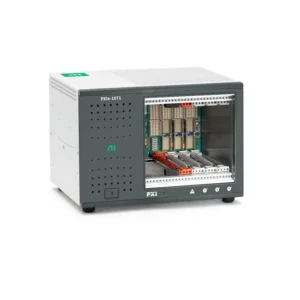
The module can be installed in a compatible chassis such as the PXI-1042Q chassis or another chassis with a conventional PXI-compatible peripheral slot.
It can be combined with PXI-4461 dynamic signal hardware, tachometer or counter modules and other NI PXI measurement modules to create a complete sound-and-vibration test system.
PXI-4472 Installation Workflow
Step 1: Verify Module Identity
Confirm whether the device is a PXI-4472 or PXI-4472B. Record its complete part number, board revision, serial number and calibration date.
Step 2: Confirm Chassis Compatibility
Select a chassis with a compatible 3U PXI peripheral slot, adequate cooling and the trigger resources required by the measurement system.
Step 3: Install the Required Software
Install a compatible version of NI-DAQmx before or according to the driver instructions. Confirm operating-system support for this legacy module and the selected development environment.
Step 4: Power Down the Chassis
Switch off the chassis before inserting the module. Keep the chassis grounded and follow appropriate electrostatic-discharge precautions.
Step 5: Install the PXI-4472
Align the module with the card guides, slide it into the selected slot and use the injector/ejector handle to seat the backplane connector. Tighten the retaining screws.
Step 6: Connect Sensors and Signals
Connect each sensor or signal to the correct SMB input. Verify signal range, sensor sensitivity, connector type and IEPE requirements before enabling excitation.
Step 7: Configure Coupling
Select DC coupling when low-frequency or bias information must be retained. Select AC coupling when DC components need to be removed and the frequencies of interest remain above the coupling cutoff.
Step 8: Configure IEPE Excitation
Enable IEPE excitation only for sensors designed to accept constant-current power. Check sensor bias voltage after enabling excitation to identify open or shorted connections.
Step 9: Select Sample Rate and Record Length
Choose a sample rate that covers the highest required frequency and allows an appropriate antialiasing-filter transition band. Select record length according to the required frequency resolution.
Step 10: Configure Triggering
Select free-running, analog, digital, pretrigger or posttrigger acquisition according to the event being measured. Verify the trigger level and source before starting the final test.
Step 11: Verify the Measurement Chain
Apply a known reference signal or sensor calibrator. Confirm amplitude, frequency, phase, channel assignment and engineering-unit scaling.
Step 12: Run and Save the Measurement
Acquire representative data and inspect time waveforms, spectra and overload indicators. Save the configuration together with measurement data and calibration information.
Sample-Rate Selection
The sample rate should be selected from the highest frequency that must be measured. Because the antialiasing filter has a transition region, the required signal bandwidth should remain below the theoretical Nyquist frequency.
Higher sample rates increase data volume. For long-duration monitoring, use a rate that captures the necessary frequency range without producing excessive storage requirements.
Engineering-Unit Scaling
Enter the sensor sensitivity using the correct unit, such as millivolts per g or millivolts per pascal. Incorrect scaling produces inaccurate engineering-unit results even when the acquired voltage is correct.
Record sensor serial numbers and calibration sensitivities with the test data. This improves traceability when sensors are exchanged between channels.
Grounding and Shielding
Use high-quality shielded coaxial cables and avoid routing sensor wiring beside motors, variable-frequency drives or high-current power cables. Ground loops can introduce line-frequency components and reduce usable dynamic range.
When several grounded devices are connected, review the complete grounding architecture. Do not defeat required protective-earth connections to remove measurement noise.
PXI-4472 Troubleshooting
The PXI-4472 Is Not Detected
Confirm that the module is installed in a compatible PXI slot and fully seated. Check chassis power, controller communication and NI-DAQmx installation, then refresh the hardware list in NI Measurement & Automation Explorer.
No Signal Is Measured
Verify the SMB cable, selected physical channel and acquisition configuration. Apply a known signal to determine whether the fault is associated with the sensor, cable or module channel.
An IEPE Sensor Produces No Valid Output
Confirm that IEPE excitation is enabled and that the sensor supports the available constant current. Check the sensor bias voltage for an open circuit, short circuit or incorrect wiring condition.
The Input Is Overloaded
Reduce the signal level or use an approved attenuating cable. Confirm that the sensor’s maximum output and DC bias remain within the module’s permitted range.
Low-Frequency Data Is Attenuated
Check whether AC coupling is enabled. The original PXI-4472 has an AC-coupling cutoff of approximately 3.4 Hz. Use DC coupling when frequencies below this region must be measured.
The Spectrum Contains Unexpected Frequencies
Check sensor mounting, cable movement, grounding, electromagnetic interference and the selected sample rate. Confirm that out-of-band signals are not overloading the analog front end before filtering.
Noise Is Higher Than Expected
Disconnect the sensor and terminate the input appropriately to separate module noise from sensor and cable noise. Inspect grounding, shielding, IEPE bias and nearby electrical equipment.
Channels Have Incorrect Phase Relationships
Verify sensor orientation, polarity, cable connections and channel assignment. When using multiple modules, confirm that clocks and triggers are routed from a common synchronization source.
The Module Cannot Reach 102.4 kS/s
Check whether all tasks use compatible sample rates and timing resources. Review driver configuration, system bandwidth and whether other devices are sharing the acquisition clock.
A Multi-Module System Loses Data
Check DMA configuration, controller performance, storage write speed and total data rate. Reduce unnecessary processing during acquisition or stream data to a faster destination.
The Trigger Does Not Occur
Verify trigger source, polarity, level and hysteresis. Confirm that the trigger signal reaches the selected analog channel or PXI trigger line and falls within its permitted electrical range.
Amplitude Measurements Are Incorrect
Check peak, RMS and peak-to-peak conventions. Confirm sensor sensitivity, external attenuation, coupling, engineering-unit scaling and calibration status.
NI-DAQmx Does Not Support the Module
The PXI-4472 is a mature legacy device. Verify that the selected NI-DAQmx release and operating system explicitly support it. A newer driver is not automatically compatible with every discontinued module.
PXI-4472 Comparison
| Model | Primary Configuration | Best Suited For |
|---|---|---|
| PXI-4472 | 8 inputs, 24 bit, 102.4 kS/s, approximately 3.4 Hz AC cutoff | General sound, vibration and dynamic signal acquisition |
| PXI-4472B | 8 inputs, 24 bit, 102.4 kS/s, approximately 0.5 Hz AC cutoff | Vibration measurements requiring improved low-frequency AC response |
| PXI-4462 | 4 inputs, 24 bit, up to 204.8 kS/s | Higher-bandwidth dynamic signal acquisition and precision audio testing |
| PXI-4461 | Dynamic input and analog output capability | Stimulus-response, audio and frequency-response testing |
| PXIe-4492 | 8 inputs, 24 bit, up to 204.8 kS/s, PXI Express | Newer high-bandwidth sound-and-vibration measurement systems |
PXI-4472 vs PXI-4472B
Both models provide eight simultaneously sampled 24-bit inputs, IEPE conditioning and a maximum sample rate of 102.4 kS/s. The most important practical difference is their AC-coupling response.
The original PXI-4472 has an AC-coupling cutoff of approximately 3.4 Hz, while the PXI-4472B lowers the cutoff to approximately 0.5 Hz. The B version is preferable when low-frequency vibration must be measured with AC coupling.
PXI-4472 vs PXI-4462
The PXI-4472 provides eight input channels at up to 102.4 kS/s. The PXI-4462 offers fewer channels but supports sample rates up to 204.8 kS/s and is designed for higher-bandwidth dynamic measurements.
Choose the PXI-4472 when channel density is more important. Choose the PXI-4462 when greater bandwidth and precision audio performance are the primary requirements.
PXI-4472 vs PXI-4461
The PXI-4472 is an input-only acquisition module with eight dynamic input channels. The PXI-4461 combines dynamic analog input and analog output functions.
The PXI-4461 is more appropriate when the system must generate a stimulus and measure the response. The PXI-4472 provides higher input-channel density for passive monitoring and multichannel sensor acquisition.
PXI-4472 vs PXIe-4492
The PXIe-4492 is a newer PXI Express dynamic signal acquisition module with a maximum sample rate of 204.8 kS/s and higher measurement performance. It is better suited to new systems requiring wider bandwidth and a PXI Express interface.
The PXI-4472 remains useful for maintaining conventional PXI systems and applications that do not require more than 102.4 kS/s per channel.
Selecting the Right Dynamic Signal Module
Choose the PXI-4472 when the application requires eight simultaneous 24-bit inputs, IEPE sensor support and measurement bandwidth up to approximately 45 kHz.
Select the PXI-4472B for improved low-frequency response with AC coupling. Choose the PXI-4462 or PXIe-4492 when sample rates up to 204.8 kS/s and wider signal bandwidth are required.
Recommended Related Products
- PXI-4472B 8-Channel Dynamic Signal Acquisition Module
- PXI-4462 4-Channel Dynamic Signal Acquisition Module
- PXI-4461 Dynamic Signal Acquisition and Generation Module
- PXIe-4492 8-Channel PXI Express Sound and Vibration Module
- PXI-1042Q Low-Noise PXI Chassis
- View More NI PXI Measurement Modules
Why Choose the PXI-4472?
- Provides eight simultaneously sampled input channels
- Uses high-resolution 24-bit delta-sigma ADCs
- Supports sampling rates up to 102.4 kS/s per channel
- Offers measurement bandwidth up to approximately 45 kHz
- Provides integrated antialiasing filters
- Includes IEPE excitation for compatible sensors
- Supports software-selectable AC and DC coupling
- Preserves channel-to-channel phase relationships
- Supports pretrigger and posttrigger acquisition
- Can be synchronized with additional PXI dynamic signal modules
- Integrates with NI-DAQmx and LabVIEW
Frequently Asked Questions
What is the PXI-4472?
The PXI-4472 is an eight-channel, 24-bit PXI dynamic signal acquisition module designed for sound, vibration and other high-dynamic-range measurements.
How many analog inputs does it provide?
It provides eight pseudodifferential analog input channels, each with its own simultaneously sampled 24-bit delta-sigma ADC.
What is the maximum sample rate?
The maximum sample rate is 102.4 kS/s on every channel.
What is the measurement bandwidth?
The module provides a maximum measurement bandwidth extending from DC to approximately 45 kHz, depending on coupling and sample-rate configuration.
Does the PXI-4472 support IEPE sensors?
Yes. It provides integrated constant-current excitation for compatible IEPE accelerometers, microphones and other two-wire powered sensors.
What is the input voltage range?
The direct input range is ±10 V peak. A compatible SMB-120 attenuating cable can extend the supported signal level to approximately ±31 V peak.
Does it have antialiasing filters?
Yes. Its integrated antialiasing filters automatically adjust according to the configured sample rate.
Can all eight channels sample simultaneously?
Yes. Every channel has a dedicated ADC, allowing simultaneous acquisition and preservation of phase relationships.
Does it support AC and DC coupling?
Yes. Input coupling is software selectable. The original PXI-4472 has an AC-coupling cutoff of approximately 3.4 Hz.
What is the difference between PXI-4472 and PXI-4472B?
The PXI-4472B provides a lower AC-coupling cutoff of approximately 0.5 Hz, compared with approximately 3.4 Hz for the original PXI-4472.
Which connectors are used?
The module provides eight front-panel SMB male connectors, one for each analog input channel.
Can several PXI-4472 modules be synchronized?
Yes. Multiple modules can share clock and trigger resources through a compatible PXI chassis to create a phase-coherent, high-channel-count system.
Which software controls the PXI-4472?
The module is controlled through a compatible NI-DAQmx release and can be programmed using LabVIEW, LabWindows/CVI and other supported environments.
What is the PXI-4472 part number?
The primary hardware part number is 778279-01. Part number 778664-01 identifies a configuration originally supplied with sound-and-vibration software.
Is the PXI-4472 suitable for new systems?
It remains useful for maintaining established PXI systems. New designs should also compare the PXI-4472 with newer PXI Express modules such as the PXIe-4492.
Request a Quote for the PXI-4472
Contact us for current availability, condition, lead time and project pricing for the NI PXI-4472 8-Channel 24-Bit Dynamic Signal Acquisition Module. We can also help identify compatible SMB cables, IEPE sensors, PXI chassis and related sound-and-vibration modules for your measurement system.