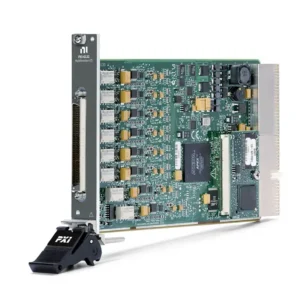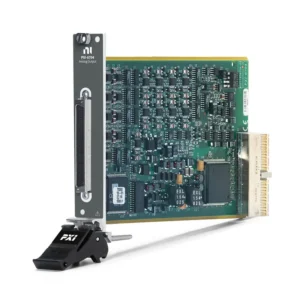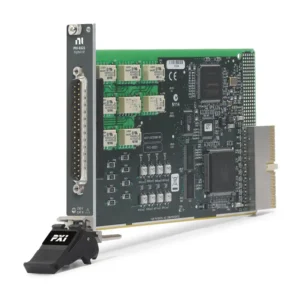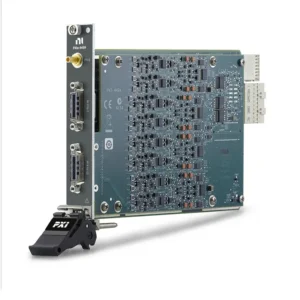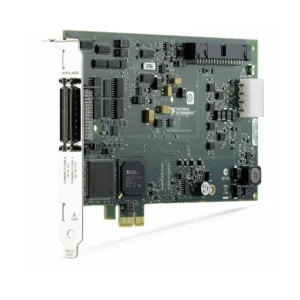


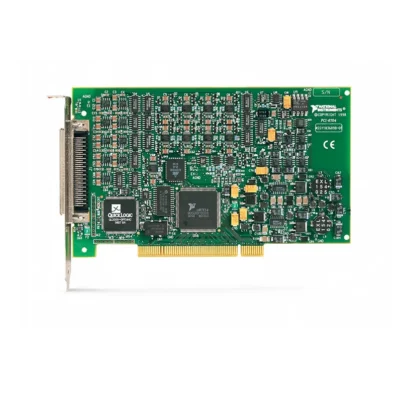
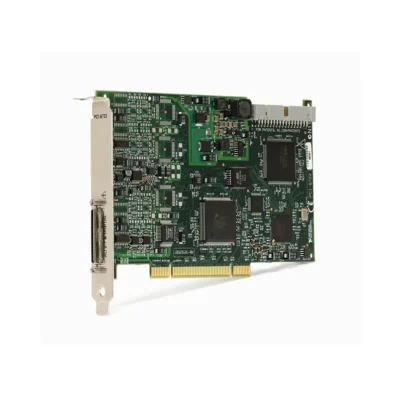
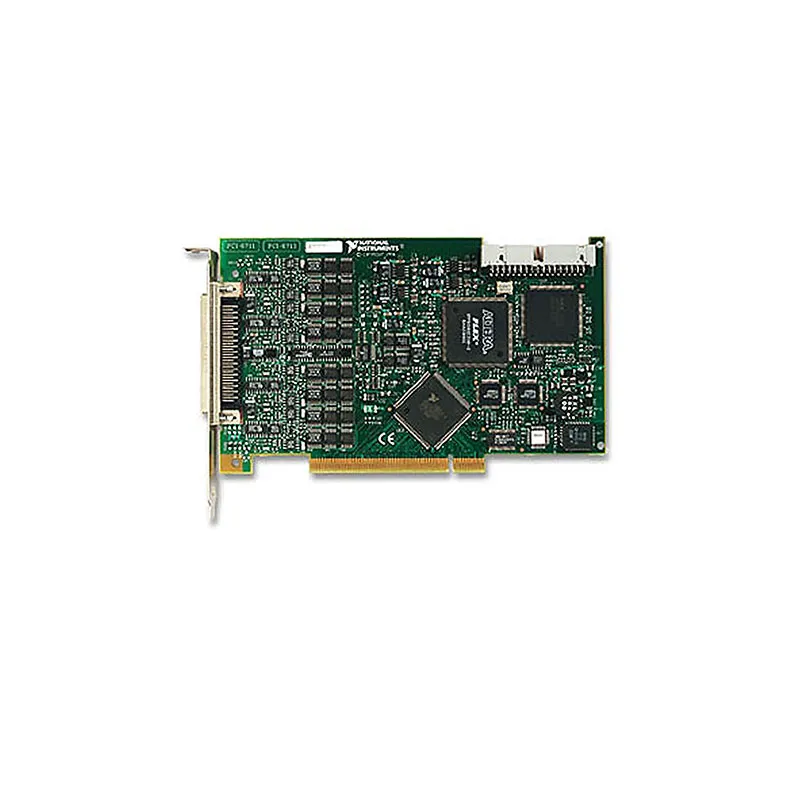
PCI-6711 4-Channel High-Speed Analog Output Device
The PCI-6711 is a high-speed PCI analog output device designed for waveform generation, stimulus-response testing, deterministic control and sensor simulation. It provides four independently programmable 12-bit voltage-output channels with hardware-timed, simultaneous multichannel updates.
Each analog output channel uses a dedicated digital-to-analog converter, allowing the device to update several outputs without the interchannel timing skew associated with multiplexed architectures. The PCI-6711 also includes eight 5 V TTL/CMOS digital I/O lines, two 24-bit counter/timers, digital triggering and external clock support.
Key Features of the PCI-6711
- Four independently programmable analog output channels
- 12-bit output resolution
- Up to 1 MS/s maximum analog update rate
- Hardware-timed simultaneous multichannel updates
- ±10 V analog output range
- Eight 5 V TTL/CMOS digital I/O lines
- Two 24-bit, 20 MHz counter/timers
- Digital triggering and external clocking
- PCI plug-in architecture
- 68-pin SCSI-type front connector
- NI-DAQmx and LabVIEW compatibility
- Suitable for deterministic control and waveform generation
PCI-6711 Technical Specifications
| Product Model | PCI-6711 |
|---|---|
| Part Number | 777740-01 |
| Product Type | High-speed analog output device |
| Bus Interface | PCI |
| Analog Output Channels | 4 voltage outputs |
| Output Resolution | 12 bits |
| Maximum Update Rate | Up to 1 MS/s |
| Output Range | ±10 V |
| Output Coupling | DC |
| Digital I/O | 8 bidirectional 5 V TTL/CMOS lines |
| Counter/Timers | 2 × 24-bit, 20 MHz |
| Triggering | Digital triggering |
| External Clocking | Supported |
| Front Connector | 68-pin male SCSI-type connector |
| Driver | NI-DAQmx |
| Analog Inputs | None |
PCI-6711 Part Number and Accessories
| Item | Part Number | Description |
|---|---|---|
| PCI-6711 | 777740-01 | Four-channel, 12-bit high-speed PCI analog output device |
| SH68-68-EPM Cable | 199006 series | Recommended shielded 68-pin cable for low-noise signal connections |
| SCB-68A | 782536-01 | Shielded screw-terminal block for custom field wiring |
| BNC-2110 | 777643-01 | BNC terminal accessory for laboratory signal connections |
| TBX-68 | 777141-01 | DIN-rail-mount screw-terminal accessory |
Verify cable length, shielding, terminal-block compatibility and connector orientation before ordering. Shielded cabling is recommended when generating low-level or noise-sensitive signals.
Dedicated DAC Architecture
The PCI-6711 provides a dedicated digital-to-analog converter for each of its four output channels. This architecture permits channels to update together using a shared hardware sample clock while preserving independently defined waveform data.
Simultaneous updating is particularly important in control systems, phase-related waveform generation and applications where the relative timing between channels must remain consistent.
Hardware-Timed Waveform Generation
Hardware timing allows the PCI-6711 to generate repeatable waveforms without depending on nondeterministic software timing for every output sample. Waveform data can be buffered and transferred to the device while its timing engine controls the actual output updates.
Engineers can generate sine, square, triangle, ramp and application-specific arbitrary waveforms. Output channels may share the same update clock while using different waveform values.
Digital I/O and Counter/Timers
Eight bidirectional digital lines can control external relays, monitor logic states or coordinate the analog outputs with other equipment. These lines are intended for 5 V TTL/CMOS-compatible signals.
The two 24-bit, 20 MHz counter/timers support event counting, pulse generation, frequency measurement and timing operations. They can also assist with trigger generation and test-sequence synchronization.
PCI-6711 Applications
- Multichannel waveform generation
- Stimulus-response testing
- Sensor and transducer simulation
- Power-supply control
- Four-channel actuator command generation
- Hardware-in-the-loop testing
- Deterministic control systems
- Automated product validation
- Laboratory function generation
- Research and educational systems
Sensor and Signal Simulation
The PCI-6711 can reproduce voltage profiles representing sensors, command signals or operating conditions. A test application can generate normal and abnormal values to evaluate how a controller responds throughout its operating range.
Stimulus-Response Testing
Four independent outputs can stimulate several DUT inputs while a separate data acquisition or digitizer device measures the resulting response. Hardware triggers can coordinate signal generation with the measurement device.
PCI-6711 Installation Workflow
Step 1: Confirm PCI Compatibility
Verify that the computer provides a compatible conventional PCI slot and supports the required NI-DAQmx version.
Step 2: Install the Device
Power down the computer, observe ESD precautions and install the PCI-6711 firmly in the selected PCI slot.
Step 3: Install and Verify NI-DAQmx
Install NI-DAQmx, restart the system and confirm that the device appears correctly in NI Measurement & Automation Explorer.
Step 4: Connect the Accessory
Attach the appropriate 68-pin cable and terminal accessory. Verify analog ground, digital ground, PFI and output-channel wiring against the connector documentation.
Step 5: Test the Outputs
Use an NI MAX test panel or a simple NI-DAQmx task to generate a safe voltage before connecting the production DUT.
PCI-6711 Troubleshooting
The device is not detected
Check PCI seating, computer BIOS settings, NI-DAQmx installation and Windows Device Manager. Test another compatible PCI slot when available.
No voltage appears at the output
Confirm the physical channel name, output range, ground reference and cable pinout. Verify that the task has started and that the load is connected to the correct AO channel.
The waveform contains noise
Use a shielded cable, shorten the signal path and separate analog wiring from motors, relays and switching power supplies. Check for grounding loops between the computer and DUT.
Channels do not start together
Place the channels in the same hardware-timed NI-DAQmx task and use a shared sample clock and start trigger.
An output reports an overload
Disconnect the load and confirm that it does not demand more current than the output can provide. Use an external amplifier when driving low-impedance or high-current loads.
PCI-6711 Comparison
| Model | AO Channels | Resolution | Maximum Update Rate |
|---|---|---|---|
| PCI-6711 | 4 | 12 bits | 1 MS/s |
| PCI-6713 | 8 | 12 bits | 1 MS/s |
| PCI-6722 | 8 | 13 bits | 800 kS/s |
| PCI-6731 | 4 | 16 bits | 1 MS/s |
| PCI-6733 | 8 | 16 bits | 1 MS/s |
Choose the PCI-6711 for four-channel applications that prioritize fast updates. Select the PCI-6731 when the same channel count and speed are required with higher 16-bit resolution.
PCI-6711 Frequently Asked Questions
What is the PCI-6711?
It is a four-channel, 12-bit PCI analog output device for hardware-timed control and waveform generation.
Does the PCI-6711 include analog inputs?
No. It is primarily an analog output device and does not provide analog input channels.
Can all four outputs update simultaneously?
Yes. Its dedicated DAC architecture supports synchronized multichannel updates under hardware timing.
What software controls the PCI-6711?
The device is controlled through NI-DAQmx and can be programmed using LabVIEW and other supported environments.
What is the PCI-6711 part number?
The standard catalog part number is 777740-01.
Recommended Related Products
- PCI-6713 8-Channel Analog Output Device
- PCI-6731 16-Bit Analog Output Device
- PCI-6733 8-Channel Analog Output Device
- PCI-6704 Static Analog Output Device
Request a Quote for the PCI-6711
Contact us for current availability, pricing and configuration assistance for the PCI-6711 high-speed analog output device. We can also help identify compatible cables, terminal blocks and replacement analog output hardware.