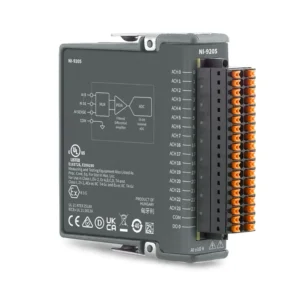


NI-9326 6-Channel C Series Frequency Input Module
The NI-9326 is a six-channel C Series frequency input module designed for frequency, period and edge-counting measurements. It supports differential or single-ended signals with amplitudes ranging from approximately ±50 mV to 150 Vrms.
Each input can be routed to an independent 32-bit counter and configured for rising- or falling-edge detection. Adjustable voltage thresholds, hysteresis, digital glitch filtering and analog Butterworth filters help the module acquire signals from variable-reluctance sensors, Hall-effect sensors, encoders and other industrial pulse sources.
Key Features of the NI-9326
- Six frequency input channels
- Six independent 32-bit counters
- Differential or single-ended input configuration
- 0.025 Hz to 128 kHz frequency range
- 102.4 kS/s maximum counter sample rate
- 100 MHz internal counter timebase
- ±50 mV minimum to 150 Vrms maximum input range
- 241 kHz input bandwidth
- Rising- or falling-edge detection per channel
- Programmable threshold and hysteresis
- Digital glitch filtering
- Selectable second-order Butterworth filters
- Channel-to-channel isolation
- 150 Vrms channel-to-earth isolation
- -40°C to 70°C operating range
NI-9326 Technical Specifications
| Product Model | NI-9326 |
|---|---|
| Product Type | C Series frequency input module |
| Number of Inputs | 6 |
| Input Configuration | Differential or single-ended |
| Input Range | ±50 mV minimum to 150 Vrms maximum |
| Input Frequency Range | 0.025 Hz to 128 kHz |
| Input Bandwidth | 241 kHz at -3 dB |
| Minimum Detectable Pulse Width | 2 µs under specified conditions |
| Input Propagation Delay | 1.67 µs maximum |
| Channel-to-Channel Skew | 85 ns maximum |
| Threshold Range | -9.5 V to +9.5 V per channel |
| Threshold Resolution | 7.8 mV |
| Hysteresis Range | 0 V to 5 V per channel |
| Digital Glitch Filter | 0 ns to 5.24 ms in 80 ns steps |
| Analog Filter | Second-order Butterworth |
| Number of Counters | 6 |
| Counter Resolution | 32 bits |
| Counter Sample Rate | 102.4 kS/s maximum |
| Counter Measurements | Frequency, period and edge counting |
| Internal Timebase | 100 MHz |
| Timebase Accuracy | ±64 ppm maximum |
| Isolation | 150 Vrms channel-to-channel and channel-to-earth, CAT I |
| Weight | 170 g |
| Operating Temperature | -40°C to 70°C |
Six Independent Frequency Counters
The NI-9326 contains six 32-bit counters, allowing all six channels to perform frequency, period or edge-counting measurements. Any input channel can be routed to any counter input, providing flexibility when configuring measurement logic.
The 100 MHz internal timebase supports accurate timing of pulse periods and edges. Measurement performance depends on the input frequency, filter settings, signal quality and selected counter mode.
Flexible Input Thresholds
The programmable threshold range allows the module to detect signals that do not conform to one fixed digital logic level. This is useful for variable-reluctance sensors, magnetic pickups, Hall-effect sensors and other devices whose output amplitude changes with speed or operating condition.
Hysteresis can be added to prevent electrical noise near the threshold from producing multiple false transitions.
Digital and Analog Filtering
The digital glitch filter rejects pulses shorter than the configured duration. Settings are available from disabled operation through 5.24 ms, with 80 ns resolution.
The second-order Butterworth filter offers selectable cutoff frequencies from approximately 1 Hz to 6.167 kHz. Lower cutoff settings reduce measurement noise but introduce additional delay and settling time.
High-Voltage Isolated Inputs
The module supports input signals up to 150 Vrms and provides isolation between channels and earth ground. It is rated for Measurement Category I signal circuits and must not be connected directly to building mains or higher measurement categories.
NI-9326 Part Number and Accessories
| Item | Part Number | Description |
|---|---|---|
| NI-9326 Standard | 786999-01 | Six-channel C Series frequency input module |
| NI-9326 Conformal Coated | 786999-02 | Conformal-coated version for additional environmental protection |
| NI-9960 | Configuration dependent | Screw-terminal plugs for NI-9326 signal connections |
| NI-9929 | Configuration dependent | Backshell kit providing insulation and operator protection |
| Shielded Sensor Cable | Application dependent | Connects encoders and frequency sensors in noisy environments |
The NI-9929 backshell is particularly important when wiring higher-voltage signals because it provides additional insulation and strain relief around the terminal connections.
NI-9326 Applications
- Rotational-speed measurement
- Variable-reluctance sensor acquisition
- Hall-effect sensor monitoring
- Encoder pulse counting
- Turbine and engine testing
- Flowmeter frequency measurement
- Industrial tachometer systems
- Automotive dynamometer testing
- Period and pulse measurement
- Machine condition monitoring
Rotational-Speed Measurement
Frequency measurements from a gear-tooth or magnetic pickup can be converted into shaft speed using the number of pulses generated per revolution. Programmable thresholds help maintain reliable detection as sensor amplitude changes with speed.
Flow and Turbine Monitoring
Many turbine flowmeters provide a pulse frequency proportional to flow rate. The NI-9326 can measure frequency or count total pulses for instantaneous-flow and accumulated-volume calculations.
NI-9326 Installation Workflow
Step 1: Identify the Sensor Signal
Determine whether the source is differential or single-ended and document its minimum and maximum amplitude, frequency and source impedance.
Step 2: Install the Module
Insert the NI-9326 into a compatible CompactDAQ or CompactRIO chassis and secure the module.
Step 3: Connect the Sensor
Connect differential signals between CH+ and CH-. Use short, shielded wiring where low-amplitude signals are exposed to electrical noise.
Step 4: Configure Threshold and Hysteresis
Set a threshold that lies within the valid signal swing and add enough hysteresis to prevent noise-related transitions.
Step 5: Select the Filter
Use digital glitch rejection or the Butterworth filter when necessary, while accounting for the filter’s delay and settling time.
Step 6: Verify Against a Known Frequency
Apply a known pulse source and confirm the measured frequency, period and edge count before connecting the production sensor.
NI-9326 Troubleshooting
The module reports zero frequency
Check CH+ and CH- polarity, sensor power and signal amplitude. Confirm that the waveform crosses the configured threshold.
The measured frequency is unstable
Increase hysteresis, enable glitch filtering or select an appropriate Butterworth filter. Inspect shielding and grounding.
Low-speed signals are not detected
Verify the minimum sensor amplitude at low speed and reduce the threshold if necessary. Variable-reluctance sensors often produce smaller signals at low rotational speed.
High-frequency pulses are missed
Review pulse width, filter settings and the 128 kHz input-frequency limit. Disable excessive filtering during high-frequency measurements.
Two channels interfere with one another
Improve cable separation and shielding. Skip an adjacent physical channel when practical to improve crosstalk performance.
NI-9326 Comparison
| Model | Configuration | Best Suited For |
|---|---|---|
| NI-9326 | 6 isolated frequency inputs, 128 kHz | High-voltage and variable-amplitude frequency signals |
| NI-9361 | 8-channel differential counter input | Encoders and conventional differential pulse sources |
| NI-9411 | 6 differential digital inputs | Fast differential digital and encoder signals |
| NI-9423 | 8 high-speed 24 V sinking inputs | Industrial pulse-state detection |
NI-9326 Frequently Asked Questions
How many counters does the NI-9326 provide?
It provides six independent 32-bit counters.
What measurements can it perform?
The counters support frequency, period and edge-counting measurements.
What is the maximum input frequency?
The specified input-frequency range extends to 128 kHz.
Can it measure variable-reluctance sensors?
Yes. Its adjustable thresholds, hysteresis and filters make it suitable for many variable-reluctance sensor signals.
Are the channels isolated?
Yes. The module provides 150 Vrms channel-to-channel and channel-to-earth isolation for CAT I circuits.
Request a Quote for the NI-9326
Contact us for availability, lead time and project pricing for the NI-9326 C Series frequency input module. We can also help select NI-9960 terminals, the NI-9929 backshell and compatible CompactDAQ or CompactRIO hardware.