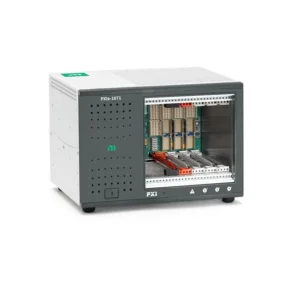


RMX-4002 4-Slot Modular DC Electronic Load Mainframe
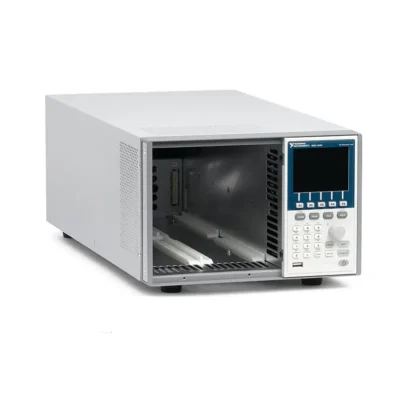
The RMX-4002 is a four-slot modular DC electronic load mainframe designed for power-source development, production testing, component validation and automated electronic test systems. It accepts RMX-4003, RMX-4004, RMX-4005 and RMX-4006 electronic load modules.
Engineers can combine different load modules in the same RMX-4002 to configure the required channel count, maximum input voltage, current-sinking capacity and power rating. Compatible modules include dual-channel and single-channel versions covering voltages up to 500 V, currents up to 70 A and power ratings up to 350 W per module.
The modular architecture allows one mainframe to support several independent loads or multiple channels connected in parallel for increased current and power capacity. The RMX-4002 is suitable for testing DC power supplies, converters, batteries, automotive electronics, chargers and other energy-producing devices.
Key Features of the RMX-4002
- Four electronic-load module slots
- Compatible with RMX-4003, RMX-4004, RMX-4005 and RMX-4006
- Supports single-channel and dual-channel load modules
- Configurable for as many as eight load channels
- Supports low-voltage, high-current load modules
- Supports high-voltage load modules up to 500 V
- Supports individual load modules rated up to 350 W
- Multiple load channels can be connected in parallel
- Constant-current operating mode
- Constant-voltage operating mode
- Constant-resistance operating mode
- Constant-power operating mode
- Dynamic current and resistance testing
- Front-panel interactive control
- USB and RS232 remote-control capability
- GPIB support according to system configuration
- Go/No-Go status output
- LabVIEW instrument-driver support
- Standard 19-inch rack installation
- Suitable for automated power-source testing
RMX-4002 Technical Specifications
| Product Model | RMX-4002 |
|---|---|
| Part Number | 786528-01 |
| Product Type | Modular DC electronic load mainframe |
| Number of Module Slots | 4 |
| Compatible Modules | RMX-4003, RMX-4004, RMX-4005 and RMX-4006 |
| Maximum Configurable Channels | Up to 8 with four dual-channel load modules |
| Maximum Power per Load Module | Up to 350 W, depending on the installed module |
| Maximum Voltage Capability | Up to 500 VDC with the RMX-4006 |
| Maximum Current Capability | Up to 70 A per module with the RMX-4005 |
| Load Operating Modes | CC, CV, CV+CC, CR and CP, depending on module and configuration |
| Dynamic Load Modes | Dynamic constant-current and constant-resistance operation |
| Remote Interfaces | USB and RS232; GPIB according to system configuration |
| Software Support | NI RMX-400x Loads instrument driver |
| Required Software for NI Driver | LabVIEW 8.2 or later and NI-VISA 5.0 or later |
| Nominal AC Input | 100 VAC to 120 VAC or 200 VAC to 240 VAC |
| AC Input Frequency | 47 Hz to 63 Hz |
| Maximum Mainframe Input Rating | 250 VA |
| Rack Format | Standard 19-inch, 4U rack-mount mainframe |
| Approximate Weight | 17.1 kg when fully populated |
| Cooling | Forced-air cooling |
| Protection Class | Class I |
| Ingress Protection | IPX0 |
The RMX-4002 does not provide a DC load channel by itself. Its voltage, current, channel count and power-sinking specifications are determined by the electronic load modules installed in its four slots.
The 250 VA value is the AC input rating of the mainframe electronics and cooling system. It is not the DC power that the installed load modules can sink.
RMX-4002 Part Number and Compatible Modules
| Item | Part Number | Configuration |
|---|---|---|
| RMX-4002 | 786528-01 | Four-slot mainframe for RMX-400x DC electronic load modules |
| RMX-4003 | 786529-01 | Two channels, 100 W per channel, 80 V and 20 A per channel |
| RMX-4004 | 786530-01 | Two channels with 30 W/5 A and 250 W/40 A ranges, up to 80 V |
| RMX-4005 | 786531-01 | One channel, 350 W, 80 V and 70 A electronic load |
| RMX-4006 | 786532-01 | One channel, 350 W, 500 V and 10 A electronic load |
Confirm the number and type of required load modules before ordering. An RMX-4002 mainframe without installed modules cannot sink power from a device under test.
Four-Slot Modular Architecture
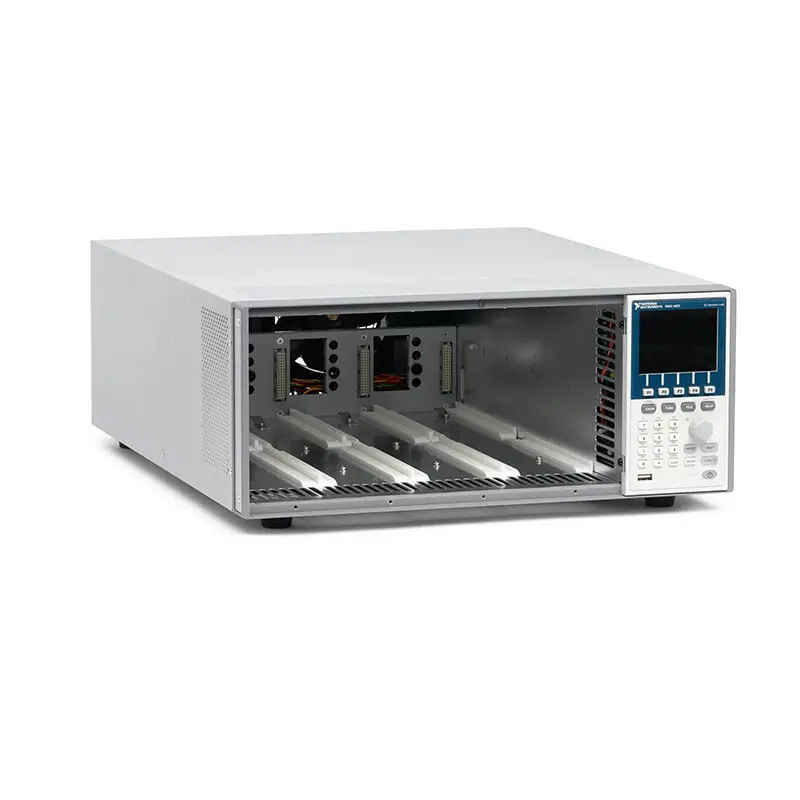
The RMX-4002 provides four front-accessible slots for electronic load modules. Each slot can accept a compatible RMX-400x load selected according to the required voltage, current, power and channel configuration.
The mainframe supplies operating power, cooling, user control and communication resources for the installed modules. The DC input terminals used to connect devices under test are located on the individual load modules.
This modular structure allows one test system to combine high-current, high-voltage and dual-channel loads without purchasing several independent benchtop instruments.
Configurable Channel Count
The number of available electronic-load channels depends on the installed modules. RMX-4003 and RMX-4004 modules each provide two channels, while the RMX-4005 and RMX-4006 each provide one channel.
Installing four dual-channel modules provides as many as eight independently controlled load channels. Installing four single-channel modules provides four higher-power load channels.
A mixed configuration can balance channel density with voltage, current and power requirements. For example, one mainframe can combine dual-channel loads for auxiliary outputs with high-current or high-voltage modules for a main power rail.
RMX-4003 Dual-Channel Load Module
The RMX-4003 provides two independent electronic-load channels. Each channel supports as much as 100 W, 80 VDC and 20 A.
Four RMX-4003 modules can create an eight-channel system with as much as 100 W of loading on each independently controlled channel. This configuration is useful for testing multi-output power supplies, automotive control modules and devices containing several lower-power DC rails.
RMX-4004 Asymmetric Dual-Channel Module
The RMX-4004 provides two channels with different power and current ratings. One channel supports up to 30 W and 5 A, while the other supports up to 250 W and 40 A. Both operate within a maximum voltage range of 80 VDC.
This arrangement is useful for devices containing one main power output and one lower-power auxiliary output. It reduces the need to dedicate two identical high-power loads to circuits with substantially different requirements.
RMX-4005 High-Current Load Module
The RMX-4005 is a single-channel, 350 W electronic load supporting input voltages up to 80 VDC and current up to 70 A.
It is appropriate for low-voltage, high-current power supplies, automotive electrical systems, DC converters, battery packs and other sources that must be evaluated under substantial current loading.
RMX-4006 High-Voltage Load Module
The RMX-4006 is a single-channel, 350 W electronic load rated for as much as 500 VDC and 10 A.
This module extends the RMX-4002 system into higher-voltage power-source testing. Applications can include industrial power supplies, high-voltage converters and other DC sources operating above the RMX-4003, RMX-4004 or RMX-4005 voltage range.
Maximum Configurable Load Power
The total DC power-sinking capacity depends on the modules installed. A mainframe populated with four 350 W RMX-4005 or RMX-4006 modules can provide as much as 1400 W of aggregate installed load capacity.
This rating represents the sum of the individual module capacities. Every module remains subject to its own voltage, current, power, cooling and operating-area limits.
Multiple channels may be connected in parallel when supported by the module configuration and official operating instructions. Parallel wiring can increase the available load current or power for one DUT output.
Constant-Current Mode
In constant-current mode, an installed electronic load sinks the programmed current as the source voltage changes within the module’s operating range.
This mode is commonly used for testing DC power-supply regulation, battery discharge performance, charger behavior and current-protection circuits.
Constant-current mode can also operate dynamically, allowing the load to alternate between two current levels to evaluate the source’s transient response.
Constant-Voltage Mode
In constant-voltage mode, the load adjusts the current it sinks to regulate the DUT output at a programmed voltage.
This mode can be useful for evaluating current sources, battery chargers and other devices that require the load to maintain a defined terminal voltage.
Constant-Resistance Mode
Constant-resistance mode simulates a resistive load by changing the input current in proportion to the applied voltage.
Dynamic constant-resistance operation can alternate between two resistance settings, helping engineers observe how the power source responds when the effective load changes.
Constant-Power Mode
Constant-power mode adjusts current as the DUT voltage changes so that the load absorbs approximately the programmed power.
This behavior is useful for simulating electronic equipment, converters and other loads that consume relatively constant power over a range of input voltages.
The programmed operating point must remain within the selected module’s voltage, current and power limits.
Dynamic Load Testing
Dynamic operation allows compatible electronic-load channels to switch between two load levels. Engineers can use this function to test the transient response of a power supply when its output demand changes suddenly.
Typical measurements include output-voltage deviation, recovery time, overshoot, undershoot and stability. A suitable oscilloscope or digitizer is normally used to capture the source response.
Parallel Load Operation
Compatible load channels can be connected in parallel to increase current-sinking or power capability. This allows the RMX-4002 to test a source whose output exceeds the capacity of one load module.
Parallel channels must have compatible voltage ratings and control settings. All cables, connectors and protective devices must be rated for the combined current.
Use matched wiring where practical so that resistance differences do not cause one channel to absorb a disproportionate share of the total load.
Front-Panel Operation
The RMX-4002 provides centralized interactive control for the installed load modules. Operators can select channels, configure operating modes, enter load values and monitor voltage, current and power.
Front-panel control is useful during initial setup, troubleshooting and engineering development. Automated production systems can use remote commands after the desired configuration has been validated manually.
Remote Control and Automation
The RMX-400x electronic load platform supports remote control through USB and RS232 interfaces. GPIB communication may also be available according to the mainframe configuration.
Remote programming allows test software to configure each channel, enable or disable loading, read measurements and check instrument status without manual intervention.
This capability makes the RMX-4002 suitable for repetitive validation, automated production testing and long-duration reliability testing.
NI RMX-400x Loads Instrument Driver
NI provides the RMX-400x Loads instrument driver for supported electronic-load modules. The driver includes LabVIEW functions for configuring and controlling RMX-4003, RMX-4004, RMX-4005 and RMX-4006 devices.
NI identifies LabVIEW 8.2 or later and NI-VISA 5.0 or later as the minimum requirements for the legacy project-style instrument driver. Confirm compatibility with the actual LabVIEW and operating-system version before installation.
The mainframe and installed load modules can also be controlled using supported remote commands documented in the RMX-400x programming manual.
Go/No-Go Testing
The RMX-400x platform can evaluate measured values against configured upper and lower limits. This supports pass/fail decisions during repetitive production or incoming-inspection tests.
A Go/No-Go status output can communicate the result to other test-system hardware. Test software can also record the measured values and pass/fail status for product traceability.
Power-Supply Testing
The RMX-4002 is well suited for evaluating single-output and multi-output DC power supplies. Different channels can load individual power rails while instruments measure voltage regulation, ripple, noise and transient behavior.
Dynamic load steps can be coordinated with an oscilloscope to capture how quickly the power supply recovers after a sudden change in demand.
Battery and Charger Testing
Electronic loads can discharge batteries at controlled current, resistance or power levels. Test software can record voltage, current, power and elapsed time throughout the discharge sequence.
The RMX-4002 can also help evaluate battery chargers by simulating different load conditions at the charger output. The system is not regenerative; energy absorbed by the load is converted into heat and removed through forced-air cooling.
DC-DC Converter Testing
Multiple load channels allow engineers to test converters containing several output rails. Each rail can be loaded independently while input and output measurements are collected.
The programmable modes support efficiency mapping, cross-regulation testing, protection verification and transient-response characterization.
Automotive ECU Testing
The RMX-4002 can be integrated into automotive electronic control-unit test systems to simulate lamps, motors, actuators and other DC electrical loads within the installed module ratings.
Its modular architecture allows high-current channels to be combined with several lower-power channels. This is useful when testing an ECU containing different driver-output types.
For inductive-load emulation or specialized fault behavior, additional switching, signal-conditioning or load-simulation hardware may be required.
Production Test Systems
In production testing, the RMX-4002 can apply repeatable electrical loads to each DUT. Automated software can select a channel, set the required operating point, capture measurements and determine whether the product meets its limits.
A single configurable mainframe can support several product variants when the installed module combination covers their different voltage, current and power requirements.
Burn-In and Reliability Testing
The mainframe can operate as part of a long-duration system used to load power sources or electronic assemblies during burn-in and reliability testing.
Because absorbed electrical power is converted into heat, provide adequate rack ventilation and keep the mainframe’s air inlet and exhaust paths unobstructed.
RMX-4002 Applications
- DC power-supply development
- Multi-output power-supply testing
- Battery discharge testing
- Battery charger validation
- DC-DC converter characterization
- Power-adapter testing
- Automotive ECU output testing
- Power-electronics validation
- Production functional testing
- Go/No-Go inspection
- Burn-in and reliability testing
- Dynamic load-transient testing
- Laboratory power-source development
- Automated test equipment
RMX-4002 Installation Considerations
The RMX-4002 requires a standard 19-inch rack location with approximately 4U of vertical space. NI installation guidance calls for additional clearance to maintain adequate ventilation.
The fully populated mainframe weighs approximately 17.1 kg. Use rack hardware and support rails rated for the instrument’s weight.
Connect the chassis to protective earth and use an AC branch circuit suitable for the 100 V to 120 V or 200 V to 240 V input configuration. Confirm the voltage-selection and installation requirements before applying power.
Cooling and Rack Airflow
Electronic loads dissipate absorbed DC power as heat. A fully populated RMX-4002 can therefore create a substantial thermal load inside an equipment rack.
Keep all cooling fans, air intakes and exhaust openings clear. Do not place heat-sensitive equipment directly in the hot exhaust path.
Monitor rack temperature during high-power operation and provide forced cabinet ventilation when the installed modules operate near their rated power for extended periods.
RMX-4002 Troubleshooting
The Mainframe Does Not Power On
Confirm the AC input voltage, power cord, branch circuit and protective earth connection. Check that the main power switch is on and that the selected input configuration matches the facility supply.
An Installed Load Module Is Not Recognized
Turn off the mainframe before removing or installing a module. Verify that the electronic load is fully inserted into a compatible slot and that its connectors are not damaged.
The Load Will Not Turn On
Check the selected channel, programmed operating mode, load value and input voltage. Review active protection or alarm messages and confirm that the DUT polarity is correct.
The Channel Cannot Sink the Programmed Current
The DUT may not provide sufficient voltage for the selected current, or the requested operating point may exceed the module’s power envelope. Check cable resistance, connection polarity and the load module’s voltage, current and power limits.
The Mainframe Reports Overtemperature
Disable the loads and allow the system to cool. Check the fans, air inlet, exhaust clearance, ambient temperature and total power being dissipated by the installed modules.
Dynamic Load Results Are Unstable
Inspect the DUT output cabling and use short, low-inductance connections where possible. Confirm that the dynamic load levels remain inside the module’s operating area.
Measurement probes and oscilloscope grounding can also affect the observed transient waveform.
USB Communication Does Not Work
Verify the USB cable, NI-VISA installation and RMX-400x driver. Confirm that the correct VISA resource is selected by the application.
RS232 Communication Does Not Work
Check the required cable wiring, COM port, baud rate, data format and command terminator. The host and RMX-4002 must use matching serial settings.
Parallel Channels Do Not Share Current Correctly
Verify that the channels use compatible operating modes and settings. Inspect cable lengths and conductor sizes because unequal connection resistance can create uneven current sharing.
RMX-4002 Comparison with Similar Electronic Load Products
| Model | Configuration | Best Suited For |
|---|---|---|
| RMX-4000 | Two-slot electronic load mainframe | Smaller systems requiring one or two load modules |
| RMX-4002 | Four-slot electronic load mainframe | Multi-channel and mixed-module power testing |
| RMX-4003 | Two channels, 100 W per channel, 80 V, 20 A | High channel density and multi-output supplies |
| RMX-4004 | Two asymmetric channels, 30 W and 250 W | Main and auxiliary rail testing |
| RMX-4005 | One channel, 350 W, 80 V, 70 A | Low-voltage, high-current sources |
| RMX-4006 | One channel, 350 W, 500 V, 10 A | High-voltage DC source testing |
RMX-4002 vs RMX-4000
The RMX-4000 provides two load-module slots, while the RMX-4002 provides four slots.
Choose the RMX-4000 for a compact system requiring no more than two modules. Choose the RMX-4002 when the application requires additional channels, mixed load types or more parallel load capacity.
RMX-4002 vs RMX-4005
The RMX-4002 is a mainframe, while the RMX-4005 is a 350 W load module installed inside a compatible mainframe.
The RMX-4002 alone cannot sink DUT current. At least one compatible electronic load module must be installed to create a functional load channel.
RMX-4002 vs Programmable DC Power Supply
The RMX-4002 system absorbs electrical power from a DUT. A programmable supply such as the RMX-4127 generates electrical power.
Using a power supply and electronic load together creates a source-and-load test system for converters, power supplies, chargers and other power-electronic devices.
The RMX-4002 is not regenerative. Power absorbed from the DUT is converted into heat rather than returned to the facility AC supply.
Selecting the Right RMX-4002 Configuration
Select RMX-4003 modules when channel density is the primary requirement. Each module provides two 100 W channels for outputs up to 80 V and 20 A.
Select the RMX-4004 when the DUT contains one higher-power output and one low-power auxiliary rail. Select the RMX-4005 for currents up to 70 A at voltages up to 80 V.
Select the RMX-4006 for input voltages above 80 V and up to 500 V. Mixed configurations can combine these capabilities in one mainframe.
Before ordering, document the required minimum operating voltage, maximum voltage, maximum current, continuous power, transient profile and number of independent DUT channels.
Recommended Related Products
- RMX-4000 2-Slot Electronic Load Mainframe
- RMX-4003 2-Channel 100 W Electronic Load Module
- RMX-4004 Dual-Channel Electronic Load Module
- RMX-4005 350 W 70 A Electronic Load Module
- RMX-4006 350 W 500 V Electronic Load Module
- RMX-4124 1500 W 30 V Programmable DC Power Supply
- RMX-4126 1500 W 230 V Programmable DC Power Supply
- RMX-4127 1500 W 650 V Programmable DC Power Supply
- View More National Instruments Products
Why Choose the RMX-4002?
- Provides four configurable electronic-load slots
- Supports as many as eight load channels
- Accepts modules covering up to 500 V or 70 A
- Supports mixed voltage, current and power configurations
- Allows compatible channels to operate in parallel
- Provides CC, CV, CR and CP load modes
- Supports dynamic load testing
- Integrates into automated LabVIEW test systems
- Fits standard 19-inch equipment racks
- Can be reconfigured for future test requirements
Frequently Asked Questions
What is the RMX-4002?
The RMX-4002 is a four-slot modular mainframe that holds compatible RMX-400x DC electronic load modules for automated power-source testing.
What is the RMX-4002 part number?
The standard NI part number for the RMX-4002 is 786528-01.
Does the RMX-4002 include electronic load modules?
The RMX-4002 is the mainframe. Confirm separately whether the required RMX-4003, RMX-4004, RMX-4005 or RMX-4006 modules are included in a quotation.
How many load channels can the RMX-4002 provide?
It can provide as many as eight channels when all four slots contain dual-channel RMX-4003 or RMX-4004 modules.
What is the maximum load power?
Power depends on the installed modules. Individual modules provide up to 350 W, and four 350 W modules can provide up to 1400 W of aggregate installed capacity.
What is the maximum supported voltage?
An RMX-4006 module supports input voltage up to 500 VDC. Other modules are rated for as much as 80 VDC.
What is the maximum supported current?
The RMX-4005 supports up to 70 A on one channel. Compatible channels can also be connected in parallel when additional current capacity is required.
Which operating modes are available?
The electronic-load platform supports constant-current, constant-voltage, constant-resistance and constant-power modes. Dynamic operation is available for constant-current and constant-resistance testing.
Can different module models be installed together?
Yes. The mainframe can combine compatible RMX-400x modules to create a mixed configuration, subject to the system’s electrical, control and cooling requirements.
Does the RMX-4002 source power?
No. It is an electronic-load mainframe that absorbs power from a source. A separate programmable power supply is required when the test system must generate DC power.
Which driver controls the RMX-4002 system?
NI provides the RMX-400x Loads project-style instrument driver for the compatible electronic load modules. NI identifies LabVIEW 8.2 or later and NI-VISA 5.0 or later as the minimum legacy requirements.
Can the RMX-4002 be installed in a rack?
Yes. It is designed for installation in a standard 19-inch rack and occupies approximately 4U of vertical space. Provide additional ventilation clearance according to the installation instructions.
Request a Quote for the RMX-4002
Contact us for current availability, lead time and project pricing for the RMX-4002 4-Slot Modular DC Electronic Load Mainframe, part number 786528-01. Please include the required voltage, current, power and channel count so we can help select compatible RMX-4003, RMX-4004, RMX-4005 or RMX-4006 load modules.