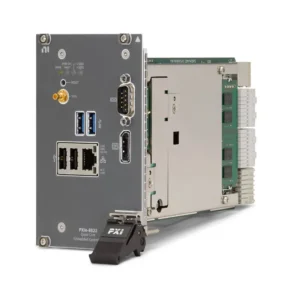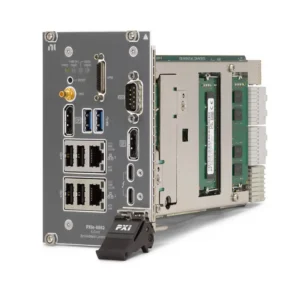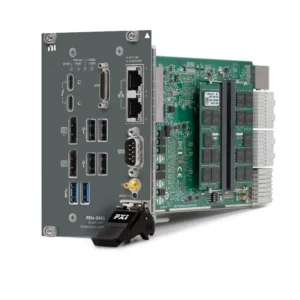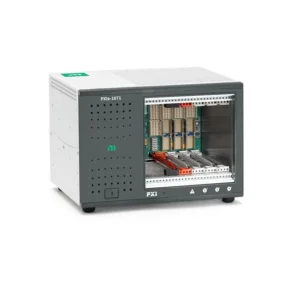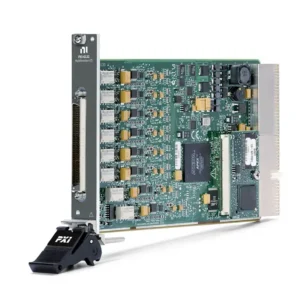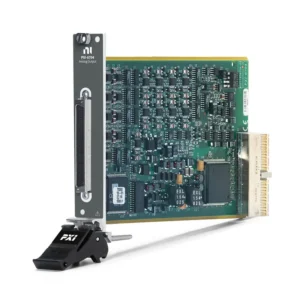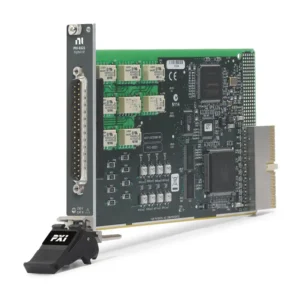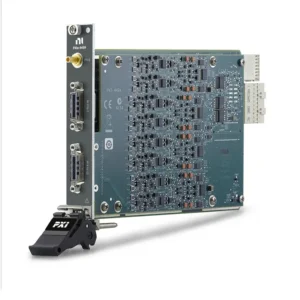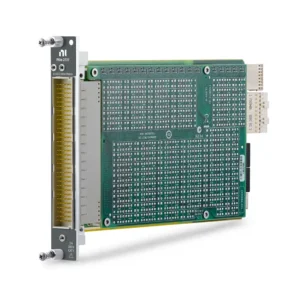


PXIe-6674T OCXO Timing and Synchronization Module
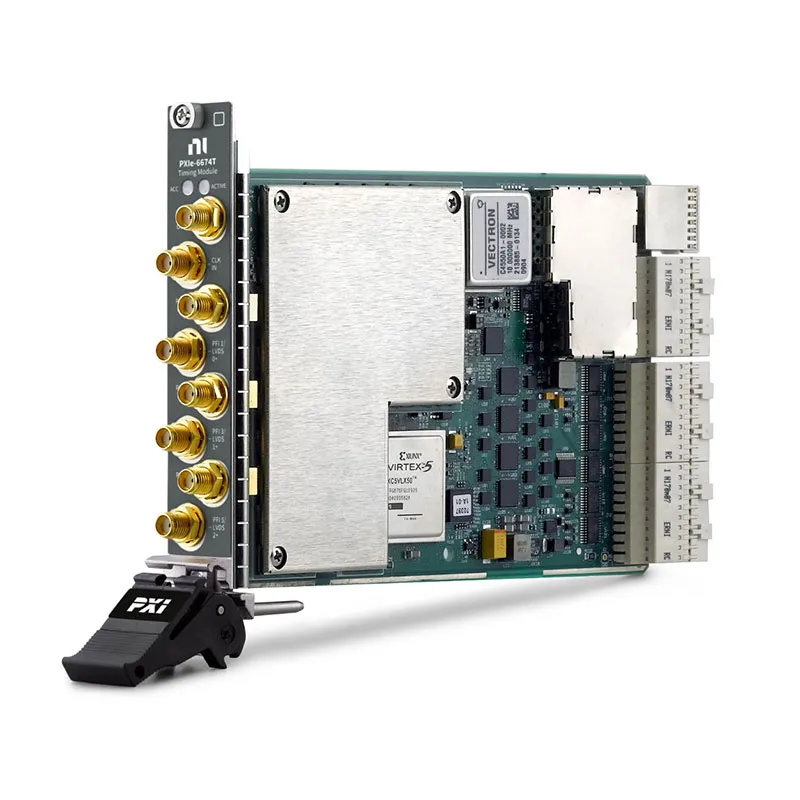
The PXIe-6674T is a high-accuracy PXI Express timing and synchronization module designed to generate, route and distribute clocks and triggers within and between automated test systems.
Its oven-controlled crystal oscillator provides a stable 10 MHz reference, while programmable clock-generation hardware, PXI Express differential-star routing and front-panel I/O support synchronization of digitizers, waveform generators, RF instruments, FlexRIO modules and other PXI devices.
Key Features of the PXIe-6674T
- High-stability 10 MHz OCXO reference
- ±80 ppb accuracy over one year after the specified warm-up period
- Programmable clock generation up to 1 GHz
- Low-jitter clock generation and distribution
- Six single-ended programmable PFI lines
- Three configurable differential PFI LVDS pairs
- PXI_CLK10 and PXIe_CLK100 synchronization
- PXIe-DStarA differential-star clock routing
- PXIe-DStarB trigger routing support
- Clock input, clock output and trigger synchronization
- 16-bit oscillator tuning DAC
- Supports single-chassis and multi-chassis systems
- NI-Sync driver compatibility
PXIe-6674T Technical Specifications
| Product Model | PXIe-6674T |
|---|---|
| Part Number | 781037-01 |
| Product Type | PXI Express timing and synchronization module |
| Reference Oscillator | Oven-controlled crystal oscillator |
| OCXO Nominal Frequency | 10 MHz |
| OCXO Accuracy | ±80 ppb within one year after 72-hour warm-up, 0°C to 55°C |
| Long-Term Stability | ±50 ppb per year |
| Oscillator Tuning | 16-bit DAC; approximately 0.0625 ppb per step |
| Clock-Input Range | From 1 MHz; maximum depends on selected routing destination |
| Maximum FPGA Clock Input | 200 MHz |
| Maximum PXIe-DStarA Clock | 1 GHz |
| Programmable Clock Range | Up to 1 GHz |
| Base Frequency Resolution | 2.84217 µHz |
| Single-Ended PFI Lines | 6, PFI 0 through PFI 5 |
| Differential PFI Pairs | 3, PFI_LVDS 0 through PFI_LVDS 2 |
| Typical PXIe-DStarA Skew | 100 ps |
| Maximum PXIe-DStarA Skew | 250 ps |
| Calibration Interval | 1 year |
| Software Driver | NI-Sync |
High-Stability OCXO Reference
The onboard oven-controlled crystal oscillator generates a stable 10 MHz reference. The oscillator is maintained at a controlled operating temperature to reduce frequency drift caused by changes in the surrounding environment.
This reference can synchronize PXI backplane clocks, programmable clock outputs and external devices. For traceable performance, follow the specified warm-up and calibration requirements.
Programmable Clock Generation
The PXIe-6674T includes direct digital synthesis and programmable clock-generation resources. Clock frequencies can be generated with very fine resolution and routed to supported front-panel or backplane destinations.
Available outputs include lower-frequency CMOS-style clocks and high-speed differential clocks. Maximum frequency and electrical format depend on the chosen output terminal.
PXIe-DStarA Clock Distribution
PXIe-DStarA provides point-to-point differential connections from the system timing slot to compatible peripheral slots. The PXIe-6674T can distribute clocks as high as 1 GHz through these lines.
The low-skew star architecture allows multiple receiving modules to use closely aligned clocks without daisy-chaining the signal through every instrument.
Trigger Routing and Synchronization
The module can route triggers among front-panel PFI terminals, PXI trigger lines and PXI Express star resources. Incoming triggers can be synchronized to a selected clock domain before being distributed.
Trigger synchronization is important when digitizers, waveform generators or FPGA modules must start at a repeatable edge relative to a shared sample clock.
Front-Panel PFI Connectivity
Six single-ended PFI terminals support external clocks and triggers. Three additional differential PFI pairs provide configurable LVDS connections for higher-speed or lower-noise timing signals.
Before connecting external devices, confirm signal direction, voltage standard, termination and maximum input frequency.
Multi-Chassis Synchronization
Two or more PXI Express chassis can be synchronized by distributing a common reference clock and triggers between timing modules. One chassis can act as the timing master while other chassis receive and redistribute the reference.
System-level skew depends on the timing modules, cable length, routing path and receiving instruments. Equal-length cables and calibrated delay correction may be necessary in demanding systems.
PXIe-6674T Applications
- Multi-instrument PXI synchronization
- Phase-coherent RF measurement systems
- Synchronized digitizer acquisition
- Waveform-generator alignment
- FlexRIO clock distribution
- Multi-chassis automated test systems
- Hardware-in-the-loop simulation
- Radar and electronic-warfare testing
- Semiconductor validation systems
- High-energy physics and research measurements
NI-Sync Software Support
The PXIe-6674T is configured through the NI-Sync driver. Software can select clock sources, create clock and trigger routes, configure output frequencies and monitor synchronization status.
NI-Sync APIs can be incorporated into LabVIEW, LabWindows/CVI and compatible text-based environments.
Calibration and Warm-Up
The highest OCXO accuracy applies after the specified warm-up period and within the calibration interval. A short power-on period is not equivalent to the full accuracy condition stated in the official specification.
For traceable timing applications, record the calibration date and allow the timing module and chassis to reach thermal equilibrium before critical measurements.
PXIe-6674T Troubleshooting
The connected instruments do not synchronize
Verify that all instruments use the intended reference clock and that the reference has been routed to the correct PXI Express destinations.
A programmable clock output is missing
Check the output terminal, frequency range, electrical standard and route configuration. Confirm that another route is not reserving the same hardware resource.
Frequency accuracy is outside the expected limit
Verify warm-up time and calibration status. Check whether the system is using the onboard OCXO or an unintended external reference.
Trigger alignment differs between slots
Confirm that compatible differential-star routes are used. Review receiving-module delay and synchronization settings rather than assuming all trigger paths have identical latency.
The PXIe-6674T is not detected
Install it in the system timing slot of a compatible PXI Express chassis and verify the installed NI-Sync driver in NI MAX.
PXIe-6674T vs General PXI Timing Modules
| Feature | PXIe-6674T | Basic Timing Module |
|---|---|---|
| Reference | High-stability OCXO | Model dependent |
| Maximum Clock Routing | Up to 1 GHz on supported destinations | Often lower |
| Differential Star Support | Yes | Model dependent |
| Best Suited For | High-accuracy, low-skew synchronization | General triggering and reference distribution |
Recommended Related Products
- PXIe-6672 Timing and Synchronization Module
- PXI-6683H GPS Timing Module
- PXIe-1095 PXI Express Chassis
- PXIe-1092 PXI Express Chassis
- PXIe-7966 FlexRIO FPGA Module
- View More NI PXI Modules
Frequently Asked Questions
What is the PXIe-6674T?
The PXIe-6674T is an OCXO-based PXI Express module for clock generation, clock routing and trigger synchronization.
What is the onboard reference frequency?
The onboard oven-controlled crystal oscillator has a nominal frequency of 10 MHz.
Can it synchronize multiple PXI Express modules?
Yes. It can distribute clocks and triggers through PXI and PXI Express backplane resources, including compatible differential-star lines.
Can it be used across multiple chassis?
Yes. Compatible timing modules and external clock or trigger cables can create master-and-slave multi-chassis systems.
Which driver controls the module?
The PXIe-6674T is configured with NI-Sync.
What is the PXIe-6674T part number?
The NI ordering part number is 781037-01.
Request a Quote for the PXIe-6674T
Contact us for current availability and pricing for the PXIe-6674T OCXO Timing and Synchronization Module. We can also help identify compatible timing cables, PXI Express chassis and synchronized measurement instruments.