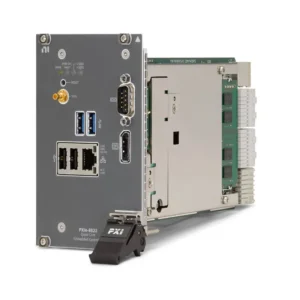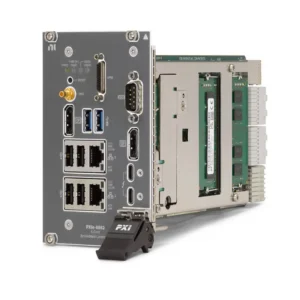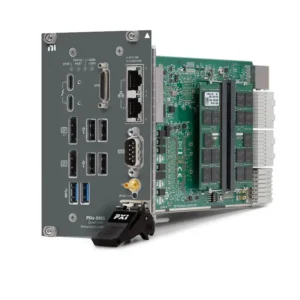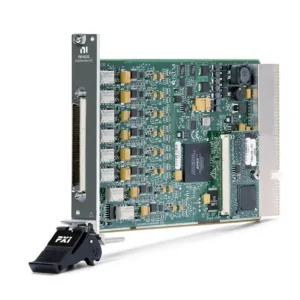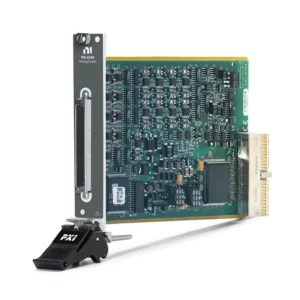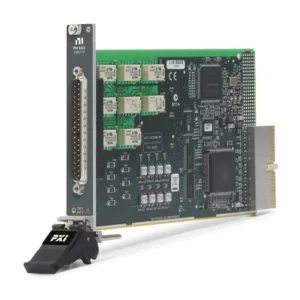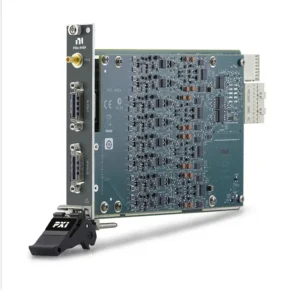




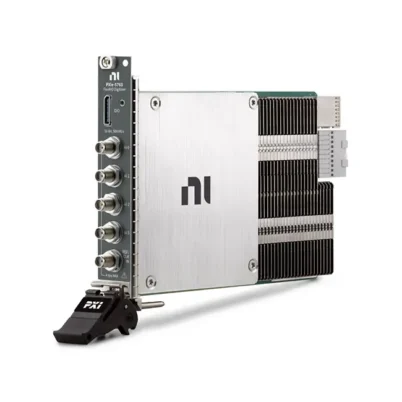
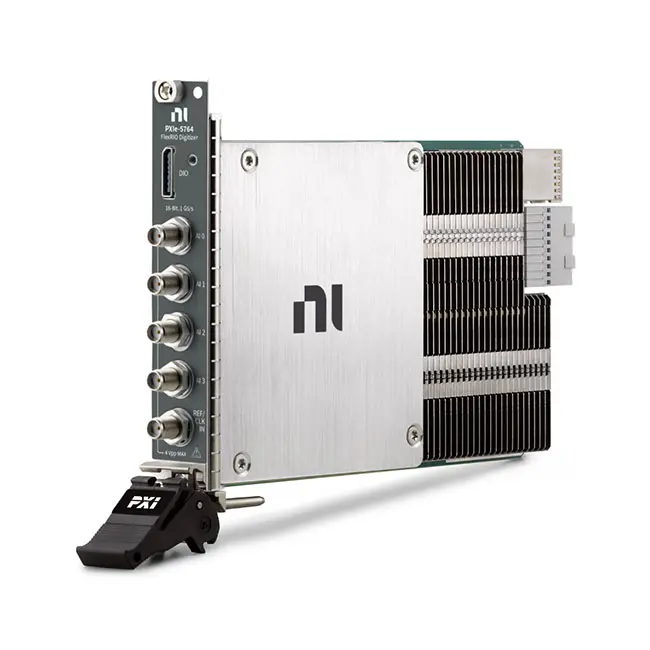
The PXIe-5764 is a 4-channel, 16-bit PXI FlexRIO digitizer designed for high-speed, wide-dynamic-range signal acquisition and FPGA-based processing. It simultaneously samples all four analog channels at 1 GS/s and provides up to 1.15 GHz small-signal bandwidth on AC-coupled configurations.
Available with AC- or DC-coupled inputs and a choice of Xilinx Kintex UltraScale KU035, KU040 or KU060 FPGAs, the PXIe-5764 can be configured for time-domain measurements, frequency-domain analysis, radar prototyping, LIDAR, communications research, microscopy, optical coherence tomography and particle physics.
Key Features of the PXIe-5764
- Four simultaneously sampled analog input channels
- 1 GS/s fixed sampling rate per channel
- 16-bit analog-to-digital resolution
- Up to 1.15 GHz small-signal bandwidth on AC-coupled models
- 400 MHz full-scale supported bandwidth on AC-coupled models
- DC to 400 MHz bandwidth on DC-coupled models
- Approximately 2 Vpk-pk full-scale input range
- 50 Ω analog input impedance
- Up to approximately 70 dB SNR
- Four SMA analog input connectors
- Choice of Kintex UltraScale KU035, KU040 or KU060 FPGA
- 4 GB onboard DRAM on KU040 and KU060 configurations
- Eight bidirectional single-ended digital I/O channels
- High-speed serial transceivers on KU040 and KU060 models
- PCI Express Gen 3 x8 bus interface
- Support for DMA and peer-to-peer streaming
- NI-TClk multidevice synchronization
PXIe-5764 Technical Specifications
| Product Model | PXIe-5764 |
|---|---|
| Product Type | PXI FlexRIO Digitizer |
| Analog Input Channels | 4, simultaneously sampled |
| Input Type | Single-ended |
| Analog Connectors | SMA |
| Maximum Sample Rate | 1 GS/s per channel |
| ADC Resolution | 16 bits |
| ADC | Texas Instruments ADS54J60 |
| AC-Coupled Bandwidth | 0.07 MHz to 1.15 GHz small signal; 400 MHz maximum for a full-scale input |
| DC-Coupled Bandwidth | DC to 400 MHz |
| AC-Coupled Full-Scale Range | 2.05 Vpk-pk at 10 MHz |
| DC-Coupled Full-Scale Range | 2.00 Vpk-pk |
| Input Impedance | 50 Ω |
| Input Coupling | AC or DC, depending on the selected hardware configuration |
| Typical SNR | Up to approximately 70 dBFS |
| FPGA Options | Xilinx Kintex UltraScale KU035, KU040 or KU060 |
| Onboard DRAM | 0 GB on KU035; 4 GB on KU040 and KU060 |
| Single-Ended Digital I/O | 8 bidirectional channels |
| Supported Digital Voltage Families | 1.2 V, 1.5 V, 1.8 V, 2.5 V and 3.3 V |
| Maximum Digital Output Toggle Rate | 60 MHz nominal with a 100 μA load |
| High-Speed Serial I/O | 4 transmit and 4 receive channels on KU040 and KU060 models |
| Serial Data Rate | 500 Mb/s to 16.375 Gb/s nominal |
| Bus Interface | PCI Express Gen 3 x8 |
| Maximum Power Requirement | 58 W |
| Operating Temperature | 0°C to 55°C with a compatible chassis providing at least 58 W slot cooling |
| Dimensions | 18.8 cm × 12.9 cm, excluding connectors |
| Weight | 190 g |
PXIe-5764 Part Numbers and Configurations
| Part Number | Coupling | Bandwidth | FPGA | DRAM |
|---|---|---|---|---|
| 785166-01 | AC | Up to 1.15 GHz small signal | Kintex UltraScale KU035 | None |
| 785167-01 | AC | Up to 1.15 GHz small signal | Kintex UltraScale KU040 | 4 GB |
| 785168-01 | AC | Up to 1.15 GHz small signal | Kintex UltraScale KU060 | 4 GB |
| 785169-01 | DC | DC to 400 MHz | Kintex UltraScale KU035 | None |
| 785170-01 | DC | DC to 400 MHz | Kintex UltraScale KU040 | 4 GB |
| 785171-01 | DC | DC to 400 MHz | Kintex UltraScale KU060 | 4 GB |
All six configurations provide four simultaneously sampled channels, 16-bit resolution and a 1 GS/s sampling rate. The main selection factors are input coupling, analog bandwidth, FPGA capacity and onboard DRAM.
Four-Channel Simultaneous Sampling
The PXIe-5764 samples all four analog channels simultaneously at 1 GS/s. This architecture preserves the timing relationship between input signals and supports multichannel phase analysis, transient capture and synchronized sensor measurements.
The sample rate remains fixed at 1 GS/s when using either the internal or external sample clock. Applications requiring a lower effective rate can acquire at 1 GS/s and implement decimation or filtering in the FPGA.
AC-Coupled and DC-Coupled Versions
The AC-coupled version provides a measured −3 dB passband from approximately 70 kHz to 1.15 GHz for small signals. For full-scale input signals, the supported maximum bandwidth is 400 MHz.
The DC-coupled version provides a signal path from DC to 400 MHz, making it suitable for time-domain measurements that contain low-frequency or DC information.
Input coupling is determined by the hardware configuration and cannot be switched between AC and DC through software. Confirm the required coupling type before placing an order.
16-Bit Wide-Dynamic-Range Acquisition
The 16-bit ADC architecture provides higher amplitude resolution than common 8-bit or 12-bit high-speed digitizers. The PXIe-5764 delivers up to approximately 70 dBFS of signal-to-noise ratio, depending on input frequency and coupling configuration.
This combination of high sampling speed and dynamic range helps detect smaller signal components in the presence of stronger signals. It is particularly useful for frequency-domain analysis, scientific measurements and wideband communications research.
Kintex UltraScale FPGA Options
The PXIe-5764 is available with three Xilinx Kintex UltraScale FPGA options. Engineers can select the FPGA according to the amount of signal-processing logic, memory and high-speed serial connectivity required.
| FPGA | Lookup Tables | DSP48 Slices | Block RAM | DRAM |
|---|---|---|---|---|
| KU035 | 203,128 | 1,700 | 19.0 Mb | None |
| KU040 | 242,200 | 1,920 | 21.1 Mb | 4 GB |
| KU060 | 331,680 | 2,760 | 38.0 Mb | 4 GB |
The KU035 configuration is suitable for less resource-intensive processing. The KU040 adds FPGA capacity, DRAM and multi-gigabit serial transceivers. The KU060 provides the largest processing resource set for complex filters, channelization, FFT processing and custom real-time algorithms.
Onboard DRAM and Data Streaming
KU040 and KU060 configurations include 4 GB of onboard DRAM organized as two 2 GB banks. The memory has a maximum theoretical aggregate data rate of 17 GB/s and can be used for buffering, waveform storage and FPGA-based processing.
The PCI Express Gen 3 x8 interface supports high-throughput transfer between the module and PXI system controller. The module supports DMA, interrupts and programmed I/O, while supported systems can use peer-to-peer streaming to transfer data directly between compatible PXI Express modules.
Digital I/O and High-Speed Serial Connectivity
The front-panel digital connector provides eight bidirectional single-ended digital I/O channels. Each line can be configured independently and supports common voltage families from 1.2 V to 3.3 V.
KU040 and KU060 configurations also provide four transmit and four receive multi-gigabit transceiver channels. These serial channels support nominal data rates from 500 Mb/s to 16.375 Gb/s and can be used for custom high-speed interfaces.
Clocking and Synchronization
The PXIe-5764 can operate from its onboard reference, the PXI 10 MHz backplane reference clock or an external 10 MHz reference connected through the front-panel CLK/REF IN connector. A 1 GHz external sample clock can also be supplied.
NI-TClk can synchronize multiple supported PXIe-5764 modules. Identical modules installed in the same chassis can achieve measured intermodule skew of 10 ps or less after manual adjustment under the specified conditions.
Custom FPGA Processing
Engineers can implement custom processing directly on the Kintex UltraScale FPGA using LabVIEW FPGA and the Instrument Design Libraries for FlexRIO. Typical FPGA functions include:
- Digital downconversion
- Finite impulse response filtering
- Fast Fourier transform processing
- Channelization
- Pulse and event detection
- Custom triggering
- Data reduction and decimation
- Real-time spectral analysis
- Closed-loop decision making
- Deterministic data streaming
Processing data inside the FPGA can reduce host-processor workload and PCI Express traffic while providing deterministic, low-latency responses.
Typical PXIe-5764 Applications
- Radar prototyping and electronic warfare research
- LIDAR signal acquisition
- Wideband communications testing
- Spectrum monitoring and signal intelligence
- Optical coherence tomography
- Microscopy and medical imaging
- Particle physics experiments
- High-speed event detection
- Ultrasonic and nondestructive testing
- Multichannel transient recording
- FPGA-based digital downconversion
- Custom real-time signal processing
Software Support
The PXIe-5764 is supported by NI LabVIEW Instrument Design Libraries for FlexRIO. These libraries provide programming interfaces, documentation and sample projects for configuring the digitizer and developing FPGA-based instruments.
- NI FlexRIO driver
- LabVIEW
- LabVIEW FPGA Module
- Instrument Design Libraries for FlexRIO
- NI-TClk synchronization driver
Software compatibility should be verified before installation, especially when integrating the module into an existing system using an older LabVIEW or FlexRIO driver release.
PXI Express Chassis Requirements
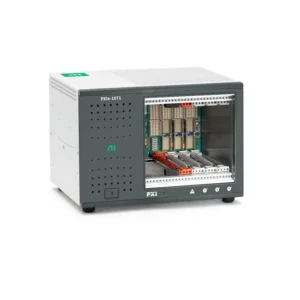
The PXIe-5764 requires a compatible PXI Express chassis with a Gen 3 x8-capable slot and sufficient controller bandwidth. The selected slot must provide a cooling capacity of at least 58 W.
Chassis cooling is especially important when deploying large FPGA designs or operating at high ambient temperatures. Use filler panels and slot blockers in empty positions and follow the chassis airflow recommendations.
Browse compatible NI PXI modules and system components when configuring a complete acquisition and processing system.
PXIe-5764 Troubleshooting
Why is the expected DC component missing?
Confirm whether the installed module is an AC-coupled configuration. AC-coupled models block DC and have a lower cutoff frequency of approximately 70 kHz. Use a DC-coupled PXIe-5764 for signals containing DC or very-low-frequency information.
Why does the module always sample at 1 GS/s?
The PXIe-5764 uses a fixed 1 GS/s sampling rate with its internal or external sample clock. Implement decimation in the FPGA or software when a lower effective data rate is required.
Why is the measured signal amplitude incorrect?
Verify that the source and cabling are designed for a 50 Ω signal path. Also confirm that the input signal is within the approximately 2 Vpk-pk full-scale range.
Why is the full 1.15 GHz bandwidth not available at maximum amplitude?
The 1.15 GHz specification applies to small-signal operation on AC-coupled models. The supported maximum bandwidth for a full-scale input signal is 400 MHz.
Why is onboard DRAM unavailable?
KU035 configurations do not include DRAM. Select a KU040 or KU060 version when the FPGA design requires 4 GB of external onboard memory.
Why are the high-speed serial transceivers unavailable?
Multi-gigabit transceiver channels are available only on KU040 and KU060 configurations. They are not supported by the KU035 variant.
Why does the module revert to its default FPGA personality?
A large FPGA design operating at a high clock rate can exceed the available slot power. Confirm that the chassis slot meets the 58 W cooling and power requirements and optimize the FPGA design if necessary.
PXIe-5764 Comparison
| Model | Channels | Maximum Sample Rate | Resolution | Bandwidth | Primary Use |
|---|---|---|---|---|---|
| PXIe-5764 | 4 | 1 GS/s | 16-bit | Up to 1.15 GHz small signal | Wide-dynamic-range acquisition with four simultaneous channels |
| PXIe-5763 | 4 | 500 MS/s | 16-bit | 225 MHz | Lower-frequency 16-bit multichannel acquisition |
| PXIe-5774 | 2 | 6.4 GS/s interleaved | 12-bit | Up to 3 GHz | High-speed DC-coupled time-domain measurements |
| PXIe-5775 | 2 | 6.4 GS/s interleaved | 12-bit | 6 GHz | AC-coupled high-bandwidth frequency-domain acquisition |
| PCIe-5764 | 4 | 1 GS/s | 16-bit | Up to 1.15 GHz small signal | Similar acquisition performance for compatible desktop PCI Express systems |
Recommended Related Products
- PXIe-5763 – Recommended when four 16-bit channels are required but 500 MS/s and 225 MHz bandwidth are sufficient.
- PXIe-5774 – Suitable for applications prioritizing DC coupling, higher sample rates and bandwidth up to 3 GHz.
- PXIe-5775 – Designed for AC-coupled frequency-domain applications requiring bandwidth up to 6 GHz.
- PCIe-5764 – Provides similar digitizer and FPGA capabilities in a PCI Express card format.
How to Select the Right PXIe-5764 Configuration
- Choose an AC-coupled version for RF, communications and frequency-domain signals without a required DC component.
- Choose a DC-coupled version for transient and time-domain signals extending to DC.
- Choose the KU035 when the application requires fewer FPGA resources and no external DRAM.
- Choose the KU040 when 4 GB DRAM and high-speed serial connectivity are required with moderate FPGA capacity.
- Choose the KU060 for demanding filters, FFT processing, channelization and complex real-time algorithms.
Why Choose the PXIe-5764?
The PXIe-5764 combines four simultaneous 1 GS/s channels, 16-bit resolution, wide analog bandwidth and a programmable Kintex UltraScale FPGA in one PXI Express module. Its balance of speed, channel density and dynamic range makes it suitable for applications that cannot be addressed efficiently by fixed-function digitizers.
The selectable FPGA configurations also allow the processing resources and memory capacity to be matched to the application, helping avoid unnecessary hardware cost while maintaining a clear upgrade path.
Frequently Asked Questions
What is the PXIe-5764?
The PXIe-5764 is a four-channel, 16-bit PXI FlexRIO digitizer that simultaneously samples every channel at 1 GS/s and includes a user-programmable Kintex UltraScale FPGA.
What bandwidth does the PXIe-5764 provide?
AC-coupled versions provide up to 1.15 GHz small-signal bandwidth, with 400 MHz supported for full-scale signals. DC-coupled versions provide bandwidth from DC to 400 MHz.
Can the sample rate be changed?
The hardware samples at a fixed rate of 1 GS/s. Lower effective sampling rates can be created through FPGA-based decimation.
Are all four channels sampled simultaneously?
Yes. All four analog inputs are simultaneously sampled at 1 GS/s with 16-bit resolution.
Does every PXIe-5764 include 4 GB of DRAM?
No. KU040 and KU060 configurations include 4 GB of DRAM. KU035 configurations do not include onboard DRAM.
Can AC and DC coupling be selected through software?
No. AC and DC coupling are separate hardware configurations. The required coupling type must be selected when ordering the module.
Does the PXIe-5764 include a programmable FPGA?
Yes. It is available with a Xilinx Kintex UltraScale KU035, KU040 or KU060 FPGA.
Can multiple PXIe-5764 modules be synchronized?
Yes. Multiple supported modules can be synchronized using NI-TClk, shared reference clocks and PXI backplane timing resources.
Can the PXIe-5764 operate without a PXI Express chassis?
No. The module requires a compatible PXI Express chassis, system controller and software environment. The selected slot must also support the module’s power and cooling requirements.
Request a Quote for the PXIe-5764
Contact us for current availability, lead time and project pricing for the PXIe-5764 PXI FlexRIO Digitizer. Please provide the required coupling type, FPGA option and part number so we can confirm the correct configuration.