



Product Introduction
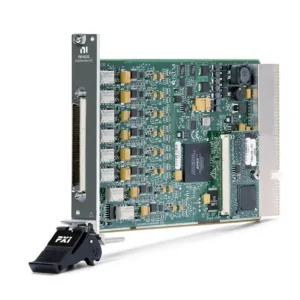
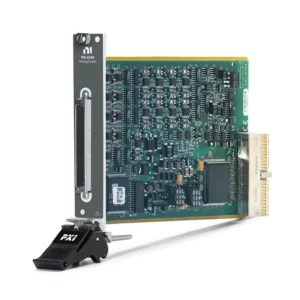
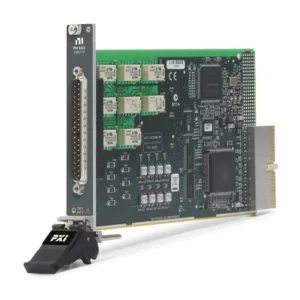
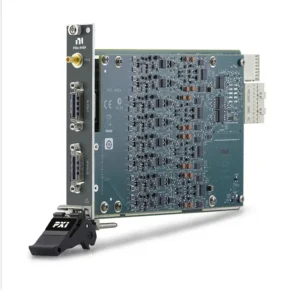
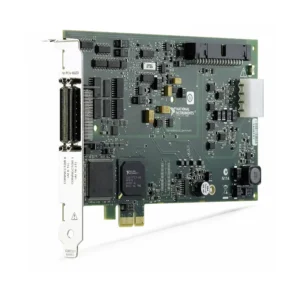
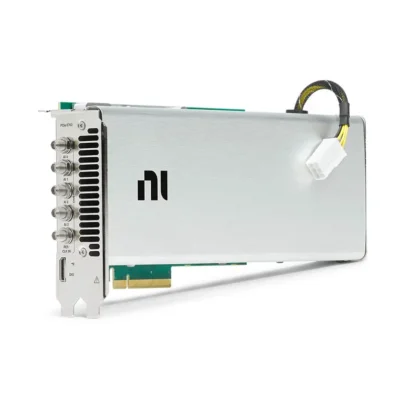
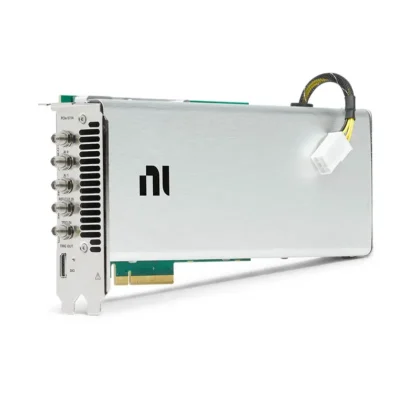
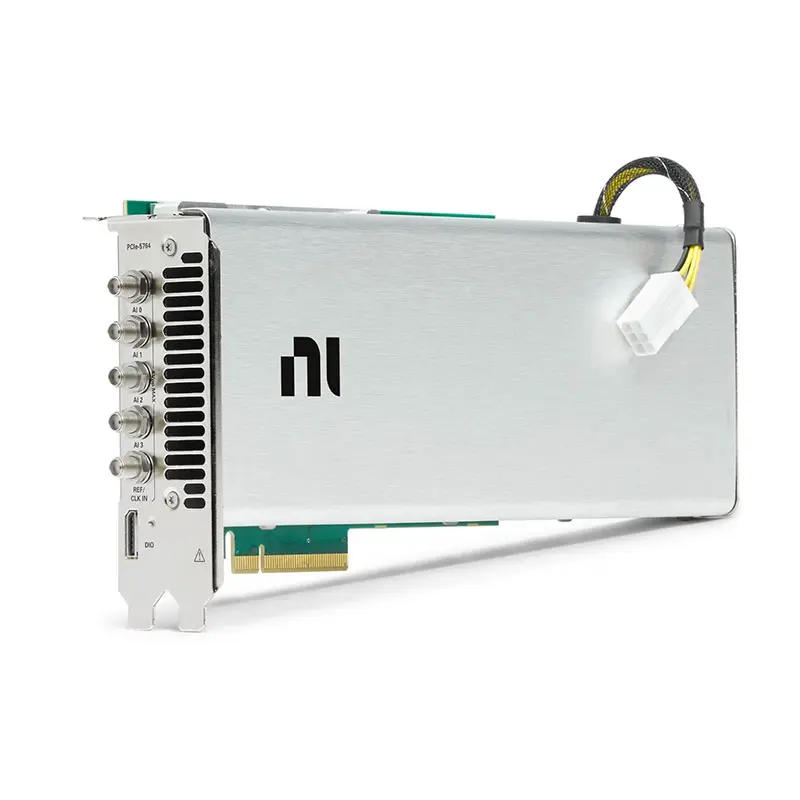
The NI PCIe-5764 is a high-performance PCI Express FlexRIO digitizer device designed for wideband signal acquisition, FPGA-based real-time signal processing, radar prototyping, LIDAR, communications research, microscopy, optical coherence tomography (OCT), event detection, and particle physics applications.
The PCIe-5764 provides 4 simultaneously sampled analog input channels with 16-bit resolution and a maximum sample rate of 1 GS/s per channel. The device combines high-speed analog acquisition with a user-programmable Xilinx Kintex UltraScale FPGA, allowing engineers to implement custom processing algorithms directly in hardware.
Depending on the selected version, the PCIe-5764 is available with AC or DC input coupling and KU035, KU040, or KU060 FPGA options. This combination of high sample rate, high resolution, wide analog bandwidth, FPGA processing, and PCI Express streaming makes the PCIe-5764 suitable for demanding time-domain and frequency-domain measurement systems.
Product Overview
The National Instruments PCIe-5764 integrates a high-speed digitizer, FPGA processing resources, onboard DRAM, and a PCI Express host interface into a computer-based FlexRIO instrument.
A typical acquisition architecture is:
Analog Signal → PCIe-5764 ADC → Kintex UltraScale FPGA → PCI Express → Host Computer
The FPGA can process acquired signals before transferring data to the host, enabling applications that require deterministic triggering, filtering, event detection, custom algorithms, or real-time signal processing.
Key Features
4 Simultaneously Sampled Analog Input Channels
The PCIe-5764 provides four analog input channels capable of simultaneous high-speed sampling.
Simultaneous sampling is important for applications requiring accurate timing relationships between multiple signals, including:
- Multi-channel RF and IF acquisition
- Radar research
- LIDAR systems
- Phase-related measurements
- Scientific experiments
- Multi-sensor acquisition
1 GS/s Maximum Sample Rate
Each PCIe-5764 analog input channel supports a maximum sample rate of 1 GS/s.
The high sample rate enables acquisition of fast transient and wideband signals that cannot be captured effectively with conventional lower-speed DAQ hardware.
16-Bit Analog Input Resolution
The PCIe-5764 combines its 1 GS/s sample rate with 16-bit analog input resolution.
The combination of high resolution and high sample rate provides strong dynamic-range capability for applications where engineers need to detect relatively small signal variations while acquiring wideband waveforms.
Up to 70 dB SNR
The PCIe-5764 architecture provides up to approximately 70 dB signal-to-noise ratio (SNR), making it suitable for applications requiring wide dynamic range together with high acquisition bandwidth.
AC and DC Coupled Versions
The PCIe-5764 is available in both AC-coupled and DC-coupled variants.
The correct coupling should be selected according to the signal being measured.
- AC coupling is useful when DC components should be blocked and the application focuses on higher-frequency signal content.
- DC coupling is appropriate when both DC and AC signal components must be preserved.
Wide Analog Input Bandwidth
The analog input bandwidth depends on the selected PCIe-5764 variant.
NI lists 400 MHz bandwidth for the DC-coupled versions and up to 1.15 GHz for AC-coupled variants under applicable operating conditions.
The exact bandwidth specification should therefore be verified using the specific PCIe-5764 part number rather than the model name alone.
±1 V Analog Input Range
The PCIe-5764 supports an analog input voltage range of approximately -1 V to +1 V.
The signal amplitude should remain within the specified input limits to maintain measurement accuracy and protect the acquisition hardware.
50 Ω Analog Input Impedance
The analog inputs use a 50 Ω input impedance, making the PCIe-5764 suitable for wideband measurement environments using standard 50 Ω signal paths.
This is particularly important for:
- RF and IF measurements
- Radar systems
- Signal generators
- High-speed laboratory instrumentation
- Communication test systems
Xilinx Kintex UltraScale FPGA
The PCIe-5764 incorporates a user-programmable Xilinx Kintex UltraScale FPGA.
Available FPGA options include:
- Kintex UltraScale KU035
- Kintex UltraScale KU040
- Kintex UltraScale KU060
The FPGA can be used to implement custom real-time processing algorithms directly on acquired data.
FPGA-Based Real-Time Signal Processing
Instead of transferring every raw sample directly to software before processing, the PCIe-5764 can process data using onboard FPGA resources.
Possible FPGA functions include:
- Digital filtering
- Threshold detection
- Event detection
- Custom triggering
- Data reduction
- FFT-related processing
- Signal averaging
- Digital signal processing
- Custom protocol processing
- Real-time decision logic
4 GB DRAM
PCIe-5764 configurations provide 4 GB of dynamic RAM (DRAM) for high-speed data handling and FPGA-based applications.
The onboard memory is valuable for buffering large amounts of acquired data and supporting applications where continuous host transfer alone may not meet the required processing architecture.
PCI Express Interface
The PCIe-5764 connects directly to a compatible computer through PCI Express.
This computer-based architecture provides a high-bandwidth path for transferring digitized data between the device and host system.
Peer-to-Peer Streaming
The PCIe-5764 supports NI peer-to-peer streaming, allowing compatible hardware devices to exchange data directly without routing all data through host application processing.
Peer-to-peer streaming can be useful in high-throughput measurement and signal-processing systems.
Technical Specifications
| Parameter | Specification |
|---|---|
| Product Type | PCI FlexRIO Digitizer Device |
| Model | PCIe-5764 |
| Manufacturer | National Instruments |
| Host Interface | PCI Express |
| Analog Input Channels | 4 |
| Sampling Architecture | Simultaneous Sampling |
| Maximum Sample Rate | 1 GS/s per Channel |
| Analog Input Resolution | 16 Bit |
| Analog Input Voltage Range | -1 V to +1 V |
| Input Impedance | 50 Ω |
| Input Coupling | AC or DC, Depending on Variant |
| Analog Input Bandwidth | Up to 1.15 GHz Depending on Variant and Operating Conditions |
| Signal-to-Noise Ratio | Up to Approximately 70 dB |
| FPGA Family | Xilinx Kintex UltraScale |
| FPGA Options | KU035 / KU040 / KU060 |
| DRAM | 4 GB |
| Reconfigurable FPGA | Yes |
| Peer-to-Peer Streaming | Supported |
| Onboard Digital Downconverter | No |
| Hardware Platform | Computer-Based Device |
| Primary Applications | Radar, LIDAR, Communications, OCT, Microscopy, Event Detection and Particle Physics |
PCIe-5764 Part Numbers
The PCIe-5764 is available in multiple configurations. The exact part number determines the input coupling and FPGA option.
| Part Number | Coupling | FPGA |
|---|---|---|
| 785957-01 | AC | KU035 |
| 785958-01 | AC | KU040 |
| 785959-01 | AC | KU060 |
| 785960-01 | DC | KU035 |
| 785962-01 | DC | KU040 |
| 785961-01 | DC | KU060 |
When requesting a quotation or replacement PCIe-5764, the complete NI part number should be provided to ensure the correct coupling and FPGA configuration.
How Does the PCIe-5764 Work?
The PCIe-5764 converts high-speed analog signals into digital data using four simultaneously sampled analog input channels.
A simplified signal path is:
Analog Signal → Analog Front End → ADC → Kintex UltraScale FPGA → DRAM / PCI Express → Host Computer
The FPGA can process incoming samples immediately, allowing custom algorithms to operate on data before it is transferred to host software.
What Is a FlexRIO Digitizer?
A FlexRIO digitizer combines high-performance analog acquisition with user-programmable FPGA resources.
Unlike a conventional fixed-function digitizer, FlexRIO allows engineers to customize portions of the hardware processing architecture for specialized measurement applications.
This makes FlexRIO particularly useful for research, prototyping, advanced automated test, and applications requiring deterministic real-time signal processing.
Simultaneous Sampling
All four PCIe-5764 analog input channels can be sampled simultaneously at rates up to 1 GS/s.
Simultaneous sampling preserves the timing relationship between channels and is important for multi-channel signal analysis.
Applications include:
- Phase comparison
- Multi-antenna signal acquisition
- Radar channel acquisition
- Sensor-array measurements
- Scientific experiments
Real-Time FPGA Processing
At 1 GS/s across four 16-bit channels, the digitizer can produce a very large amount of raw measurement data.
Processing selected data directly in the FPGA can reduce the amount of information that must be transferred and processed by host software.
For example:
Raw Samples → FPGA Filter → Event Detection → Selected Data → Host Computer
This architecture can be particularly valuable for applications where only specific signal events need to be captured or analyzed.
Finite and Continuous Streaming
The FlexRIO driver supports finite and continuous streaming modes for the PCIe-5764.
Finite acquisition is useful when capturing a defined amount of waveform data around a trigger event, while continuous streaming is useful for long-duration monitoring and processing applications.
Radar Prototyping
Radar development requires high-speed acquisition and real-time processing of wideband signals.
The PCIe-5764 can be used in radar prototyping systems for:
- Wideband waveform acquisition
- IF signal capture
- Pulse detection
- Custom triggering
- Real-time FPGA processing
- Algorithm prototyping
LIDAR Applications
The PCIe-5764 is suitable for LIDAR research and prototyping applications requiring high-speed acquisition of optical detector signals.
FPGA processing can be used to implement event detection, timing analysis, filtering, and other application-specific signal-processing algorithms.
Communications Research
The combination of high sample rate, 16-bit resolution, wide bandwidth, and FPGA processing makes the PCIe-5764 suitable for communications research and prototyping.
Applications can include:
- Wideband signal capture
- IF acquisition
- Modulated waveform analysis
- Communication algorithm development
- Custom real-time signal processing
Microscopy Applications
High-speed digitizers can be used in advanced microscopy systems where detector signals must be acquired at high rates and processed in real time.
The PCIe-5764 provides multi-channel high-speed acquisition and FPGA processing for compatible research imaging architectures.
Optical Coherence Tomography
NI identifies optical coherence tomography (OCT) as an application for the PCIe-5764.
OCT systems can require high-speed acquisition, wide dynamic range, and deterministic processing of optical detector signals, making FPGA-based digitizers useful for system development and research.
Event Detection
The programmable FPGA makes the PCIe-5764 particularly useful for high-speed event-detection applications.
A custom FPGA algorithm can continuously analyze incoming samples and identify conditions such as:
- Threshold crossings
- Transient events
- Pulse detection
- Signal anomalies
- Custom waveform signatures
Particle Physics
Particle physics experiments can generate fast detector pulses that require high-speed digitization and real-time event processing.
The PCIe-5764 can provide simultaneous multi-channel acquisition and FPGA-based processing for compatible detector and experimental systems.
Time-Domain Measurements
The 1 GS/s sampling capability allows the PCIe-5764 to capture high-speed waveforms in the time domain.
Typical measurements can include:
- Transient waveform capture
- Pulse characterization
- Rise and fall behavior
- Event timing
- Signal amplitude analysis
Frequency-Domain Measurements
The PCIe-5764 can also be used for frequency-domain signal analysis when combined with appropriate FPGA or host-based processing.
Possible applications include:
- Spectrum analysis
- FFT processing
- Wideband signal characterization
- Frequency-domain research
- Communication signal analysis
AC vs DC Coupled PCIe-5764
| Feature | AC-Coupled Version | DC-Coupled Version |
|---|---|---|
| DC Signal Component | Blocked | Preserved |
| Typical Application | Wideband AC / RF / IF Signals | Time-Domain and DC-to-Wideband Signals |
| Listed Bandwidth | Up to 1.15 GHz* | 400 MHz |
| Input Impedance | 50 Ω | 50 Ω |
| Maximum Sample Rate | 1 GS/s | 1 GS/s |
| Resolution | 16 Bit | 16 Bit |
*Bandwidth depends on signal level and operating conditions. Verify the detailed specifications for the exact part number and application.
PCIe-5764 vs PXIe-5764
The PCIe-5764 and PXIe-5764 provide closely related high-speed FlexRIO digitizer capabilities but use different host platforms.
| Feature | PCIe-5764 | PXIe-5764 |
|---|---|---|
| Platform | Computer-Based | PXI Express |
| Host Interface | PCI Express | PXI Express |
| Analog Input Channels | 4 | 4 |
| Maximum Sample Rate | 1 GS/s | 1 GS/s |
| Resolution | 16 Bit | 16 Bit |
| Input Impedance | 50 Ω | 50 Ω |
| FPGA Family | Kintex UltraScale | Kintex UltraScale |
| FPGA Options | KU035 / KU040 / KU060 | KU035 / KU040 / KU060 |
| Best Fit | PCI Express Computer Systems | Modular PXI Express Systems |
PCIe-5764 vs Conventional Digitizer
| Feature | PCIe-5764 | Conventional Digitizer |
|---|---|---|
| Analog Acquisition | Yes | Yes |
| User-Programmable FPGA | Yes | Usually No |
| Custom Real-Time Processing | Yes | Usually Host-Based |
| Custom Triggering | FPGA Programmable | Fixed Functions |
| Data Reduction | Can Be Performed on FPGA | Typically Host-Based |
| Application Flexibility | High | Fixed Instrument Architecture |
How to Choose a PCIe-5764 Configuration
The PCIe-5764 model name alone is not enough to identify the complete hardware configuration.
Before purchasing, determine:
- AC or DC coupling requirement
- Required FPGA size
- Required analog bandwidth
- Signal frequency range
- Signal amplitude
- Number of acquisition channels
- Required sample rate
- Real-time FPGA processing complexity
- Data streaming requirements
- PCI Express slot compatibility
- Software and driver compatibility
Choosing the FPGA
PCIe-5764 variants are available with KU035, KU040, and KU060 FPGA options.
The appropriate FPGA should be selected according to the complexity of the real-time processing algorithm.
Applications involving large parallel processing structures, multiple filters, complex signal-processing chains, or extensive custom logic may benefit from a larger FPGA.
Industries
- Radar Research
- LIDAR Development
- Wireless Communications
- Scientific Research
- Particle Physics
- Optical Measurement
- Automated Test
- Electronic Validation
- Research and Development
- Advanced Signal Processing
Applications
Radar Prototyping
The PCIe-5764 provides wideband multi-channel digitization and programmable FPGA processing for radar waveform acquisition and algorithm development.
LIDAR
High-speed analog acquisition and FPGA-based event processing make the PCIe-5764 suitable for compatible LIDAR research and prototyping systems.
Communications
The PCIe-5764 can acquire wideband communication and IF signals for analysis, algorithm prototyping, and real-time FPGA processing.
OCT
The high sample rate, dynamic range, and FPGA resources can support optical coherence tomography research and development applications.
Event Detection
Custom FPGA logic can analyze high-speed incoming samples and identify events according to application-specific conditions.
Particle Physics
The PCIe-5764 can acquire fast detector signals and implement FPGA-based processing for compatible particle physics experiments.
Recommended Related Products
| PCIe-5764 | 4-channel, 16-bit, 1 GS/s PCI Express FlexRIO digitizer with Kintex UltraScale FPGA. |
| PXIe-5764 | PXI Express version providing 4-channel, 16-bit, 1 GS/s FlexRIO digitization and FPGA processing. |
| PXIe-5763 | 4-channel, 16-bit FlexRIO digitizer with a lower maximum sample rate for applications that do not require 1 GS/s acquisition. |
| PXIe-5774 | Higher-speed FlexRIO digitizer for applications requiring substantially higher sample rates and wider analog bandwidth. |
Why Choose PCIe-5764?
- 4 simultaneously sampled analog input channels
- 1 GS/s maximum sample rate per channel
- 16-bit analog input resolution
- Up to approximately 70 dB SNR
- AC and DC coupled variants
- Up to 1.15 GHz bandwidth depending on configuration
- 50 Ω analog input impedance
- -1 V to +1 V input range
- Xilinx Kintex UltraScale FPGA
- KU035, KU040 and KU060 FPGA options
- 4 GB DRAM
- Real-time FPGA signal processing
- Finite and continuous streaming
- Peer-to-peer streaming support
- PCI Express host interface
- Radar and LIDAR applications
- Communications research
- Scientific measurement
Frequently Asked Questions
What is the NI PCIe-5764?
The NI PCIe-5764 is a PCI Express FlexRIO digitizer with four simultaneously sampled analog input channels, 16-bit resolution, a maximum sample rate of 1 GS/s per channel, and a user-programmable Kintex UltraScale FPGA.
How many analog input channels does PCIe-5764 have?
The PCIe-5764 provides 4 analog input channels.
Does PCIe-5764 sample all four channels simultaneously?
Yes. The four channels can be sampled simultaneously, which helps preserve the timing relationship between multi-channel signals.
What is the maximum sample rate of PCIe-5764?
The PCIe-5764 supports a maximum sample rate of 1 GS/s per channel.
What is the resolution of PCIe-5764?
The PCIe-5764 provides 16-bit analog input resolution.
What is the input voltage range of PCIe-5764?
NI specifies an analog input voltage range of approximately -1 V to +1 V.
What is the input impedance of PCIe-5764?
The PCIe-5764 analog inputs have a 50 Ω input impedance.
What FPGA does PCIe-5764 use?
The PCIe-5764 uses a Xilinx Kintex UltraScale FPGA. Depending on the part number, the device is available with KU035, KU040, or KU060 FPGA resources.
Does PCIe-5764 support AC coupling?
Yes. AC-coupled PCIe-5764 configurations are available.
Does PCIe-5764 support DC coupling?
Yes. DC-coupled PCIe-5764 configurations are also available.
What is the bandwidth of PCIe-5764?
Bandwidth depends on the selected configuration. NI lists 400 MHz for DC-coupled versions and up to 1.15 GHz for AC-coupled variants under applicable conditions. The detailed specifications for the exact part number should be checked before system design.
How much DRAM does PCIe-5764 have?
PCIe-5764 configurations provide 4 GB of DRAM.
Does PCIe-5764 have a programmable FPGA?
Yes. The PCIe-5764 is a reconfigurable FlexRIO device with a user-programmable Xilinx Kintex UltraScale FPGA for custom real-time signal processing.
Does PCIe-5764 support peer-to-peer streaming?
Yes. NI specifies peer-to-peer streaming support for the PCIe-5764.
Does PCIe-5764 include an onboard digital downconverter?
No. NI lists the PCIe-5764 as not having a fixed onboard digital downconverter. Application-specific digital processing can instead be implemented using the programmable FPGA where appropriate.
What is the difference between PCIe-5764 and PXIe-5764?
Both provide four-channel, 16-bit, 1 GS/s FlexRIO digitization with Kintex UltraScale FPGA options. The main difference is the system platform: PCIe-5764 installs in a compatible PCI Express computer, while PXIe-5764 is designed for a PXI Express chassis.
What applications is PCIe-5764 designed for?
NI identifies applications including radar prototyping, LIDAR, communications, microscopy, optical coherence tomography, event detection, and particle physics.
What part numbers are available for PCIe-5764?
PCIe-5764 configurations include 785957-01, 785958-01, 785959-01, 785960-01, 785961-01, and 785962-01. The exact part number identifies the input coupling and FPGA configuration.
What should I check before purchasing PCIe-5764?
Verify the complete NI part number, AC or DC coupling, KU035/KU040/KU060 FPGA requirement, analog bandwidth, signal amplitude, input impedance, sample-rate requirement, FPGA processing requirements, PCI Express slot compatibility, FlexRIO driver support, LabVIEW FPGA requirements, and operating system compatibility.
Conclusion
The NI PCIe-5764 FlexRIO Digitizer combines four simultaneously sampled analog input channels, 16-bit resolution, up to 1 GS/s per channel, wide analog bandwidth, 50 Ω inputs, 4 GB DRAM, and a user-programmable Xilinx Kintex UltraScale FPGA. Its combination of high-speed digitization and custom real-time FPGA processing makes it particularly suitable for radar, LIDAR, communications, OCT, microscopy, event detection, particle physics, scientific research, and advanced automated test applications.