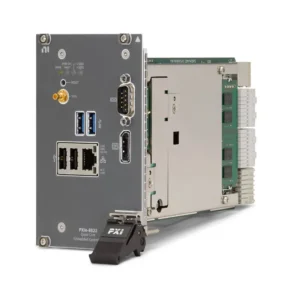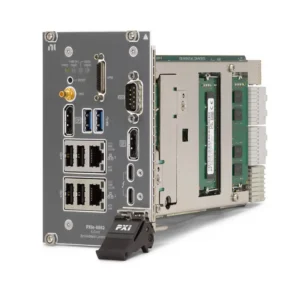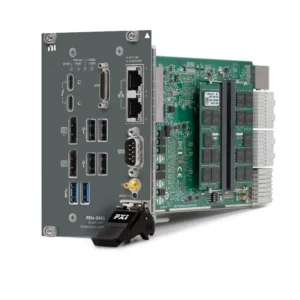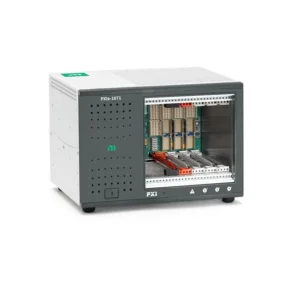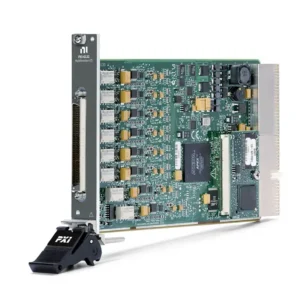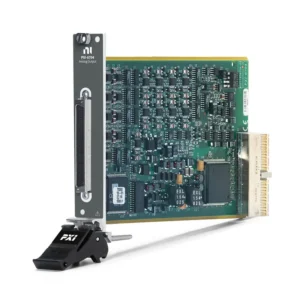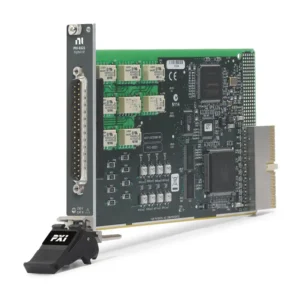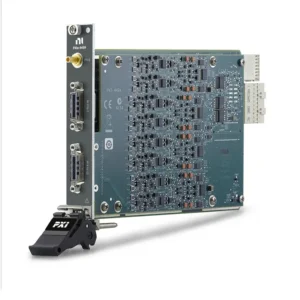


PXIe-5673 6.6 GHz PXI Vector Signal Generator
The NI PXIe-5673 is a modular PXI vector signal generator designed for wideband RF signal generation, wireless-device testing, receiver validation and automated production applications. Depending on the selected configuration, it provides frequency coverage from 50 MHz to 1.3 GHz, 3.3 GHz or 6.6 GHz.
The PXIe-5673 delivers more than 100 MHz of modulation bandwidth, RF output power up to +10 dBm and 16-bit arbitrary I/Q waveform generation. It can generate AM, FM, PM, CPM, ASK, FSK, MSK, PSK, QPSK, QAM, multitone and user-defined arbitrary RF signals.
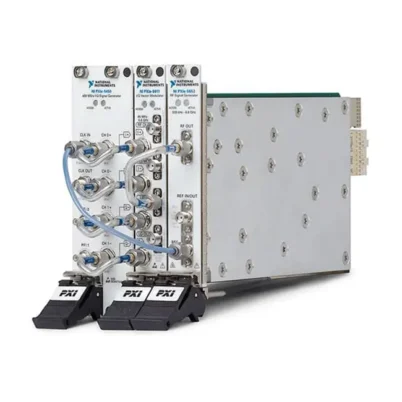
The complete generator combines an PXIe-5611 I/Q modulator, a PXIe-5450 or PXIe-5451 dual-channel arbitrary waveform generator and a PXI-5650, PXI-5651 or PXI-5652 RF signal generator used as the local oscillator. NI-RFSG coordinates these modules as one vector signal generator.
Key Features of the PXIe-5673
- Modular PXI vector signal generator
- Frequency configurations up to 1.3 GHz, 3.3 GHz or 6.6 GHz
- 50 MHz to 6.6 GHz maximum frequency coverage
- More than 100 MHz of modulation bandwidth
- 16-bit dual-channel I/Q waveform generation
- 400 MS/s AWG sample rate
- 128 MB or 512 MB onboard memory options
- Enhanced I/Q modulator configuration available
- RF output power up to +10 dBm
- 156 dB compression-to-noise dynamic range
- Typical noise density of −144 dBm/Hz at 0 dBm output
- Frequency resolution better than 1 Hz below 1.3 GHz
- Typical tuning time below 7.5 ms
- Up to 500 MB/s nominal continuous data streaming
- Direct RF upconversion from differential I/Q signals
- Phase-coherent multi-generator synchronization
- Stream-from-disk waveform generation
- NI-RFSG driver software support
- Suitable for wireless, aerospace and semiconductor testing
PXIe-5673 Technical Specifications
| Product Model | PXIe-5673 |
|---|---|
| Product Type | PXI vector signal generator |
| Available Frequency Ranges | 50 MHz to 1.3 GHz, 3.3 GHz or 6.6 GHz |
| Maximum Modulation Bandwidth | Greater than 100 MHz |
| Maximum RF Output Power | +10 dBm |
| AWG Resolution | 16 bits |
| AWG Sample Rate | 400 MS/s |
| Usable Baseband I/Q Range | Approximately −80 MHz to +80 MHz |
| Onboard Waveform Memory | 128 MB or 512 MB |
| Frequency Resolution to 1.3 GHz | Better than 1 Hz |
| Frequency Resolution Above 1.3 GHz to 3.3 GHz | Better than 2 Hz |
| Frequency Resolution Above 3.3 GHz to 6.6 GHz | Better than 4 Hz |
| Typical Tuning Time | Less than 7.5 ms |
| Continuous Data-Streaming Rate | 500 MB/s nominal |
| Compression-to-Noise Dynamic Range | 156 dB |
| Typical Noise Density | −144 dBm/Hz at 0 dBm output |
| Typical Image Rejection | Approximately −64 dBc at 2.4 GHz |
| Typical Carrier Suppression | Approximately −64 dBc at 2.4 GHz |
| Supported Modulation | AM, FM, PM, CPM, ASK, FSK, MSK, PSK, QPSK, PAM and QAM |
| System Components | PXIe-5611, PXIe-5450/5451 and PXI-5650/5651/5652 |
| Required Chassis Space | Four slots |
| Bus Interfaces | PXI Express and PXI hybrid-compatible |
| Warm-Up Time | 30 minutes |
| Operating Temperature | 0°C to 55°C |
| Software Driver | NI-RFSG |
PXIe-5673 Part Numbers and Configurations
| Part Number | Maximum Frequency | Onboard Memory | Configuration |
|---|---|---|---|
| 780416-01 | 1.3 GHz | 128 MB | Standard I/Q modulator |
| 780416-02 | 1.3 GHz | 512 MB | Standard I/Q modulator |
| 780417-01 | 3.3 GHz | 128 MB | Standard I/Q modulator |
| 780417-02 | 3.3 GHz | 512 MB | Standard I/Q modulator |
| 780418-01 | 6.6 GHz | 128 MB | Standard I/Q modulator |
| 780418-02 | 6.6 GHz | 512 MB | Standard I/Q modulator |
| 780418-12 | 6.6 GHz | 512 MB | Enhanced I/Q modulator configuration |
Select the frequency option according to the highest RF carrier required by the application. Choose the 512 MB version when longer waveform records or additional stored waveform segments are required.
PXIe-5673 Product Status
NI identifies the PXIe-5673 as a discontinued product that is no longer available for standard purchase or support directly from NI. Availability is generally limited to unused surplus, refurbished and tested used equipment.
NI lists the PXIe-5673E 6.6 GHz, 512 MB configuration, part number 781263-02, as the recommended replacement. Compatibility should be reviewed before changing from the PXIe-5673 to the PXIe-5673E because the local-oscillator module and chassis-slot requirements differ.
PXIe-5673 Modular Architecture
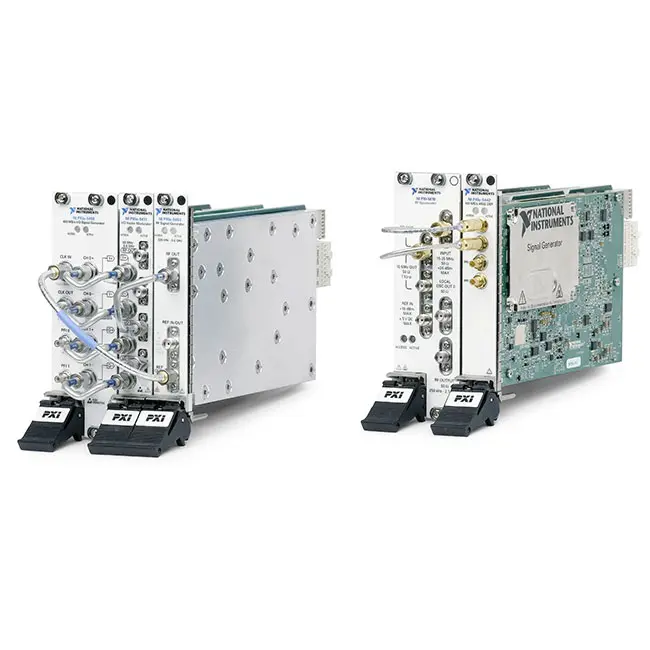
PXIe-5673 is a system-level instrument name rather than the model number of one physical module. The complete generator contains three coordinated hardware modules.
| Module | Function | Typical Width |
|---|---|---|
| PXIe-5450 or PXIe-5451 | Generates differential baseband I and Q arbitrary waveforms | One PXI Express slot |
| PXIe-5611 | Directly modulates and upconverts the baseband I/Q signals to RF | Two PXI Express slots |
| PXI-5650, PXI-5651 or PXI-5652 | Supplies the local-oscillator signal for the selected RF range | One PXI hybrid-compatible slot |
The modules are connected using the specified SMA cables and associated in NI Measurement & Automation Explorer. NI-RFSG then controls the connected hardware as one vector signal generator.
PXIe-5450 and PXIe-5451 I/Q Generator
The PXIe-5450 and PXIe-5451 are dual-channel arbitrary waveform generators that produce the differential baseband I and Q signals used by the RF modulator.
Their 16-bit digital-to-analog conversion and 400 MS/s sample rate support high-quality waveform generation across more than 100 MHz of RF modulation bandwidth.
PXIe-5611 I/Q Modulator
The PXIe-5611 performs direct RF upconversion of the differential I and Q signals. It combines the baseband waveform with the local-oscillator signal and provides the final modulated RF output.
Direct I/Q modulation supports wide signal bandwidth and allows engineers to generate complex modulation formats without using multiple intermediate-frequency conversion stages.
PXI-5650-Series Local Oscillator
The local-oscillator module depends on the maximum frequency configuration:
- PXI-5650 for configurations extending to 1.3 GHz
- PXI-5651 for configurations extending to 3.3 GHz
- PXI-5652 for configurations extending to 6.6 GHz
The LO source determines the system’s maximum carrier frequency. The PXIe-5673 uses the PXI versions of these modules, while the PXIe-5673E uses corresponding PXI Express LO modules.
More Than 100 MHz Modulation Bandwidth
The PXIe-5673 provides more than 100 MHz of double-sideband modulation bandwidth over applicable carrier frequencies. This supports broadband wireless signals, high-symbol-rate QAM, multicarrier waveforms and customized wideband RF stimulus.
At carrier frequencies close to the lower frequency limit, the usable bandwidth is restricted because both sidebands must remain within the operating range. For example, full 100 MHz bandwidth cannot be centered at the minimum carrier frequency.
16-Bit Arbitrary I/Q Generation
The arbitrary waveform generator uses two synchronized 16-bit output channels to produce the in-phase and quadrature components of the RF waveform. The I and Q signals carry the amplitude and phase information required for vector modulation.
Custom waveform data can represent standard wireless signals, recorded RF environments, multitone tests, interference scenarios or proprietary communication formats.
128 MB and 512 MB Memory Options
The PXIe-5673 is available with 128 MB or 512 MB of onboard waveform memory. Larger memory supports longer nonrepeating signals and allows more waveform segments to remain loaded in the instrument.
When the waveform is larger than onboard memory, the generator can use continuous streaming from host memory or a suitable storage system, subject to controller and PXI Express transfer performance.
Continuous Waveform Streaming
The PXIe-5673 supports a nominal continuous data-transfer rate of 500 MB/s. Streaming allows long RF waveforms to be generated without storing the entire signal in onboard memory.
Actual performance depends on the PXI Express chassis, system controller, storage array, host memory, waveform-processing requirements and other devices sharing the system bandwidth.
RF Record-and-Playback Systems
The PXIe-5673 can reproduce RF waveforms captured by a compatible vector signal analyzer. Recorded complex I/Q data is stored on the host system and streamed to the generator for later playback.
This architecture is useful for reproducing field signals, interference conditions, intermittent events and realistic receiver-test environments.
Phase-Coherent Signal Generation
Multiple PXIe-5673 generators can share a common start trigger, reference clock and local-oscillator signal. A shared LO provides phase coherency because each channel derives its carrier from the same oscillator.
Up to four synchronized generators can be installed in a suitable 18-slot chassis, subject to slot availability and system configuration. This enables multi-channel RF generation for MIMO, beamforming and phased-array testing.
High-Order QAM Generation
The PXIe-5673 can generate QAM formats including 4-QAM, 16-QAM, 64-QAM and 256-QAM. High-order modulation places strict requirements on amplitude accuracy, phase accuracy, carrier suppression, image rejection and noise.
Correct waveform scaling and I/Q calibration are important for achieving low error vector magnitude. NI-RFSG provides controls for compensating I/Q gain imbalance, DC offset and quadrature skew.
Supported Modulation Formats
- Amplitude modulation
- Frequency modulation
- Phase modulation
- Continuous phase modulation
- Amplitude-shift keying
- Frequency-shift keying
- Minimum-shift keying
- Gaussian minimum-shift keying
- Phase-shift keying
- Quadrature phase-shift keying
- Pulse-amplitude modulation
- 4-QAM, 16-QAM, 64-QAM and 256-QAM
- Multitone signals
- User-defined arbitrary I/Q waveforms
Typical PXIe-5673 Applications
- Wireless receiver testing
- WLAN signal generation
- Cellular communication testing
- GPS receiver validation
- RFID device testing
- Wireless sensor-network development
- WiMAX signal generation
- DVB and digital broadcast testing
- Software-defined radio research
- Aerospace and defense RF testing
- Semiconductor RF characterization
- MIMO and beamforming testing
- RF record and playback
- Automated production testing
Wireless Receiver Testing
The PXIe-5673 can generate controlled modulated signals for receiver sensitivity, adjacent-channel rejection, blocking and functional testing. Frequency, power, modulation and impairment parameters can be changed automatically through software.
Standard-specific waveform software or custom I/Q waveforms can be used to reproduce the communication signal required by the receiver.
WLAN and Cellular Testing
The generator’s 6.6 GHz maximum frequency and 100 MHz bandwidth support many legacy WLAN and cellular bands. It can produce QPSK, QAM, OFDM and other signals when combined with the appropriate waveform-generation software.
Before selecting the PXIe-5673, verify that the required wireless standard, occupied bandwidth, carrier frequency and modulation-quality requirements are supported by the available hardware and software.
MIMO and Beamforming Applications
Multiple synchronized PXIe-5673 channels can generate phase-coherent signals for multi-antenna receivers, beamforming algorithms and MIMO communication systems.
Channel-to-channel phase alignment requires a shared LO, common reference clock, synchronized start trigger and correctly matched RF cabling.
Aerospace and Defense Testing
The PXIe-5673 can generate custom broadband signals for communications, navigation, radar-component and electronic-warfare research within its supported frequency range.
Arbitrary waveform generation allows engineers to reproduce complex pulses, frequency-agile signals, multitone environments and recorded RF conditions.
Semiconductor RF Testing
The generator can provide RF stimulus for testing amplifiers, mixers, receivers, front-end modules and other semiconductor devices. PXI integration makes it possible to coordinate the source with digitizers, analyzers, power supplies and switch systems.
Fast waveform transfer and software automation help reduce measurement time in characterization and production environments.
NI-RFSG Software Support
The PXIe-5673 is controlled through the NI-RFSG instrument driver. NI-RFSG transparently coordinates the AWG, I/Q modulator and local-oscillator source as one RF instrument.
The driver provides functions for configuring carrier frequency, output power, waveform data, generation mode, reference clocks, triggers, I/Q impairments and streaming.
LabVIEW Integration
LabVIEW applications can use NI-RFSG functions to download waveforms, initiate generation and coordinate the PXIe-5673 with other modular instruments.
The generator can also be integrated into TestStand sequences and supported text-based programming environments for automated test deployment.
PXI Express Chassis Requirements
The complete PXIe-5673 occupies four chassis slots. The PXIe-5611 occupies two PXI Express slots, the PXIe-5450 or PXIe-5451 occupies one PXI Express slot and the PXI-5650-series LO occupies one compatible PXI hybrid slot.
Before installation, confirm that four suitable slots are available and that the chassis provides adequate cooling. NI specifies High fan operation for published PXIe-5673 performance.
PXIe-5673 Troubleshooting
The PXIe-5673 does not appear as one instrument
Confirm that the PXIe-5611, PXIe-5450 or PXIe-5451 and correct PXI-5650-series LO are all detected in NI MAX. Check the intermodule cables and associate the modules using the applicable NI-RFSG procedure.
No RF output is detected
Verify that signal generation is initiated and RF output is enabled. Check the carrier frequency, power level, waveform configuration and RF output cable.
The output signal is distorted
Reduce digital waveform scaling and check for I/Q clipping. Confirm that the waveform sample rate, interpolation and occupied bandwidth are compatible with the generator.
Image rejection is poor
Perform self-calibration after the instrument temperature stabilizes. Check the differential I/Q cables and verify I/Q gain imbalance, quadrature skew and DC-offset settings.
Carrier leakage is too high
Perform self-calibration and review the I/Q DC-offset correction. Check that all intermodule connections are secure and that the system has completed its warm-up period.
A waveform does not fit in memory
Reduce the waveform length or sample rate, use repeating waveform segments or configure streaming. A 512 MB version provides more capacity than a 128 MB configuration.
Streaming is interrupted
Check the controller, storage system and chassis bandwidth. Avoid other high-throughput operations that compete with the waveform data stream.
Multiple generators are not phase coherent
Verify that all channels share the same LO, reference clock and start trigger. Check cable lengths, trigger routing and synchronization configuration.
The module reports an overtemperature condition
Stop generation and allow the modules to cool. Set chassis fans to High, check airflow and install filler panels in unused slots.
PXIe-5673 Comparison with Similar NI RF Generators
| Model | General Configuration | Best Suited For |
|---|---|---|
| PXIe-5672 | 2.7 GHz and 20 MHz bandwidth | Legacy narrowband and moderate-bandwidth RF testing |
| PXIe-5673 | Up to 6.6 GHz and more than 100 MHz bandwidth | Wideband wireless and arbitrary RF signal generation |
| PXIe-5673E | Enhanced PXI Express LO architecture and RF list mode | Faster tuning and newer PXI Express systems |
| PXIe-5644 | Integrated vector signal transceiver | Combined RF signal generation and analysis |
| PXIe-5840 | Newer wideband vector signal transceiver | Advanced wireless and semiconductor testing |
PXIe-5673 vs PXIe-5672
The PXIe-5672 covers frequencies to 2.7 GHz with 20 MHz instantaneous bandwidth. The PXIe-5673 extends coverage to 6.6 GHz and provides more than 100 MHz of modulation bandwidth.
Choose the PXIe-5672 for established systems that do not require signals above 2.7 GHz or bandwidth beyond 20 MHz. Choose the PXIe-5673 for wider-bandwidth and higher-frequency wireless signals.
PXIe-5673 vs PXIe-5673E
The PXIe-5673 uses a PXI-5650-series local oscillator, while the PXIe-5673E uses the corresponding PXI Express LO module.
The enhanced version also supports RF list mode and faster frequency changes when configured for wide-loop operation. The PXIe-5673 may be preferred when maintaining an existing system built around its PXI LO hardware.
PXIe-5673 vs PXIe-5644
The PXIe-5673 is a dedicated vector signal generator. The PXIe-5644 Vector Signal Transceiver combines RF generation, RF analysis and programmable FPGA processing in one instrument.
Choose the PXIe-5673 when only wideband RF generation is required or when maintaining an existing modular VSG system. Choose the PXIe-5644 when the system requires both stimulus and response measurements.
Recommended Related Products
- PXIe-5672 2.7 GHz Vector Signal Generator
- PXIe-5673E 6.6 GHz Vector Signal Generator
- PXIe-5611 I/Q Modulator
- PXIe-5450 Arbitrary Waveform Generator
- PXIe-5451 Arbitrary Waveform Generator
- PXI-5652 6.6 GHz RF Signal Generator
- PXIe-5644 Vector Signal Transceiver
- PXIe-5663 Vector Signal Analyzer
- View More NI PXI and PXI Express Modules
Selecting the Right PXIe-5673
Choose the 1.3 GHz, 3.3 GHz or 6.6 GHz version according to the highest RF carrier frequency required by the test application. Select 512 MB memory for longer nonrepeating waveforms and 128 MB when shorter waveform sequences are sufficient.
Before ordering, verify that all three component modules and the complete intermodule cable set are included. Also confirm the PXIe-5450 or PXIe-5451 memory size, LO model, I/Q modulator revision, calibration status and chassis compatibility.
Why Choose the PXIe-5673?
- Provides frequency configurations extending to 6.6 GHz
- Generates more than 100 MHz of modulation bandwidth
- Uses 16-bit, 400 MS/s dual-channel I/Q generation
- Supports complex arbitrary RF waveforms
- Provides 128 MB and 512 MB memory options
- Supports common analog and digital modulation formats
- Enables phase-coherent multi-channel generation
- Supports continuous waveform streaming
- Integrates with NI-RFSG and LabVIEW
- Fits established wireless and automated RF test systems
Frequently Asked Questions
What is the PXIe-5673?
The PXIe-5673 is a modular PXI vector signal generator that creates wideband CW and digitally modulated RF signals at frequencies up to 6.6 GHz.
Is the PXIe-5673 one physical module?
No. It combines a PXIe-5611 I/Q modulator, a PXIe-5450 or PXIe-5451 AWG and a PXI-5650-series LO source.
What frequency ranges are available?
The PXIe-5673 is available with maximum frequencies of 1.3 GHz, 3.3 GHz or 6.6 GHz.
What is its modulation bandwidth?
The PXIe-5673 provides more than 100 MHz of double-sideband modulation bandwidth under the applicable carrier-frequency conditions.
What memory options are available?
Standard PXIe-5673 configurations provide either 128 MB or 512 MB of onboard arbitrary waveform memory.
What is part number 780418-12?
Part number 780418-12 identifies a 6.6 GHz, 512 MB PXIe-5673 configuration equipped with an enhanced I/Q modulator.
What modulation formats can it generate?
The generator supports AM, FM, PM, CPM, ASK, FSK, MSK, GMSK, PSK, QPSK, PAM, QAM, multitone and user-defined arbitrary waveforms.
Can multiple PXIe-5673 generators be synchronized?
Yes. Multiple generators can share a reference clock, start trigger and LO for phase-coherent RF generation.
Can it stream waveforms from disk?
Yes. The PXIe-5673 supports continuous waveform streaming, subject to the performance of the chassis, controller and storage system.
Which software controls the PXIe-5673?
The PXIe-5673 is controlled through NI-RFSG, which coordinates its separate hardware modules as one vector signal generator.
How many PXI slots does it require?
The complete PXIe-5673 occupies four chassis slots, including a compatible hybrid slot for the PXI-5650-series local oscillator.
Is the PXIe-5673 still manufactured?
No. NI identifies it as discontinued. Existing inventory, refurbished units and tested used systems may remain available from independent suppliers.
What is the recommended replacement?
NI lists the 6.6 GHz, 512 MB PXIe-5673E, part number 781263-02, as the recommended replacement.
Request a Quote for the PXIe-5673
Contact us for current availability, condition, calibration options and project pricing for the NI PXIe-5673 Vector Signal Generator. Please provide the required frequency range, memory capacity and exact part number when available.
We can also help identify individual PXIe-5611, PXIe-5450, PXIe-5451 and PXI-5650-series replacement modules, intermodule cable kits, compatible chassis and newer NI vector signal generators for your RF test system.