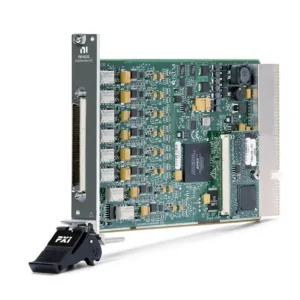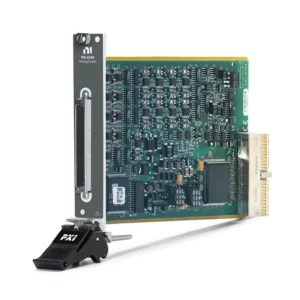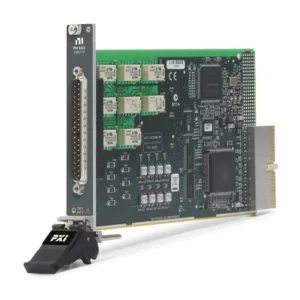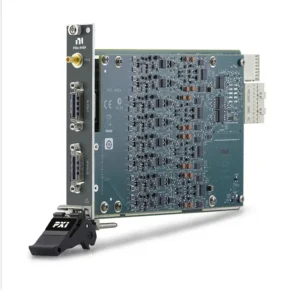




Product Introduction
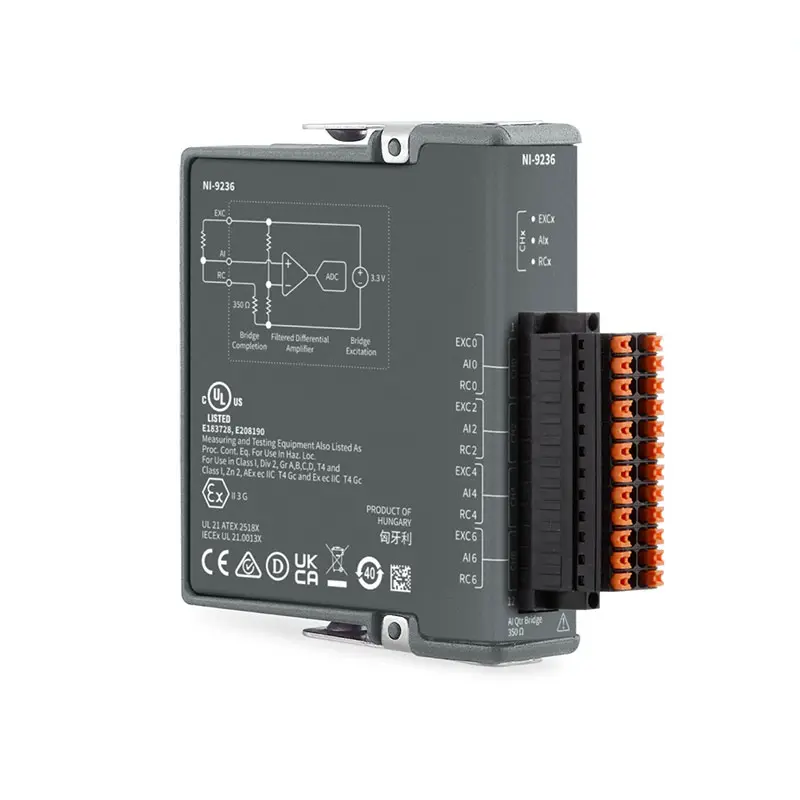
The NI-9236 is an 8-channel C Series strain/bridge input module specifically designed for dynamic measurement of 350 Ω quarter-bridge strain gauges. It combines bridge completion, sensor excitation, signal conditioning, high-resolution analog-to-digital conversion, and simultaneous multi-channel acquisition in a compact C Series module.
The NI-9236 provides 8 analog input channels, 24-bit resolution, and simultaneous sampling rates up to 10 kS/s per channel. Its synchronized acquisition architecture makes it particularly suitable for applications where strain measurements from multiple locations must be compared at the same instant.
Typical applications include structural testing, mechanical testing, impact testing, fatigue testing, load analysis, component validation, automotive testing, aerospace testing, and structural monitoring.
Product Overview
The National Instruments NI-9236 belongs to the C Series strain and bridge measurement family and is optimized for 350 Ω quarter-bridge strain gauges.
A typical measurement architecture is:
350 Ω Quarter-Bridge Strain Gauge → NI-9236 → CompactDAQ / CompactRIO → Measurement and Analysis Software
Because bridge completion and excitation are integrated into the module, the NI-9236 simplifies strain measurement system design and reduces the amount of external signal-conditioning hardware required.
Key Features
8 Strain Measurement Channels
The NI-9236 provides 8 analog input channels for measuring multiple quarter-bridge strain gauges from a single C Series module.
This channel density is useful for applications where strain must be measured at several points on a structure or mechanical component.
Typical measurement locations can include:
- Structural beams
- Vehicle components
- Mechanical assemblies
- Test specimens
- Aircraft structures
- Machine components
- Load-bearing structures
- Prototype assemblies
350 Ω Quarter-Bridge Strain Gauge Support
The NI-9236 is specifically designed for 350 Ω quarter-bridge strain gauge measurements.
The module incorporates the required quarter-bridge completion circuitry, reducing the need for separate external bridge completion hardware.
This makes the NI-9236 particularly convenient when building multi-channel strain measurement systems using standard 350 Ω strain gauges.
Built-In Bridge Completion
Quarter-bridge strain measurement requires additional precision resistance to complete the Wheatstone bridge.
The NI-9236 provides integrated 350 Ω quarter-bridge completion.
A simplified architecture is:
350 Ω Strain Gauge + NI-9236 Internal Bridge Completion → Complete Measurement Bridge
Integrating bridge completion inside the module simplifies wiring and reduces the number of external components required in the measurement system.
Built-In Voltage Excitation
The NI-9236 includes built-in voltage excitation for quarter-bridge strain gauges.
Strain gauges require excitation to produce a measurable bridge output. Integrating excitation into the module simplifies system configuration and helps provide a controlled measurement architecture.
24-Bit Resolution
The NI-9236 uses a 24-bit Delta-Sigma analog-to-digital converter.
High-resolution conversion is important for strain measurements because the electrical changes generated by strain gauges can be very small.
The 24-bit measurement architecture helps provide the resolution required for mechanical and structural testing applications.
10 kS/s per Channel
The NI-9236 supports sampling rates up to 10 kS/s per channel.
Unlike multiplexed measurement architectures where channels are measured sequentially, the NI-9236 provides simultaneous acquisition across its channels.
This makes the module suitable for dynamic strain measurements where the timing relationship between channels must be preserved.
Simultaneous Sampling
All eight NI-9236 channels can acquire measurements simultaneously.
Simultaneous sampling is particularly important for:
- Impact testing
- Dynamic structural testing
- Mechanical transient analysis
- Multi-point strain comparison
- Component validation
- Load event analysis
When an impact or mechanical event occurs, simultaneous acquisition allows measurements from different strain gauges to represent the same instant in time.
Delta-Sigma ADC Architecture
The NI-9236 uses Delta-Sigma ADC technology with analog prefiltering.
This architecture is well suited for precision dynamic measurements where high resolution, synchronized sampling, and controlled frequency response are important.
60 VDC Isolation
The NI-9236 provides 60 VDC channel-to-earth ground isolation.
Isolation helps improve measurement robustness and provides protection against common-mode voltage differences between the measurement system and connected equipment.
1,000 Vrms Transient Isolation
The module also provides 1,000 Vrms transient isolation.
This helps provide increased protection against transient electrical conditions that may occur in industrial or test environments.
High Common-Mode Noise Rejection
The isolation and differential measurement architecture help the NI-9236 provide strong rejection of common-mode electrical noise.
This can be particularly useful when strain gauges are installed on large structures, machinery, vehicles, or test fixtures where electrical interference may be present.
Technical Specifications
| Parameter | Specification |
|---|---|
| Product Type | C Series Strain/Bridge Input Module |
| Model | NI-9236 |
| Manufacturer | National Instruments |
| Bus / Platform | C Series |
| Number of Analog Input Channels | 8 |
| Bridge Configuration | Quarter Bridge |
| Nominal Bridge Resistance | 350 Ω |
| Quarter-Bridge Completion | 350 Ω |
| Quarter-Bridge Completion Temperature Coefficient | 10 ppm/°C Maximum |
| ADC Resolution | 24 Bit |
| ADC Type | Delta-Sigma with Analog Prefiltering |
| Sampling Mode | Simultaneous |
| Maximum Sample Rate | 10 kS/s/ch |
| Analog Input Range | ±29.4 mV/V |
| Sensor Excitation | Built-In |
| Channel-to-Earth Isolation | 60 VDC |
| Transient Isolation | 1,000 Vrms |
| Front Connection | Spring Terminal |
| Operating Temperature | -40 °C to 70 °C |
| Primary Sensor Type | 350 Ω Quarter-Bridge Strain Gauge |
| Primary Applications | Dynamic Strain, Structural Test, Impact Test, Mechanical Test and Data Acquisition |
NI-9236 Part Numbers
The NI-9236 is available in standard and conformal-coated configurations.
| Part Number | Configuration | Conformal Coating |
|---|---|---|
| 785996-01 | NI-9236 Standard Version | No |
| 779994-02 | NI-9236 Conformal-Coated Version | Yes |
Both versions provide the same core 8-channel, 350 Ω quarter-bridge strain measurement functionality. The conformal-coated version is intended for applications requiring additional protection of the module electronics against environmental contaminants and moisture.
Included NI-9966 Terminal Plug
The NI-9236 uses a 34-position spring terminal connection.
NI lists the NI-9966 34-position spring terminal plug as an included item with the NI-9236.
When purchasing a used NI-9236, verify whether the NI-9966 terminal plug is included because replacement modules may be supplied without their original removable terminal connector.
How Does the NI-9236 Work?
A strain gauge changes electrical resistance when the material to which it is attached experiences mechanical deformation.
Because the resistance change is very small, the strain gauge is typically incorporated into a Wheatstone bridge measurement circuit.
The NI-9236 simplifies this process by providing bridge completion, excitation, signal conditioning, and analog-to-digital conversion.
A simplified signal path is:
Mechanical Strain → 350 Ω Strain Gauge → Wheatstone Quarter Bridge → NI-9236 → 24-Bit ADC → Digital Strain Data
What Is a Quarter-Bridge Strain Gauge?
A quarter-bridge configuration uses one active strain gauge as part of a Wheatstone bridge.
The remaining bridge resistance is provided by completion resistors.
A simplified architecture is:
1 Active Strain Gauge + Bridge Completion Resistors = Quarter-Bridge Measurement
Quarter-bridge configurations are widely used because they require only one active strain gauge at each measurement location.
350 Ω Strain Gauge Measurement
The NI-9236 is optimized for nominal 350 Ω strain gauges.
NI specifies 350 Ω quarter-bridge completion resistance for the module.
This distinction is important because NI also offers modules intended for other nominal bridge resistances.
350 Ω Gauge Resistance Range
Although the NI-9236 is nominally designed for 350 Ω strain gauges, compatible gauges do not necessarily need to measure exactly 350.000 Ω.
Based on the module’s ±29.4 mV/V input range and quarter-bridge architecture, the practical resistance range is approximately:
| Parameter | Resistance |
|---|---|
| Minimum | Approximately 311 Ω |
| Nominal | 350 Ω |
| Maximum | Approximately 394 Ω |
Sensor compatibility should still be verified against the complete NI-9236 specifications before installation.
Dynamic Strain Measurement
The combination of 10 kS/s/ch sampling and simultaneous acquisition makes the NI-9236 suitable for dynamic strain measurement.
Dynamic strain applications involve mechanical loads that change over time, such as:
- Impact events
- Mechanical vibration
- Rapid loading
- Structural movement
- Component deformation
- Transient mechanical events
Impact Testing
Impact testing is an important application for the NI-9236 because all eight channels can be sampled simultaneously.
For example:
Gauge 1 → Structural Point A
Gauge 2 → Structural Point B
Gauge 3 → Structural Point C
Gauge 4 → Structural Point D
Gauges 5–8 → Additional Measurement Locations
When an impact occurs, all channels capture the event on the same sampling timeline, allowing engineers to compare how different parts of the structure respond.
Structural Testing
The NI-9236 can be used for multi-point structural strain measurement during static and dynamic mechanical tests.
Typical structures include:
- Frames
- Beams
- Vehicle structures
- Aircraft components
- Mechanical assemblies
- Test fixtures
- Prototype structures
Fatigue Testing
Fatigue testing repeatedly loads a component to evaluate how it behaves over time.
The NI-9236 can acquire strain measurements from multiple locations while the test specimen undergoes repeated mechanical loading.
Measurement software can then analyze:
- Maximum strain
- Minimum strain
- Strain range
- Cycle behavior
- Structural response
- Changes during test duration
Mechanical Component Validation
During component validation, engineers can install multiple 350 Ω strain gauges on critical areas of the DUT.
The NI-9236 can simultaneously acquire these signals while the component is subjected to mechanical loads.
This allows engineers to compare measured strain with:
- Design calculations
- Finite element analysis
- Simulation results
- Material limits
- Previous test results
Automotive Testing
Automotive test systems frequently require multi-channel strain measurements from vehicle structures and mechanical components.
Potential applications include:
- Chassis testing
- Suspension component testing
- Vehicle structural testing
- Powertrain component testing
- Durability testing
- Road-load testing
- Component fatigue testing
Aerospace Testing
The NI-9236 can be used in aerospace structural test systems where multiple strain gauges monitor deformation under mechanical loading.
Applications can include:
- Airframe testing
- Wing structural testing
- Mechanical component validation
- Ground testing
- Structural load testing
- Prototype validation
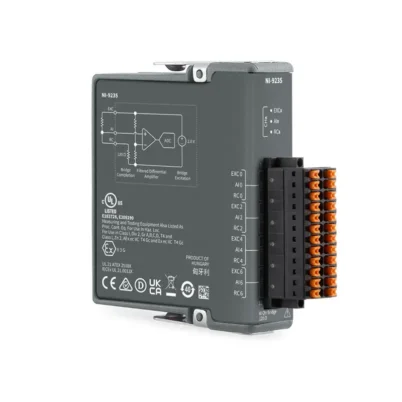
NI-9236 vs NI-9235
The NI-9235 and NI-9236 are closely related quarter-bridge strain measurement modules. The primary difference is the nominal strain gauge resistance.
| Feature | NI-9236 | NI-9235 |
|---|---|---|
| Bridge Configuration | Quarter Bridge | Quarter Bridge |
| Nominal Gauge Resistance | 350 Ω | 120 Ω |
| Channels | 8 | 8 |
| Resolution | 24 Bit | 24 Bit |
| Maximum Sampling Rate | 10 kS/s/ch | 10 kS/s/ch |
| Sampling Architecture | Simultaneous | Simultaneous |
| Best Application | 350 Ω Quarter-Bridge Gauges | 120 Ω Quarter-Bridge Gauges |
If the application uses 350 Ω quarter-bridge strain gauges, the NI-9236 is the appropriate model. For nominal 120 Ω quarter-bridge gauges, the NI-9235 should be considered.
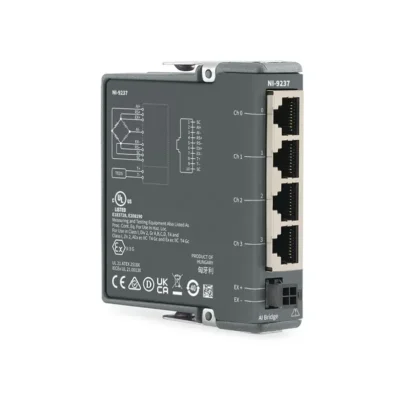
NI-9236 vs NI-9237
The NI-9236 and NI-9237 are both C Series strain/bridge input modules, but they are optimized for different bridge configurations and measurement requirements.
| Feature | NI-9236 | NI-9237 |
|---|---|---|
| Channels | 8 | 4 |
| Primary Bridge Configuration | 350 Ω Quarter Bridge | More Flexible Bridge Measurements |
| Resolution | 24 Bit | 24 Bit |
| Maximum Sample Rate | 10 kS/s/ch | 50 kS/s/ch |
| Primary Advantage | 8-Channel 350 Ω Quarter-Bridge Measurement | Higher Speed and Bridge Flexibility |
Choose the NI-9236 when the application primarily uses multiple 350 Ω quarter-bridge strain gauges. Consider the NI-9237 when higher sampling rates or additional bridge configurations are required.
NI-9236 vs General-Purpose Voltage Input Modules
A general-purpose voltage input module can measure electrical voltage, but it does not necessarily provide the bridge-specific functionality required for direct strain gauge measurement.
| Feature | NI-9236 | General Voltage Input Module |
|---|---|---|
| Strain Gauge Measurement | Purpose-Built | Requires Additional Conditioning |
| 350 Ω Bridge Completion | Integrated | Typically External |
| Sensor Excitation | Integrated | Typically External |
| Strain Scaling | Designed for Bridge Measurement | Additional Configuration Required |
NI-9236 with CompactDAQ
The NI-9236 can be installed in compatible CompactDAQ chassis for PC-based strain measurement.
A typical system consists of:
- 350 Ω strain gauges
- NI-9236
- CompactDAQ chassis
- Host computer
- NI-DAQmx
- LabVIEW, FlexLogger, or compatible software
This architecture is suitable for laboratory structural testing, component validation, fatigue testing, and multi-channel strain data logging.
NI-9236 with CompactRIO
The NI-9236 can also be integrated into compatible CompactRIO systems for embedded and distributed strain measurement.
A typical architecture is:
Strain Gauges → NI-9236 → CompactRIO → Real-Time / FPGA System → Analysis, Logging or Control
CompactRIO integration can be useful for rugged field testing, embedded monitoring, industrial structural measurement, and distributed test systems.
NI-DAQmx Integration
When used with compatible CompactDAQ hardware, the NI-9236 can be configured through NI-DAQmx.
Typical configuration parameters include:
- Physical channel
- Bridge configuration
- Gauge resistance
- Gauge factor
- Excitation
- Sample rate
- Strain units
- Initial bridge balance
LabVIEW Integration
The NI-9236 can be incorporated into compatible LabVIEW applications for automated strain measurement, data acquisition, analysis, visualization, and test control.
A typical workflow is:
Configure Strain Channels → Balance Bridge → Configure Timing → Acquire Data → Analyze Strain → Display / Log Results
FlexLogger Applications
The NI-9236 can also be used with compatible FlexLogger configurations for interactive sensor setup and data logging.
This can simplify applications that require:
- Multiple strain channels
- Live measurement displays
- Data logging
- Calculated channels
- Test monitoring
- Engineering-unit scaling
Strain Gauge Wiring Considerations
Correct strain gauge wiring is critical for obtaining accurate measurements.
Before connecting a gauge to the NI-9236, verify:
- Gauge resistance
- Quarter-bridge configuration
- Gauge factor
- Lead-wire configuration
- Terminal connections
- Shielding
- Grounding
- Expected strain range
- Temperature environment
Bridge Balancing
A strain gauge bridge may produce a non-zero output even when no mechanical strain is applied.
This offset can result from:
- Gauge resistance tolerance
- Installation stress
- Lead-wire resistance
- Temperature
- Mechanical preload
- Bridge component tolerances
Bridge balancing or offset compensation should therefore be performed before precision strain measurements.
Gauge Factor
The gauge factor describes how much the electrical resistance of a strain gauge changes relative to mechanical strain.
The correct gauge factor must be entered into the measurement configuration to convert the electrical bridge output into accurate engineering strain values.
Always use the gauge factor supplied by the strain gauge manufacturer whenever available.
Temperature Effects
Temperature changes can affect strain gauge resistance and therefore influence measurement accuracy.
For demanding measurements, consider:
- Gauge temperature coefficient
- Specimen material
- Gauge installation method
- Lead-wire resistance
- Ambient temperature variation
- Temperature compensation strategy
Troubleshooting NI-9236 Measurements
If NI-9236 measurements are unstable or incorrect, check the complete measurement system.
- Verify that the NI-9236 is detected by the chassis.
- Confirm that a compatible 350 Ω quarter-bridge gauge is connected.
- Check the strain gauge wiring.
- Verify the NI-9966 terminal connections.
- Confirm the correct gauge factor.
- Perform bridge balancing before measurement.
- Verify the sample rate.
- Check cable shielding and grounding.
- Inspect the strain gauge installation.
- Check for temperature-induced drift.
- Verify CompactDAQ or CompactRIO software compatibility.
How to Choose a C Series Strain Input Module
Before selecting the NI-9236, determine:
- Required number of strain channels
- Quarter-, half-, or full-bridge configuration
- Nominal strain gauge resistance
- Required sample rate
- Need for simultaneous sampling
- Required resolution
- Excitation requirements
- Isolation requirements
- CompactDAQ or CompactRIO chassis
- Environmental requirements
- Software compatibility
Industries
- Automotive
- Aerospace
- Mechanical Engineering
- Structural Engineering
- Manufacturing
- Transportation
- Energy
- Research and Development
- Automated Test
- Industrial Measurement
Applications
Dynamic Strain Measurement
The NI-9236 provides simultaneous 10 kS/s/ch acquisition for dynamic strain measurements using 350 Ω quarter-bridge strain gauges.
Structural Testing
Eight synchronized channels allow strain to be measured at multiple locations on a structure during mechanical loading.
Impact Testing
Simultaneous sampling allows all channels to capture the same impact event, making the NI-9236 suitable for transient mechanical tests.
Fatigue Testing
The module can monitor strain at multiple locations during repeated loading and durability testing.
Automotive Testing
The NI-9236 can measure strain on vehicle chassis, suspension systems, mechanical components, and structural assemblies.
Aerospace Structural Testing
Multiple 350 Ω strain gauges can be monitored simultaneously during airframe and aerospace component testing.
Mechanical Component Validation
The NI-9236 can compare measured mechanical strain against design calculations, simulation results, and engineering limits.
Recommended Related Products
| NI-9236 | 8-channel, 350 Ω quarter-bridge strain input module with 24-bit simultaneous acquisition at up to 10 kS/s/ch. |
| NI-9235 | 8-channel quarter-bridge strain input module designed for nominal 120 Ω strain gauges. |
| NI-9237 | 4-channel, 24-bit bridge input module with up to 50 kS/s/ch for applications requiring higher speed and more flexible bridge configurations. |
| NI-9219 | Universal C Series analog input module supporting multiple sensor and measurement types for lower-speed applications. |
Why Choose NI-9236?
- 8 analog strain input channels
- Designed for 350 Ω quarter-bridge strain gauges
- Integrated 350 Ω bridge completion
- Built-in sensor excitation
- 24-bit Delta-Sigma ADC
- Up to 10 kS/s per channel
- Simultaneous sampling
- ±29.4 mV/V input range
- 60 VDC channel-to-earth isolation
- 1,000 Vrms transient isolation
- High common-mode noise rejection
- Spring-terminal connectivity
- Standard and conformal-coated versions available
- Suitable for dynamic strain measurement
- Suitable for impact testing
- Suitable for structural testing
- Suitable for fatigue testing
- Suitable for automotive and aerospace validation
Frequently Asked Questions
What is the NI-9236?
The NI-9236 is an 8-channel C Series strain/bridge input module designed for dynamic measurement of 350 Ω quarter-bridge strain gauges.
How many channels does NI-9236 have?
The NI-9236 provides 8 analog input channels.
What type of strain gauge does NI-9236 support?
The NI-9236 is specifically designed for 350 Ω quarter-bridge strain gauges.
What is the resolution of NI-9236?
The NI-9236 uses a 24-bit Delta-Sigma ADC.
What is the maximum sampling rate of NI-9236?
The NI-9236 supports sampling rates up to 10 kS/s per channel.
Is NI-9236 10 kS/s per channel or aggregate?
The NI-9236 specification is 10 kS/s per channel. Its channels are simultaneously sampled, rather than sharing a single 10 kS/s aggregate sampling rate.
Does NI-9236 support simultaneous sampling?
Yes. All eight channels are simultaneously sampled, making the NI-9236 particularly suitable for dynamic strain and impact measurements.
Does NI-9236 provide bridge completion?
Yes. The NI-9236 includes built-in 350 Ω quarter-bridge completion.
Does NI-9236 provide strain gauge excitation?
Yes. The NI-9236 includes built-in voltage excitation for compatible quarter-bridge strain gauges.
What is the input range of NI-9236?
The NI-9236 has a specified analog input range of approximately -29.4 mV/V to +29.4 mV/V.
Is NI-9236 isolated?
Yes. The NI-9236 provides 60 VDC channel-to-earth ground isolation and 1,000 Vrms transient isolation.
What are the NI-9236 part numbers?
The primary NI-9236 part numbers are 785996-01 for the standard version and 779994-02 for the conformal-coated version.
What is the difference between NI-9236 785996-01 and 779994-02?
Both provide the same core NI-9236 strain measurement functionality. Part number 779994-02 has conformal coating, while 785996-01 is the standard non-conformal-coated configuration.
What terminal connector does NI-9236 use?
The NI-9236 uses a spring-terminal connection. NI lists the NI-9966 34-position spring terminal plug with the module.
Can NI-9236 measure a 120 Ω strain gauge?
The NI-9236 is designed around 350 Ω quarter-bridge completion. For nominal 120 Ω quarter-bridge strain gauges, the NI-9235 is the corresponding C Series module and is generally the appropriate choice.
What is the difference between NI-9236 and NI-9235?
The primary difference is bridge resistance. The NI-9236 is designed for 350 Ω quarter-bridge strain gauges, while the NI-9235 is designed for 120 Ω quarter-bridge strain gauges.
What is the difference between NI-9236 and NI-9237?
The NI-9236 provides eight channels optimized for 350 Ω quarter-bridge gauges at up to 10 kS/s/ch. The NI-9237 provides four channels, supports more flexible bridge measurement configurations, and offers sampling rates up to 50 kS/s/ch.
Can NI-9236 be used for impact testing?
Yes. Impact testing is an important NI-9236 application because its eight channels are sampled simultaneously, allowing strain measurements from different locations to be compared at the same instant.
Can NI-9236 be used with CompactDAQ?
Yes. The NI-9236 can be used with compatible CompactDAQ chassis for PC-based strain measurement, structural testing, and data logging.
Can NI-9236 be used with CompactRIO?
Yes. The NI-9236 can be integrated into compatible CompactRIO systems for embedded, rugged, and distributed strain measurement applications.
What should I check before purchasing NI-9236?
Verify that your application uses 350 Ω quarter-bridge strain gauges, and check the required channel count, 10 kS/s/ch sampling capability, simultaneous acquisition requirement, gauge factor, wiring, NI-9966 terminal connector, CompactDAQ or CompactRIO chassis compatibility, software compatibility, and whether the standard or conformal-coated version is required.
Conclusion
The NI-9236 8-Channel C Series Strain/Bridge Input Module is specifically optimized for high-resolution measurement of 350 Ω quarter-bridge strain gauges. With eight simultaneously sampled channels, 24-bit Delta-Sigma conversion, sampling rates up to 10 kS/s/ch, built-in bridge completion, integrated excitation, 60 VDC channel-to-earth isolation, and 1,000 Vrms transient isolation, it is particularly well suited for dynamic strain measurement, impact testing, structural testing, fatigue analysis, automotive validation, aerospace testing, and multi-channel mechanical measurement systems.