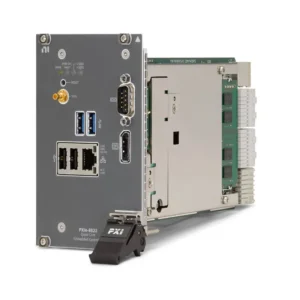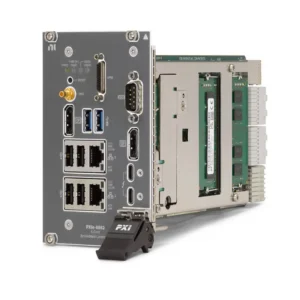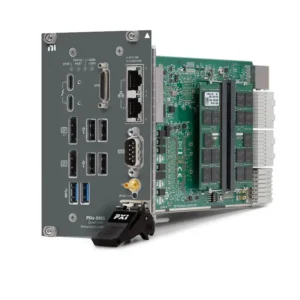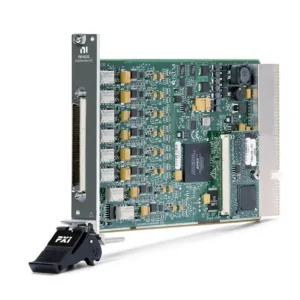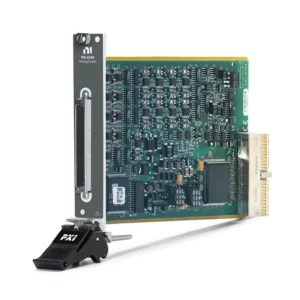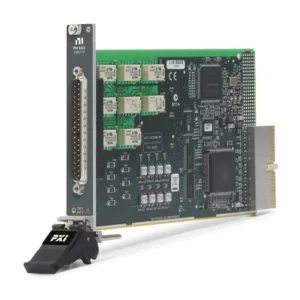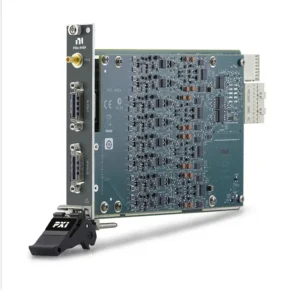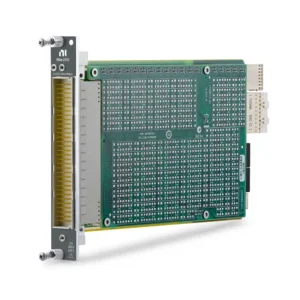




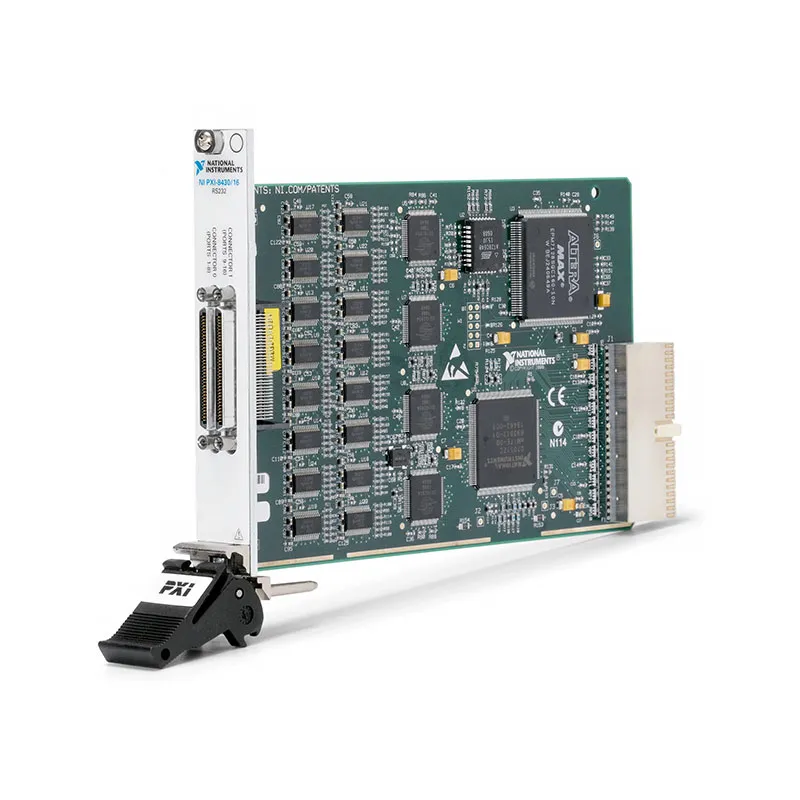
PXI-8430/16 16-Port RS-232 Serial Interface Module
The NI PXI-8430/16 is a high-density PXI serial interface module that adds 16 nonisolated RS-232 ports to an automated test system. It is designed for applications that must communicate with numerous instruments, controllers, barcode readers, operator panels or embedded devices from a single PXI chassis.
Each port supports standard RS-232 communication at rates up to 1 Mbaud. DMA-based transfers and multithreaded driver support help reduce processor overhead when several ports communicate concurrently.
Key Features of the PXI-8430/16
- 16 independent RS-232 serial ports
- Up to 1 Mbaud communication rate
- Nonisolated serial interfaces
- High-performance DMA transfers
- Simultaneous multithreaded communication
- Hardware and software flow-control support
- Standard COM-port programming compatibility
- NI-Serial driver support
- NI-VISA application compatibility
- Compact 3U PXI module format
- High-density front-panel connections
- Suitable for multi-device automated testing
PXI-8430/16 Technical Specifications
| Product Model | PXI-8430/16 |
|---|---|
| Product Type | 16-port PXI serial interface module |
| Serial Standard | RS-232 |
| Number of Ports | 16 |
| Port Isolation | Nonisolated |
| Maximum Baud Rate | 1 Mbaud per port |
| Data Transfer | DMA-based architecture |
| Communication Mode | Full duplex |
| Flow Control | Hardware and software flow control, configuration dependent |
| Software | NI-Serial and NI-VISA |
| Programming Interface | Serial API, VISA or operating-system COM ports |
| Bus Platform | PXI |
| Module Format | 3U PXI |
| Front Connection | High-density connector system requiring compatible breakout cables |
Sixteen Independent RS-232 Ports
The high port density enables one PXI slot to replace several lower-density serial cards. Each port can be configured independently for baud rate, data bits, parity, stop bits and flow-control behavior.
Because the ports are nonisolated, all connected devices must have compatible ground references. Use isolated interfaces or external isolators where ground-potential differences, long cable runs or electrical noise present a risk.
DMA and Multithreaded Operation
The PXI-8430/16 uses DMA transfers to move serial data with reduced host-processor involvement. This is particularly valuable when several ports transfer data at the same time or when the test program performs additional acquisition and analysis tasks.
Multithreaded applications can assign separate communication loops to different ports, helping prevent a slow peripheral from delaying unrelated serial devices.
PXI-8430/16 Part Number and Accessories
| Item | Description |
|---|---|
| PXI-8430/16 | 16-port, nonisolated RS-232 PXI serial module |
| High-Density Serial Cable | Connects the module front panel to the serial breakout assembly |
| 16-Port DB9 Breakout Assembly | Provides conventional connectors for external RS-232 devices |
| Custom Breakout Cable | Supports direct connection to a production fixture or wiring panel |
| External Serial Isolator | Adds isolation where ground differences or noise require protection |
Cable pinout and connector compatibility must be verified before ordering. Do not assume that a cable for a different PXI-843x port count or electrical standard has the same wiring.
PXI-8430/16 Applications
- Automated instrument control
- Multi-device production testing
- Embedded-controller communication
- Barcode scanner integration
- Operator-panel communication
- Environmental chamber control
- Laboratory equipment automation
- Manufacturing-line data collection
- Legacy RS-232 system migration
- Serial-device validation
Multi-Instrument Test Systems
The module can communicate with programmable power supplies, temperature chambers, motion controllers and other equipment that uses RS-232. Sixteen ports allow these devices to remain permanently connected to the PXI system.
Production Test
In production systems, individual ports can connect to different fixture stations or DUT communication channels. Software can send commands, collect results and associate each response with the correct device.
PXI-8430/16 Installation Workflow
Step 1: Install NI-Serial
Install a compatible version of NI-Serial and NI-VISA before installing or configuring the module.
Step 2: Power Down the PXI Chassis
Turn off and disconnect chassis power before inserting the PXI-8430/16 into an appropriate slot.
Step 3: Install the Module and Breakout Cable
Secure the module and attach the correct high-density cable and serial breakout assembly without forcing the connectors.
Step 4: Identify the Ports
Use NI MAX or the operating system to identify the assigned serial resources, then label the physical breakout connectors to match the software port names.
Step 5: Test Each Connection
Configure the baud rate and framing parameters for each peripheral and perform a basic command-and-response test before running the full application.
PXI-8430/16 Troubleshooting
A serial port does not appear
Check chassis recognition, module seating and NI-Serial installation. Confirm that the operating system version is supported by the installed driver.
The device receives commands but does not respond
Verify the transmit, receive and ground connections. Confirm baud rate, parity, data bits, stop bits and any required hardware-flow-control lines.
Characters are corrupted
Mismatched framing parameters are the most common cause. Also inspect cable length, shielding, grounding and nearby electrical noise.
Only some of the 16 ports work
Check the breakout cable, connector seating and port mapping. Swap two external devices to determine whether the fault follows the device, cable branch or module port.
Communication fails under heavy traffic
Review application buffering, read timeouts and thread design. Ensure each port is serviced frequently enough and that the application processes received data without blocking other ports.
PXI-8430/16 Comparison
| Model | Interface | Best Suited For |
|---|---|---|
| PXI-8430/16 | 16-port RS-232, nonisolated | Highest RS-232 port density |
| PXI-8430/8 | 8-port RS-232, nonisolated | Medium-density RS-232 systems |
| PXI-8430/4 | 4-port RS-232, nonisolated | Smaller serial systems |
| PXI-8431/8 | 8-port RS-485/RS-422 | Differential multidrop and long-distance links |
PXI-8430/16 Frequently Asked Questions
How many serial ports does the module provide?
The PXI-8430/16 provides 16 independent RS-232 ports.
What is the maximum serial rate?
Each port supports communication rates up to 1 Mbaud under the applicable configuration and cabling conditions.
Are the ports isolated?
No. The PXI-8430/16 ports are nonisolated.
Can it communicate with RS-485 equipment?
Not directly. Use an RS-232-to-RS-485 converter or select a PXI-8431-series module.
Which software controls the module?
The module uses NI-Serial and can be accessed through NI-VISA or compatible serial-port APIs.
Request a Quote for the PXI-8430/16
Contact us for availability and pricing for the NI PXI-8430/16 16-port RS-232 module. We can also help identify compatible breakout cables, PXI chassis and other NI PXI modules.