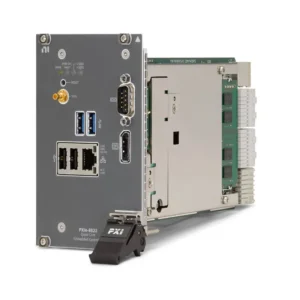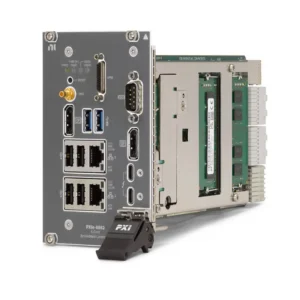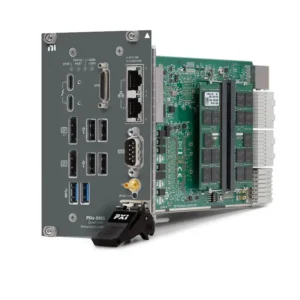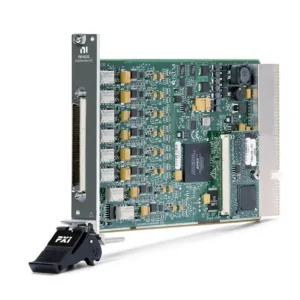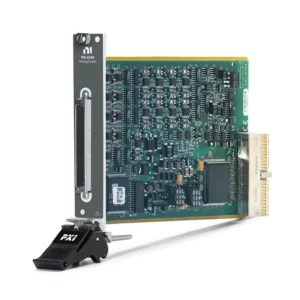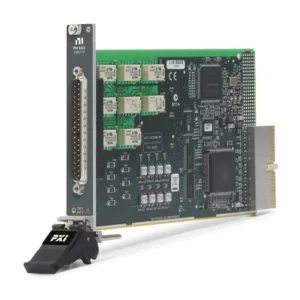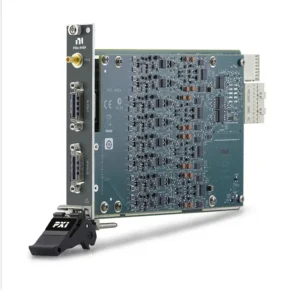




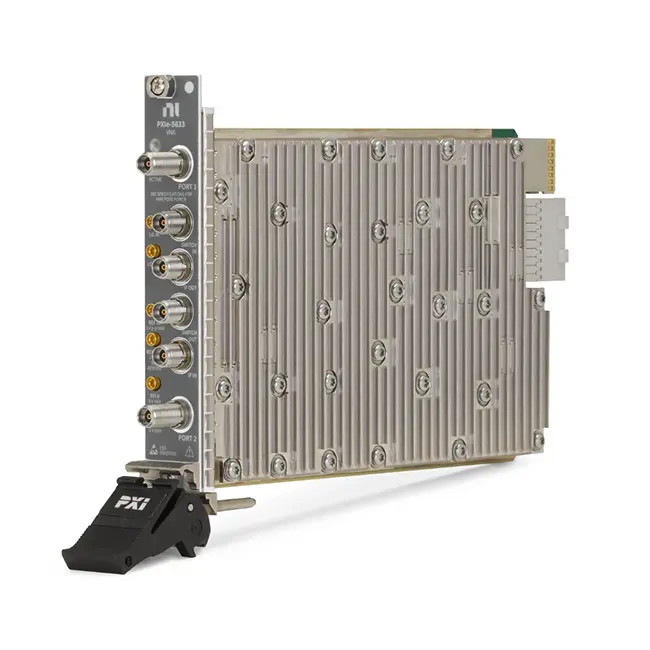
PXIe-5633 26.5 GHz PXI Vector Network Analyzer
The NI PXIe-5633 is a single-slot, two-port PXI Express vector network analyzer designed for RF component characterization, automated production testing and design validation. It measures the magnitude and phase response of one-port and two-port RF devices over frequency ranges extending from 50 MHz to 8 GHz, 12 GHz, 18 GHz or 26.5 GHz.
The PXIe-5633 supports continuous-wave and pulsed S-parameter measurements, automatic or manual two-port calibration, de-embedding and full vector analysis. Its typical dynamic range reaches 146 dB from above 300 MHz to 6 GHz, helping engineers characterize filters, amplifiers, antennas, cables, attenuators, switches and other RF components.
A built-in hardware pass-through path allows compatible versions of the PXIe-5633 to work with the PXIe-5842 Vector Signal Transceiver or PXIe-5860 Vector Signal Transceiver. This architecture enables S-parameter, modulated-signal generation and vector signal analysis through the same test ports and DUT connection.
Key Features of the PXIe-5633
- Single-slot PXI Express vector network analyzer
- Two fully bidirectional VNA test ports
- 50 MHz to 8 GHz, 12 GHz, 18 GHz or 26.5 GHz configurations
- Typical dynamic range up to 146 dB
- Maximum typical source output power up to +18 dBm
- 1 Hz frequency resolution
- 1 Hz to 15 MHz selectable IF bandwidth
- Up to 100,001 measurement points
- Full S11, S21, S12 and S22 measurements
- Continuous-wave and pulsed S-parameter measurements
- Minimum nominal pulse width of 200 ns
- Manual and electronic two-port calibration
- Compatible with the CAL-5501 electronic calibration module
- De-embedding and reference-plane correction support
- Hardware pass-through path for compatible NI VSTs
- NI RFmx VNA and InstrumentStudio integration
- PXI Express timing and synchronization
- Designed for automated RF production testing
PXIe-5633 Technical Specifications
| Product Model | PXIe-5633 |
|---|---|
| Product Type | PXI Express vector network analyzer |
| Number of VNA Ports | 2 |
| Frequency Options | 50 MHz to 8 GHz, 12 GHz, 18 GHz or 26.5 GHz |
| Frequency Resolution | 1 Hz |
| Maximum Typical Dynamic Range | 146 dB from above 300 MHz to 6 GHz |
| Maximum Typical Output Power | +18 dBm from 50 MHz to 6 GHz |
| Output Amplitude Resolution | ≤0.05 dB nominal |
| Minimum IF Bandwidth | 1 Hz |
| Maximum IF Bandwidth | 15 MHz |
| Number of Measurement Points | 1 to 100,001 |
| S-Parameter Measurements | S11, S21, S12 and S22 |
| Measurement Modes | Continuous-wave and pulsed S-parameter measurements |
| Minimum Pulse Width | 200 ns nominal |
| Minimum Pulse Period | 400 ns nominal |
| Pulse On/Off Ratio | 90 dB measured |
| Calibration Methods | Manual calibration and electronic calibration |
| Compatible Electronic Calibrator | NI CAL-5501 |
| Test-Port Connectors | 2 × 3.5 mm female |
| Bus Interface | PXI Express |
| Module Size | 3U, one slot |
| Dimensions | 21.1 × 12.9 × 2.03 cm |
| Weight | 555 g |
| Nominal Power Consumption | 62.07 W |
| Required Slot Cooling | 82 W |
| Warm-Up Time | 30 minutes |
| Operating Temperature | 0°C to 40°C |
| Storage Temperature | −40°C to 71°C |
| External Calibration Interval | 1 year |
| Software Support | NI RFmx VNA and InstrumentStudio |
PXIe-5633 Part Numbers and Frequency Options
The PXIe-5633 is available in four frequency ranges and two pass-through configurations. Confirm both the required maximum frequency and the compatible VST before ordering.
| Part Number | Frequency Range | Pass-Through Compatibility |
|---|---|---|
| 788182-08 | 50 MHz to 8 GHz | PXIe-5842 VST |
| 788182-12 | 50 MHz to 12 GHz | PXIe-5842 VST |
| 788182-18 | 50 MHz to 18 GHz | PXIe-5842 VST |
| 788182-26 | 50 MHz to 26.5 GHz | PXIe-5842 VST |
| 790406-08 | 50 MHz to 8 GHz | PXIe-5860 VST |
| 790406-12 | 50 MHz to 12 GHz | PXIe-5860 VST |
| 790406-18 | 50 MHz to 18 GHz | PXIe-5860 VST |
| 790406-26 | 50 MHz to 26.5 GHz | PXIe-5860 VST |
PXIe-5633 Accessories
| Accessory | Part Number | Description |
|---|---|---|
| PXIe-5842 Pass-Through Cable Kit | 790597-01 | Cable kit for connecting compatible PXIe-5633 versions to the PXIe-5842 VST |
| PXIe-5860 Pass-Through Cable Kit | 790504-01 | Cable kit for connecting compatible PXIe-5633 versions to the PXIe-5860 VST |
| CAL-5501 | Configuration dependent | USB-controlled, two-port electronic vector calibration module |
| Mechanical Calibration Kit | Configuration dependent | Open, short, load and thru standards for manual calibration |
| 3.5 mm RF Cables | Configuration dependent | Precision cables selected according to frequency and connector requirements |
The two pass-through cable kits are not interchangeable. Match the cable kit to the PXIe-5633 part number and the VST model installed in the system.
Two-Port Vector Network Analysis
The PXIe-5633 provides two bidirectional RF test ports for characterizing one-port and two-port networks. It compares incident, reflected and transmitted RF signals to determine both magnitude and phase response.
A two-port configuration supports the four fundamental scattering parameters:
- S11—Input reflection coefficient or input return loss
- S21—Forward transmission, insertion loss or gain
- S12—Reverse transmission or reverse isolation
- S22—Output reflection coefficient or output return loss
These measurements provide the information required to evaluate impedance matching, signal transmission, isolation, gain and loss across the selected frequency range.
50 MHz to 26.5 GHz Frequency Coverage
The highest-frequency PXIe-5633 version covers 50 MHz to 26.5 GHz. This range supports RF and microwave devices used in wireless communications, aerospace systems, radar, satellite equipment, semiconductor testing and electronic component validation.
Lower-frequency 8 GHz, 12 GHz and 18 GHz versions allow buyers to select only the frequency coverage required by the application. The frequency range is a hardware option and should be confirmed before purchase.
PXIe-5633 Dynamic Range
| Frequency Range | Typical Dynamic Range |
|---|---|
| 100 MHz to 300 MHz | 134 dB |
| Above 300 MHz to 6 GHz | 146 dB |
| Above 6 GHz to 18 GHz | 137 dB |
| Above 18 GHz to 22 GHz | 134 dB |
| Above 22 GHz to 26.5 GHz | 125 dB |
High dynamic range enables the analyzer to measure low-level transmitted signals while applying a stronger stimulus to the device under test. This is important when testing high-rejection filters, attenuators and components with substantial insertion loss.
The specified dynamic-range values are normalized to a 10 Hz IF bandwidth and exclude crosstalk. Actual results depend on frequency, IF bandwidth, source power, averaging, calibration quality and the test fixture.
Programmable Source Output Power
| Frequency Range | Typical Maximum Power | Typical Minimum Power |
|---|---|---|
| 50 MHz to 6 GHz | +18 dBm | −36 dBm |
| Above 6 GHz to 8 GHz | +16 dBm | −38 dBm |
| Above 8 GHz to 12 GHz | +15 dBm | −39 dBm |
| Above 12 GHz to 18 GHz | +13 dBm | −39 dBm |
| Above 18 GHz to 22 GHz | +10 dBm | −43 dBm |
| Above 22 GHz to 26.5 GHz | +5 dBm | −44 dBm |
The source-amplitude resolution is 0.05 dB or better. Programmable power helps engineers test RF components at multiple stimulus levels and evaluate gain compression, linearity and power-dependent behavior.
1 Hz to 15 MHz IF Bandwidth
The PXIe-5633 provides selectable IF bandwidth from 1 Hz to 15 MHz. Narrow IF bandwidth reduces measurement noise and improves dynamic range, while wider bandwidth increases sweep speed and supports pulsed measurements.
The appropriate IF bandwidth depends on the DUT, required noise performance and production throughput. Narrow settings are commonly used for high-rejection or low-level measurements, while wider settings are useful for rapid screening and manufacturing tests.
Fast S-Parameter Measurements
The PXIe-5633 is optimized for automated testing. With a 15 MHz IF bandwidth, a measured corrected two-port sweep containing 51 points can be completed in approximately 5.6 ms over 50 MHz to 8 GHz or 6.5 ms over 50 MHz to 26.5 GHz under NI’s documented test conditions.
Actual measurement time depends on frequency span, number of points, IF bandwidth, averaging, calibration corrections, controller performance and the measurements returned by the software.
CW S-Parameter Measurements
Continuous-wave measurements characterize how a device responds to a steady sinusoidal RF stimulus at each frequency point. The analyzer sweeps through the selected frequency list and calculates the required reflection and transmission parameters.
CW measurements are suitable for passive filters, cables, connectors, attenuators, switches, antennas and many amplifier measurements.
Pulsed S-Parameter Measurements
The PXIe-5633 supports pulsed RF generation and pulsed S-parameter measurements. Its nominal minimum pulse width is 200 ns, while the nominal minimum pulse period is 400 ns.
Pulsed testing helps characterize power amplifiers and other active devices while limiting average power and thermal loading. It can also be used to measure devices operating under radar-like or time-dependent RF conditions.
Manual VNA Calibration
Manual calibration uses known standards such as open, short, load and thru connections. The software guides the operator through each connection and calculates correction coefficients for the selected frequency, power and IF-bandwidth configuration.
This calibration moves the effective measurement reference plane from the module ports to the ends of the test cables, reducing systematic errors introduced by cables, adapters and fixtures.
CAL-5501 Electronic Calibration
The CAL-5501 is a USB-powered, two-port electronic vector calibration module with 3.5 mm connectors and coverage extending to 26.5 GHz. It automates the connection of calibration standards and works with RFmx VNA and InstrumentStudio.
Electronic calibration reduces repeated connector handling, shortens the calibration process and helps minimize operator connection errors. It is especially useful in production environments where the VNA must be recalibrated regularly.
De-Embedding and Reference-Plane Correction
De-embedding mathematically removes the effects of fixtures, adapters or transmission lines located between the calibrated reference plane and the device under test.
This capability helps engineers estimate the DUT’s actual performance when direct calibration at its terminals is impractical. Accurate fixture characterization and correct network definitions are required for reliable results.
VST Hardware Pass-Through Path
The PXIe-5633 contains a hardware pass-through path for compatible NI vector signal transceivers. When connected to a supported VST, the same two front-panel ports can be used for VNA measurements and modulated VST testing.
This architecture can eliminate an external RF switching network and reduce the number of DUT connections required for a complete test. Software selects whether the ports operate with the internal VNA measurement system or the connected VST.
PXIe-5633 with PXIe-5842
Part numbers beginning with 788182 are designed for pass-through integration with the PXIe-5842. The required PXIe-5842 pass-through cable kit is part number 790597-01.
The combined system can perform calibrated S-parameter measurements and wideband modulated-signal generation or analysis through the PXIe-5633 test ports. This is useful for RF front-end modules requiring both small-signal and modulated large-signal testing.
PXIe-5633 with PXIe-5860
Part numbers beginning with 790406 provide pass-through compatibility with the PXIe-5860. The corresponding PXIe-5860 pass-through cable kit is part number 790504-01.
Before ordering, confirm that the PXIe-5633 frequency option, PXIe-5860 configuration and cable kit provide the frequency coverage required by the complete test system.
Typical PXIe-5633 Applications
- RF filter insertion-loss and return-loss testing
- Amplifier gain and impedance measurements
- Antenna and matching-network characterization
- RF cable and connector testing
- Attenuator and RF switch characterization
- Power-amplifier pulsed S-parameter testing
- Wireless front-end module testing
- Semiconductor RF device validation
- Aerospace and defense RF testing
- Radar and satellite component testing
- Automated production testing
- Research and development
RF Filter Testing
The PXIe-5633 can measure filter insertion loss, return loss, passband ripple, rejection, phase response and group delay. Its high dynamic range is valuable for measuring deep stopbands and high-rejection filters.
For accurate results, perform calibration at the cable ends and use an IF bandwidth appropriate for the filter’s expected rejection level.
Amplifier Characterization
Two-port S-parameter measurements provide forward gain, reverse isolation, input matching and output matching for RF amplifiers. Programmable source power allows the amplifier to be evaluated at different stimulus levels.
When testing an active device, use suitable biasing, DC blocks, attenuators and protection components. Verify that the amplifier output cannot exceed the analyzer’s applicable input-power limits.
Antenna and Matching-Network Testing
One-port S11 measurements can characterize antenna return loss, reflection coefficient and impedance over frequency. The same method can be used to tune impedance-matching networks and validate RF front-end designs.
Antenna measurements are sensitive to nearby objects, cables and operator movement. Use stable fixtures and an appropriate test environment for repeatable results.
Production RF Testing
The single-slot form factor allows multiple PXIe-5633 instruments and other PXI modules to be installed in a compact automated test system. RFmx VNA provides a programmatic API for executing calibrated measurements and returning results to production-test software.
Fast sweeps, electronic calibration and VST pass-through integration can reduce test time, fixture complexity and manual intervention.
RFmx VNA Software Support
The PXIe-5633 operates with NI RFmx VNA. RFmx VNA provides functions for configuring frequency sweeps, source power, IF bandwidth, calibration, S-parameter traces, markers and result acquisition.
The measurement API can be integrated into LabVIEW and supported text-based programming environments for automated characterization and production testing.
InstrumentStudio Integration
InstrumentStudio provides an interactive interface for configuring the PXIe-5633, viewing S-parameter traces and performing calibration. Engineers can use it during system setup, troubleshooting and manual device characterization.
Instrument configurations can be saved and reused, helping maintain consistent test settings when moving from interactive measurements to automated test code.
PXI Express Chassis Requirements
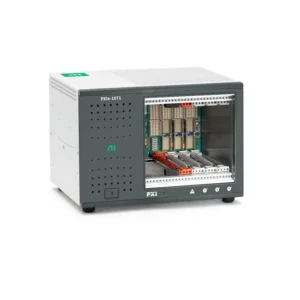
The PXIe-5633 occupies one 3U PXI Express slot and requires a slot with up to 82 W of cooling capacity. The chassis should be operated with the documented fan mode, slot blockers and EMC filler panels installed where required.
Before installation, verify chassis cooling, controller compatibility, available slots and RF cable clearance. Allow the module to warm up for at least 30 minutes before measurements that require specified performance.
PXIe-5633 Troubleshooting
The PXIe-5633 is not detected
Confirm that the module is fully seated in a compatible PXI Express slot. Check chassis power, controller communication, RFmx installation and device recognition in NI Measurement & Automation Explorer.
The ACTIVE indicator is red
A red ACTIVE indicator can signal an error such as loss of PLL lock or thermal shutdown. Check chassis airflow, module temperature, software error messages and the installed hardware configuration.
S-parameter results are inaccurate
Perform a new measurement calibration at the DUT reference plane. Inspect test cables and connectors, verify the selected calibration kit and confirm that frequency, source power and IF-bandwidth settings match the calibration.
The measurement noise is too high
Reduce the IF bandwidth, increase averaging and confirm that source power is suitable for the DUT. Check cables, connectors, fixture repeatability and environmental interference.
The measured insertion loss is unexpected
Confirm that the DUT direction and port connections are correct. Inspect the calibration thru, cables and adapters, and verify whether fixture loss must be removed through de-embedding.
Pulsed measurements are unstable
Check pulse width, period, delay, trigger configuration and averaging. Confirm that the measurement receiver samples the stable portion of the RF pulse.
The VST signal does not appear at the VNA ports
Verify that the PXIe-5633 part number is compatible with the installed VST. Check the intermodule pass-through cables, cable routing and RFmx configuration, then confirm that pass-through mode is selected.
The module reports an overtemperature condition
Stop measurements and inspect chassis airflow. Confirm that the slot provides the required cooling capacity and that unused slots contain the recommended slot blockers and filler panels.
PXIe-5633 Comparison with Similar NI VNAs
| Model | General Configuration | Best Suited For |
|---|---|---|
| PXIe-5630 | Two-port VNA with frequency coverage to 6 GHz | Legacy sub-6 GHz RF component testing |
| PXIe-5632 | Two-port VNA with frequency coverage to 8.5 GHz | General RF and wireless component characterization |
| PXIe-5633 | Single-slot, two-port VNA with coverage to 26.5 GHz | Modern RF and microwave automated testing |
| PXIe-5842 with PXIe-5633 | VST and VNA measurements through the same ports | Combined modulated-signal and S-parameter testing |
| PXIe-5860 with PXIe-5633 | Compatible VST pass-through architecture | Integrated high-frequency RF production systems |
PXIe-5633 vs PXIe-5632
The PXIe-5632 provides two-port vector network analysis to 8.5 GHz. The PXIe-5633 offers selectable ranges extending to 26.5 GHz, a single-slot design and a pass-through architecture for compatible NI VSTs.
Choose the PXIe-5632 when the existing application is limited to its supported range and must maintain compatibility with an established system. Choose the PXIe-5633 for higher-frequency testing, newer RFmx integration or combined VNA and VST workflows.
Recommended Related Products
- PXIe-5630 6 GHz Vector Network Analyzer
- PXIe-5632 8.5 GHz Vector Network Analyzer
- PXIe-5842 Vector Signal Transceiver
- PXIe-5860 Vector Signal Transceiver
- CAL-5501 Electronic Vector Calibration Module
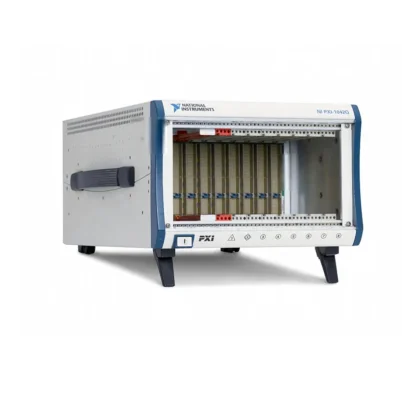
- PXIe-1095 PXI Express Chassis
- PXIe-8881 Embedded Controller
- View More NI PXI and PXI Express Modules
Selecting the Right PXIe-5633
Choose the 8 GHz, 12 GHz, 18 GHz or 26.5 GHz option according to the highest frequency that must be generated and measured. A lower-frequency version can reduce system cost when microwave coverage is unnecessary.
If VST pass-through operation is required, select the product family that matches either the PXIe-5842 or PXIe-5860. Also verify the required cable kit, PXI Express chassis cooling, calibration module, test-port cables and DUT connector type.
Why Choose the PXIe-5633?
- Provides full two-port vector network analysis
- Offers frequency configurations up to 26.5 GHz
- Delivers typical dynamic range up to 146 dB
- Supports CW and pulsed S-parameter measurements
- Provides IF bandwidth from 1 Hz to 15 MHz
- Supports as many as 100,001 measurement points
- Occupies only one PXI Express slot
- Supports manual and electronic calibration
- Integrates with RFmx VNA and InstrumentStudio
- Provides a pass-through path for compatible NI VSTs
- Supports automated design-validation and production testing
Frequently Asked Questions
What is the PXIe-5633?
The PXIe-5633 is a single-slot, two-port PXI Express vector network analyzer used to measure the magnitude and phase response of RF and microwave components.
What frequency ranges are available?
The PXIe-5633 is available with frequency ranges of 50 MHz to 8 GHz, 12 GHz, 18 GHz or 26.5 GHz.
How many test ports does it have?
The PXIe-5633 provides two bidirectional 3.5 mm female VNA test ports.
Which S-parameters can it measure?
It can measure S11, S21, S12 and S22 for complete characterization of one-port and two-port RF devices.
What is the PXIe-5633 dynamic range?
Typical dynamic range reaches 146 dB from above 300 MHz to 6 GHz. Dynamic range varies with frequency and reaches a typical 125 dB above 22 GHz to 26.5 GHz.
What is the maximum output power?
Typical maximum output power reaches +18 dBm from 50 MHz to 6 GHz. Available maximum power decreases at higher frequencies.
Does the PXIe-5633 support pulsed measurements?
Yes. It supports pulsed S-parameter measurements with a nominal minimum pulse width of 200 ns.
Can it use electronic calibration?
Yes. The PXIe-5633 supports electronic two-port calibration using the NI CAL-5501 as well as manual calibration kits.
Can the PXIe-5633 work with an NI VST?
Yes. Depending on its part number, the hardware pass-through path is compatible with either the PXIe-5842 or PXIe-5860 VST.
Which cable kit is required for the PXIe-5842?
The PXIe-5842 pass-through cable kit is part number 790597-01.
Which cable kit is required for the PXIe-5860?
The PXIe-5860 pass-through cable kit is part number 790504-01.
Which software controls the PXIe-5633?
The PXIe-5633 is supported by NI RFmx VNA and can be operated interactively through InstrumentStudio or programmatically in an automated test application.
How many PXI slots does it occupy?
The module occupies one 3U PXI Express slot and requires a chassis slot capable of providing the specified cooling.
What is the calibration interval?
The recommended external calibration interval is one year.
Request a Quote for the PXIe-5633
Contact us for current availability, project pricing and configuration assistance for the NI PXIe-5633 Vector Network Analyzer. Please specify the required 8 GHz, 12 GHz, 18 GHz or 26.5 GHz frequency range and whether the system must support PXIe-5842 or PXIe-5860 pass-through operation.
We can also help identify compatible pass-through cables, CAL-5501 electronic calibration hardware, precision RF cables, PXI Express chassis, embedded controllers and related NI RF instruments for your automated test system.