






What Is a PXI System? A Modular Platform for Automated Test, RF Testing, Data Acquisition and Electronic Validation
Quick Answer: A PXI system is a modular, software-defined test and measurement platform. It combines a PXI or PXIe chassis, controller, instrument modules and software to create automated systems for data acquisition, RF testing, electronic validation, semiconductor testing and industrial measurement.
What Is a PXI System?
A PXI system is a modular test and measurement platform widely used in automated testing, data acquisition, electronic validation, RF testing, semiconductor testing and industrial measurement. PXI stands for PCI eXtensions for Instrumentation. The platform is based on PCI or PCI Express bus technology and includes additional features developed specifically for measurement, automation and instrumentation applications.In simple terms, PXI provides a professional platform on which engineers can build a customized test system. Different measurement and control modules can be installed in the same PXI chassis according to the requirements of a particular project.Compared with a collection of independent benchtop instruments, a PXI system can integrate multiple testing functions into a compact, high-performance platform that is controlled through software.A typical PXI system may include:- Oscilloscope and digitizer modules
- Digital multimeter modules
- Waveform and function generator modules
- RF signal analyzers
- RF signal generators
- Vector signal transceivers
- Digital I/O modules
- Multifunction I/O modules
- Source measure units
- Relay and switching modules
- Timing and synchronization modules
- FPGA and FlexRIO modules
Main Components of a PXI System
A PXI system normally consists of four core components:1
PXI or PXIe ChassisProvides the mechanical enclosure, power, cooling, backplane communication, timing and synchronization resources.
2
PXI ControllerRuns the test software, controls installed modules and processes measurement data.
3
PXI/PXIe ModulesPerform specific measurement, signal generation, switching, communication or control functions.
4
Software and DriversDefine the test sequence, control hardware, analyze data and generate results or reports.
1. PXI Chassis
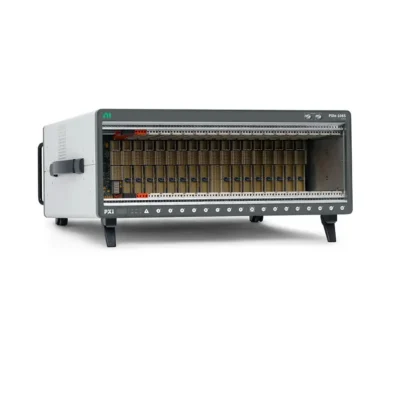
The PXI chassis is the physical foundation of the system. It houses the controller and instrument modules while providing power, cooling, communication, timing and synchronization resources.PXI chassis are available with different numbers of slots, including compact 4-slot systems and larger 8-slot, 14-slot and 18-slot platforms. The required number of slots depends on how many controllers and instrument modules the system must accommodate.For example, a basic data acquisition system may require only a small chassis and several I/O modules. A complex RF validation or semiconductor test platform may require a larger PXIe chassis equipped with high-bandwidth instrument modules, switching modules, synchronization hardware and a high-performance embedded controller.The chassis is a critical system component because it can determine:- The number of available system slots
- Supported PXI and PXIe module types
- Backplane bandwidth
- Power and cooling capacity
- Timing and synchronization capabilities
- Future system expansion options
- Automated test systems
- RF and wireless test platforms
- Semiconductor characterization and validation
- Aerospace and defense testing
- Automotive electronics testing
- Industrial data acquisition
- Hardware-in-the-loop testing
- Production-line functional testing
2. PXI Controller
The PXI controller acts as the brain of the system. It controls the modules installed in the chassis, runs the test software, processes measurement data and communicates with external networks or equipment.There are two common methods for controlling a PXI system.Embedded PXI Controller
An embedded PXI controller is installed directly in the PXI chassis. It normally provides computer functions such as a processor, memory, data storage, Ethernet, USB and display outputs. Depending on the application, it may run Windows or a real-time operating system.This configuration is suitable for compact, integrated and high-reliability test platforms. Because the computer is installed inside the chassis, fewer external connections are required.External Remote Controller
A remotely controlled PXI system uses an external desktop computer, industrial PC or workstation connected to the PXI chassis through a compatible interface such as PCI Express or Thunderbolt.Remote control can be suitable when:- More computing performance is required.
- The computer must be upgraded independently.
- The operator computer must be separated from the test rack.
- A workstation-class processor or GPU is required.
- The test system needs access to specialized computer hardware.
3. PXI and PXIe Modules
PXI modules are the functional instruments within the system. Each module performs a particular measurement, signal-generation, switching, control or communication task.Common PXI and PXIe module categories include:- Oscilloscope and digitizer modules
- Digital multimeter modules
- Function generators
- Arbitrary waveform generators
- RF signal generators
- RF signal analyzers
- Vector signal transceivers
- Source measure units
- Digital I/O modules
- Analog input modules
- Analog output modules
- Multifunction I/O modules
- Relay and switching modules
- CAN, LIN, FlexRay, Ethernet and serial communication modules
- FPGA and FlexRIO modules
- Timing and synchronization modules
Compatibility reminder: A module that physically fits into a chassis is not automatically guaranteed to provide its full performance. Chassis slot type, bus compatibility, controller capability, cooling, power and software support must all be verified.
4. Software and Drivers
PXI is fundamentally a software-defined test platform. The hardware provides measurement and control capabilities, while software determines how tests are executed, how data is analyzed, where results are stored and how reports are generated.Common software environments and drivers include:- LabVIEW
- TestStand
- C and C++
- C# and .NET
- Python
- MATLAB
- NI-DAQmx
- NI-VISA
- NI-SCOPE
- NI-RFSA and NI-RFSG
- Dedicated instrument drivers
What Is the Difference Between PXI and PXIe?
PXI and PXIe are closely related, but they are not identical.Traditional PXI is based on the PCI bus, while PXIe, or PXI Express, is based on PCI Express technology. PXIe provides substantially higher data bandwidth and is better suited to high-performance applications such as:- High-speed digitization
- Wideband RF signal analysis
- Wireless communication testing
- Radar testing and simulation
- Semiconductor validation
- High-speed digital testing
- FPGA-based signal processing
- High-channel-count data streaming
PXI:Suitable for many established test and measurement applications where extremely high data bandwidth is not required.PXIe:Better suited to high-performance applications requiring higher bandwidth, lower latency and greater system throughput.
Many newly designed test systems use PXIe chassis and PXIe modules because they provide higher performance and greater flexibility for future expansion.However, the exact compatibility between PXI, hybrid-compatible and PXIe modules depends on the slot design of the selected chassis. The chassis and module documentation should therefore be checked before purchasing or installing hardware.Why Do Engineers Use PXI Systems?
PXI systems are widely used because they offer several important advantages over collections of traditional standalone instruments.1. Modular System Design
Engineers can select modules according to the exact requirements of a project. A PXI platform can be configured as an analog measurement system, digital test system, RF test platform, switching system, data acquisition platform or mixed-signal validation system.2. High-Speed Data Transfer
PXIe systems use PCI Express architecture to provide high-bandwidth data transfer between instrument modules and the controller. This is especially important for high-speed digitizers, RF analyzers, waveform generators and FPGA modules that generate or process large amounts of data.3. Accurate Timing and Synchronization
PXI chassis provide shared timing, clocking and triggering resources that allow multiple modules to operate with precise timing relationships.Accurate synchronization is important in:- Multichannel measurements
- Phase-coherent RF testing
- Radar simulation
- Semiconductor testing
- Synchronized data acquisition
- Mixed-signal validation
- Hardware-in-the-loop systems
4. Compact System Size
One PXI system can replace multiple benchtop instruments. This can reduce rack space, cable quantity and overall system integration complexity.5. Designed for Software Automation
PXI systems are particularly suitable for automated testing. Engineers can use software to create test sequences, execute measurements, control multiple instruments and automatically generate test reports.6. Strong Expansion Capability
When testing requirements increase, additional modules can be installed or the controller and chassis can be upgraded. This makes PXI suitable for long-term engineering programs and scalable production test platforms.7. Suitable for System Integration
PXI is widely used in professional test environments because it supports repeatable, maintainable and expandable system integration. These qualities are particularly valuable in manufacturing test systems and long-term validation platforms.Common Applications of PXI Systems
PXI systems are used across many industries because of their flexibility, performance and ability to integrate multiple instrument functions.Automated Test Equipment
PXI is frequently used to automate testing for electronic products, printed circuit boards, power modules, sensors, communication equipment and industrial controllers.Engineers can combine measurement, signal generation, switching and software control in one coordinated platform.Data Acquisition
PXI systems are suitable for high-channel-count data acquisition involving:- Voltage
- Current
- Temperature
- Strain
- Vibration
- Pressure
- Sound and dynamic signals
RF and Wireless Testing
PXIe platforms are widely used for RF signal generation, spectrum analysis, wireless communication testing, 5G validation, radar testing, satellite communication testing and wideband signal analysis.The combination of high-speed data transfer, accurate synchronization and software-defined instruments makes PXIe particularly suitable for advanced RF applications.Semiconductor Testing
PXI systems can be used for semiconductor characterization, wafer testing, device validation, production testing and mixed-signal integrated circuit testing.Common modules used in semiconductor applications include:- Source measure units
- Precision digital multimeters
- High-speed digitizers
- Digital pattern instruments
- Power supplies
- Switching modules
- Timing and synchronization modules
Automotive Electronics Testing
Automotive engineers use PXI systems for:- Electronic control unit testing
- Battery management system testing
- Sensor and actuator validation
- ADAS testing
- In-vehicle network testing
- Power electronics testing
- Hardware-in-the-loop simulation
Aerospace and Defense
PXI and PXIe systems are commonly used in radar, avionics, electronic warfare, communication, navigation and mission-critical test systems because they support high-speed, synchronized and scalable test architectures.Production-Line Testing
PXI platforms are suitable for manufacturing environments where test speed, repeatability and automation are important. A properly designed PXI system can reduce test time, improve throughput and provide consistent test results across multiple production stations.PXI System Configuration Examples
Automated Functional Test System
A typical automated PXI test system may include:- PXIe chassis
- Embedded PXI controller
- Digital multimeter module
- Oscilloscope or digitizer module
- Arbitrary waveform generator
- Source measure unit
- Digital I/O module
- Relay switching module
- Timing and synchronization module
- LabVIEW or TestStand software
RF Test System
An RF test system may include:- High-bandwidth PXIe chassis
- High-performance embedded controller
- Vector signal analyzer
- Vector signal generator
- RF switching module
- Timing and synchronization module
- FPGA or signal-processing module
- RF cables, adapters and test fixtures
Data Acquisition System
A PXI data acquisition system may include:- PXI or PXIe chassis
- Embedded or remote controller
- Analog input modules
- Temperature measurement modules
- Digital I/O modules
- Signal-conditioning hardware
- Data logging and analysis software
PXI Systems vs. Traditional Benchtop Instruments
Traditional benchtop instruments are easy to use and are often suitable for manual measurements, troubleshooting and general laboratory work. However, as the test system becomes more complex, manual operation becomes slower and more difficult to scale.PXI systems are generally better suited to automation and integrated test platforms.Typical advantages of PXI systems:
PXI systems usually require more engineering configuration, software development and system integration expertise. A benchtop instrument may be sufficient for a simple one-time measurement. PXI is normally more appropriate for repetitive testing, automated testing, high-speed measurements and multichannel applications.- More compact system size
- Greater automation capability
- Higher channel density
- Better timing and synchronization
- Higher data-transfer performance
- Reduced cabling complexity
- Greater system expandability
- Stronger integration capability
How to Select a PXI System
Engineers should evaluate the following factors before selecting a chassis, controller and instrument modules.Required Test Functions
First determine which signals the system must measure, generate or control. These may include voltage, current, frequency, RF signals, digital signals, temperature, vibration, strain or industrial communication signals.Channel Count
The required number of channels directly affects module selection and chassis capacity. High-channel-count systems generally require more modules, a larger chassis and careful planning of available slots.Sampling Rate and Bandwidth
High-speed applications require modules with higher sampling rates and wider analog or RF bandwidth. RF, radar and high-speed digital applications are generally better suited to PXIe modules.Accuracy and Resolution
Different applications require different levels of accuracy. Precision DC measurements, source-measurement applications and sensor testing may require high-resolution modules with low noise and strong long-term stability.Timing and Synchronization
Timing and synchronization are critical when multiple modules must acquire or generate signals together. Engineers should consider the chassis timing architecture, available trigger lines, reference clocks and the synchronization capabilities of each module.Software Compatibility
The selected hardware should support the software environment used by the engineering team, such as LabVIEW, TestStand, C/C++, C#, Python or MATLAB.Driver availability, supported operating systems and application programming interfaces should be verified before purchasing the system.Future Expansion
A well-planned PXI platform should provide room for future expansion. Choosing a chassis with spare slots, adequate power and sufficient backplane bandwidth may reduce future upgrade costs.Budget and Delivery Time
PXI systems range from basic measurement platforms to advanced RF and semiconductor test systems. Engineers should evaluate performance, project budget, delivery time, software requirements and long-term technical support together.System-selection advice: Do not select a PXI system based only on the model number of an individual module. Chassis compatibility, controller performance, software support, required accessories, terminal blocks, cables and system synchronization must also be considered.
Why Is PXI Important for Modern Test Systems?
Modern electronic products are becoming faster, more integrated and more complex. Engineers need test systems capable of handling high-speed signals, multichannel measurements, software automation and precise synchronization.PXI addresses these requirements by allowing engineers to build compact, modular and high-performance test platforms that can be adapted to different projects.For companies involved in research, manufacturing, product validation and quality control, a PXI system can:- Increase test efficiency
- Reduce manual operation
- Improve measurement repeatability
- Standardize test processes
- Support scalable test architectures
- Improve data collection and traceability
- Reduce the time required to reconfigure a test system
Frequently Asked Questions About PXI Systems
What does PXI stand for?
PXI stands for PCI eXtensions for Instrumentation. It is a modular instrumentation standard developed for automated test, measurement and control applications.What are the main parts of a PXI system?
A typical PXI system includes a PXI or PXIe chassis, an embedded or remote controller, one or more instrument modules, and the software and drivers required to control the hardware.Is PXIe the same as PXI?
PXIe is the PCI Express-based version of the PXI platform. It provides higher data bandwidth and is generally more suitable for high-speed digitizers, RF instruments, FPGA modules and other data-intensive applications.Can PXI and PXIe modules be used in the same chassis?
Some PXIe chassis include hybrid-compatible slots that support both compatible PXI and PXIe modules. Compatibility depends on the chassis slot and module connector type, so the specifications of both products must be checked.Does a PXI system require an embedded controller?
No. A PXI system can use either an embedded controller installed in the chassis or an external computer connected through a supported remote-control interface.What software can control PXI instruments?
Depending on the hardware and available drivers, PXI instruments can be controlled through LabVIEW, TestStand, C/C++, C#, Python, MATLAB and other compatible development environments.Is PXI suitable only for National Instruments products?
No. PXI is an industry-standard modular platform supported by multiple test and measurement manufacturers. However, hardware, driver and software compatibility should always be verified when combining products from different suppliers.Can a PXI system replace benchtop instruments?
In many automated or multichannel applications, a PXI system can replace several benchtop instruments. Benchtop instruments may still be more convenient for simple manual measurements, troubleshooting and general laboratory use.What information is needed to configure a PXI system?
Important information includes the required test functions, signal types, voltage and frequency ranges, channel count, sampling rate, bandwidth, accuracy, synchronization requirements, software environment, available budget and expected future expansion.Conclusion
A PXI system is a modular, software-defined test and measurement platform consisting of a chassis, controller, instrument modules and software. It is widely used in automated testing, data acquisition, RF testing, semiconductor validation, automotive electronics, aerospace, defense and industrial measurement.Compared with traditional benchtop instruments, PXI systems provide stronger integration, higher data-transfer performance, more precise synchronization, greater channel density, a more compact footprint and better expansion capability.For engineers who require a reliable, repeatable and automated test solution, PXI remains one of the most important platforms in the test and measurement industry.Whether the objective is to build a production test station, RF validation platform, semiconductor test system or high-channel-count data acquisition system, PXI can provide the flexibility and performance required by modern engineering applications.Need help selecting a PXI system?Contact us with your required measurements, channel count, sampling rate, bandwidth, preferred software and target application. We can help identify suitable PXI chassis, controllers and instrument modules for your project.
Categories
Latest Articles
Products on Sale


Need Help Choosing a Product?
Contact our sales team for product selection, pricing, availability and lead-time information.
sales@pxisource.com